
BuddhistCatholicContemplativeEvangelicalGeneral ChristianHinduJewishLatter-day SaintMuslimNew VisionsProgressive Christian
Beliefs
- Buddhist
- Catholic
- Contemplative
- Evangelical
- General Christian
- Hindu
- Jewish
- Latter-day Saint
- More Voices
- Muslim
- New Visions
- Pagan
- Progressive Christian
Topics
- Religion News
- Food and Religion
- Sports and Religion
- Religious Art
- Religious Music and Entertainment
- Religious Events
- History and Religion
- Style and Religion
- Politics and Religion
- Women in Religion
- Recreation Outdoors and Religion
- Business Finance and Religion
- Careers Workplace and Religion
- Education and Religion
- Family Parenting and Religion
- Health Fitness and Religion
- Home and Religion
- Relationships and Religion
- Technology and Religion
- Travel and Religion
Columnists
- Buddhist Columnists
- Business Finance and Religion Columnists
- Careers Workplace and Religion Columnists
- Catholic Columnists
- Contemplative Columnists
- Education and Religion Columnists
- Evangelists Columnists
- Family Parenting and Religion Columnists
- General Christian Columnists
- Health Fitness and Religion Columnists
- Hindu Columnists
- History and Religion Columnists
- Home and Religion Columnists
- Jewish Columnists
- More Voices Columnists
- Latter Day Columnists
- Muslim Columnists
- New Visions Columnists
- Nonreligious Columnists
- Pagan Columnists
- Politics and Religion Columnists
- Progressive Columnists
- Recreation Outdoors and Religion Columnists
- Relationships and Religion Columnists
- Religion News Columnists
- Religious Art Columnists
- Religious Events Columnists
- Religious Music and Entertainment Columnists
- Sports and Religion Columnists
- Style and Religion Columnists
- Technology and Religion Columnists
- Travel and Religion Columnists
- Women in Religion Columnists
Resource Library
- 2026 Calendar
- Library of World Religions
- The 100 Most Holy Places on Earth
- Patheos Answers
- Podcasts
- Videos
- Faith Leaders Database
- Anglican Episcopalian
- Bahai
- Baptist
- Buddhism
- Christianity
- Confucianism
- Eastern Orthodoxy
- Hinduism
- Holiness and Pentecostal
- ISKCON
- Islam
- Judaism
- Lutheran
- Methodist
- The Church of Jesus Christ of Latter-day Saints
- New Age
- Paganism
- Presbytarian and Reformed
- Protestantism
- Religion Behind the Scenes
- Roman Catholic
- Scientology
- Shia Islam
- Sikhism
- Sufism
- Sunni Islam
- Taoism
- Zen
- See all religions
Research Tools
 Ad-Free & Subscriber Log-In Subscription Support
Ad-Free & Subscriber Log-In Subscription Support
Follow Patheos 

- Trending:
- Forgiveness
- |
- Marriage
- |
- Consciousness
- |
- Death Penalty
- |
- Election
- |
- Halloween
 Shekhinah Calling
-
Archive Index
- Home
- Pagan
- Shame and Your Beautiful Cooties
Shame and Your Beautiful Cooties
Last updated on: June 10, 2015 at 1:10 pm by Asa West
Shame and Your Beautiful Cooties 2015-06-10T13:10:53-08:00 Asa West
Patheos Explore the world's faith through different perspectives on religion and spirituality! Patheos has the views of the prevalent religions and spiritualities of the world.
So a few weeks ago there was this article in the New York Times on how shame can be at the root of depression:
Several years ago a patient named Brian was referred to me. He had suffered for years from an intractable depression for which he had been hospitalized. He had been through cognitive behavioral therapy, psychoanalytic psychotherapy, supportive therapy and dialectical behavioral therapy. He had tried several medication “cocktails,” each with a litany of side effects that made them virtually intolerable. They had been ineffective anyway. The next step was electroshock therapy, which Brian did not want.
…
He told me that his parents were both “preoccupied” with the heavy burdens of a family that “could barely make ends meet.” While his mother never called herself an alcoholic, she drank to excess, and his father was often emotionally checked out as well. Brian had few memories of being held, comforted, played with or asked how we was doing.
One innate response to this type of environment is for the child to develop chronic shame. He interprets his distress, which is caused by his emotional aloneness, as a personal flaw. He blames himself for what he is feeling and concludes that there must be something wrong with him. This all happens unconsciously. For the child, shaming himself is less terrifying than accepting that his caregivers can’t be counted on for comfort or connection.
The author claims that shame and depression can be two separate things, and that, in Brian’s case, what seemed like depression was actually shame. I don’t know if I agree with the dichotomy she sets up–maybe by depression she means depression-as-chemical-imbalance?–but the idea of shame being a root cause of depression stuck with me.
I can’t count the number of times I’ve been shamed by my family. The emotional neglect? Yup. My situation was virtually identical to Brian’s, right down to the drinking problem and checked-out father. (My dad’s been a Scientologist my whole life, so he’s been encouraged, quite aggressively, to pretend he doesn’t experience any bad emotions.) There’s really not a whole lot to say about that type of shame, because on the surface it looks quite mundane.
Rather, although it wasn’t the focus of this particular article, I found myself more interested in the explicit shaming I’ve experienced–around my writing (“Why aren’t you rich like Stephen King yet?”), my career choice (“Why would anyone be a librarian?”), the way I look (“Tweeze your eyebrows and wear the kind of clothes I wear, please”), but especially around my witchcraft. When I started to get interested in Wicca in high school, I hid it from my mom as long as possible, and when she finally found out, she gave me a copy of the Bible for my birthday. A friend of mine pointed out that she couldn’t have possibly thought that the gift would change my mind; after all, we already had both a regular and a children’s bible in the house. I figured that she did it simply to demonstrate how unhappy she was with my “devil worship.”
If the reaction from those around me had been purely along the lines of “that’s wicked,” I don’t know if I would have felt quite so shamed. After all, there’s a certain mystique to wickedness; this was the 90s, and half my friends were dressing in black velvet and listening to Marilyn Manson. No, what really left me shaken was the idea that Wicca wasn’t evil, but just silly. My sister once asked me what I believed, and as I told her, she giggled and averted her eyes. One of my classmates (a devout Christian) came up to me out of the blue one day and said, “I just want you to know that I think your religion is stupid.” Complete with emphatic arm gestures.
When someone makes a concerted effort to shame you, they’re often driven by fear, anxiety, and insecurity. You’re doing something they’re unfamiliar with, or you hold a belief that contradicts their beliefs, or they simply don’t know how to relate to the kind of person you are. That’s threatening to people who have been trained to believe that their way is the best way. They feel contaminated by your very existence. They don’t want your cooties, so they try to cleanse themselves by lashing out.
But, you might be wondering, what about shaming people when they do legitimately bad things? That’s okay, right? That’s necessary! Well, I’d argue that even in situations where one’s behavior is harmful or misguided–an anger problem, say, or a sexist remark–shaming is often a knee-jerk reaction instead of a thoughtful, strategic response. People shame others because it feels good. It anesthetizes a wound. It almost never actually changes anything–or, if it does, only in an excruciating, Rube Goldberg-like way.
But knowing that doesn’t make the sting go away, nor does it prevent shaming from getting under your skin. Even today I deal with a lot of internalized shame around witchcraft. When I see a Druid or Witch in beautiful ritual regalia, a little part of me squirms. I hear the voices of my family, judging and laughing. Yet when I see a bishop or an Eastern Orthodox priest or a Hasidic Jew, I feel nothing. Because they’re considered normal. Unlike us stupid, weird Pagans.
I’m guessing at least some of this story is familiar to you.
As I mulled over shame, I came across this delightful picture in a parenting forum:
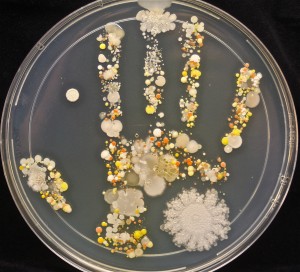
CC Tasha Sturm, Cabrillo College
It’s a lab culture taken from the hand print of an 8-year-old after playing outside. Talk about cooties! You think you’re getting your children’s hands clean with mere soap and water? Ha ha ha. Our little darlings are walking germ vectors.
And yet–the vast majority of the bacteria on our skin is harmless, even beneficial. There are more bacteria in our bodies than our own cells. There’s some evidence that bacteria actually influence our personalities.
Isn’t that something? The things people consider foreign, bad, and unclean are often not only beautiful, but vital.
Think about that the next time someone sneers at what makes you feel alive.

CLICK HERE TO “LIKE” PATHEOS PAGAN ON FACEBOOK
Support great Pagan writing by liking Patheos Pagan and Asa West!
Previous Post
June 2, 2015
Feeling Shekhinah
Next Post

June 15, 2015 Anu Sent Me a Litha Dream
Browse Our Archives
Select a Category Anu Aphrodite Book reviews Books Buddhism Daily practice Deity Depression Divination Feminism Goddess Holidays Judaism Justice Magic Mental Health Morrigan Morrigan Hymns Nature Politics Pop culture Priestessing Race Reclaiming Tradition Sabbats Shekhinah Tikkun Olam Travel Uncategorized Witchcraft
Select a Month June 2016 May 2016 April 2016 March 2016 February 2016 January 2016 December 2015 November 2015 October 2015 September 2015 August 2015 July 2015 June 2015 May 2015 March 2015 February 2015 January 2015 December 2014 November 2014 October 2014 September 2014 August 2014 July 2014 June 2014 May 2014 April 2014 March 2014 February 2014 January 2014
Follow Us!
TAKE THE
Religious Wisdom Quiz
Who said: "I am the Alpha and the Omega, who is, and who was, and who is to come, the Almighty"?
Select your answer to see how you score.
John God (the Lord God) Jesus An angel
Related posts from Shekhinah Calling

A Witch in Iceland (Part 2: Earth)

A Witch in Iceland (Part 1: Water)

A New Queer Jewitch Tarot Deck: The Hidden...

"Just Let Me Label You So We Can...
TRENDING AT PATHEOS Pagan

When we talk about Greek religion, we often begin with the dodekatheion—the...

I was recently chatting with someone on Instagram. She asked me what...

While there are many people who share their results, the end of...

On July 23, I saw Christopher Nolan's The Odyssey which is Homer’s...

As I write this two big events have just finished up. One...

Restoring the Watershed of Divine Love
Perhaps cooperation is not something we manufacture through legislation, ideology, or moral...
view all Pagan blogs
Ad-Free & Subscriber Log-In Subscription Support
- About Us
- 2026 Calendar
- Videos
- Podcasts
- Library of World Religions
- Faith In Media Tracker
- Advertise With Us
- Write for Us
- Privacy Policy
- Terms of Service
- Do Not Sell My Data
- Contact Us
- Radiant Digital
- Manage Newsletter Subscriptions
- Unsubscribe From Notifications
- Sitemap
Copyright 2008-2026, Patheos. All rights reserved.
Subscription Support Ad-Free & Subscriber Log-In
Follow Patheos