
BuddhistCatholicContemplativeEvangelicalGeneral ChristianHinduJewishLatter-day SaintMuslimNew VisionsProgressive Christian
Beliefs
- Buddhist
- Catholic
- Contemplative
- Evangelical
- General Christian
- Hindu
- Jewish
- Latter-day Saint
- More Voices
- Muslim
- New Visions
- Pagan
- Progressive Christian
Topics
- Religion News
- Food and Religion
- Sports and Religion
- Religious Art
- Religious Music and Entertainment
- Religious Events
- History and Religion
- Style and Religion
- Politics and Religion
- Women in Religion
- Recreation Outdoors and Religion
- Business Finance and Religion
- Careers Workplace and Religion
- Education and Religion
- Family Parenting and Religion
- Health Fitness and Religion
- Home and Religion
- Relationships and Religion
- Technology and Religion
- Travel and Religion
Columnists
- Buddhist Columnists
- Business Finance and Religion Columnists
- Careers Workplace and Religion Columnists
- Catholic Columnists
- Contemplative Columnists
- Education and Religion Columnists
- Evangelists Columnists
- Family Parenting and Religion Columnists
- General Christian Columnists
- Health Fitness and Religion Columnists
- Hindu Columnists
- History and Religion Columnists
- Home and Religion Columnists
- Jewish Columnists
- More Voices Columnists
- Latter Day Columnists
- Muslim Columnists
- New Visions Columnists
- Nonreligious Columnists
- Pagan Columnists
- Politics and Religion Columnists
- Progressive Columnists
- Recreation Outdoors and Religion Columnists
- Relationships and Religion Columnists
- Religion News Columnists
- Religious Art Columnists
- Religious Events Columnists
- Religious Music and Entertainment Columnists
- Sports and Religion Columnists
- Style and Religion Columnists
- Technology and Religion Columnists
- Travel and Religion Columnists
- Women in Religion Columnists
Resource Library
- 2026 Calendar
- Library of World Religions
- The 100 Most Holy Places on Earth
- Patheos Answers
- Podcasts
- Videos
- Faith Leaders Database
- Anglican Episcopalian
- Bahai
- Baptist
- Buddhism
- Christianity
- Confucianism
- Eastern Orthodoxy
- Hinduism
- Holiness and Pentecostal
- ISKCON
- Islam
- Judaism
- Lutheran
- Methodist
- The Church of Jesus Christ of Latter-day Saints
- New Age
- Paganism
- Presbytarian and Reformed
- Protestantism
- Religion Behind the Scenes
- Roman Catholic
- Scientology
- Shia Islam
- Sikhism
- Sufism
- Sunni Islam
- Taoism
- Zen
- See all religions
Research Tools
 Ad-Free & Subscriber Log-In Subscription Support
Ad-Free & Subscriber Log-In Subscription Support
Follow Patheos 

- Trending:
- Forgiveness
- |
- Marriage
- |
- Consciousness
- |
- Death Penalty
- |
- Election
- |
- Halloween
 Shekhinah Calling
-
Archive Index
- Home
- Pagan
- Los Angeles is not a Desert
Los Angeles is not a Desert
Last updated on: March 16, 2015 at 7:45 pm by Asa West
Los Angeles is not a Desert 2015-03-16T19:45:13-08:00 Asa West
Patheos Explore the world's faith through different perspectives on religion and spirituality! Patheos has the views of the prevalent religions and spiritualities of the world.
A few weeks ago I got to attend the inaugural Jewitch Camp, which celebrated Tu B’Shevat (the new year for trees) a couple hours north of San Francisco. I flew out of LAX and thus got a nice view of Malibu and the Santa Monica Mountains on my way up. Because it’s our rainy season, everything was verdant–even despite the drought–and I spent the first few minutes of the flight tenderly watching my home roll by underneath me. (“Home” defined loosely–I could never afford to live in Malibu or the Santa Monica Mountains.) We’ve gotten just enough rain this year that, from a distance, the hills resemble Ireland more than Southern California. Over the past couple of years, as the drought has worsened, I’d begun to fear that I would never see green in my city again.
The view from the plane reminded me of this comment I got on a post I wrote about the challenges of container gardening:
You are in California, in the desert, go and look at what is grown in pots in Mexico and in the hispanic communities, you will have more food success there. Ie grow the food the enviroment [sic] allows.
Everyone knows, of course, that Los Angeles is a desert.
…Except it’s not. It has a mediterranean climate, like Barcelona or Athens. The Latino communities? They’re growing corn, squash, tomatoes, bananas, citrus, guava, and more. Our trees are the live oak and conifers and sycamore and ash and willow. True, not all these species are native, but they like it here a lot, thriving even in areas with little irrigation.
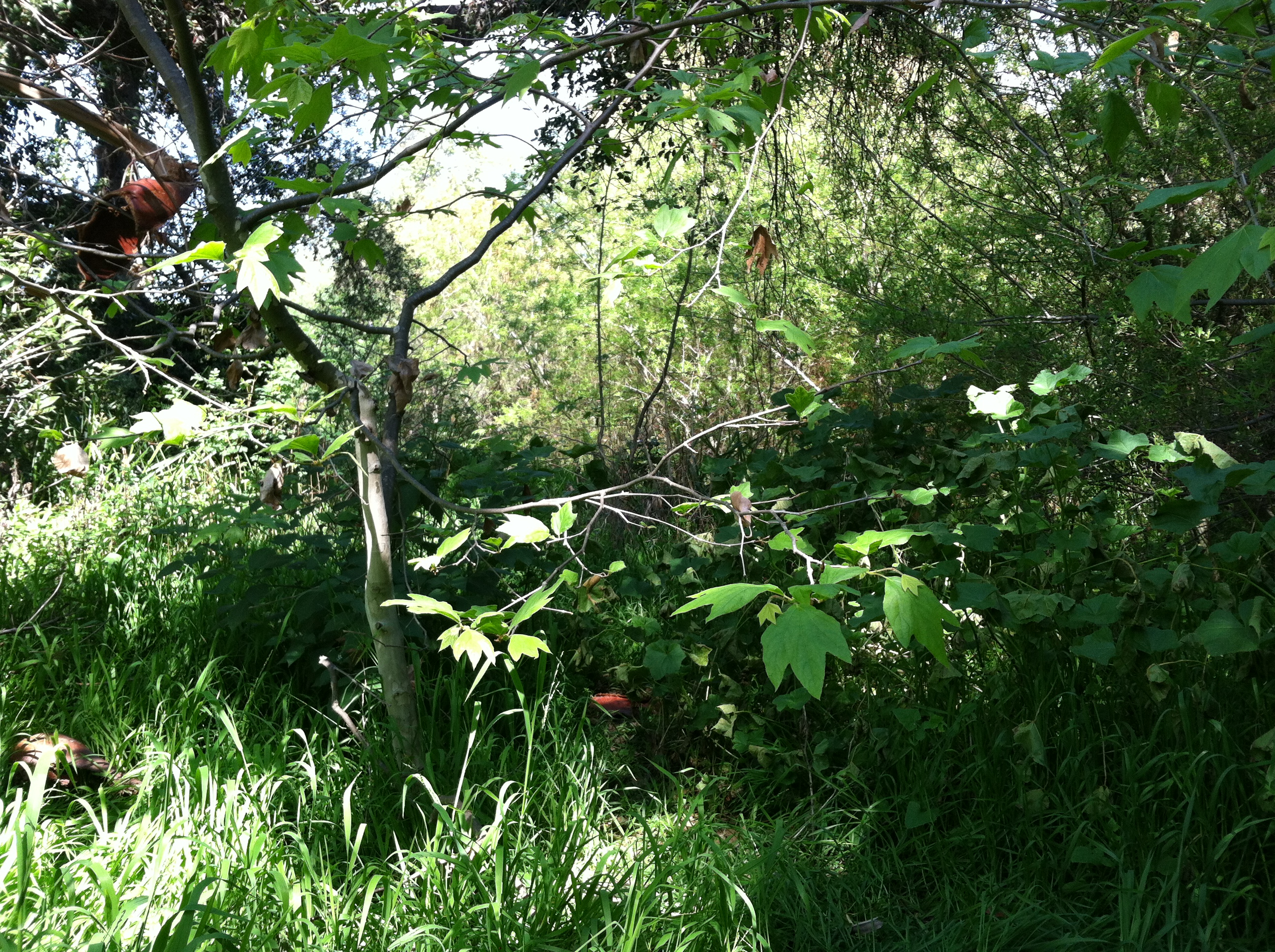
A restored creek with native growth in Westwood.
Truth be told, I don’t really blame people when they tell me I’m living in a desert. I thought I was living in a desert for my first few years here. It’s the kind of stubborn myth you believe even when confronted with blatant evidence against it: the woodsy areas of Topanga and Griffith Park, the aforementioned Irish hills. I remember multiple hikes through Temescal Canyon during which I wouldn’t question the desert myth for a second–even as I stepped over burbling streams and pushed live oak branches out of the way.

The creek in Westwood.
We think it’s a desert because it’s covered in concrete and asphalt, and we can’t see the ground that was originally underneath us. We think it’s a desert because it’s hot and dry and dusty. We think it’s a desert because it feels like a desert. We think it’s a desert because the destructive forces that paved over this land concealed and normalized themselves.

A hill off the 101, near Pasadena.
So much of our reality is the result of someone else’s agenda. We think that police are a natural and necessary part of civilization; they’re not. We think that racism is hardwired into us; it’s not.* We think that, because of the way our outer and inner landscapes have been ravaged by capitalism and kyriarchy, those landscapes are naturally harsh. They’re not.

One of the Serra Springs, natural springs sacred to LA’s original inhabitants, the Tongva People. Image credit Jengod, via Wikipedia.
In her essay “Icebergs and Shadows,” Rebecca Solnit explores the “other invisible hand:” a “shadow system of kindness” that operates alongside capitalism. Alternatives to capitalism aren’t just possible, she argues; they already exist, providing food and shelter and help and comfort to those whom capitalism dispossesses. This invisible system ranges from soup kitchens to stay-at-home moms–countless individuals and communities that work not for profit, but for the benefit of others. But we don’t see it because we’ve been trained not to.
Solnit includes an interesting anecdote about Vladimir Nabokov:
[Nabokov] once asked someone coming down a trail in the Rockies whether he’d seen any butterflies. The answer was negative–there were no butterflies. Nabokov, of course, went up that same trail and saw butterflies galore.
You see what you’re looking for. Most of us are constantly urged to see the world as, at best, a competitive place and, at worst, a constant war of each against each, and you can see just that without even bothering to look too hard. But that’s not all you can see.
Underneath the asphalt of LA, underneath the worsening catastrophe of the drought, are the flattened remains of a mediterranean ecosystem. Underneath our broken communities are hope and health and love.
* See page 30 of A People’s History of the United States.
Previous Post
February 28, 2015
How the dress can help you understand Pantycon

Browse Our Archives
Select a Category Anu Aphrodite Book reviews Books Buddhism Daily practice Deity Depression Divination Feminism Goddess Holidays Judaism Justice Magic Mental Health Morrigan Morrigan Hymns Nature Politics Pop culture Priestessing Race Reclaiming Tradition Sabbats Shekhinah Tikkun Olam Travel Uncategorized Witchcraft
Select a Month June 2016 May 2016 April 2016 March 2016 February 2016 January 2016 December 2015 November 2015 October 2015 September 2015 August 2015 July 2015 June 2015 May 2015 March 2015 February 2015 January 2015 December 2014 November 2014 October 2014 September 2014 August 2014 July 2014 June 2014 May 2014 April 2014 March 2014 February 2014 January 2014
Follow Us!
TAKE THE
Religious Wisdom Quiz
What does the name "Abraham" mean?
Select your answer to see how you score.
Father of many Strong leader Shelter Blessed man
Related posts from Shekhinah Calling
A Witch in Iceland (Part 2: Earth)

A Witch in Iceland (Part 1: Water)
A New Queer Jewitch Tarot Deck: The Hidden...

"Just Let Me Label You So We Can...
TRENDING AT PATHEOS Pagan

I was recently chatting with someone on Instagram. She asked me what...

While there are many people who share their results, the end of...

On July 23, I saw Christopher Nolan's The Odyssey which is Homer’s...

As I write this two big events have just finished up. One...

Restoring the Watershed of Divine Love
Perhaps cooperation is not something we manufacture through legislation, ideology, or moral...

Many UUs don’t pray because of bad experiences in a previous religion,...
view all Pagan blogs
Ad-Free & Subscriber Log-In Subscription Support
- About Us
- 2026 Calendar
- Videos
- Podcasts
- Library of World Religions
- Faith In Media Tracker
- Advertise With Us
- Write for Us
- Privacy Policy
- Terms of Service
- Do Not Sell My Data
- Contact Us
- Radiant Digital
- Manage Newsletter Subscriptions
- Unsubscribe From Notifications
- Sitemap
Copyright 2008-2026, Patheos. All rights reserved.
Subscription Support Ad-Free & Subscriber Log-In
Follow Patheos