
BuddhistCatholicContemplativeEvangelicalGeneral ChristianHinduJewishLatter-day SaintMuslimNew VisionsProgressive Christian
Beliefs
- Buddhist
- Catholic
- Contemplative
- Evangelical
- General Christian
- Hindu
- Jewish
- Latter-day Saint
- More Voices
- Muslim
- New Visions
- Pagan
- Progressive Christian
Topics
- Religion News
- Food and Religion
- Sports and Religion
- Religious Art
- Religious Music and Entertainment
- Religious Events
- History and Religion
- Style and Religion
- Politics and Religion
- Women in Religion
- Recreation Outdoors and Religion
- Business Finance and Religion
- Careers Workplace and Religion
- Education and Religion
- Family Parenting and Religion
- Health Fitness and Religion
- Home and Religion
- Relationships and Religion
- Technology and Religion
- Travel and Religion
Columnists
- Buddhist Columnists
- Business Finance and Religion Columnists
- Careers Workplace and Religion Columnists
- Catholic Columnists
- Contemplative Columnists
- Education and Religion Columnists
- Evangelists Columnists
- Family Parenting and Religion Columnists
- General Christian Columnists
- Health Fitness and Religion Columnists
- Hindu Columnists
- History and Religion Columnists
- Home and Religion Columnists
- Jewish Columnists
- More Voices Columnists
- Latter Day Columnists
- Muslim Columnists
- New Visions Columnists
- Nonreligious Columnists
- Pagan Columnists
- Politics and Religion Columnists
- Progressive Columnists
- Recreation Outdoors and Religion Columnists
- Relationships and Religion Columnists
- Religion News Columnists
- Religious Art Columnists
- Religious Events Columnists
- Religious Music and Entertainment Columnists
- Sports and Religion Columnists
- Style and Religion Columnists
- Technology and Religion Columnists
- Travel and Religion Columnists
- Women in Religion Columnists
Resource Library
- 2026 Calendar
- Library of World Religions
- The 100 Most Holy Places on Earth
- Patheos Answers
- Podcasts
- Videos
- Faith Leaders Database
- Anglican Episcopalian
- Bahai
- Baptist
- Buddhism
- Christianity
- Confucianism
- Eastern Orthodoxy
- Hinduism
- Holiness and Pentecostal
- ISKCON
- Islam
- Judaism
- Lutheran
- Methodist
- The Church of Jesus Christ of Latter-day Saints
- New Age
- Paganism
- Presbytarian and Reformed
- Protestantism
- Religion Behind the Scenes
- Roman Catholic
- Scientology
- Shia Islam
- Sikhism
- Sufism
- Sunni Islam
- Taoism
- Zen
- See all religions
Research Tools
 Ad-Free & Subscriber Log-In Subscription Support
Ad-Free & Subscriber Log-In Subscription Support
Follow Patheos 

- Trending:
- Forgiveness
- |
- Marriage
- |
- Consciousness
- |
- Death Penalty
- |
- Election
- |
- Halloween
 Shekhinah Calling
-
Archive Index
- Home
- Pagan
- Tending the Altar
Tending the Altar
Last updated on: November 14, 2014 at 8:00 am by Asa West
Tending the Altar 2014-11-12T19:30:37-08:00 Asa West
Patheos Explore the world's faith through different perspectives on religion and spirituality! Patheos has the views of the prevalent religions and spiritualities of the world.
Last weekend, Reclaiming LA held our Samhain ritual. Due to some scheduling issues, we hold our ritual the week after Samhain proper, and when I arrived at the venue on Saturday afternoon, I was worried. I worried that the energy would be low, that people would be done with Samhain, that the veil would be thickening again.
There are times when too much of my Witchcraft is taken up with worrying. I worry about whether my perceptions are correct. I worry about whether a download is genuine or a product of my own projection and ego. I worry about balancing priestessing with blogging and work and the kid and fiction writing. I worry that I’ll leave a candle unattended and burn the apartment down. I worry about worrying so much. I worry that I’ll never find my center again.
But those worries often fall away when I’m tending my altar.
Rabbi Jill Hammer and Holly Taya Shere write that “the altar represents the cosmos. The altar is the space that connects the world we live in to the upper and lower worlds, and to the past and future….the altar represents the earth itself: Shekhinah’s body.”
It’s true. The altar is an umbilical cord to the Divine.
* * *
Last Saturday, when all the priestesses had arrived, we set to building the altar. We placed our Hermes and Hekate statues. We set out photos of our beloved dead, leaving room for celebrants to add theirs. We added gifts and offerings: a feather for Hermes, a key for Hekate, candles and branches and pomegranates and miscellaneous pretty things that spoke to our Younger Selves. One priestess had a wonderfully unsettling set of human anatomy figures, and those took prominent spots. I found a deck of tarot cards in the box and chose some appropriate ones. Death, of course; that went in the middle. Then the Moon for Hekate. The Lovers for one of our beloved dead, because in life she was a priestess of Aphrodite.
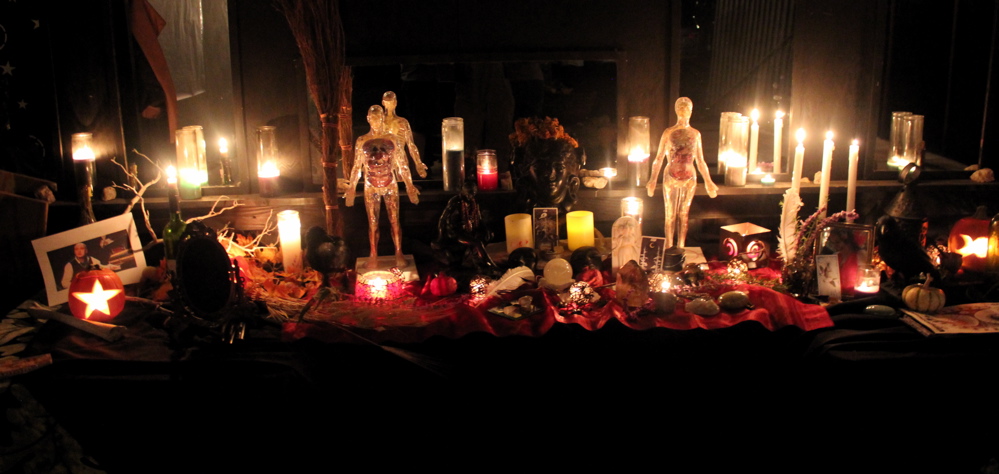
Image copyright 2014 Heather Rudynsky
As we worked, one priestess asked if those of us who were going to sing during the trance could rehearse. Of course, we said. We hadn’t done a run-through together yet. So she started and the rest of us joined in:
Set sail, set sail
Over the waves where the spray blows white
Into the night, into the night
Set sail, set sail
Turn your face where the veil grows thin
Beyond the rim, beyond the rim
Set sail, set sail
Follow the twilight to the West
Where you may rest, where you may rest
Set sail, set sail
Over the dark of the sunless sea
You are free, you are free
Set sail, set sail
Four women, singing a spell and tending our altar. Four Witches, our voices lilting in the evening air. When we were finished, the moon rose.
* * *
who is like you
o my people
who bind your stories to your arms
I too
tie my story to the parabolic curves of my body
my physics like an alphabet
you must recover me
from the tar pits of the years**
That night, the ritual went very well. I invoked Hermes and he helped us travel to our ancestors. Another priestess led a Hekate devotional with a harmonium. I drummed solo for the first time (normally I play backup). In trance I met my great-grandmother, who escaped from the pogroms in Poland with her two young children. Family lore has it that she stuffed a rag in my two-year-old grandmother’s mouth to keep her from making noise while they hid from soldiers in the forest. My great-grandmother, who used to hug me as if I’d fly away when I was a little girl, explained to me how fierce and uncompromising motherhood can be.
The ritual was ambitious, but we pulled it off with only a couple of minor hitches. When everything was done and the circle was devoked and everyone went in for the potluck, I felt the same weak relief that any introvert feels after performing. I felt embarrassed about the places where I felt I’d messed up. Deep down, though, I felt gratitude, exhilaration, pride in my calling.
But all that night and for days after, I kept thinking about our time at the altar, when we sang as we placed offerings. The deepest moments of Witchcraft are usually the simplest, when your analytical mind falls away, when you’re lifted by song, when you’re guided by ancient memory and your hands craft something holy. When you feel yourself deeply in service and it doesn’t even matter what exactly you’re serving.
May you recover yourself from the tar pits of the years. May your altar thrum with love.
* “Ritual Tools: The Altar” from Siddur HaKohanot.
** “What Is In the Goddess’s Tefillin?” by Rabbi Jill Hammer, also in Siddur HaKohanot.
Previous Post

November 12, 2014
Send Healing Energy to Thich Nhat Hanh
Next Post

November 18, 2014 Spirituality Versus Superstition (Or: What If We're Making It All Up?)
Browse Our Archives
Select a Category Anu Aphrodite Book reviews Books Buddhism Daily practice Deity Depression Divination Feminism Goddess Holidays Judaism Justice Magic Mental Health Morrigan Morrigan Hymns Nature Politics Pop culture Priestessing Race Reclaiming Tradition Sabbats Shekhinah Tikkun Olam Travel Uncategorized Witchcraft
Select a Month June 2016 May 2016 April 2016 March 2016 February 2016 January 2016 December 2015 November 2015 October 2015 September 2015 August 2015 July 2015 June 2015 May 2015 March 2015 February 2015 January 2015 December 2014 November 2014 October 2014 September 2014 August 2014 July 2014 June 2014 May 2014 April 2014 March 2014 February 2014 January 2014
Follow Us!
TAKE THE
Religious Wisdom Quiz
True or False: James teaches that pure religion before God is to visit orphans and widows in their trouble.
Select your answer to see how you score.
FALSE TRUE
Related posts from Shekhinah Calling

A Witch in Iceland (Part 2: Earth)

A Witch in Iceland (Part 1: Water)
A New Queer Jewitch Tarot Deck: The Hidden...

"Just Let Me Label You So We Can...
TRENDING AT PATHEOS Pagan

I was recently chatting with someone on Instagram. She asked me what...

While there are many people who share their results, the end of...

On July 23, I saw Christopher Nolan's The Odyssey which is Homer’s...

As I write this two big events have just finished up. One...

Restoring the Watershed of Divine Love
Perhaps cooperation is not something we manufacture through legislation, ideology, or moral...

Many UUs don’t pray because of bad experiences in a previous religion,...
view all Pagan blogs
Ad-Free & Subscriber Log-In Subscription Support
- About Us
- 2026 Calendar
- Videos
- Podcasts
- Library of World Religions
- Faith In Media Tracker
- Advertise With Us
- Write for Us
- Privacy Policy
- Terms of Service
- Do Not Sell My Data
- Contact Us
- Radiant Digital
- Manage Newsletter Subscriptions
- Unsubscribe From Notifications
- Sitemap
Copyright 2008-2026, Patheos. All rights reserved.
Subscription Support Ad-Free & Subscriber Log-In
Follow Patheos