
BuddhistCatholicContemplativeEvangelicalGeneral ChristianHinduJewishLatter-day SaintMuslimNew VisionsProgressive Christian
Beliefs
- Buddhist
- Catholic
- Contemplative
- Evangelical
- General Christian
- Hindu
- Jewish
- Latter-day Saint
- More Voices
- Muslim
- New Visions
- Pagan
- Progressive Christian
Topics
- Religion News
- Food and Religion
- Sports and Religion
- Religious Art
- Religious Music and Entertainment
- Religious Events
- History and Religion
- Style and Religion
- Politics and Religion
- Women in Religion
- Recreation Outdoors and Religion
- Business Finance and Religion
- Careers Workplace and Religion
- Education and Religion
- Family Parenting and Religion
- Health Fitness and Religion
- Home and Religion
- Relationships and Religion
- Technology and Religion
- Travel and Religion
Columnists
- Buddhist Columnists
- Business Finance and Religion Columnists
- Careers Workplace and Religion Columnists
- Catholic Columnists
- Contemplative Columnists
- Education and Religion Columnists
- Evangelists Columnists
- Family Parenting and Religion Columnists
- General Christian Columnists
- Health Fitness and Religion Columnists
- Hindu Columnists
- History and Religion Columnists
- Home and Religion Columnists
- Jewish Columnists
- More Voices Columnists
- Latter Day Columnists
- Muslim Columnists
- New Visions Columnists
- Nonreligious Columnists
- Pagan Columnists
- Politics and Religion Columnists
- Progressive Columnists
- Recreation Outdoors and Religion Columnists
- Relationships and Religion Columnists
- Religion News Columnists
- Religious Art Columnists
- Religious Events Columnists
- Religious Music and Entertainment Columnists
- Sports and Religion Columnists
- Style and Religion Columnists
- Technology and Religion Columnists
- Travel and Religion Columnists
- Women in Religion Columnists
Resource Library
- 2026 Calendar
- Library of World Religions
- The 100 Most Holy Places on Earth
- Patheos Answers
- Podcasts
- Videos
- Faith Leaders Database
- Anglican Episcopalian
- Bahai
- Baptist
- Buddhism
- Christianity
- Confucianism
- Eastern Orthodoxy
- Hinduism
- Holiness and Pentecostal
- ISKCON
- Islam
- Judaism
- Lutheran
- Methodist
- The Church of Jesus Christ of Latter-day Saints
- New Age
- Paganism
- Presbytarian and Reformed
- Protestantism
- Religion Behind the Scenes
- Roman Catholic
- Scientology
- Shia Islam
- Sikhism
- Sufism
- Sunni Islam
- Taoism
- Zen
- See all religions
Research Tools
 Ad-Free & Subscriber Log-In Subscription Support
Ad-Free & Subscriber Log-In Subscription Support
Follow Patheos 

- Trending:
- Forgiveness
- |
- Marriage
- |
- Consciousness
- |
- Death Penalty
- |
- Election
- |
- Halloween
 Empathy Mining
- Home
- Progressive Christian
- CRT is the latest in a long history of far right moral panic attacks against public education…remember Ebonics?
CRT is the latest in a long history of far right moral panic attacks against public education…remember Ebonics?
Last updated on: March 10, 2022 at 9:28 pm by Shane Phipps
CRT is the latest in a long history of far right moral panic attacks against public education…remember Ebonics? 2022-03-10T21:28:03-04:00 Shane Phipps
Patheos Explore the world's faith through different perspectives on religion and spirituality! Patheos has the views of the prevalent religions and spiritualities of the world.
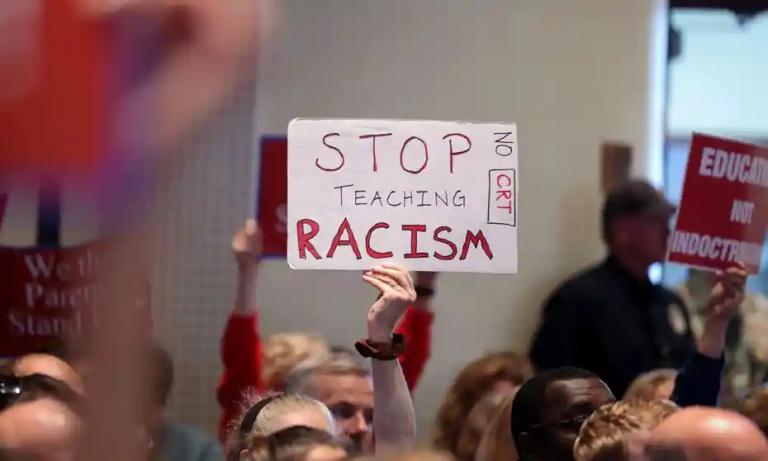
The uproar we are currently experiencing over the topic of the teaching of Critical Race Theory in schools is just the latest in a long history of unwarranted attacks from the far right on public education. It is just the next thing in line where right wing leadership misrepresents the truth and uses mendacious propaganda to play to the deep-seated racial bias and fear of middle class, conservative white America. Let me give you an example of another such false-flag hysteria that swept through America in the not-so-distant past. The Ebonics controversy of the 1990s.
In 1960s the racial achievement gap in education was blamed on the predominant theory of the time, something called the “cultural deficit theory.”
- This theory claimed that inner-city black kids came to school with less capacity to learn language because they were exposed to less words at home because black parents spoke in shorter sentences than white parents so black children were getting less complicated messages.
- Here is a very cring-y Eugenics-like quote from one 1964 study: “The language of culturally deficient children is not an underdeveloped version of English. It is a non-logical mode of expressive behavior. Their communication is primarily through gestures, single words, and a series of badly connected words and phrases, such as, ‘they mine’ or ‘me got juice’.
At the time, no one really seemed to think about holding these standardized tests up to close examine for evidence cultural bias. As it turns out, when they finally did scrutinize them, standardized tests were found to be written and assessed from a completely white, middle-class perspective, which obviously contributed greatly to the racial achievement gap.
Here is a test question example to better illustrate the issue: Students are shown a drawing of a squirrel sitting in a nest in a tree and they are asked, “where is the squirrel?” African American kids tended to answer, “in the tree,” which the test graders marked wrong because they didn’t answer in a complete sentence.
In essence, these tests were very good at identifying which kids were white and middle class, but not a whole lot of good for much else.
The results of such theories led to new (but awful) methods to try to bring black kids up closer to mastery of standard English by punishing them whenever they were caught falling short. This resulted in a drill, drill, drill, and repeat approach to education to fix the problem of these, as one 1968 study labeled them, “linguistically retarded” kids. It also served to stigmatize entire cultures as inferior—a recipe for self-fulfilling prophesy and a vicious cycle of failure.
This went on until some linguists began to reexamine this issue and started questioning whether or not these kids really were somehow linguistically challenged. During this time of inquiry, it became clear that the age of racial segregation, which at that time we were just emerging from, had been so impactful on in black communities that these interactions between black kids and the professional linguists were often the first direct interaction some of the 4 and 5-year-old kids in the study had ever had with a white adult. It became clear that many of the black kids and even their parents, because of the history of how they’d been treated, had come to the idea that they had best not say something wrong in front of white people for fear of repercussions. So, they had become conditioned to speak in very short and halting ways when they were in uncomfortable settings with whites. Once the kids were made comfortable enough to to speak freely without repercussions, they suddenly began speaking in much more complex ways.
In 1972, the noted linguist, Willam Labov, conducted a lengthy study of what he referred to at that time as “Black English.” He spent years visiting the homes of children in Harlem, N.Y. during which time he came to some revealing conclusions. He wrote an article about his findings in The Atlantic in 1972, in which he stated, “the concept of verbal deprivation has no basis in social reality. In fact, black children in urban ghettos receive a great deal of verbal stimulation and participate fully in a highly verbal culture. The myth of verbal deprivation is particularly dangerous because it diverts attention from the real defects of our [student evaluation system] to the imaginary defect of the child.” Mr. Labov went on to compare standardized test answers of white, middle-class students with those of black students and found that in many cases, the white students were scored higher not because of how well they got their point across, but rather by how many poly-syllabic words they used, how long their sentences were, and their use of phrases such as, “I suppose,” or “in conclusion.”
In 1973, a black psychologist named, Robert L. Williams, coined the term “Ebonics,” a combination of the words ebony and phonics, in an effort to take the negative connotation away from the language spoken by many African-Americans and to try to control the narrative on the subject by turning it into something more positive and less degrading. This began a new area of linguistics dedicated to better understanding the patterns and contours of African American speech. Today, the accepted term for this is African American English, rather than Ebonics, but this was the beginning of an effort to use education as a bridge building tool rather than a divisive weapon. And this is what made far-right conservatives so nervous—very similar to the current panic over Critical Race Theory (CRT).
As it turns out, like so many of the challenges we face in this nation, African American English has its roots in slavery. When slaves arrived in America from different parts of Africa, they were often intentionally separated from other slaves who spoke the same languages. This was to prevent them from being able to communicate effectively with one another. Effective communication could lead to organization and revolt. So, by the process of immersion, all the many different cultures from Africa began to meld together and combine with whatever bits of the English language they picked up. Ebonics is a part of the vestigial remains of this sad chapter of the American story. But more than that, to many African Americans it is a vital and precious part of their identity. For decades, this part of black culture was stigmatized.
Identifying African American English as a legitimate thing was a big step. Linguists still debate today whether or not African American English is a separate language or just a different dialect—much like you might find in any number of regions of the country, like Southern Appalachia, New England, Boston, Brooklyn, etc. Regardless of how it’s labeled, the fact that it is recognized as a thing has helped to destigmatize it—except perhaps for those on the far right.
The whole “Ebonics” scare exploded in the 1990s when far-right pundits like Rush Limbaugh started making wild claims about what was going on in some school districts around the country including Los Angeles and Oakland, California. These conservative opportunists never missed an opportunity to stoke the racial fears of their supporters. They began to misrepresent what was actually happening. They claimed that these schools were teaching Ebonics as a separate language, implying that all kids were being forced to use Ebonics in school. When conservative white folks across the nation got wind of this, it started a panic. But none of it was true. What was actually going on in those schools was teaching a deeper understanding of Standard American English by comparing and contrasting it with Ebonics.
Here are just a couple examples of how comparing and contrasting African American English with standard American English can be beneficial to all learners, not just black kids.
- Multiple Negatives
In African American English, the use of multiple negatives strung together in a sentence is commonly used. It isn’t seen as “less-than” standard English. In fact, it’s more closely related to the syntax rules of Spanish. And in some ways, could be seen as a more effective way to convey meaning.
Take these two phrases and compare them…
“He ain’t never got no money.” “He never has any money.”
Obviously, the second version of the sentence would score much higher on any graded essay. For that reason, every student should learn to write it that way. But the first version is much livelier and emotes a great deal more feeling in the message. Perhaps if one were writing a play with dialogue, the first sentence might be superior.
Wouldn’t the discussion of such a topic help any student better understand the nuance of language? This is what was happening in Oakland and L.A.
It scared the hell out of the far right.
- Pluralization
In standard American English we add markers like “s” or “es” to the end of words to show pluralization even when the numeric value is given. In African American English, plural markers are not necessary when a numeric value is already present.
In standard English we would say that we have 47 cents. In African American English, the “s” marker at the end of the word cent is considered redundant because the number 47 already implies plurality.
How much more interesting and valuable would it be if students were asked to compare and contrast and then be able to translate these different things in both directions rather than just one?
This was what was happening in places like Los Angeles and Oakland.
This is what made the far right lose their minds. They did not want to do anything whatsoever that would validate any other form of communication. They preferred instead to stigmatize generation after generation of African American children by portraying their culture as less than.
Remember Robert L. Williams, the black psychologist who coined the term “Ebonics?” Well, here is the rest of the story on him. He went on to develop new standardized tests that were written in a more African American English format and were more culturally aligned to minorities in order to see what impact these tests would have on the racial achievement gap. The results were remarkable. As it turns out, the racial achievement gap remained about the same with one notable exception, this time, it was the white, middle-class students who were on the bottom side of the scale. Remarkable, isn’t it?
Today, American history teachers like me tell the story of America from multiple perspectives. We don’t just force feed the perspective of the dominant white culture. We tell of the struggle of the vanquished people of color—Hispanic Americans, African Americans, Native American Indians, women, immigrants, etc.—and we stir it all together and ask our students to chew on difficult concepts until they’ve formed their own opinions. For too long, America has been taught as a melting pot. That is misleading because the melting pot always seemed to default to the story of the predominant white culture being portrayed as America’s story. In reality, America is not a melting pot. America is a stew. We are made of a multitude of different ingredients and spices that mix together to create something unique.
That should be seen as a good thing.
But it scares the bejezus out of too many white, middle-class Americans.
They call it CRT and they try to make laws to force their preferred idyllic melting pot narrative.
Our kids deserve the truth, not fairytales.
Previous Post

March 8, 2022
Teacher who struck student has long history of political indoctrination
Next Post
March 11, 2022 If I Were a Pastor
Browse Our Archives
Select a Category 150 word story 2nd Amendment AARP abortion addiction aging alcoholism Anderson Wigwam Andrew Jackson Appalachia Basketball bias bigotry Black Lives Matter Christianity Christmas, Constitution, Bill of Rights Civil War Clinton cloning confirmation bias Conservation Constitution Controversial Creationism Creepy tales David Bowie depression Dogs Education Election Electoral College Empathy Environmental Evolution exvangelical faith Family Family History Fantasy Genealogy Genesis George Washington Ghetto Global Warming Gun Control health care High School Basketball Hillary History Hockey homosexuality Hoosier Hysteria Hoosiers Hunting immigration income inequality Interview ISTEP Jurassic Park Kaepernick Ken Hamm Kids say the Darndest things LGBTQ Love MAGA Manifest Destiny Merit Pay Mike Pence Muhammad Ali Multiple Perspectives Music Music Review Nashville News media NHL No Child Left Behind NRA Paradox Parenting Pence Perspective Politics POTUS Poverty Predators Race Religion religious freedom Sci Fi Science Secret of Life sexual harrassment Short Stories Slavery Small Town Indiana Smashville Social Commentary social media sports Stress technology Terrorism Thomas Jefferson Trauma Trump Turning 50 Uncategorized war Washington DC White Privilege wooly mammoths words in red Writing Writing Process Writing, Writing Process Young Earth
Select a Month June 2022 May 2022 April 2022 March 2022 February 2022 August 2021 May 2021 March 2021 February 2021 January 2021 November 2020 October 2020 September 2020 August 2020 July 2020 June 2020 April 2020 March 2020 February 2020 January 2020 December 2019 November 2019 October 2019 September 2019 August 2019 July 2019 June 2019 May 2019 April 2019 March 2019 February 2019 January 2019 December 2018 November 2018 October 2018 September 2018 August 2018 July 2018 June 2018 May 2018 April 2018 March 2018 February 2018 January 2018 December 2017 November 2017 October 2017 September 2017 August 2017 July 2017 June 2017 May 2017 April 2017 March 2017 February 2017 January 2017 December 2016 November 2016 October 2016 September 2016 August 2016 July 2016 June 2016 May 2016 March 2016 February 2016 January 2016 December 2015
Follow Us!
TAKE THE
Religious Wisdom Quiz
Who found baby Moses in the river?
Select your answer to see how you score.
A shepherd Miriam Pharaoh's daughter Moses' mother
Support this
Column


Related posts from Empathy Mining

Jesus and Elon Musk: America's Income Inequality Problem

Dear Christians, Relax, Schools Are NOT Grooming Your...
Why is the Christian Right So Scared of...
Christian Pre-School Teacher Leads 4-Year-Olds in Anti-Biden Chant
TRENDING AT PATHEOS Progressive Christian

Why Christians Have a Sacred Duty to Vote:...
The Bible offers strong support for the sacred duty to vote. Here...

What Being a Modern-Day Apostle Means to Me
In my last column, I discussed the ins and outs of modern-day...

Did Ancient China Once Worship the God of...
Across human history, a common thread weaves through the origins of the...

Love Your Neighbor – Including Earth-Kin: Lev. 19,...
God’s command to love your neighbor means acting in an ethical and...

Lead a Church Study of “Jesus and Lao...
Guest writer Jack Thomas (The Irreverent Reverend) reflects on leading his church...

Principles for Understanding the Apostolic Ministry Today
Whenever people discover that my formal ministry title is "apostle," as in...
view all Progressive Christian blogs
Ad-Free & Subscriber Log-In Subscription Support
- About Us
- 2026 Calendar
- Videos
- Podcasts
- Library of World Religions
- Faith In Media Tracker
- Advertise With Us
- Write for Us
- Privacy Policy
- Terms of Service
- Do Not Sell My Data
- Contact Us
- Radiant Digital
- Manage Newsletter Subscriptions
- Unsubscribe From Notifications
- Sitemap
Copyright 2008-2026, Patheos. All rights reserved.
Subscription Support Ad-Free & Subscriber Log-In
Follow Patheos