
BuddhistCatholicContemplativeEvangelicalGeneral ChristianHinduJewishLatter-day SaintMuslimNew VisionsProgressive Christian
Beliefs
- Buddhist
- Catholic
- Contemplative
- Evangelical
- General Christian
- Hindu
- Jewish
- Latter-day Saint
- More Voices
- Muslim
- New Visions
- Pagan
- Progressive Christian
Topics
- Religion News
- Food and Religion
- Sports and Religion
- Religious Art
- Religious Music and Entertainment
- Religious Events
- History and Religion
- Style and Religion
- Politics and Religion
- Women in Religion
- Recreation Outdoors and Religion
- Business Finance and Religion
- Careers Workplace and Religion
- Education and Religion
- Family Parenting and Religion
- Health Fitness and Religion
- Home and Religion
- Relationships and Religion
- Technology and Religion
- Travel and Religion
Columnists
- Buddhist Columnists
- Business Finance and Religion Columnists
- Careers Workplace and Religion Columnists
- Catholic Columnists
- Contemplative Columnists
- Education and Religion Columnists
- Evangelists Columnists
- Family Parenting and Religion Columnists
- General Christian Columnists
- Health Fitness and Religion Columnists
- Hindu Columnists
- History and Religion Columnists
- Home and Religion Columnists
- Jewish Columnists
- More Voices Columnists
- Latter Day Columnists
- Muslim Columnists
- New Visions Columnists
- Nonreligious Columnists
- Pagan Columnists
- Politics and Religion Columnists
- Progressive Columnists
- Recreation Outdoors and Religion Columnists
- Relationships and Religion Columnists
- Religion News Columnists
- Religious Art Columnists
- Religious Events Columnists
- Religious Music and Entertainment Columnists
- Sports and Religion Columnists
- Style and Religion Columnists
- Technology and Religion Columnists
- Travel and Religion Columnists
- Women in Religion Columnists
Resource Library
- 2026 Calendar
- Library of World Religions
- The 100 Most Holy Places on Earth
- Patheos Answers
- Podcasts
- Videos
- Faith Leaders Database
- Anglican Episcopalian
- Bahai
- Baptist
- Buddhism
- Christianity
- Confucianism
- Eastern Orthodoxy
- Hinduism
- Holiness and Pentecostal
- ISKCON
- Islam
- Judaism
- Lutheran
- Methodist
- The Church of Jesus Christ of Latter-day Saints
- New Age
- Paganism
- Presbytarian and Reformed
- Protestantism
- Religion Behind the Scenes
- Roman Catholic
- Scientology
- Shia Islam
- Sikhism
- Sufism
- Sunni Islam
- Taoism
- Zen
- See all religions
Research Tools
 Ad-Free & Subscriber Log-In Subscription Support
Ad-Free & Subscriber Log-In Subscription Support
Follow Patheos 

- Trending:
- Forgiveness
- |
- Marriage
- |
- Consciousness
- |
- Death Penalty
- |
- Election
- |
- Halloween
 Empathy Mining
- Home
- Progressive Christian
- Manifest Destiny-Doing the Unsavory Work of God
Manifest Destiny-Doing the Unsavory Work of God
Last updated on: July 28, 2017 at 9:54 pm by Shane Phipps
Manifest Destiny-Doing the Unsavory Work of God 2017-07-28T21:54:10-04:00 Shane Phipps
Patheos Explore the world's faith through different perspectives on religion and spirituality! Patheos has the views of the prevalent religions and spiritualities of the world.
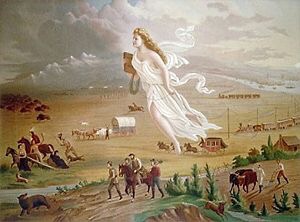
The image above is the most famous work of art depicting Manifest Destiny. The John Gast painting shows an angel leading the way west across the vast plains of America. Behind her lie the industrialized eastern cities. Before her lie the great Rocky Mountains and the Pacific Ocean. Indians and bison are shown, quite appropriately, fleeing in fear. The angel is leading the way for new technologies with a train nipping at her heels and a length of telegraph wire in her hands. There are many layers and perspectives to ponder in the painting, just as there are with the theme of the work, Manifest Destiny.
It is difficult to put an exact date to the beginning of Manifest Destiny because it was a long process. The term itself does have a definite beginning. Journalist John L. O’Sullivan coined the phrase in 1845 to help drum up support for the annexation of Texas and the Oregon Country into the United States. Taken literally, the term means the obvious will of God. In essence, the term means that it was clearly a divinely inspired plan for America to expand from sea to shining sea, no matter what it took or who was in the way. O’Sullivan may have given the phenomenon a moniker, but Manifest Destiny was in full swing long before that.
The seeds of Manifest Destiny came across the Atlantic with the first colonists. Colonial immigrants were hungry for land, nearly impossible to find in tiny England, but America had it in spades. From the beginning, Americans were looking westward longingly, wondering how far they could go and just how they might get there. The process got off to a creeping slow start because technology hadn’t caught up with ambition. The Appalachian Mountains provided a formidable wall to keep the early colonists contained. Still, many Americans ventured slowly westward, sparking conflict with every encroaching step. The French and Indian War resulted from American settlers trying to push westward into lands claimed and controlled by France. Once the French were dispatched, Americans tried to push further, running into many more conflicts with Indians. King George issued the Proclamation of 1763 in an attempt to keep his American subjects from crossing the mountains, saying England didn’t have the resources to protect them from the “savages” beyond the Alleghenies. Yet, Americans like Daniel Boone pushed westward anyway, opening up Kentucky and the Ohio Valley for more settlement.
Once America won independence from Mother England, we were on our own to roam the land all the way to the Mississippi River, then the western extent of the new nation. Slowly but surely, America crawled westward. Still, technology would not allow for haste.
If one wanted to put a date on the period the feverish curiosity about the West began to blossom toward full blown Manifest Destiny, a good starting point might be 1803 and the Louisiana Purchase. President Jefferson, just 27 years after penning America’s birth certificate, doubled the size of the nation by purchasing over 800 million square miles of mostly unknown and unexplored territory from France. Shortly thereafter, the Lewis and Clark Expedition braved their incredible trek through the newly purchased lands and beyond, all the way to the Pacific Ocean. Their accounts of hundreds of species of flora and fauna, brand new to science, and of the potential for vast, rich farmlands whetted the appetite of an American public already itching to go west. Slowly but surely a new flow of emigrants oozed westward.
By the time the term Manifest Destiny was coined by Mr. O’Sullivan, technology had begun to catch up with the demand for more elbow room. The railway system was getting underway. People and goods were beginning to travel at comparatively astounding speeds. Before the trains, a good hard day of travel by wagon might gain you 20 miles. Trains could do better than that in a single hour. And information speeds got a boost infinitely better than that. In what may have been the single biggest leap forward in technology ever, the telegraph system changed everything. In 1843, information could travel no faster than a horse or, where available, a train. By 1844, information could travel as fast as electric signals could transmit along wires. Once connected by wire, cities hundreds or even thousands of miles apart could communicate in mere minutes where previously it would have taken days or weeks to exchange news. With new technologies on the way, there was nothing standing in the way of Manifest Destiny plunging full speed ahead. Nothing, that is, except for people who already lived where Manifest Destiny was heading. It is here where westward expansion loses some of its luster.
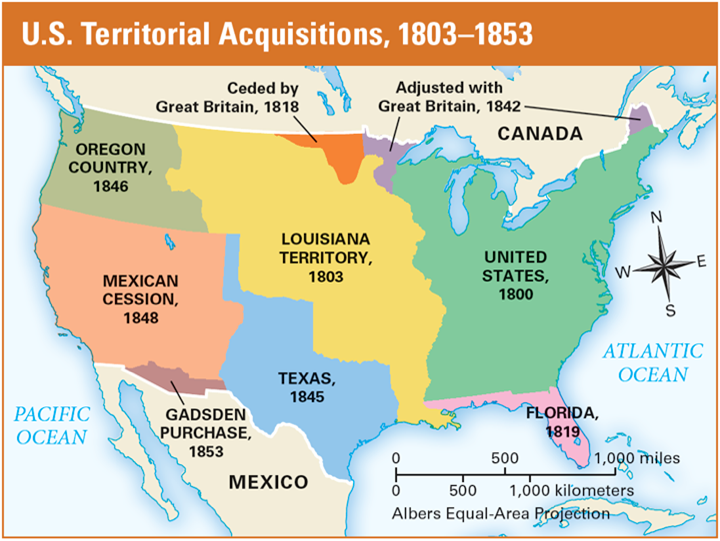
I call the above map the “puzzle piece map.” One very similar to it hangs on the wall of my classroom and I refer to it frequently throughout the year. It tells the story I just laid out very clearly. Look at the slow build of Manifest Destiny played out on the map, then once we get to 1845, it’s Katie bar the door! What too often gets overlooked on the map is the story of conquered people. With each and every new piece added to the American puzzle, many thousands (or millions) of people had to be conquered, killed, or relocated against their will.
America doesn’t like to view itself as a conqueror. We like to paint conquerors as evil villains. Genghis Khan, Attila the Hun, Hitler–those guys were conquerors. But what of the likes of Andrew Jackson and James K. Polk? Depending on your perspective, conquerors can come in many different packages. It can’t be sugarcoated, Indians were conquered, killed (in battle or by disease), or forced out of every single puzzle piece on that map up there.
The justification for the plight of the Indians in the story of Manifest Destiny is seated in a wrong-headed notion of the American expansionist mindset. Americans, truly sold on the belief that they were doing the work of God in expanding America westward, wrongly assumed that the Natives would see how great American culture was, convert to Christianity and gleefully join the cause–in a word, they assumed Indians would be willing to assimilate. That never happened to any great extent. As it turns out, Indians liked being Indians and didn’t want to stop (go figure). At the core of the problem were the fundamentally and diametrically opposed views on the very nature of land held by Euro-Americans and Native Americans. The Euro-American view of land ownership was stitched right into the DNA of white American settlers who always hungered for more land. It is the ultimate American Dream to own land, to fence it off and say this is mine! You stay off mine and I’ll stay off yours and we’ll get along just fine. This was a largely foreign concept to Indians. Tribes staked claims to large portions of land for tribal use, but the idea of individuals owning large tracts of land was unfathomable to most Indians. The great Chief Tecumseh famously ranted about this saying, “Sell the land? Why not sell the air and the great seas, too?” We can’t imagine selling the air or the sea. We can agree that we all share those things. Indians saw the land the same way. That fundamental difference was so great that it was impossible to overcome. The results were truly tragic for Native Americans.
Another conquered people with a very different perspective on Manifest Destiny are the Mexicans. Mexico gained independence from Spain in 1821, just before Manifest Destiny shifted into high gear. Eager to develop a sparsely populated section of their new country called Texas, the Mexican government issued an invitation to Americans to move in and settle there. In return for generous land grants, transplanted Americans simply had to agree to a few rules; become Mexican citizens and follow Mexican law (including no slavery), learn to speak Spanish, and convert to Catholicism. Americans poured into Texas by the thousands to take advantage of the opportunity. There was one problem–the Americans didn’t want to follow the laws of Mexico. They still viewed themselves as Americans and didn’t want to abide by the rules. Imagine, Americans crossing the border into Mexico and refusing to do so in a legal manner…oh, the irony! This all eventually led to the Alamo and the subsequent defeat of Santa Anna at San Jacinto, after which he was forced to sign a treaty recognizing Texas’ independence. A decade later, after trying and failing to buy California and the New Mexico territory, President Polk pressed the issue, sending the military to patrol the disputed border, basically provoking Mexico into war. At the end of that war, America would get the land they had wanted to buy, this time at bargain basement prices and the Mexican Cession puzzle piece was added to the U.S. Incredibly, just days before the Treaty of Guadalupe-Hidalgo was signed, giving America possession of California, gold was discovered at Sutter’s Mill, which quickly sparked the California Gold Rush, during which the world’s known gold supply more than doubled. Tough break, Mexico…
In the end, America ended up with a tremendous chunk of Mexico. Look at the map up there again. Now imagine adding Texas, our second most populous state, California by far our biggest, and everything in between them back to Mexico. That includes all the resources; all the gold found in California, all the oil sucked out of Texas, all the agricultural produce grown year round in those warm climates…all of it. How different would Mexico look today? How different would the U.S. look today? Sorry Mexico…
So, when we talk of building a wall to keep “illegals” from crossing the border into America, just keep these things in the back of your mind someplace. It might help add a dose of empathy to the whole situation that might otherwise appear black and white.
Another perspective about Manifest Destiny that often gets overlooked is that of the African-American slave. Manifest Destiny helped create an explosion in the number of slaves in America. As the Industrial Revolution continued to streamline the textile industry, the demand for cotton skyrocketed. Southern planters, eager to step up and meet the demand, needed more land to grow more cotton. They also needed more slaves to plant, tend, and pick the cotton. The following graph shows the explosive growth of cotton production and slave populations during the period.
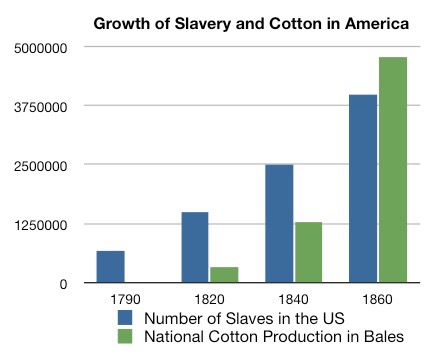
Manifest Destiny was certainly good for slave owners and it was just as bad for slaves…or was it?
It could be argued that Manifest Destiny actually hastened the end of slavery, as well. As southerners attempted to move slavery westward with the nation’s growth, it constantly caused problems with northerners. Northern states were adamantly against the spreading of slavery to western states and territories and it caused terrible sectional division. Ultimately, the Civil War was not caused by slavery but by the expansion of slavery into the west. So it could be argued that, without the westward expansion of Manifest Destiny, slavery could have gone on for a lot longer than it did. In helping to spawn a terrible war, Manifest Destiny also helped bring an end to slavery.
There are so many levels and perspectives to consider when weighing the pros and cons of Manifest Destiny and so many questions to ponder. Does the end justify the means? Many argue that it does. Many will say that all that ugly business of “doing God’s work” was necessary to create the most powerful nation the world has ever seen. Many will say that the world needed the U. S. to become great and powerful so that we could do all the good we did in the 20th Century. America is capable of doing great things and has, no doubt, done a lot of good. I don’t have the answer to the questions. I know I love my country and wouldn’t want to live many other places in the world. But I don’t want to forget what “God’s work” hath wrought on the folks who were trampled beneath the feet of the workers. Even if the end justifies the means, the means need to be acknowledged.
It can’t be denied that we still carry the scars of Manifest Destiny. They are the lines on our maps, they’re entangled in our ongoing immigration debates, and they flow like a stream in the undercurrent of our national racial tension.
Manifest Destiny is still alive. It springs forth in patriotic song, it spills out in speeches of those who still espouse that the United States is the chosen instrument of God Almighty, like when Franklin Graham claimed the victory of Donald Trump was divinely inspired.
Manifest Destiny arises whenever anyone dares to own the will of God and uses it for their gain.
May God have mercy upon us.

Next Post

July 31, 2017 Fundamentalist Evangelical Leaders Need to Learn from Billy Graham
Browse Our Archives
Select a Category 150 word story 2nd Amendment AARP abortion addiction aging alcoholism Anderson Wigwam Andrew Jackson Appalachia Basketball bias bigotry Black Lives Matter Christianity Christmas, Constitution, Bill of Rights Civil War Clinton cloning confirmation bias Conservation Constitution Controversial Creationism Creepy tales David Bowie depression Dogs Education Election Electoral College Empathy Environmental Evolution exvangelical faith Family Family History Fantasy Genealogy Genesis George Washington Ghetto Global Warming Gun Control health care High School Basketball Hillary History Hockey homosexuality Hoosier Hysteria Hoosiers Hunting immigration income inequality Interview ISTEP Jurassic Park Kaepernick Ken Hamm Kids say the Darndest things LGBTQ Love MAGA Manifest Destiny Merit Pay Mike Pence Muhammad Ali Multiple Perspectives Music Music Review Nashville News media NHL No Child Left Behind NRA Paradox Parenting Pence Perspective Politics POTUS Poverty Predators Race Religion religious freedom Sci Fi Science Secret of Life sexual harrassment Short Stories Slavery Small Town Indiana Smashville Social Commentary social media sports Stress technology Terrorism Thomas Jefferson Trauma Trump Turning 50 Uncategorized war Washington DC White Privilege wooly mammoths words in red Writing Writing Process Writing, Writing Process Young Earth
Select a Month June 2022 May 2022 April 2022 March 2022 February 2022 August 2021 May 2021 March 2021 February 2021 January 2021 November 2020 October 2020 September 2020 August 2020 July 2020 June 2020 April 2020 March 2020 February 2020 January 2020 December 2019 November 2019 October 2019 September 2019 August 2019 July 2019 June 2019 May 2019 April 2019 March 2019 February 2019 January 2019 December 2018 November 2018 October 2018 September 2018 August 2018 July 2018 June 2018 May 2018 April 2018 March 2018 February 2018 January 2018 December 2017 November 2017 October 2017 September 2017 August 2017 July 2017 June 2017 May 2017 April 2017 March 2017 February 2017 January 2017 December 2016 November 2016 October 2016 September 2016 August 2016 July 2016 June 2016 May 2016 March 2016 February 2016 January 2016 December 2015
Follow Us!
TAKE THE
Religious Wisdom Quiz
What is the name for the Christian "day of rest and worship"?
Select your answer to see how you score.
Day of Prayer Sabbath Seder Feast
Support this
Column


Related posts from Empathy Mining

Gun Rights Advocates are Focusing on the Wrong...

It's Time for Pro-Lifers to Be Pro-Life

Can a Democrat Be a Christian?

Don't let Dissociation Keep You from Standing for...
TRENDING AT PATHEOS Progressive Christian

Why Christians Have a Sacred Duty to Vote:...
The Bible offers strong support for the sacred duty to vote. Here...

What Being a Modern-Day Apostle Means to Me
In my last column, I discussed the ins and outs of modern-day...

Did Ancient China Once Worship the God of...
Across human history, a common thread weaves through the origins of the...

Love Your Neighbor – Including Earth-Kin: Lev. 19,...
God’s command to love your neighbor means acting in an ethical and...

Lead a Church Study of “Jesus and Lao...
Guest writer Jack Thomas (The Irreverent Reverend) reflects on leading his church...

Principles for Understanding the Apostolic Ministry Today
Whenever people discover that my formal ministry title is "apostle," as in...
view all Progressive Christian blogs
Ad-Free & Subscriber Log-In Subscription Support
- About Us
- 2026 Calendar
- Videos
- Podcasts
- Library of World Religions
- Faith In Media Tracker
- Advertise With Us
- Write for Us
- Privacy Policy
- Terms of Service
- Do Not Sell My Data
- Contact Us
- Radiant Digital
- Manage Newsletter Subscriptions
- Unsubscribe From Notifications
- Sitemap
Copyright 2008-2026, Patheos. All rights reserved.
Subscription Support Ad-Free & Subscriber Log-In
Follow Patheos