
BuddhistCatholicContemplativeEvangelicalGeneral ChristianHinduJewishLatter-day SaintMuslimNew VisionsProgressive Christian
Beliefs
- Buddhist
- Catholic
- Contemplative
- Evangelical
- General Christian
- Hindu
- Jewish
- Latter-day Saint
- More Voices
- Muslim
- New Visions
- Pagan
- Progressive Christian
Topics
- Religion News
- Food and Religion
- Sports and Religion
- Religious Art
- Religious Music and Entertainment
- Religious Events
- History and Religion
- Style and Religion
- Politics and Religion
- Women in Religion
- Recreation Outdoors and Religion
- Business Finance and Religion
- Careers Workplace and Religion
- Education and Religion
- Family Parenting and Religion
- Health Fitness and Religion
- Home and Religion
- Relationships and Religion
- Technology and Religion
- Travel and Religion
Columnists
- Buddhist Columnists
- Business Finance and Religion Columnists
- Careers Workplace and Religion Columnists
- Catholic Columnists
- Contemplative Columnists
- Education and Religion Columnists
- Evangelists Columnists
- Family Parenting and Religion Columnists
- General Christian Columnists
- Health Fitness and Religion Columnists
- Hindu Columnists
- History and Religion Columnists
- Home and Religion Columnists
- Jewish Columnists
- More Voices Columnists
- Latter Day Columnists
- Muslim Columnists
- New Visions Columnists
- Nonreligious Columnists
- Pagan Columnists
- Politics and Religion Columnists
- Progressive Columnists
- Recreation Outdoors and Religion Columnists
- Relationships and Religion Columnists
- Religion News Columnists
- Religious Art Columnists
- Religious Events Columnists
- Religious Music and Entertainment Columnists
- Sports and Religion Columnists
- Style and Religion Columnists
- Technology and Religion Columnists
- Travel and Religion Columnists
- Women in Religion Columnists
Resource Library
- 2026 Calendar
- Library of World Religions
- The 100 Most Holy Places on Earth
- Patheos Answers
- Podcasts
- Videos
- Faith Leaders Database
- Anglican Episcopalian
- Bahai
- Baptist
- Buddhism
- Christianity
- Confucianism
- Eastern Orthodoxy
- Hinduism
- Holiness and Pentecostal
- ISKCON
- Islam
- Judaism
- Lutheran
- Methodist
- The Church of Jesus Christ of Latter-day Saints
- New Age
- Paganism
- Presbytarian and Reformed
- Protestantism
- Religion Behind the Scenes
- Roman Catholic
- Scientology
- Shia Islam
- Sikhism
- Sufism
- Sunni Islam
- Taoism
- Zen
- See all religions
Research Tools
 Ad-Free & Subscriber Log-In Subscription Support
Ad-Free & Subscriber Log-In Subscription Support
Follow Patheos 

- Trending:
- Forgiveness
- |
- Marriage
- |
- Consciousness
- |
- Death Penalty
- |
- Election
- |
- Halloween

- Home
- About Hebrew College
- The Rabbinical School of Hebrew College
- The Book of Psalms
- FREE NEWSLETTER
- Home
- Jewish
- What is Ours to Do? The “Humble” Aleph of Leviticus 1:1
What is Ours to Do? The “Humble” Aleph of Leviticus 1:1
Last updated on: April 16, 2024 at 9:44 am by Hebrew College
What is Ours to Do? The “Humble” Aleph of Leviticus 1:1 2024-04-16T09:44:24-04:00 Hebrew College
Patheos Explore the world's faith through different perspectives on religion and spirituality! Patheos has the views of the prevalent religions and spiritualities of the world.
Parashat Va’yikra (Leviticus 1:1-5:26)
By Rabbi Or N. Rose, Director, Miller Center for Interreligious Learning & Leadership, Hebrew College
“And he [YHWH] called to Moses from the Tent of Meeting…”
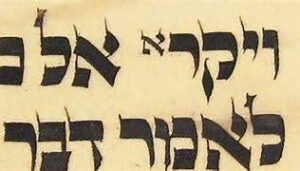
As one can see in the image above, the letter Aleph at the end of the word “Va’yikra—And He called,” is smaller than the rest of the letters. This oddity (like other instances of reduced or enlarged letters in the Hebrew Bible) has led to an outpouring of creative commentary throughout the ages.
One common interpretation is that the small Aleph is reflective of Moses’ humility. Even though he is a great prophet and leader, Moses does not develop an outsized ego. In fact, the Bible later describes him as “humbler than all other people on the face of the earth.” (Numbers 12:3) As we begin reading the third book of the Torah—the center point or heart of the “Five Books of Moses”—we are reminded of the core value of humility.
But humility is not the same as denigration. The great Hasidic master, Rabbi Levi Yitzhak of Berditchev (1740-1809), makes this point deftly through a careful reading of the verse just cited from the Book of Numbers. Why is Moses described as “humbler” than all other people? Because while they turned their gaze downward—to “the earth”—Moses looked up to the heavens. Meaning, Moses did not think of himself as a lowly creature, but in meditating on the vastness of creation, and his place in it, he came to an appropriate assessment of his stature. As the Berditchever states, “This is the rung of the true and holy tzaddik (righteous one), who comes to this level of humility through his contemplative gaze” upon the whole of the cosmos, including the angels above, who stand before the blessed Creator in “awe and fear.” Moses did not seek to aggrandize or belittle himself, but to position himself fittingly within the “great chain of being.”
In crafting this commentary on Moses, Rabbi Levi Yitzhak is, of course, exploring the meaning of humility for himself as a religious leader and for his community. In fact, Hasidic masters are commonly referred to as tzaddikim (plural form of tzaddik). What does it mean to be a humble seeker and/or leader? This master’s answer is that it requires one to develop a measured understanding of their place within their earthly and cosmic contexts.
Inspired by this insight, I find myself asking the following questions anew:
What is my current location?
Where do I wish to be?
How can I utilize my particular talents and skills to become the best possible version of myself, and in so doing, be of greater service to others?
It is noteworthy that God’s call to Moses at the beginning of Leviticus comes immediately after the Israelite leader has completed the great task of erecting the Tabernacle. In fact, in the closing lines of the Book of Exodus, we learn that, “the glory of YHWH” so filled the new sanctuary that Moses could not enter it. Furthermore, now that the Tabernacle has been built, it will be Aaron, the High Priest, and not Moses, who will serve as the chief actor in this sacred domain and in the ritual life of the Israelite community. This, too, requires Moses to demonstrate humility. He must make space for his brother to carry out his priestly duties. This is not an act of self-deprecation but one of thoughtful recognition of their respective leadership roles.
In reading the opening words of Leviticus—including contemplating the significance of the “humble” Aleph—we are invited to reflect on our place within our communities, past and present, and within the larger context of creation. And like Moses, even when we find ourselves outside of the sacred center (or offstage) we must listen intently for God’s call emerging from the “Tent of Meeting.” Each of us has a distinctive role to play in the unfolding cosmic drama; discerning what is ours to do—and what is not—is essential to this sacred service.
Rabbi Or N. Rose is the founding Director of the Miller Center for Interreligious Learning & Leadership of Hebrew College. His recent publications include With the Best of Intentions: Interreligious Misteps and Mistakes and Rabbi Zalman Schachter-Shalomi: Essential Teachings (both by Orbis Books).
Previous Post

March 13, 2024
(Re)Arranging A World of Chesed
Next Post

March 26, 2024 Ecstasy Burns Away Meanness
Recent Comments
"Did God call in Genesis chapter 1 also small Aleph?"
""Maybe this is the year to take the Yovel seriously even if we can’t take ..."
Proclaiming Release: Why We Need a ..."
"very nice!"
""
Browse Our Archives
Select a Category Uncategorized
Select a Month April 2026 March 2026 December 2025 November 2025 October 2025 September 2025 August 2025 July 2025 June 2025 May 2025 April 2025 March 2025 February 2025 January 2025 December 2024 November 2024 October 2024 September 2024 August 2024 July 2024 June 2024 May 2024 April 2024 March 2024 February 2024 January 2024 December 2023 November 2023 October 2023 September 2023 August 2023 July 2023 June 2023 May 2023 April 2023 March 2023 February 2023 January 2023 December 2022 November 2022 October 2022 September 2022 August 2022 July 2022 June 2022 May 2022 April 2022 March 2022 February 2022 January 2022 December 2021 November 2021 October 2021 September 2021 August 2021 July 2021 June 2021 May 2021 April 2021 March 2021 February 2021 January 2021 December 2020 November 2020 October 2020 September 2020 August 2020 July 2020 June 2020 May 2020 April 2020 March 2020 February 2020 January 2020 December 2019 November 2019 October 2019 September 2019 August 2019 July 2019 June 2019 May 2019 April 2019 March 2019 February 2019 January 2019 December 2018 November 2018 October 2018 September 2018 August 2018 July 2018 June 2018 May 2018 April 2018 March 2018 February 2018 January 2018 December 2017 November 2017 October 2017 September 2017 August 2017 July 2017 June 2017
Follow Us!
TAKE THE
Religious Wisdom Quiz
Why was Moses placed in a basket in the Nile?
Select your answer to see how you score.
To send him to another land As part of a religious ritual To hide him from Egyptian soldiers To save him from Pharaoh’s decree
Related posts from Seventy Faces of Torah



Within Our Torah and Ourselves
TRENDING AT PATHEOS Jewish

Building a Little Ark in a Frightening World
This past Shabbat, we read about Noah. I love this story. The...

Yom Kippur : Is There Always Room for...
Making Room for Forgiveness Every year as Yom Kippur approaches, I find...

This Rosh Hashanah: Can I Find New Meaning?
A Sunrise, a New Year, and a Question On our way to...

Killing Amalek: The Torah’s Most Misunderstood Commandment
Few passages of the Torah have provoked more confusion, polemic, and misuse...

I have never trusted a first draft. I don’t mean that...

Back to School, Back to Reality—and a New...
A New School Year Begins… Back to Reality A new school year...
view all Jewish blogs
What Are Your Thoughts?leave a comment
Ad-Free & Subscriber Log-In Subscription Support
- About Us
- 2026 Calendar
- Videos
- Podcasts
- Library of World Religions
- Faith In Media Tracker
- Advertise With Us
- Write for Us
- Privacy Policy
- Terms of Service
- Do Not Sell My Data
- Contact Us
- Radiant Digital
- Manage Newsletter Subscriptions
- Unsubscribe From Notifications
- Sitemap
Copyright 2008-2026, Patheos. All rights reserved.
Subscription Support Ad-Free & Subscriber Log-In
Follow Patheos