
BuddhistCatholicContemplativeEvangelicalGeneral ChristianHinduJewishLatter-day SaintMuslimNew VisionsProgressive Christian
Beliefs
- Buddhist
- Catholic
- Contemplative
- Evangelical
- General Christian
- Hindu
- Jewish
- Latter-day Saint
- More Voices
- Muslim
- New Visions
- Pagan
- Progressive Christian
Topics
- Religion News
- Food and Religion
- Sports and Religion
- Religious Art
- Religious Music and Entertainment
- Religious Events
- History and Religion
- Style and Religion
- Politics and Religion
- Women in Religion
- Recreation Outdoors and Religion
- Business Finance and Religion
- Careers Workplace and Religion
- Education and Religion
- Family Parenting and Religion
- Health Fitness and Religion
- Home and Religion
- Relationships and Religion
- Technology and Religion
- Travel and Religion
Columnists
- Buddhist Columnists
- Business Finance and Religion Columnists
- Careers Workplace and Religion Columnists
- Catholic Columnists
- Contemplative Columnists
- Education and Religion Columnists
- Evangelists Columnists
- Family Parenting and Religion Columnists
- General Christian Columnists
- Health Fitness and Religion Columnists
- Hindu Columnists
- History and Religion Columnists
- Home and Religion Columnists
- Jewish Columnists
- More Voices Columnists
- Latter Day Columnists
- Muslim Columnists
- New Visions Columnists
- Nonreligious Columnists
- Pagan Columnists
- Politics and Religion Columnists
- Progressive Columnists
- Recreation Outdoors and Religion Columnists
- Relationships and Religion Columnists
- Religion News Columnists
- Religious Art Columnists
- Religious Events Columnists
- Religious Music and Entertainment Columnists
- Sports and Religion Columnists
- Style and Religion Columnists
- Technology and Religion Columnists
- Travel and Religion Columnists
- Women in Religion Columnists
Resource Library
- 2026 Calendar
- Library of World Religions
- The 100 Most Holy Places on Earth
- Patheos Answers
- Podcasts
- Videos
- Faith Leaders Database
- Anglican Episcopalian
- Bahai
- Baptist
- Buddhism
- Christianity
- Confucianism
- Eastern Orthodoxy
- Hinduism
- Holiness and Pentecostal
- ISKCON
- Islam
- Judaism
- Lutheran
- Methodist
- The Church of Jesus Christ of Latter-day Saints
- New Age
- Paganism
- Presbytarian and Reformed
- Protestantism
- Religion Behind the Scenes
- Roman Catholic
- Scientology
- Shia Islam
- Sikhism
- Sufism
- Sunni Islam
- Taoism
- Zen
- See all religions
Research Tools
 Ad-Free & Subscriber Log-In Subscription Support
Follow Patheos 

- Trending:
- Advent
- |
- Forgiveness
- |
- Thanksgiving
- |
- Election
- |
- Seasonal Holidays
- |
- Marriage

- Home
- About Hebrew College
- The Rabbinical School of Hebrew College
- The Book of Psalms
- FREE NEWSLETTER
- Home
- Jewish
- Choose Life
Choose Life
Last updated on: September 5, 2023 at 12:40 pm by Hebrew College
Choose Life 2023-09-05T12:40:35-04:00 Hebrew College
Patheos Explore the world's faith through different perspectives on religion and spirituality! Patheos has the views of the prevalent religions and spiritualities of the world.
By Rav Rachel Adelman
Parashat Nitzavim-VaYelekh (Deuteronomy 29:9–31:30)
My father, Howard Adelman (z”l), passed away on July 23rd and was buried on Tisha be’Av. Though he was eighty five, and had lived a full, vigorous life, his death still came as a terrible shock to me for I thought he was immortal. He had survived so many near-misses in his life—from an attack of pericarditis when I first moved to Israel in the mid-‘80s, to a full cardiac arrest in March 2020 at the onset of the Covid pandemic. Each time, he rose from near death—a cat with nine lives.
But this time he could not evade the Angel of Death. He fell and hit his head and, with the anti-coagulants he was on, blood flooded his brain causing irreversible damage. He died eight days later. He was on Vancouver Island in British Columbia, while I was in Israel. Still, just before he passed away, I was able to convey these last words in a video recording, drawn from the lullaby that he used to sing to us as children: Swing low, sweet chariot, coming for to carry me home…
The moment of Death is the ultimate din, the harshest Day of Judgment.
I feel keenly the irreversibility of that day. Coming for to carry him home.
Rosh Hashanah and Yom Kippur are also called “the Day of Judgment” [Yom ha-Din]. How do we move into this period without feeling condemned to the irreversibility of judgment but, rather, open ourselves up to transformation?
My sister recently reminded me of another of my father’s favorite songs, “Oh Sinner Man,” also an African-American Spiritual. The first stanzas of the song go like this:
Oh, sinner man, where you gonna run to?
Oh, sinner man, where you gonna run to?
Oh, sinner man, where you gonna run to all on that day?
Run to the moon, “Moon, won’t you hide me?”
Run to the sea, “Sea, won’t you hide me?”
Run to the sun, “Sun, won’t you hide me all on that day?”
Lord said, “Sinner man, moon’ll be a bleeding”
Lord said, “Sinner man, sea’ll be a sinking”
Lord said, “Sinner man, sun’ll be a freezing all on that day”
Oh, sinner man, where you gonna run to?
Oh, sinner man, where you gonna run to?
Oh, sinner man, where you gonna run to all on that day?
The Sinner Man runs from judgment or from himself, looking to hide with the Moon, or the Sea, or the Sun. He even runs to the Lord to hide him. But there is no hiding on that day.
In this week’s Parashah we read about the subtlety of teshuvah (repentance):
Surely this commandment [ha-mitzvah ha-z’ot] that I command you today
it is not too extraordinary for you,
it is not too far away!
It is not in the heavens,
[for you] to say:
Who will go up for us to the heavens and get it for us
and have us hear it, that we may observe it?
And it is not across the sea,
[for you] to say:
Who will cross for us, across the sea, and get it for us
and have us hear it, that we may observe it?
Rather, near to you is the word, exceedingly,
in your mouth and in your heart, to observe it!
(Deut. 30:11-14, Everett Fox translation).
Most commentaries, including Rashi and at least one opinion in the Talmud (b. Eruvin 55a) consider “this commandment” or “instruction” [ha-mitzvah ha-z’ot] to be about the Law and teachings of the book of Deuteronomy. However, Ramban identifies the commandment [ha-mitzvah] as repentance or return [teshuvah]. God wants Israel to know that even in the depth of exile, return to God is “not too hard, not far off from you, but is rather ‘very close to you,’ such that you can do it at any time and in any place” (Ramban’s commentary to Deut. 30:11).
That is, one cannot run to the Moon or the Sea or the Sun—for the moon’ll be a bleeding, the sea’ll be a sinking, and the sun’ll be a freezing, “all on that day.” On the Day of Judgement or the Day of Death, there will be no escape. No hiding.
The obverse, as the Torah conveys, of that sense of the irreversibility of judgment, of death, is the possibility of self-transformation through return, teshuvah. It is not in the Heavens nor across the sea but in your mouth and in your heart to observe and to do.
My father knew something about fleeing the Presence of God, or, rather, of not being able to flee the Presence of God. He always felt keenly that facing God entailed facing one’s responsibilities in life. He would even confront God, adjuring Him not to abandon His people, and to live up to the responsibilities of the covenant. You see, his own father had run away like “Sinner Man,” abandoning his wife (my Bubby), with three young sons when my father was just eight years old.
In response, my father became an Uber-Dad, intensely present and involved in each and all of his six children’s lives. His teshuvah crossed over generations—committed not to repeat the sins of the father upon the children unto the third and fourth generation. His return to Torah and God came later in life, decades later. As he softened, so did his judgment of God.
The Torah presents the process of return as a choice:
See, I set before you today
life and good, and death and evil
(Deut. 30:15).
Ultimately, God wants us to choose life, to walk in the path of the good and of Torah, and not to flee, choosing the irreversibility of death or condemnation.
My father’s Hebrew name was Hayyim, meaning life. He was a vital force in so many people’s lives, a charismatic and brilliant man and a deeply loving father. In bodying forth his memory and the process of intergenerational return, I (as bat Hayyim, daughter of Life) wish to embrace the life force that he has been and continues to be for me.
So may his memory be a source of blessing, zikhrono barukh.
Dr. Rabbi Rachel Adelman is Associate Professor of Hebrew Bible at Hebrew College, where she recently earned rabbinic ordination. She completed her Ph.D. at the Hebrew University of Jerusalem. Her doctoral dissertation, books, and academic articles center on rabbinic midrash and Tanakh, as well as gender. She is currently working on a new book, Daughters in Danger, from the Hebrew Bible to Modern Midrash. When she is not writing books, papers, or divrei Torah, it is poetry that flows from her pen.
Learn more about Hebrew College’s rabbinical and cantorial programs at Ta Sh’ma (Come & Hear), our November Open Houses (in-person & virtual options).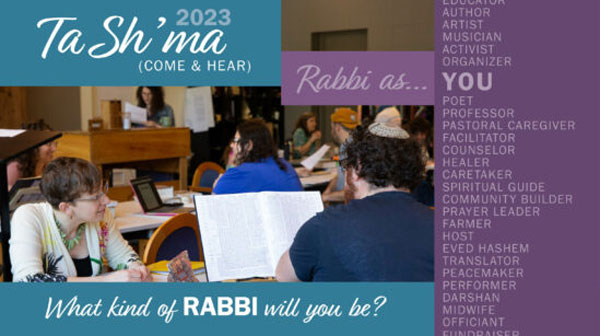
Previous Post

August 29, 2023
If Only It Were Now
Next Post

September 12, 2023 A Message for Rosh Hashana: Welcoming Tishrei
Recent Comments
"Did God call in Genesis chapter 1 also small Aleph?"
""Maybe this is the year to take the Yovel seriously even if we can’t take ..."
Proclaiming Release: Why We Need a ..."
"very nice!"
""
Browse Our Archives
Select a Category Uncategorized
Select a Month April 2026 March 2026 December 2025 November 2025 October 2025 September 2025 August 2025 July 2025 June 2025 May 2025 April 2025 March 2025 February 2025 January 2025 December 2024 November 2024 October 2024 September 2024 August 2024 July 2024 June 2024 May 2024 April 2024 March 2024 February 2024 January 2024 December 2023 November 2023 October 2023 September 2023 August 2023 July 2023 June 2023 May 2023 April 2023 March 2023 February 2023 January 2023 December 2022 November 2022 October 2022 September 2022 August 2022 July 2022 June 2022 May 2022 April 2022 March 2022 February 2022 January 2022 December 2021 November 2021 October 2021 September 2021 August 2021 July 2021 June 2021 May 2021 April 2021 March 2021 February 2021 January 2021 December 2020 November 2020 October 2020 September 2020 August 2020 July 2020 June 2020 May 2020 April 2020 March 2020 February 2020 January 2020 December 2019 November 2019 October 2019 September 2019 August 2019 July 2019 June 2019 May 2019 April 2019 March 2019 February 2019 January 2019 December 2018 November 2018 October 2018 September 2018 August 2018 July 2018 June 2018 May 2018 April 2018 March 2018 February 2018 January 2018 December 2017 November 2017 October 2017 September 2017 August 2017 July 2017 June 2017
Follow Us!
TAKE THE
Religious Wisdom Quiz
Where did Philip meet the Ethiopian eunuch?
Select your answer to see how you score.
Jericho road Desert road Jerusalem road Samaria road
Related posts from Seventy Faces of Torah
The Holy Art of World Building
Parashat Tzav: Keeping the Sacred Fire Burning
Color Theory: What Joseph’s Coat Reveals
TRENDING AT PATHEOS Jewish

Building a Little Ark in a Frightening World
This past Shabbat, we read about Noah. I love this story. The...

Yom Kippur : Is There Always Room for...
Making Room for Forgiveness Every year as Yom Kippur approaches, I find...
This Rosh Hashanah: Can I Find New Meaning?
A Sunrise, a New Year, and a Question On our way to...
Killing Amalek: The Torah’s Most Misunderstood Commandment
Few passages of the Torah have provoked more confusion, polemic, and misuse...

I have never trusted a first draft. I don’t mean that...
Back to School, Back to Reality—and a New...
A New School Year Begins… Back to Reality A new school year...
view all Jewish blogs
What Are Your Thoughts?leave a comment
Ad-Free & Subscriber Log-In Subscription Support
- About Us
- 2026 Calendar
- Videos
- Podcasts
- Library of World Religions
- Faith In Media Tracker
- Advertise With Us
- Write for Us
- Privacy Policy
- Terms of Service
- Do Not Sell My Data
- Contact Us
- Radiant Digital
- Manage Newsletter Subscriptions
- Unsubscribe From Notifications
- Sitemap
Copyright 2008-2026, Patheos, part of the Radiant Digital network of media brands. All rights reserved.
Subscription Support Ad-Free & Subscriber Log-In
Follow Patheos