
BuddhistCatholicContemplativeEvangelicalGeneral ChristianHinduJewishLatter-day SaintMuslimNew VisionsProgressive Christian
Beliefs
- Buddhist
- Catholic
- Contemplative
- Evangelical
- General Christian
- Hindu
- Jewish
- Latter-day Saint
- More Voices
- Muslim
- New Visions
- Pagan
- Progressive Christian
Topics
- Religion News
- Food and Religion
- Sports and Religion
- Religious Art
- Religious Music and Entertainment
- Religious Events
- History and Religion
- Style and Religion
- Politics and Religion
- Women in Religion
- Recreation Outdoors and Religion
- Business Finance and Religion
- Careers Workplace and Religion
- Education and Religion
- Family Parenting and Religion
- Health Fitness and Religion
- Home and Religion
- Relationships and Religion
- Technology and Religion
- Travel and Religion
Columnists
- Buddhist Columnists
- Business Finance and Religion Columnists
- Careers Workplace and Religion Columnists
- Catholic Columnists
- Contemplative Columnists
- Education and Religion Columnists
- Evangelists Columnists
- Family Parenting and Religion Columnists
- General Christian Columnists
- Health Fitness and Religion Columnists
- Hindu Columnists
- History and Religion Columnists
- Home and Religion Columnists
- Jewish Columnists
- More Voices Columnists
- Latter Day Columnists
- Muslim Columnists
- New Visions Columnists
- Nonreligious Columnists
- Pagan Columnists
- Politics and Religion Columnists
- Progressive Columnists
- Recreation Outdoors and Religion Columnists
- Relationships and Religion Columnists
- Religion News Columnists
- Religious Art Columnists
- Religious Events Columnists
- Religious Music and Entertainment Columnists
- Sports and Religion Columnists
- Style and Religion Columnists
- Technology and Religion Columnists
- Travel and Religion Columnists
- Women in Religion Columnists
Resource Library
- 2026 Calendar
- Library of World Religions
- The 100 Most Holy Places on Earth
- Patheos Answers
- Podcasts
- Videos
- Faith Leaders Database
- Anglican Episcopalian
- Bahai
- Baptist
- Buddhism
- Christianity
- Confucianism
- Eastern Orthodoxy
- Hinduism
- Holiness and Pentecostal
- ISKCON
- Islam
- Judaism
- Lutheran
- Methodist
- The Church of Jesus Christ of Latter-day Saints
- New Age
- Paganism
- Presbytarian and Reformed
- Protestantism
- Religion Behind the Scenes
- Roman Catholic
- Scientology
- Shia Islam
- Sikhism
- Sufism
- Sunni Islam
- Taoism
- Zen
- See all religions
Research Tools
 Ad-Free & Subscriber Log-In Subscription Support
Ad-Free & Subscriber Log-In Subscription Support
Follow Patheos 

- Trending:
- Forgiveness
- |
- Marriage
- |
- Consciousness
- |
- Death Penalty
- |
- Election
- |
- Halloween

- Home
- About Hebrew College
- The Rabbinical School of Hebrew College
- The Book of Psalms
- FREE NEWSLETTER
- Home
- Jewish
- Abodes of Possibility: Sukkot 5784
Abodes of Possibility: Sukkot 5784
Last updated on: September 26, 2023 at 1:19 pm by Hebrew College
Abodes of Possibility: Sukkot 5784 2023-09-26T13:19:43-04:00 Hebrew College
Patheos Explore the world's faith through different perspectives on religion and spirituality! Patheos has the views of the prevalent religions and spiritualities of the world.
By Risa Dunbar
I have always felt that celebrating Sukkot in New England means facing the tension between our physical vulnerability, and our tradition’s description of this season as “the time of our joy.” Some years it has been impossible to sing in the Sukkah while drenched and shivering, or to enjoy dinner as shreds of multicolored decorations are whipped into my food by the wind. But Sukkot, at its best, can serve as a time for grappling with the varied paradoxes of the world. One expression of the sacred paradox of Sukkot that I find particularly notable comes to us on Shabbat Chol HaMoed, the Shabbat between the official ‘holiday’ days of Sukkot. In that Shabbat’s Torah reading, we are thrust back to the moments following the Golden Calf, when in a moment of spiritual crisis and beseeching, Moshe goes up Mount Sinai to speak with G?d and asks to see the Divine. G?d responds that Moshe cannot see G?d and live. As a compromise, Moshe is instructed to take shelter in the cleft of a rock, protected by G?d’s hand. It is in this place that Moshe dwells, before the Divine passes before him in a cloud, and we hear the refrain of the words that so animate this Jewish month of Tishrei:
וַיֵּרֶד יְהֹוָה בֶּֽעָנָן וַיִּתְיַצֵּב עִמּוֹ שָׁם וַיִּקְרָא בְשֵׁם ה’’׃
וַיַּעֲבֹר יְהֹוָה ׀ עַל־פָּנָיו וַיִּקְרָא ה’’ ה’’ אֵל רַחוּם וְחַנּוּן אֶרֶךְ אַפַּיִם וְרַב־חֶסֶד וֶאֱמֶת׃
נֹצֵר חֶסֶד לָאֲלָפִים נֹשֵׂא עָוֺן וָפֶשַׁע וְחַטָּאָה וְנַקֵּה
“And YHVH descended in a cloud, and stationed G?d’s self beside him there, and called out the name YHVH. And YHVH passed before his face and called out, “YHVH YHVH, G?d showing-mercy, showing-favor, long-suffering in anger, abundant in loyalty and truth, keeping loyalty to the thousandth [generation], a bearer of guilt, rebellious sin, misdeed, and clearing [these sins].” — Exodus 34:5-7, partial
These words are eternally evocative but this year, as I moved to Jerusalem for my Hebrew College year in Israel, I found myself particularly drawn to the images of the place where G?d utters these words (within a cloud) and the place where Moshe hears them (within the cleft of a rock). My deepest reference and relationship to clouds is the fog that surrounds my home city of San Francisco. The clouds there are often misty and ephemeral, yet can be so powerfully dense that they completely block visibility, inconveniencing millions of people. And this attention to clouds extends beyond the particular fog of San Francisco. When we notice a sky without clouds, we often speak about it in reference to the clouds it lacks, saying “the sky is spotless.” Any way we speak of them, clouds have a sense of presence. Or in the case of the Cloud of G?d, The Presence.
In contrast, Moshe is cradled inside of the cleft of a rock, a formation which often appears as though the rock is splitting, or is a narrow opening that might trap us inside. It is often dark, without the guarantee of light ahead. And it is precisely in this harsh and mysterious fissure that Moshe experiences one of the most intimate moments with the Divine that we have in our tradition.
The softness and the harshness, the intimacy and the grandeur, of these two images strike me so startlingly that I can’t help feeling like that is the whole point. As Carl Jung explained, and Rabbi Sharon Cohen Anisfeld has championed, “the paradox is one of our most valued spiritual possessions and a great witness to the truth.” Jung wrote that “only the paradox comes anywhere near to comprehending the fullness of life.” We have a paradoxical and true G?d, so it is only fitting that we have an illustration of communing with that G?d blooming with paradox.
Our Sages and poetic liturgists notice the Cloud of G?d, HeAnan, in Moshe’s moment of revelation and connect it to the Clouds of Glory, the Ananei Kavod, which are ambiguous—yet definitively “protective”—clouds that are with the Israelites during their desert travels; eventually the Sages even connect these Clouds of Glory to the Sukkah itself. According to the Shulkhan Arukh, a 16th century Sephardic code of Jewish Law, the Ananei Kavod are a manifestation of G?d’s presence, which accompany and protect the Israelites from the desert’s searing sun. The Medieval French commentator Rashi bolsters this, saying that the Ananei Kavod led us throughout all of our forty years in the wilderness. Rabbi Yaakov ben Asher (a Medieval Rabbinic authority) goes further, saying that the clouds gave personal attention to every Israelite based on their own individual needs. And each of these Rabbinic authorities seem to notice that just like Moshe can, paradoxically, only commune with G?d when G?d is concealed in HeAnan, so too was the Divine able to reveal care to us through the Ananei Kavod because of their inherently concealing form. Centuries later, in the 1700s, Rav Moshe Adahan, head of the Moroccan Beit Din (Court of Law), connected the Ananei Kavod to the Sukkah itself. In his liturgical poem Sukkah v’Lulav, he wrote: “The Clouds of Glory encircled us as four directions, above and below.” Thus, the entire Sukkah is a manifestation of the Ananei Kavod.
It is hard to feel like the world we are in is soft, even when we are surrounded by people we love. It is hard to feel as though we are in a place of shade when the darkness threatens to be an unyielding night. It is hard for us to suspend our disbelief that the walls surrounding us are safe and reliable enough to risk joy. Yet, the text we read on Shabbat Chol Hamoed Sukkot urges us not to dispose of these feelings and these recognitions of hardness, but to understand that even when the Sukkah as the Ananei Kavod feels unreachable, sometimes the Sukkah as a crag in the rock can be exactly the cradle that we need. For Moshe, for G?d, for us, they are both abodes of possibility. May we continue to merit and find abodes of possibility, and be blessed to have the eyes to see them, and the faith to know that there will always be space for us in the crag, the cloud, and the paradox.
Please email the author to provide feedback.
Risa Dunbar is originally from the San Francisco, Bay Area. At eleven years old, she initiated her formal Jewish education, studying to be the first person in her family to become a Bat Mitzvah and enroll in Jewish day school. In 2017 she graduated from Brandeis University with a major in Anthropology and minors in Near Eastern and Judaic Studies, and Creative Writing. She then worked at the New Israel Fund, where she supported the LA, Boston, and Chicago regions in their work to fund progressive causes in Israel. In the summer of 2021, she served as the Head of Education for Camp Ramah in Northern California, working to construct meaningful tefillot, shabbatot, and other rituals and learning for all ages. In the summer of 2022 she interned for Lehrhaus, an innovative hybrid beit midrash/tavern and communal learning space in Somerville, MA, curating and acquiring books for their Beit Midrash and library, and building chevruta learning scaffolding. She has also served as a Jewish educator at the International Kallah program for BBYO, educating about self, communal, environmental, and spiritual care. In 2022-2023 she was the Rabbinic Intern at Ohav Shalom in Albany, NY, where she served as an adult, family, and children’s educator, wrote and delivered divrei torah, led communal prayer, and served as a pastoral presence for the community. She will spend the 2023-2024 Academic year living in Jerusalem before she returns to Somerville, MA.
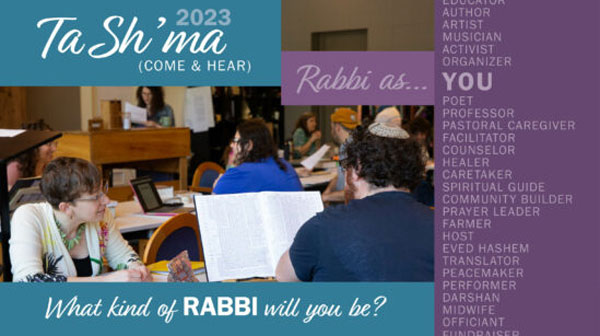
Learn more about Hebrew College’s rabbinical and cantorial programs at Ta Sh’ma (Come & Hear), our November Open Houses (in-person & virtual options).
Previous Post

September 20, 2023
The Gift of Darkness
Next Post
October 2, 2023 Just Me and My Baby
Recent Comments
"Did God call in Genesis chapter 1 also small Aleph?"
""Maybe this is the year to take the Yovel seriously even if we can’t take ..."
Proclaiming Release: Why We Need a ..."
"very nice!"
""
Browse Our Archives
Select a Category Uncategorized
Select a Month April 2026 March 2026 December 2025 November 2025 October 2025 September 2025 August 2025 July 2025 June 2025 May 2025 April 2025 March 2025 February 2025 January 2025 December 2024 November 2024 October 2024 September 2024 August 2024 July 2024 June 2024 May 2024 April 2024 March 2024 February 2024 January 2024 December 2023 November 2023 October 2023 September 2023 August 2023 July 2023 June 2023 May 2023 April 2023 March 2023 February 2023 January 2023 December 2022 November 2022 October 2022 September 2022 August 2022 July 2022 June 2022 May 2022 April 2022 March 2022 February 2022 January 2022 December 2021 November 2021 October 2021 September 2021 August 2021 July 2021 June 2021 May 2021 April 2021 March 2021 February 2021 January 2021 December 2020 November 2020 October 2020 September 2020 August 2020 July 2020 June 2020 May 2020 April 2020 March 2020 February 2020 January 2020 December 2019 November 2019 October 2019 September 2019 August 2019 July 2019 June 2019 May 2019 April 2019 March 2019 February 2019 January 2019 December 2018 November 2018 October 2018 September 2018 August 2018 July 2018 June 2018 May 2018 April 2018 March 2018 February 2018 January 2018 December 2017 November 2017 October 2017 September 2017 August 2017 July 2017 June 2017
Follow Us!
TAKE THE
Religious Wisdom Quiz
What tax collector wrote a Gospel and was called by Jesus?
Select your answer to see how you score.
Barnabas Mark Matthew Luke
Related posts from Seventy Faces of Torah

The Holy Art of World Building

Parashat Tzav: Keeping the Sacred Fire Burning

Color Theory: What Joseph’s Coat Reveals
TRENDING AT PATHEOS Jewish

Building a Little Ark in a Frightening World
This past Shabbat, we read about Noah. I love this story. The...

Yom Kippur : Is There Always Room for...
Making Room for Forgiveness Every year as Yom Kippur approaches, I find...

This Rosh Hashanah: Can I Find New Meaning?
A Sunrise, a New Year, and a Question On our way to...

Killing Amalek: The Torah’s Most Misunderstood Commandment
Few passages of the Torah have provoked more confusion, polemic, and misuse...

I have never trusted a first draft. I don’t mean that...

Back to School, Back to Reality—and a New...
A New School Year Begins… Back to Reality A new school year...
view all Jewish blogs
What Are Your Thoughts?leave a comment
Ad-Free & Subscriber Log-In Subscription Support
- About Us
- 2026 Calendar
- Videos
- Podcasts
- Library of World Religions
- Faith In Media Tracker
- Advertise With Us
- Write for Us
- Privacy Policy
- Terms of Service
- Do Not Sell My Data
- Contact Us
- Radiant Digital
- Manage Newsletter Subscriptions
- Unsubscribe From Notifications
- Sitemap
Copyright 2008-2026, Patheos. All rights reserved.
Subscription Support Ad-Free & Subscriber Log-In
Follow Patheos