
BuddhistCatholicContemplativeEvangelicalGeneral ChristianHinduJewishLatter-day SaintMuslimNew VisionsProgressive Christian
Beliefs
- Buddhist
- Catholic
- Contemplative
- Evangelical
- General Christian
- Hindu
- Jewish
- Latter-day Saint
- More Voices
- Muslim
- New Visions
- Pagan
- Progressive Christian
Topics
- Religion News
- Food and Religion
- Sports and Religion
- Religious Art
- Religious Music and Entertainment
- Religious Events
- History and Religion
- Style and Religion
- Politics and Religion
- Women in Religion
- Recreation Outdoors and Religion
- Business Finance and Religion
- Careers Workplace and Religion
- Education and Religion
- Family Parenting and Religion
- Health Fitness and Religion
- Home and Religion
- Relationships and Religion
- Technology and Religion
- Travel and Religion
Columnists
- Buddhist Columnists
- Business Finance and Religion Columnists
- Careers Workplace and Religion Columnists
- Catholic Columnists
- Contemplative Columnists
- Education and Religion Columnists
- Evangelists Columnists
- Family Parenting and Religion Columnists
- General Christian Columnists
- Health Fitness and Religion Columnists
- Hindu Columnists
- History and Religion Columnists
- Home and Religion Columnists
- Jewish Columnists
- More Voices Columnists
- Latter Day Columnists
- Muslim Columnists
- New Visions Columnists
- Nonreligious Columnists
- Pagan Columnists
- Politics and Religion Columnists
- Progressive Columnists
- Recreation Outdoors and Religion Columnists
- Relationships and Religion Columnists
- Religion News Columnists
- Religious Art Columnists
- Religious Events Columnists
- Religious Music and Entertainment Columnists
- Sports and Religion Columnists
- Style and Religion Columnists
- Technology and Religion Columnists
- Travel and Religion Columnists
- Women in Religion Columnists
Resource Library
- 2026 Calendar
- Library of World Religions
- The 100 Most Holy Places on Earth
- Patheos Answers
- Podcasts
- Videos
- Faith Leaders Database
- Anglican Episcopalian
- Bahai
- Baptist
- Buddhism
- Christianity
- Confucianism
- Eastern Orthodoxy
- Hinduism
- Holiness and Pentecostal
- ISKCON
- Islam
- Judaism
- Lutheran
- Methodist
- The Church of Jesus Christ of Latter-day Saints
- New Age
- Paganism
- Presbytarian and Reformed
- Protestantism
- Religion Behind the Scenes
- Roman Catholic
- Scientology
- Shia Islam
- Sikhism
- Sufism
- Sunni Islam
- Taoism
- Zen
- See all religions
Research Tools
 Ad-Free & Subscriber Log-In Subscription Support
Ad-Free & Subscriber Log-In Subscription Support
Follow Patheos 

- Trending:
- Forgiveness
- |
- Marriage
- |
- Consciousness
- |
- Death Penalty
- |
- Election
- |
- Halloween

- Home
- About Hebrew College
- The Rabbinical School of Hebrew College
- The Book of Psalms
- FREE NEWSLETTER
- Home
- Jewish
- If Only It Were Now
If Only It Were Now
Last updated on: August 29, 2023 at 9:52 am by Hebrew College
If Only It Were Now 2023-08-29T09:52:59-04:00 Hebrew College
Patheos Explore the world's faith through different perspectives on religion and spirituality! Patheos has the views of the prevalent religions and spiritualities of the world.
By Naomi Gurt Lind
Parashat Ki Tavo (Deuteronomy 26:1-29:8)
By the time we chant Parashat Ki Tavo in synagogue this Shabbat—with its ritual enumeration of blessings and curses, and its passage of rebuke so excruciating we traditionally read it in a voice barely above a murmur—my elder son, blessing of my heart, should be safely back at college for another year. As I write this now, he is still in my home for just another few days, already dreaming of rejoining his friends on campus while I ponder adjusting again to saying goodbye to this man-child, this intimate stranger whose very existence remade me.
Walking home from synagogue last Shabbat, we stopped by the library. The day was glorious: sunny and golden in the hold-onto-this way that late summer is sunny and golden. We passed a family with two young children; the elder one was climbing a tree and the younger, a toddler, was exploring smaller plant life nearby. I remarked to my husband, “Those were the days,” as we passed by these two high-intensity, fast-moving scientists exploring the natural world like it would disappear tomorrow. The scientists’ mother overheard me and said, not without exasperation, “Really?” There was a spark of skepticism in her voice, maybe even a flash of anger.
“Yeah. Really.”
It is impossible to convey just how short our children’s childhoods are.
It’s no surprise, then, that the verse that hit me hardest this week in studying Ki Tavo was this one, from the tochecha (rebuke):
בַּבֹּקֶר תֹּאמַר מִי־יִתֵּן עֶרֶב וּבָעֶרֶב תֹּאמַר מִי־יִתֵּן בֹּקֶר מִפַּחַד לְבָבְךָ אֲשֶׁר תִּפְחָד וּמִמַּרְאֵה עֵינֶיךָ אֲשֶׁר תִּרְאֶה׃
In the morning you will say, “If only it were evening…” and in the evening you will say, “If only it were morning…” because of that which your heart fears and that which your eyes see (Deuteronomy 28:67).
Taken as a whole, the tochecha (which is a recapitulation from a similar passage in Parashat Bechukotai) tells us of all that can and will go wrong if we turn away from God, if we do not engage with the mitzvot in a meaningful way and instead lust after false idols. It teaches of misalignment and dysfunction, of heartbreak and calamity, of losing battles and waning health, of crops failing and bread dough drooping, of parents so desperate with hunger that they devour their own children, of madness, of blindness and dismay. The rebuke describes in horrifying terms—the stuff of nightmares—what it is to live a life out of touch with the Divine. And the penultimate line of this agonizing litany is the one I quoted above, about wishing for morning at night and for night in the morning.
Our Torah sees the longing that inheres in our tendency to wish for a different time—the longings that whisper to us:
if only my children were older and less need-intensive;
if only my children were younger and we had more time together;
if only my parents would leave me alone and let me individuate;
if only my parents were here to advise.
These wishes, no matter how much they are steeped in love, are also threaded with pain. They direct us away from the world as it is now and curse us instead with unquenchable desires. If God is the continual unfolding of life (and death and love and hate and growth and decay and…), to wish for things to be different is to turn away from God.
The beginning of the parashah, by contrast, offers a more wholesome picture. In it we see an untarnished idea of what God wants from us as we enter the Holy Land. Namely, upon coming into the land, our first obligation is for service and gratitude. We settle the land and we take the first fruits of its soil and dedicate them to the Holy One. In so doing, we recall our past hardships, reciting a formula that begins, אֲרַמִּי אֹבֵד אָבִי My father was a wandering Aramean.
We gather up our first fruits and our stories and our pain and our gratitude at how far we’ve come,
וְשָׂמַחְתָּ בְכׇל־הַטּוֹב אֲשֶׁר נָתַן־לְךָ יְהֹוָה אֱלֹהֶיךָ וּלְבֵיתֶךָ אַתָּה וְהַלֵּוִי וְהַגֵּר אֲשֶׁר בְּקִרְבֶּךָ
And you, and your households, and the Levites, and the strangers in your midst shall rejoice for all the good which Adonai your God has given you (Deuteronomy 26:11).
And we rejoice, in this very moment. Not because it’s perfect, but because it’s here.
Naomi Gurt Lind (she/her) is a Shanah Dalet student at the Rabbinical School of Hebrew College. These past few months, she served as summer rabbinic intern at Congregation Shirat Hayam in Swampscott and is slated to continue at Shirat Hayam in the fall, as well as at Temple Ahavat Achim in Gloucester and Temple Reyim in Newton. Naomi’s High Holiday pulpit this year is at Oberlin College Hillel. Also a sought-after educator, Naomi has taught several courses through Open Circle Jewish Learning, and at numerous local synagogues and community events. She has been known to move her classroom outdoors and around town, with a much-praised Pop-up Mishnah Study. Check out her upcoming Open Circle Jewish Learning class here. In her spare time, Naomi sings with the Zamir Chorale of Boston and edits the 70 Faces of Torah blog. She enjoys solving crossword puzzles (in pencil!), writing divrei Torah on her blog, Jewish Themes, and playing Bananagrams with her spouse and their two genius children.
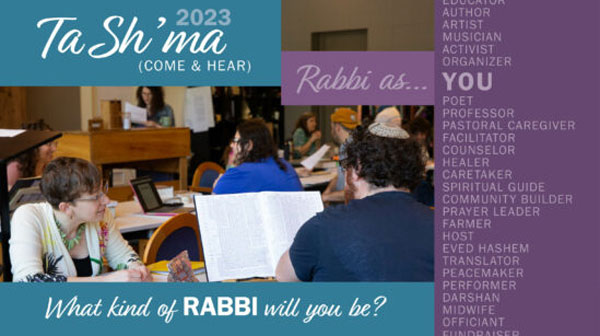
Learn more about Hebrew College’s rabbinical and cantorial programs at Ta Sh’ma (Come & Hear), our November Open Houses (in-person & virtual options).
Previous Post

August 22, 2023
From Enemy Aliens to a Free People
Next Post

September 5, 2023 Choose Life
Recent Comments
"Did God call in Genesis chapter 1 also small Aleph?"
""Maybe this is the year to take the Yovel seriously even if we can’t take ..."
Proclaiming Release: Why We Need a ..."
"very nice!"
""
Browse Our Archives
Select a Category Uncategorized
Select a Month April 2026 March 2026 December 2025 November 2025 October 2025 September 2025 August 2025 July 2025 June 2025 May 2025 April 2025 March 2025 February 2025 January 2025 December 2024 November 2024 October 2024 September 2024 August 2024 July 2024 June 2024 May 2024 April 2024 March 2024 February 2024 January 2024 December 2023 November 2023 October 2023 September 2023 August 2023 July 2023 June 2023 May 2023 April 2023 March 2023 February 2023 January 2023 December 2022 November 2022 October 2022 September 2022 August 2022 July 2022 June 2022 May 2022 April 2022 March 2022 February 2022 January 2022 December 2021 November 2021 October 2021 September 2021 August 2021 July 2021 June 2021 May 2021 April 2021 March 2021 February 2021 January 2021 December 2020 November 2020 October 2020 September 2020 August 2020 July 2020 June 2020 May 2020 April 2020 March 2020 February 2020 January 2020 December 2019 November 2019 October 2019 September 2019 August 2019 July 2019 June 2019 May 2019 April 2019 March 2019 February 2019 January 2019 December 2018 November 2018 October 2018 September 2018 August 2018 July 2018 June 2018 May 2018 April 2018 March 2018 February 2018 January 2018 December 2017 November 2017 October 2017 September 2017 August 2017 July 2017 June 2017
Follow Us!
TAKE THE
Religious Wisdom Quiz
What did Job's wife suggest he do during his suffering?
Select your answer to see how you score.
Flee to Egypt Burn offerings Curse God and die Rebuke his friends
Related posts from Seventy Faces of Torah

The Holy Art of World Building

Parashat Tzav: Keeping the Sacred Fire Burning

Color Theory: What Joseph’s Coat Reveals
TRENDING AT PATHEOS Jewish

Yom Kippur : Is There Always Room for...
Making Room for Forgiveness Every year as Yom Kippur approaches, I find...

This Rosh Hashanah: Can I Find New Meaning?
A Sunrise, a New Year, and a Question On our way to...

Killing Amalek: The Torah’s Most Misunderstood Commandment
Few passages of the Torah have provoked more confusion, polemic, and misuse...

I have never trusted a first draft. I don’t mean that...

Back to School, Back to Reality—and a New...
A New School Year Begins… Back to Reality A new school year...

Out-Crowleying Crowley: The Emptiness of the O9A
O9A Neo-Crowley Racial Cosplay and Edgelord Atrocitism Aleister Crowley did not create...
view all Jewish blogs
What Are Your Thoughts?leave a comment
Ad-Free & Subscriber Log-In Subscription Support
- About Us
- 2026 Calendar
- Videos
- Podcasts
- Library of World Religions
- Faith In Media Tracker
- Advertise With Us
- Write for Us
- Privacy Policy
- Terms of Service
- Do Not Sell My Data
- Contact Us
- Radiant Digital
- Manage Newsletter Subscriptions
- Unsubscribe From Notifications
- Sitemap
Copyright 2008-2026, Patheos. All rights reserved.
Subscription Support Ad-Free & Subscriber Log-In
Follow Patheos