
BuddhistCatholicContemplativeEvangelicalGeneral ChristianHinduJewishLatter-day SaintMuslimNew VisionsProgressive Christian
Beliefs
- Buddhist
- Catholic
- Contemplative
- Evangelical
- General Christian
- Hindu
- Jewish
- Latter-day Saint
- More Voices
- Muslim
- New Visions
- Pagan
- Progressive Christian
Topics
- Religion News
- Food and Religion
- Sports and Religion
- Religious Art
- Religious Music and Entertainment
- Religious Events
- History and Religion
- Style and Religion
- Politics and Religion
- Women in Religion
- Recreation Outdoors and Religion
- Business Finance and Religion
- Careers Workplace and Religion
- Education and Religion
- Family Parenting and Religion
- Health Fitness and Religion
- Home and Religion
- Relationships and Religion
- Technology and Religion
- Travel and Religion
Columnists
- Buddhist Columnists
- Business Finance and Religion Columnists
- Careers Workplace and Religion Columnists
- Catholic Columnists
- Contemplative Columnists
- Education and Religion Columnists
- Evangelists Columnists
- Family Parenting and Religion Columnists
- General Christian Columnists
- Health Fitness and Religion Columnists
- Hindu Columnists
- History and Religion Columnists
- Home and Religion Columnists
- Jewish Columnists
- More Voices Columnists
- Latter Day Columnists
- Muslim Columnists
- New Visions Columnists
- Nonreligious Columnists
- Pagan Columnists
- Politics and Religion Columnists
- Progressive Columnists
- Recreation Outdoors and Religion Columnists
- Relationships and Religion Columnists
- Religion News Columnists
- Religious Art Columnists
- Religious Events Columnists
- Religious Music and Entertainment Columnists
- Sports and Religion Columnists
- Style and Religion Columnists
- Technology and Religion Columnists
- Travel and Religion Columnists
- Women in Religion Columnists
Resource Library
- 2026 Calendar
- Library of World Religions
- The 100 Most Holy Places on Earth
- Patheos Answers
- Podcasts
- Videos
- Faith Leaders Database
- Anglican Episcopalian
- Bahai
- Baptist
- Buddhism
- Christianity
- Confucianism
- Eastern Orthodoxy
- Hinduism
- Holiness and Pentecostal
- ISKCON
- Islam
- Judaism
- Lutheran
- Methodist
- The Church of Jesus Christ of Latter-day Saints
- New Age
- Paganism
- Presbytarian and Reformed
- Protestantism
- Religion Behind the Scenes
- Roman Catholic
- Scientology
- Shia Islam
- Sikhism
- Sufism
- Sunni Islam
- Taoism
- Zen
- See all religions
Research Tools
 Ad-Free & Subscriber Log-In Subscription Support
Follow Patheos 

- Trending:
- Advent
- |
- Forgiveness
- |
- Thanksgiving
- |
- Election
- |
- Seasonal Holidays
- |
- Marriage

- Home
- About Hebrew College
- The Rabbinical School of Hebrew College
- The Book of Psalms
- FREE NEWSLETTER
- Home
- Jewish
- Religious Music and Entertainment
- Van Halen, Brown M&Ms, & Parashat Terumah
Van Halen, Brown M&Ms, & Parashat Terumah
Last updated on: February 27, 2023 at 11:25 am by Hebrew College
Van Halen, Brown M&Ms, & Parashat Terumah 2023-02-27T11:25:18-04:00 Hebrew College
Patheos Explore the world's faith through different perspectives on religion and spirituality! Patheos has the views of the prevalent religions and spiritualities of the world.
Parashat Terumah (Exodus 25:1-27:19)
Have you heard the mashal (parable) about Van Halen and the brown M&M’s?
For those who haven’t:
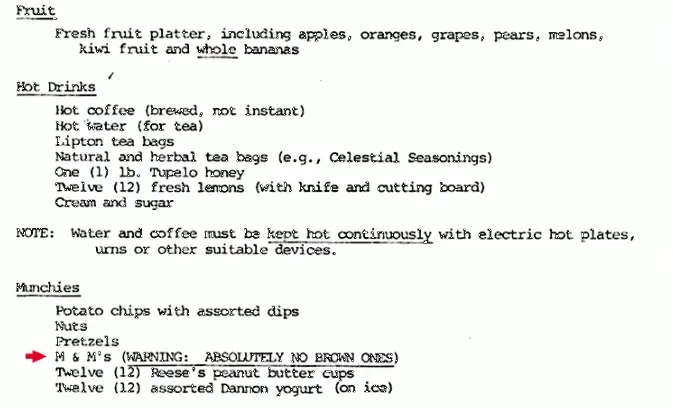
In 1982, Van Halen World Tour included a 53-page typewritten rider to their touring contract. In addition to stipulating that promoters provide the group with “herring in sour cream,” (not the subject of this post, but definitely worth thinking more about), and four cases of “Schlitz Malt Liquor beer (16 ounce cans),” the rider’s “Munchies” section famously included this caveat:
“M&M’s (WARNING: ABSOLUTELY NO BROWN ONES)”

In the rock community, there’s a makhloket (disagreement) about this infamous caveat. Did Van Halen’s prohibition on brown M&Ms represent the entitlement and excess of rock and fame? Or, was it an ingenious and useful litmus, allowing Van Halen to quickly verify whether or not its promoters read and took care to fulfill all of the obligations in its rider (many of which had higher stakes for their performance than the munchies section)?
One could ask similar questions about Parashat Terumah.
In our parashah, more ink is spilled on the construction of the Mishkan (Hashem’s tour bus?) than is spilled on the creation of the entire universe in Bereshit 1. “Exactly as I show you—the pattern of the Tabernacle and the pattern of all its furnishings—so shall you make it. They shall make an ark of acacia wood, two and a half cubits long, a cubit and a half wide, and a cubit and a half high. Overlay it with pure gold—overlay it inside and out—and make upon it a gold molding round about…” (Ex 25 9-11, JPS 2006). The entire parashah continues in this way, with exacting instruction.
What are we to make of the detail with which Hashem instructs Moses and the Israelites to construct the Mishkan?
To be honest, my initial reactions to both of these stories (Van Halen’s M&Ms rider and Hashem’s Mishkan commandments) were fairly dismissive. Sometimes, I experience glut-of-detail as arbitrary or numbing — boring at best, and at worst, a sort of passive weaponization of minutiae for oft-unsavory ends (class maintenance, for example, and all manner of signaling in-group and out-group status).
But I began to soften my position as I took a closer look at the why behind all of Hashem’s detailed architectural requests in Parashat Terumah.
וְעָשׂוּ לִי מִקְדָּשׁ וְשָׁכַנְתִּי בְּתוֹכָם
Have them make for me a sacred place that I may dwell among them (Exodus 25:8).
I softened because, while I can find it difficult to get excited about the particulars of constructing ritual objects (and if I’m being completely honest, ritual observance), the construction of and care for dwelling places—home-making—is a cause I can get behind. I spend inordinate amounts of time arranging and rearranging the plants in my room, my books, where I keep my keys, my phone. I love my bed, its quilt throw and home-sewn pillow cases, the nooks where I keep my art supplies and school supplies. I stock tasty leftovers in the fridge. Paying close attention to these details doesn’t feel boring at all, it feels nourishing.
~
It’s often the case that materialism is cast as an antithesis to spiritual or religious life. But, alongside our parashah, there are many who make the opposite claim.
The architect and author, Christopher Alexander, is one example. Over and over again, Alexander comes to the same central idea—there’s something essential and wonderful about being alive that can be both expressed through and supported by the way we organize and ornament the materials in our lives.
Here’s a passage from his chapter on “The Process of Repair” in The Timeless Way of Building:
When things are first built, the gaps between the parts are often left unwhole.
In the kind of world we have today, almost half the places in a building or a town are places “in between” the places where you are meant to be.
The dark narrow space between two houses, the corner of the kitchen which no one can reach…
And there are more remarkable examples, where spaces are actually intended to be left over.
Think about the streets with cars parked on them, parking lots, long corridors, waiting rooms… All these places are made with the mistaken notion that you are only there in limbo, in between moments of living—as if they were way-stations between the few places where you are actually meant to be alive.
But these gaps must be healed and made as whole as the parts on either side of them…
Slowly, at every level, the arrangement of wholes becomes so dense that there are no gaps between the wholes: every part, and every part between two parts, is whole.
I found this passage to be particularly resonant with our parashah, in which Hashem initiates a massive and elaborate building project specifically at a moment in which the Israelites are bamidbar, are in the wilderness of “between.”
This, then, I think, is the radical commandment of Parashat Terumah: to marshal the materiality of our environment, of our lives—to adorn densely, to care for, to celebrate materiality and through materiality—wherever we are—to make spaces that court the divine, spaces in which Hashem can dwell among us.
Please leave any feedback you’d like to share with the author here.
David Mahfouda (he/him) is a rabbinical student and teaching fellow at Hebrew College, and recent student rabbi at Congregation Or HaTzafon in Fairbanks, Alaska. Prior to attending Hebrew College, David was an artist and curator at the Proteus Gowanus Gallery in Brooklyn, where he co-founded the Fixers Collective—an anarchist repair community that gathered weekly to fix broken things. David was also the cofounder and CEO of Bandwagon, an environmental tech company that organized shared taxi rides from NYC airports. David really loves gathering (people), and practice (all kinds, spiritual, Jewish, athletic, artistic, etc.), and believes that his artistic and technical inclinations stem from deep-rooted Jewish values around interdependence and redemption. In addition to rabbinical school, David loves cooking, hiking, and singing—and he’s excited to be a contributor to 70 Faces of Torah.
Religious Music and Entertainment
Previous Post

February 13, 2023
Moses and Joshua Halfway up the Mountain
Next Post

February 27, 2023 Israel’s Ancient Ouija Board
Recent Comments
"Did God call in Genesis chapter 1 also small Aleph?"
""Maybe this is the year to take the Yovel seriously even if we can’t take ..."
Proclaiming Release: Why We Need a ..."
"very nice!"
""
Browse Our Archives
Select a Category Uncategorized
Select a Month April 2026 March 2026 December 2025 November 2025 October 2025 September 2025 August 2025 July 2025 June 2025 May 2025 April 2025 March 2025 February 2025 January 2025 December 2024 November 2024 October 2024 September 2024 August 2024 July 2024 June 2024 May 2024 April 2024 March 2024 February 2024 January 2024 December 2023 November 2023 October 2023 September 2023 August 2023 July 2023 June 2023 May 2023 April 2023 March 2023 February 2023 January 2023 December 2022 November 2022 October 2022 September 2022 August 2022 July 2022 June 2022 May 2022 April 2022 March 2022 February 2022 January 2022 December 2021 November 2021 October 2021 September 2021 August 2021 July 2021 June 2021 May 2021 April 2021 March 2021 February 2021 January 2021 December 2020 November 2020 October 2020 September 2020 August 2020 July 2020 June 2020 May 2020 April 2020 March 2020 February 2020 January 2020 December 2019 November 2019 October 2019 September 2019 August 2019 July 2019 June 2019 May 2019 April 2019 March 2019 February 2019 January 2019 December 2018 November 2018 October 2018 September 2018 August 2018 July 2018 June 2018 May 2018 April 2018 March 2018 February 2018 January 2018 December 2017 November 2017 October 2017 September 2017 August 2017 July 2017 June 2017
Follow Us!
TAKE THE
Religious Wisdom Quiz
I am an ancestor of King David, born from a foreign widow's faithfulness. Who am I?
Select your answer to see how you score.
Boaz Obed Salmon Jesse
Related posts from Seventy Faces of Torah

The Holy Art of World Building

Parashat Tzav: Keeping the Sacred Fire Burning

Color Theory: What Joseph’s Coat Reveals
TRENDING AT PATHEOS Jewish

Building a Little Ark in a Frightening World
This past Shabbat, we read about Noah. I love this story. The...

Yom Kippur : Is There Always Room for...
Making Room for Forgiveness Every year as Yom Kippur approaches, I find...

This Rosh Hashanah: Can I Find New Meaning?
A Sunrise, a New Year, and a Question On our way to...
Killing Amalek: The Torah’s Most Misunderstood Commandment
Few passages of the Torah have provoked more confusion, polemic, and misuse...

I have never trusted a first draft. I don’t mean that...

Back to School, Back to Reality—and a New...
A New School Year Begins… Back to Reality A new school year...
view all Jewish blogs
What Are Your Thoughts?leave a comment
Ad-Free & Subscriber Log-In Subscription Support
- About Us
- 2026 Calendar
- Videos
- Podcasts
- Library of World Religions
- Faith In Media Tracker
- Advertise With Us
- Write for Us
- Privacy Policy
- Terms of Service
- Do Not Sell My Data
- Contact Us
- Radiant Digital
- Manage Newsletter Subscriptions
- Unsubscribe From Notifications
- Sitemap
Copyright 2008-2026, Patheos, part of the Radiant Digital network of media brands. All rights reserved.
Subscription Support Ad-Free & Subscriber Log-In
Follow Patheos