
BuddhistCatholicContemplativeEvangelicalGeneral ChristianHinduJewishLatter-day SaintMuslimNew VisionsProgressive Christian
Beliefs
- Buddhist
- Catholic
- Contemplative
- Evangelical
- General Christian
- Hindu
- Jewish
- Latter-day Saint
- More Voices
- Muslim
- New Visions
- Pagan
- Progressive Christian
Topics
- Religion News
- Food and Religion
- Sports and Religion
- Religious Art
- Religious Music and Entertainment
- Religious Events
- History and Religion
- Style and Religion
- Politics and Religion
- Women in Religion
- Recreation Outdoors and Religion
- Business Finance and Religion
- Careers Workplace and Religion
- Education and Religion
- Family Parenting and Religion
- Health Fitness and Religion
- Home and Religion
- Relationships and Religion
- Technology and Religion
- Travel and Religion
Columnists
- Buddhist Columnists
- Business Finance and Religion Columnists
- Careers Workplace and Religion Columnists
- Catholic Columnists
- Contemplative Columnists
- Education and Religion Columnists
- Evangelists Columnists
- Family Parenting and Religion Columnists
- General Christian Columnists
- Health Fitness and Religion Columnists
- Hindu Columnists
- History and Religion Columnists
- Home and Religion Columnists
- Jewish Columnists
- More Voices Columnists
- Latter Day Columnists
- Muslim Columnists
- New Visions Columnists
- Nonreligious Columnists
- Pagan Columnists
- Politics and Religion Columnists
- Progressive Columnists
- Recreation Outdoors and Religion Columnists
- Relationships and Religion Columnists
- Religion News Columnists
- Religious Art Columnists
- Religious Events Columnists
- Religious Music and Entertainment Columnists
- Sports and Religion Columnists
- Style and Religion Columnists
- Technology and Religion Columnists
- Travel and Religion Columnists
- Women in Religion Columnists
Resource Library
- 2026 Calendar
- Library of World Religions
- The 100 Most Holy Places on Earth
- Patheos Answers
- Podcasts
- Videos
- Faith Leaders Database
- Anglican Episcopalian
- Bahai
- Baptist
- Buddhism
- Christianity
- Confucianism
- Eastern Orthodoxy
- Hinduism
- Holiness and Pentecostal
- ISKCON
- Islam
- Judaism
- Lutheran
- Methodist
- The Church of Jesus Christ of Latter-day Saints
- New Age
- Paganism
- Presbytarian and Reformed
- Protestantism
- Religion Behind the Scenes
- Roman Catholic
- Scientology
- Shia Islam
- Sikhism
- Sufism
- Sunni Islam
- Taoism
- Zen
- See all religions
Research Tools
 Ad-Free & Subscriber Log-In Subscription Support
Ad-Free & Subscriber Log-In Subscription Support
Follow Patheos 

- Trending:
- Forgiveness
- |
- Marriage
- |
- Consciousness
- |
- Death Penalty
- |
- Election
- |
- Halloween

- Home
- About Hebrew College
- The Rabbinical School of Hebrew College
- The Book of Psalms
- FREE NEWSLETTER
- Home
- Jewish
- Drawing out the Tender Side
Drawing out the Tender Side
Last updated on: November 7, 2022 at 11:05 am by Hebrew College
Drawing out the Tender Side 2022-11-07T11:05:36-04:00 Hebrew College
Patheos Explore the world's faith through different perspectives on religion and spirituality! Patheos has the views of the prevalent religions and spiritualities of the world.
Parashat Vayeira
(Genesis 18:1-22:24)
 Time barrels on as the seasons change and the natural world starts to go underground for winter, at least here in Boston, where I am writing. The moon of Marcheshvan is reaching its fullness, but for many of us, the themes and melodies of the High Holidays are still faintly ringing in our ears. One such echo is the Thirteen Attributes of God: Adonai, Adonai, El rachum v’chanun… (Adonai, Adonai, God of compassion and grace…) The faith that inheres in these words from the book of Exodus (34:6-7) is perhaps undercut by the plaintive quality of the melody we hear chanted in many Ashkenazi synagogues, a melody that, for me, cuts straight to the soul. The plaintiveness, it turns out, is borne out by what happens after the famous part:
לֹא יְנַקֶּה פֹּקֵד עֲוֹן אָבוֹת עַל־בָּנִים וְעַל־בְּנֵי בָנִים עַל־שִׁלֵּשִׁים וְעַל־רִבֵּעִים
Not acquitting, [but rather] visiting the iniquities of the parents onto their children, and their children’s children, to the third and fourth generations.
This rather more troubling image of God has been playing in my mind as I encounter Parashat Vayeira this year. The parashah holds parallel parental iniquities that play out across generations of trauma, made all the more ironic by the verse in which God articulates Abraham’s role as exemplar for generations to come:
כִּי יְדַעְתִּיו לְמַעַן אֲשֶׁר יְצַוֶּה אֶת־בָּנָיו וְאֶת־בֵּיתוֹ אַחֲרָיו וְשָׁמְרוּ דֶּרֶךְ יְהֹוָה לַעֲשׂוֹת צְדָקָה וּמִשְׁפָּט
לְמַעַן הָבִיא יְהֹוָה עַל־אַבְרָהָם אֵת אֲשֶׁר־דִּבֶּר עָלָיו׃
For I have discerned that he [Abraham] will command his children and his household after him, and they will keep to the path of Adonai, to enact righteousness and justice, in order that Adonai may bring to Abraham what has been promised to him (Genesis 18:19).
Just a few chapters ahead, though, Abraham, this seeming paragon of mitzvot, will find himself in an impossible position, commanded to do one of the most abhorrent things a parent can imagine: sacrifice his own child. But hints of parental iniquity begin even before that.
When the three Holy Messengers who come to call on Abraham arrive in Sodom, they are offered protection and a place to stay by Abraham’s nephew Lot. In a nightmarish scene, the visitors are set upon by the townspeople, who are in a frenzy to rape them. Lot begins to act out his own kind of child sacrifice, and he tries to offer his virgin daughters in place of the three strangers. The generous hospitality of Abraham is turned on its head in this disturbing scene, as Lot’s kindly impulses toward the visitors override whatever parental instincts he might have. The daughters are saved only by the Holy Messengers’ brave hands, which pull Lot back inside and bar the door before the unthinkable occurs.
But the trauma reverberates down the generations. The walls of Sodom’s sin close in, and Lot whisks his family away. As the ashes rise from Sodom and Gemorah, Lot’s wife looks back at their lost city and dissolves into salt. Lot and his daughters forge on, eventually taking refuge in a cave where recent horrific events come to a bizarre conclusion. These motherless daughters, fueled by wine and loneliness, devise to become mothers themselves by their fatherless father. The resulting line is two tribes, the Ammonites and the Moabites, peoples who were eternally cursed by God to be enemies of the Israelites (Deuteronomy 23:5).
The Vayeira doomscrolling continues. In chapter 22, God asks the unbearable of Abraham, and he is prepared to deliver. The text rubs it in: “Please take your son, your only one, whom you love, Isaac, and go to the land of Moriah,” (Genesis 22:2) Each phrase turns the screw a bit tighter, heightening the stakes. Of course, Abraham had already rehearsed this travesty when he sent Hagar and Ishmael away. But this, this is heavier still. Uninfluenced by Sarah, this is between Abraham and the God whose covenant he thinks he is upholding. Grimly, Abraham is willing to take on this terrible task. And as Isaac starts to ask questions, Abraham says, essentially, it’s not ours to question.
Let go and let God. Let’s go.
While Isaac is saved in the nick of time when God’s Messenger stays Abraham’s hand, the trauma again reverberates. The family is ruptured: Isaac disappears from the story in a way that suggests he is not present when his mother Sarah dies. His adult identity is a passive one; the thread that held him together seems, understandably, to have broken when his father held the knife over him.
Both these childhood traumas were repaid in successive generations with more trauma, and more after that. Why would our Torah, our book of instruction, take us to such a dark place? The stories of Lot’s daughters and Abraham’s sons are clearly not meant as shining examples, but rather as dire warnings. What might these parables be teaching us? Perhaps that, in the words of the immortal Stephen Sondheim, “Careful the things you say, children will listen. Careful the things you do, children will see, and learn,” (Into the Woods, Act 2). The things we experience as children have a way of staying with us and informing our paths long after we are grown.
The first word, and namesake, of our parashah is “Vayeira,” meaning: “and [God] appeared.” We look into these hard and troubling stories for the teachings they contain, searching them for lessons. Perhaps we can discern there the appearance of the God Who distributes the harsh effects of our sins to generation and generation, but Who also–—remember!—is a God of compassion and grace. With Vayeira’s warnings in mind, against the backdrop of all manner of societal contention and moral muddle, may each one of us mind our words and our deeds. May we draw out the tender side of God, the God of compassion and grace, by taking up our roles, b’tzelem Elohim (in the image of God), as sowers of the compassion and grace we wish to see.
Naomi Gurt Lind is a Shanah Gimel student at the Rabbinical School of Hebrew College, and serves as rabbinic intern with Congregation Shirat Hayam, 2Life Communities, and Congregation Betenu. Naomi also sings with the Zamir Chorale of Boston, teaches online and around town, and edits the 70 Faces of Torah blog. When she has a free moment, she enjoys solving crossword puzzles (in pencil!), writing divrei Torah on her blog, Jewish Themes, and playing Bananagrams with her spouse and their two genius children.
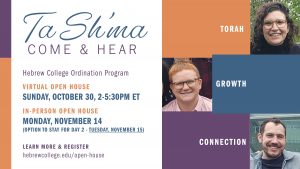 If you or someone you know is considering the rabbinate, please join us or share information about our fall Open House on Nov. 14. Learn more and register here.
Previous Post

October 31, 2022
Journeying with Blessings
Next Post

November 15, 2022 Blessings in Winter
Browse Our Archives
Select a Category Uncategorized
Select a Month April 2026 March 2026 December 2025 November 2025 October 2025 September 2025 August 2025 July 2025 June 2025 May 2025 April 2025 March 2025 February 2025 January 2025 December 2024 November 2024 October 2024 September 2024 August 2024 July 2024 June 2024 May 2024 April 2024 March 2024 February 2024 January 2024 December 2023 November 2023 October 2023 September 2023 August 2023 July 2023 June 2023 May 2023 April 2023 March 2023 February 2023 January 2023 December 2022 November 2022 October 2022 September 2022 August 2022 July 2022 June 2022 May 2022 April 2022 March 2022 February 2022 January 2022 December 2021 November 2021 October 2021 September 2021 August 2021 July 2021 June 2021 May 2021 April 2021 March 2021 February 2021 January 2021 December 2020 November 2020 October 2020 September 2020 August 2020 July 2020 June 2020 May 2020 April 2020 March 2020 February 2020 January 2020 December 2019 November 2019 October 2019 September 2019 August 2019 July 2019 June 2019 May 2019 April 2019 March 2019 February 2019 January 2019 December 2018 November 2018 October 2018 September 2018 August 2018 July 2018 June 2018 May 2018 April 2018 March 2018 February 2018 January 2018 December 2017 November 2017 October 2017 September 2017 August 2017 July 2017 June 2017
Follow Us!
TAKE THE
Religious Wisdom Quiz
"Thou shalt not..."
Select your answer to see how you score.
Give into the Vainness of Men Have Pride Covet Fight
Related posts from Seventy Faces of Torah

The Holy Art of World Building

Parashat Tzav: Keeping the Sacred Fire Burning

Color Theory: What Joseph’s Coat Reveals
TRENDING AT PATHEOS Jewish

Yom Kippur : Is There Always Room for...
Making Room for Forgiveness Every year as Yom Kippur approaches, I find...

This Rosh Hashanah: Can I Find New Meaning?
A Sunrise, a New Year, and a Question On our way to...

Killing Amalek: The Torah’s Most Misunderstood Commandment
Few passages of the Torah have provoked more confusion, polemic, and misuse...

I have never trusted a first draft. I don’t mean that...

Back to School, Back to Reality—and a New...
A New School Year Begins… Back to Reality A new school year...

Out-Crowleying Crowley: The Emptiness of the O9A
O9A Neo-Crowley Racial Cosplay and Edgelord Atrocitism Aleister Crowley did not create...
view all Jewish blogs
Ad-Free & Subscriber Log-In Subscription Support
- About Us
- 2026 Calendar
- Videos
- Podcasts
- Library of World Religions
- Faith In Media Tracker
- Advertise With Us
- Write for Us
- Privacy Policy
- Terms of Service
- Do Not Sell My Data
- Contact Us
- Radiant Digital
- Manage Newsletter Subscriptions
- Unsubscribe From Notifications
- Sitemap
Copyright 2008-2026, Patheos. All rights reserved.
Subscription Support Ad-Free & Subscriber Log-In
Follow Patheos