
BuddhistCatholicContemplativeEvangelicalGeneral ChristianHinduJewishLatter-day SaintMuslimNew VisionsProgressive Christian
Beliefs
- Buddhist
- Catholic
- Contemplative
- Evangelical
- General Christian
- Hindu
- Jewish
- Latter-day Saint
- More Voices
- Muslim
- New Visions
- Pagan
- Progressive Christian
Topics
- Religion News
- Food and Religion
- Sports and Religion
- Religious Art
- Religious Music and Entertainment
- Religious Events
- History and Religion
- Style and Religion
- Politics and Religion
- Women in Religion
- Recreation Outdoors and Religion
- Business Finance and Religion
- Careers Workplace and Religion
- Education and Religion
- Family Parenting and Religion
- Health Fitness and Religion
- Home and Religion
- Relationships and Religion
- Technology and Religion
- Travel and Religion
Columnists
- Buddhist Columnists
- Business Finance and Religion Columnists
- Careers Workplace and Religion Columnists
- Catholic Columnists
- Contemplative Columnists
- Education and Religion Columnists
- Evangelists Columnists
- Family Parenting and Religion Columnists
- General Christian Columnists
- Health Fitness and Religion Columnists
- Hindu Columnists
- History and Religion Columnists
- Home and Religion Columnists
- Jewish Columnists
- More Voices Columnists
- Latter Day Columnists
- Muslim Columnists
- New Visions Columnists
- Nonreligious Columnists
- Pagan Columnists
- Politics and Religion Columnists
- Progressive Columnists
- Recreation Outdoors and Religion Columnists
- Relationships and Religion Columnists
- Religion News Columnists
- Religious Art Columnists
- Religious Events Columnists
- Religious Music and Entertainment Columnists
- Sports and Religion Columnists
- Style and Religion Columnists
- Technology and Religion Columnists
- Travel and Religion Columnists
- Women in Religion Columnists
Resource Library
- 2026 Calendar
- Library of World Religions
- The 100 Most Holy Places on Earth
- Patheos Answers
- Podcasts
- Videos
- Faith Leaders Database
- Anglican Episcopalian
- Bahai
- Baptist
- Buddhism
- Christianity
- Confucianism
- Eastern Orthodoxy
- Hinduism
- Holiness and Pentecostal
- ISKCON
- Islam
- Judaism
- Lutheran
- Methodist
- The Church of Jesus Christ of Latter-day Saints
- New Age
- Paganism
- Presbytarian and Reformed
- Protestantism
- Religion Behind the Scenes
- Roman Catholic
- Scientology
- Shia Islam
- Sikhism
- Sufism
- Sunni Islam
- Taoism
- Zen
- See all religions
Research Tools
 Ad-Free & Subscriber Log-In Subscription Support
Ad-Free & Subscriber Log-In Subscription Support
Follow Patheos 

- Trending:
- Forgiveness
- |
- Marriage
- |
- Consciousness
- |
- Death Penalty
- |
- Election
- |
- Halloween

- Home
- About Hebrew College
- The Rabbinical School of Hebrew College
- The Book of Psalms
- FREE NEWSLETTER
- Home
- Jewish
- Relationships and Religion
- Listening to Trees
Listening to Trees
Last updated on: September 1, 2022 at 1:06 pm by Hebrew College
Listening to Trees 2022-09-01T13:06:22-04:00 Hebrew College
Patheos Explore the world's faith through different perspectives on religion and spirituality! Patheos has the views of the prevalent religions and spiritualities of the world.
 Parashat Shoftim (Deuteronomy 16:18-21:9)
By Emmanuel Cantor
This past summer I made my way through The Overstory, a sweeping work of fiction by Richard Powers. A Pulitzer Prize winner in 2019, the novel weaves together nine stories of Americans fighting the deforestation of the California redwoods. One of them, the plant ecologist Dr. Patricia Westerford, writes the following in her book on the power of trees:
“Trees know when we’re close by. The chemistry of their roots and the perfumes their leaves pump out change when we’re near… When you feel good after a walk in the woods, it may be that certain species are bribing you. So many wonder drugs have come from trees, and we haven’t yet scratched the surface of the offerings. Trees have long been trying to reach us. But they speak on frequencies too low for people to hear.”
What might the trees be trying to tell us? An oft-quoted verse from Parashat Shoftim about trees, humans, and the laws of war invites us to consider our relationship to trees and what we can learn from them. As Moses prepares the Israelites to enter the promised land, he instructs:
כִּי תָצוּר אֶל עִיר יָמִים רַבִּים לְהִלָּחֵם עָלֶיהָ לְתָפְשָׂהּ לֹא תַשְׁחִית אֶת עֵצָהּ לִנְדֹּחַ עָלָיו גַּרְזֶן כִּי מִמֶּנּוּ תֹאכֵל וְאֹתוֹ לֹא תִכְרֹת כִּי הָאָדָם עֵץ הַשָּׂדֶה לָבֹא מִפָּנֶיךָ בַּמָּצוֹר
When in your war against a city you have to besiege it a long time in order to capture it, you must not destroy its trees, wielding the ax against them. You may eat of them, but you must not cut them down. Are trees of the field human to withdraw before you into the besieged city? (Deuteronomy 20:19, NJPS)
Classical Rabbinic commentators are divided over how to understand the verse’s final phrase. Rashi, the 11th century commentator, reads the bolded line as a rhetorical question, reflected in the translation above. For Rashi, the relationship between humans and trees is premised on difference. Humans can flee danger, but trees cannot, and therefore must be protected.
In contrast, Ibn Ezra, in the 12th century, places humans and trees on a continuum. Humans are inextricably bound up with trees, insofar as:
“.כי חיי בן אדם הוא עץ השדה”
Human life is trees, writes Ibn Ezra, meaning we cannot live without them.
In today’s climate crisis, Rashi and Ibn Ezra seem like two sides of the same coin. Our rapidly vanishing forests are often described as the “earth’s lungs.” Trees absorb carbon and emit oxygen—the very opposite of human breath, in line with Rashi’s emphasis on difference. But it is on this very difference that our survival as a species depends, just as Ibn Ezra stresses.
Shoftim may still leave environmentalists wanting. The portion’s following verse, Deuteronomy 20:20, clarifies that the tree-chopping ban refers only to fruit trees. This addendum prompts several traditional commentators to read the prohibition as largely a matter of tactical prudence. With a shift from plant conservation to fruit rations for a besieging army, Shoftim’s ecological bent is eclipsed by its military context. And yet the curious link between humans and trees invites the question inspired by Dr. Westerford. What might the trees be trying to tell us?
Spiritual traditions across the globe have long practiced listening to and learning from nature and trees specifically. The application of these practices has been described as “biomimicry,” which writer and activist adrienne maree brown* defines as the “imitation of the models, systems, and elements of nature for the purpose of solving complex human problems.” In brown’s 2017 book Emergent Strategy, she offers an example of biomimicry by charting how humans can learn interdependence from one “tree of the field,” the oak.
“Oak trees don’t set an intention to listen to each other better, or agree to hold tight to each other when the next storm comes. Under the earth, always, they reach for each other, they grow such that their roots are intertwined and create a system of strength that is as resilient on a sunny day as it is a hurricane.
Biomimicry can be found in rabbinic sources as well. One example appears in Babylonian Talmud Taanit 20b, where Rabbi Elazar teaches that a person should be soft like a reed and not stiff like a cedar. This is why, Rabbi Elazar explains, we use reed quills to write our Torah scrolls, tefillin, and mezuzot. The reed imbues these sacred objects with gentle flexibility.
One could read Rabbi Elazar’s statement as merely a natural simile, or a retroactive explanation of scribal practices. I prefer to imagine a different scene. Perhaps, one day, Rabbi Elazar left the study house in a huff, frustrated by his Rabbinic colleagues’ stubbornness and cedar-like rigidity. While taking a walk to cool his nerves, he passed a bushel of reeds. Bending in the direction of changing winds, the reeds remained rooted in the earth. “What can we learn from these trees of the field?” Rabbi Elazar asked himself. He then rushed back to the study house with an answer, which was recorded for generations to come.
As a whole, Shoftim outlines a wide range of practices concerning how humans ought to relate to one another. Commandments are given to establish a judicial system, limit a king’s power, weed out false prophets, and account for the tragedy of an unclaimed corpse. Yet Deuteronomy 20:19’s link between humans and trees urges us to not see the natural world as merely the backdrop for these social systems. For as Dr. Patricia Westerford teaches in a final, climatic scene, “trees stand at the heart of ecology, and they must come to stand at the heart of human politics.”
* adrienne maree brown styles her name in lowercase. She writes that “i like to self determine what i capitalize ? and lowercase letters are generally more aesthetically pleasing to me.”
Emmanuel Cantor is a fourth-year rabbinical student at Hebrew College. As a student rabbi he has served a number of Jewish communities, most recently Congregation Dorshei Tzedek and the Slifka Center for Jewish life at Yale. Before rabbinical school, Emmanuel worked as a community organizer for Jews United for Justice and lived in an Avodah Bayit. He earned his BA at Yale, where he majored in Women’s, Gender, and Sexuality Studies, and is an alum of Yeshivat Maale Gilboa in northern Israel.
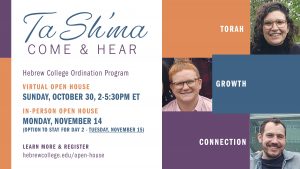 Ever considered the rabbinate? Join us for our fall Open House. Learn more and register here.
Relationships and Religion
Education and Religion
Previous Post

August 23, 2022
Looking for God, Eyes Wide Open
Next Post

September 6, 2022 The Mitzvah of Forgetting
Browse Our Archives
Select a Category Uncategorized
Select a Month April 2026 March 2026 December 2025 November 2025 October 2025 September 2025 August 2025 July 2025 June 2025 May 2025 April 2025 March 2025 February 2025 January 2025 December 2024 November 2024 October 2024 September 2024 August 2024 July 2024 June 2024 May 2024 April 2024 March 2024 February 2024 January 2024 December 2023 November 2023 October 2023 September 2023 August 2023 July 2023 June 2023 May 2023 April 2023 March 2023 February 2023 January 2023 December 2022 November 2022 October 2022 September 2022 August 2022 July 2022 June 2022 May 2022 April 2022 March 2022 February 2022 January 2022 December 2021 November 2021 October 2021 September 2021 August 2021 July 2021 June 2021 May 2021 April 2021 March 2021 February 2021 January 2021 December 2020 November 2020 October 2020 September 2020 August 2020 July 2020 June 2020 May 2020 April 2020 March 2020 February 2020 January 2020 December 2019 November 2019 October 2019 September 2019 August 2019 July 2019 June 2019 May 2019 April 2019 March 2019 February 2019 January 2019 December 2018 November 2018 October 2018 September 2018 August 2018 July 2018 June 2018 May 2018 April 2018 March 2018 February 2018 January 2018 December 2017 November 2017 October 2017 September 2017 August 2017 July 2017 June 2017
Follow Us!
TAKE THE
Religious Wisdom Quiz
What did God make on the fourth day of creation?
Select your answer to see how you score.
Man Plants Fish and birds Sun, moon, and stars
Related posts from Seventy Faces of Torah

The Holy Art of World Building

Parashat Tzav: Keeping the Sacred Fire Burning

Color Theory: What Joseph’s Coat Reveals
TRENDING AT PATHEOS Jewish

Yom Kippur : Is There Always Room for...
Making Room for Forgiveness Every year as Yom Kippur approaches, I find...

This Rosh Hashanah: Can I Find New Meaning?
A Sunrise, a New Year, and a Question On our way to...

Killing Amalek: The Torah’s Most Misunderstood Commandment
Few passages of the Torah have provoked more confusion, polemic, and misuse...

I have never trusted a first draft. I don’t mean that...

Back to School, Back to Reality—and a New...
A New School Year Begins… Back to Reality A new school year...

Out-Crowleying Crowley: The Emptiness of the O9A
O9A Neo-Crowley Racial Cosplay and Edgelord Atrocitism Aleister Crowley did not create...
view all Jewish blogs
Ad-Free & Subscriber Log-In Subscription Support
- About Us
- 2026 Calendar
- Videos
- Podcasts
- Library of World Religions
- Faith In Media Tracker
- Advertise With Us
- Write for Us
- Privacy Policy
- Terms of Service
- Do Not Sell My Data
- Contact Us
- Radiant Digital
- Manage Newsletter Subscriptions
- Unsubscribe From Notifications
- Sitemap
Copyright 2008-2026, Patheos. All rights reserved.
Subscription Support Ad-Free & Subscriber Log-In
Follow Patheos