
BuddhistCatholicContemplativeEvangelicalGeneral ChristianHinduJewishLatter-day SaintMuslimNew VisionsProgressive Christian
Beliefs
- Buddhist
- Catholic
- Contemplative
- Evangelical
- General Christian
- Hindu
- Jewish
- Latter-day Saint
- More Voices
- Muslim
- New Visions
- Pagan
- Progressive Christian
Topics
- Religion News
- Food and Religion
- Sports and Religion
- Religious Art
- Religious Music and Entertainment
- Religious Events
- History and Religion
- Style and Religion
- Politics and Religion
- Women in Religion
- Recreation Outdoors and Religion
- Business Finance and Religion
- Careers Workplace and Religion
- Education and Religion
- Family Parenting and Religion
- Health Fitness and Religion
- Home and Religion
- Relationships and Religion
- Technology and Religion
- Travel and Religion
Columnists
- Buddhist Columnists
- Business Finance and Religion Columnists
- Careers Workplace and Religion Columnists
- Catholic Columnists
- Contemplative Columnists
- Education and Religion Columnists
- Evangelists Columnists
- Family Parenting and Religion Columnists
- General Christian Columnists
- Health Fitness and Religion Columnists
- Hindu Columnists
- History and Religion Columnists
- Home and Religion Columnists
- Jewish Columnists
- More Voices Columnists
- Latter Day Columnists
- Muslim Columnists
- New Visions Columnists
- Nonreligious Columnists
- Pagan Columnists
- Politics and Religion Columnists
- Progressive Columnists
- Recreation Outdoors and Religion Columnists
- Relationships and Religion Columnists
- Religion News Columnists
- Religious Art Columnists
- Religious Events Columnists
- Religious Music and Entertainment Columnists
- Sports and Religion Columnists
- Style and Religion Columnists
- Technology and Religion Columnists
- Travel and Religion Columnists
- Women in Religion Columnists
Resource Library
- 2026 Calendar
- Library of World Religions
- The 100 Most Holy Places on Earth
- Patheos Answers
- Podcasts
- Videos
- Faith Leaders Database
- Anglican Episcopalian
- Bahai
- Baptist
- Buddhism
- Christianity
- Confucianism
- Eastern Orthodoxy
- Hinduism
- Holiness and Pentecostal
- ISKCON
- Islam
- Judaism
- Lutheran
- Methodist
- The Church of Jesus Christ of Latter-day Saints
- New Age
- Paganism
- Presbytarian and Reformed
- Protestantism
- Religion Behind the Scenes
- Roman Catholic
- Scientology
- Shia Islam
- Sikhism
- Sufism
- Sunni Islam
- Taoism
- Zen
- See all religions
Research Tools
 Ad-Free & Subscriber Log-In Subscription Support
Ad-Free & Subscriber Log-In Subscription Support
Follow Patheos 

- Trending:
- Forgiveness
- |
- Marriage
- |
- Consciousness
- |
- Death Penalty
- |
- Election
- |
- Halloween

- Home
- About Hebrew College
- The Rabbinical School of Hebrew College
- The Book of Psalms
- FREE NEWSLETTER
- Home
- Jewish
- The Blossoming Almond Staff of Aaron
The Blossoming Almond Staff of Aaron
Last updated on: June 28, 2022 at 2:11 pm by Hebrew College
The Blossoming Almond Staff of Aaron 2022-06-28T14:11:12-04:00 Hebrew College
Patheos Explore the world's faith through different perspectives on religion and spirituality! Patheos has the views of the prevalent religions and spiritualities of the world.
by Rav Dr. Rachel Adelman
Parashat Korach (Numbers 16:1 – 18:32)
Inspired by Rabbi Giulia Fleishman’s `22 teaching, BeMidbar Spring of ‘20.
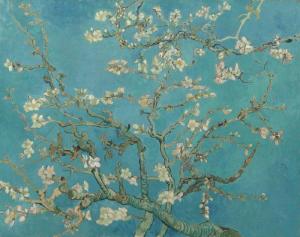
Almond Blossom, Vincent Van Gogh, 1890
For Van Gogh, white almond blossom branches set against the blue sky were a favorite subject of painting. In 1890, he made a gift of the famous “Almond Blossom” painting (above) to his brother Theo and his sister-in-law, Jo, who had just had a baby son. They named their son after their brother, Vincent, who later that year took his own life. The artist’s nephew, Vincent Willem, then went on to found the Van Gogh Museum in Amsterdam. Hope and despair, life and death cling to the same branch.
What grants hope in the wake of calamity? This week’s Torah reading, Parashat Korach (Numbers 16:1-18:32), is rife with rebellion and divine death decrees: the 250 chieftains, wielding their firepans, are burnt alive (16:35); Korach, Dathan and Abiram, along with their followers, are swallowed by the mouth of the earth (16:32-33); 14,700 Israelites are swept away in a plague ostensibly because they blame Moses and Aaron for bringing all this death upon the people (17:6). All this death, indeed! That whole generation would walk, over the course of the next forty years, through the Valley of Death, subject to God’s judgment. They were destined to die for their faithlessness in heeding the spies’ report (14:32-34). According to one ghoulish image, every year on Tisha b’Av (1), Moses sent out a crier, telling them to dig themselves bed-tombs at night; most would rise in the morning, though every year 15,000 went missing, swallowed by unmarked graves in the desert sand. On the last Tisha b’Av of the fortieth year, all the survivors arose alive, brushing off the sand, blinking in the bright morning light (Lamentations Rabbah Petichta 33, author’s paraphrase).
As a reprieve to this morbid narrative, we are given an image of Aaron’s blossoming staff. It appears in the context of a dispute about the legitimacy of the divinely chosen leadership. The chieftain of each tribe was ordered to contribute a staff, inscribed with his name, along with the staff of Levi, inscribed with Aaron’s name, and the twelve staffs were placed before the Ark in the Tent of Meeting. God tells Moses: “The staff of the man whom I (God) have chosen shall sprout, and I will allay from Myself (va-hashikoti me-‘alai) the grumblings of the Israelites that they grumble about you (‘aleikhem, pl. Moses and Aaron)” (Numbers 17:20, author’s translation). They did so; the next day, when Moses entered the Tent, “there the staff of Aaron of the house of Levi had sprouted: it had brought forth sprouts, produced blossoms, and borne almonds” (v. 23). What message does this remarkable blossoming staff convey? And to whom is the message directed?
According to the biblical botanist, Noga Hareuveni, the almond is one of the first fruit trees to blossom in spring in the Land of Israel. It rapidly buds leaves, develops new branches, and forms its sustaining fruit—all before the flower’s calyx drops off. That is, the fruit and outermost petals of the blossom cling to the tree at once; the fading sepals and bitter nut, process and product, hang out together simultaneously. Its Hebrew name, shaqed, means “the early waker,” and it signifies God’s watchfulness and vigilant response (Jeremiah 1:11-12). Is Aaron’s almond blossom staff then a symbol of God’s scrutiny and quick judgment—a warning to the Israelites—or is it a sign of hope, of life in the death-wracked camp?
God orders Aaron’s staff to be placed before the Pact “as a memorial (le-mishmeret), as a sign to rebels, so that their grumblings against Me may cease lest they die” (Num. 17:25). Yet, as soon as it is placed in the Ark, in the Holy of Holies, along with the jar of Manna (Exodus 16:32-34), and the shards of the first and second sets of Tablets of the Law (T. Sota 13:1, b. Horayot 12a), it becomes inaccessible to the people! Once Solomon placed the Ark in precincts of the First Temple, it was presumably never taken out again (1 Kgs 8:1–11; cf. 2 Chr 5:2–14). Perhaps the memorial, mishmeret, is meant rather for God and posterity. God avowed in setting up the test: “I will allay, or cause to abate (va-hashikoti, root sh.k.k.) from Myself the grumblings of Israel” (Num. 17:20), just as the waters of the Flood abated from the face of the earth (va-yashoku, Genesis 8:1) and the anger of the Persian King Ahasuerus was allayed (ka-shokh, Esther 2:1, and shakhakhah, 7:10). Perhaps the flowering staff reminds God to burst out—not in fury but in blossom, and then to hold tenaciously to the process of the people’s growth, like the calyx of the blossom holds the hard, bitter nut of the almond in the spring.
In her book Orwell’s Roses, Rebecca Solnit recounts how, in the spring of 1936, Orwell planted roses in the yard of his house in Wallington, England. Though he left to fight in the Spanish civil war, he returned six years later to find that “the little white rose, no bigger than a boy’s catapult when I put it in, had grown into a huge vigorous bush, while the blossom of the pink rose was tumbling over the fence.” The author of the dystopian 1984, and of numerous articles critical of fascist regimes and rapacious capitalism, lived with a deep abiding love for roses and trees, for growing things. In placing a seedling in the ground, Orwell expressed a commitment to hope, alongside his vigilance to see the cause of suffering in the world around him.
According to legend, the staff of Aaron was created at twilight on the Sixth Day of Creation (M. Avot 5:6, b. Pesachim 54a); it will be the very staff that the Messiah wields upon entering Jerusalem in the End Days (BeMidbar Rabbah 18:20). The staff thus represents continuity, a kind of time capsule, like the rings of the great Sequoia trees in California. Solnit offers us an idea-word for this:
There’s an Etruscan word, saeculum, that describes the span of time lived by the oldest person present, sometimes calculated to be about a hundred years. In a looser sense, the word means the expanse of time during which something is in living memory….To us, trees seemed to offer another kind of saeculum, a longer time scale and deeper continuity, giving shelter from our ephemerality the way that a tree might offer literal shelter under its boughs.
Aaron’s staff in the Ark, as it traveled with the people through the desert sojourn, served as a kind of saeculum. The never-dying blossom offered hope, even if only in the imagination as it was sequestered, unseen, in the Holy of Holies. There would be generations to follow, to carry that Ark into the Temple precincts and plant trees in the Land of Israel, reap their fruit and paint their blossoms.
(1) The great day of calamity for the Jewish people, associated with the Destruction of the First and Second Temple, ‘inaugurated’ first by the people weeping in response to the Spies’ report (Num. 16:1, b. Taanit 29a).
Rav Rachel Adelman (PhD, the Hebrew University of Jerusalem) is Associate Professor of Hebrew Bible at Hebrew College, where she recently earned rabbinic ordination (2021). She is the author of several academic and popular articles in Jewish studies, as well as two books: The Return of the Repressed: Pirqe de-Rabbi Eliezer and the Pseudepigrapha (Brill, 2009) and The Female Ruse: Women’s Deception and Divine Sanction in the Hebrew Bible (Sheffield Press, 2015). She is currently working on a new monograph: Daughters in Danger, from the Hebrew Bible to Modern Midrash. When not writing books, papers, or divrei Torah, it is poetry that flows from her pen.
Previous Post

June 22, 2022
A Biblical Body Image Problem
Next Post

July 5, 2022 Keeping Safe and Letting Go
Browse Our Archives
Select a Category Uncategorized
Select a Month April 2026 March 2026 December 2025 November 2025 October 2025 September 2025 August 2025 July 2025 June 2025 May 2025 April 2025 March 2025 February 2025 January 2025 December 2024 November 2024 October 2024 September 2024 August 2024 July 2024 June 2024 May 2024 April 2024 March 2024 February 2024 January 2024 December 2023 November 2023 October 2023 September 2023 August 2023 July 2023 June 2023 May 2023 April 2023 March 2023 February 2023 January 2023 December 2022 November 2022 October 2022 September 2022 August 2022 July 2022 June 2022 May 2022 April 2022 March 2022 February 2022 January 2022 December 2021 November 2021 October 2021 September 2021 August 2021 July 2021 June 2021 May 2021 April 2021 March 2021 February 2021 January 2021 December 2020 November 2020 October 2020 September 2020 August 2020 July 2020 June 2020 May 2020 April 2020 March 2020 February 2020 January 2020 December 2019 November 2019 October 2019 September 2019 August 2019 July 2019 June 2019 May 2019 April 2019 March 2019 February 2019 January 2019 December 2018 November 2018 October 2018 September 2018 August 2018 July 2018 June 2018 May 2018 April 2018 March 2018 February 2018 January 2018 December 2017 November 2017 October 2017 September 2017 August 2017 July 2017 June 2017
Follow Us!
TAKE THE
Religious Wisdom Quiz
How many people were added to the church on the day of Pentecost?
Select your answer to see how you score.
About 10,000 About 3,000 About 5,000 About 1,000
Related posts from Seventy Faces of Torah

The Holy Art of World Building

Parashat Tzav: Keeping the Sacred Fire Burning

Color Theory: What Joseph’s Coat Reveals
TRENDING AT PATHEOS Jewish

Building a Little Ark in a Frightening World
This past Shabbat, we read about Noah. I love this story. The...

Yom Kippur : Is There Always Room for...
Making Room for Forgiveness Every year as Yom Kippur approaches, I find...

This Rosh Hashanah: Can I Find New Meaning?
A Sunrise, a New Year, and a Question On our way to...

Killing Amalek: The Torah’s Most Misunderstood Commandment
Few passages of the Torah have provoked more confusion, polemic, and misuse...

I have never trusted a first draft. I don’t mean that...

Back to School, Back to Reality—and a New...
A New School Year Begins… Back to Reality A new school year...
view all Jewish blogs
Ad-Free & Subscriber Log-In Subscription Support
- About Us
- 2026 Calendar
- Videos
- Podcasts
- Library of World Religions
- Faith In Media Tracker
- Advertise With Us
- Write for Us
- Privacy Policy
- Terms of Service
- Do Not Sell My Data
- Contact Us
- Radiant Digital
- Manage Newsletter Subscriptions
- Unsubscribe From Notifications
- Sitemap
Copyright 2008-2026, Patheos. All rights reserved.
Subscription Support Ad-Free & Subscriber Log-In
Follow Patheos