
BuddhistCatholicContemplativeEvangelicalGeneral ChristianHinduJewishLatter-day SaintMuslimNew VisionsProgressive Christian
Beliefs
- Buddhist
- Catholic
- Contemplative
- Evangelical
- General Christian
- Hindu
- Jewish
- Latter-day Saint
- More Voices
- Muslim
- New Visions
- Pagan
- Progressive Christian
Topics
- Religion News
- Food and Religion
- Sports and Religion
- Religious Art
- Religious Music and Entertainment
- Religious Events
- History and Religion
- Style and Religion
- Politics and Religion
- Women in Religion
- Recreation Outdoors and Religion
- Business Finance and Religion
- Careers Workplace and Religion
- Education and Religion
- Family Parenting and Religion
- Health Fitness and Religion
- Home and Religion
- Relationships and Religion
- Technology and Religion
- Travel and Religion
Columnists
- Buddhist Columnists
- Business Finance and Religion Columnists
- Careers Workplace and Religion Columnists
- Catholic Columnists
- Contemplative Columnists
- Education and Religion Columnists
- Evangelists Columnists
- Family Parenting and Religion Columnists
- General Christian Columnists
- Health Fitness and Religion Columnists
- Hindu Columnists
- History and Religion Columnists
- Home and Religion Columnists
- Jewish Columnists
- More Voices Columnists
- Latter Day Columnists
- Muslim Columnists
- New Visions Columnists
- Nonreligious Columnists
- Pagan Columnists
- Politics and Religion Columnists
- Progressive Columnists
- Recreation Outdoors and Religion Columnists
- Relationships and Religion Columnists
- Religion News Columnists
- Religious Art Columnists
- Religious Events Columnists
- Religious Music and Entertainment Columnists
- Sports and Religion Columnists
- Style and Religion Columnists
- Technology and Religion Columnists
- Travel and Religion Columnists
- Women in Religion Columnists
Resource Library
- 2026 Calendar
- Library of World Religions
- The 100 Most Holy Places on Earth
- Patheos Answers
- Podcasts
- Videos
- Faith Leaders Database
- Anglican Episcopalian
- Bahai
- Baptist
- Buddhism
- Christianity
- Confucianism
- Eastern Orthodoxy
- Hinduism
- Holiness and Pentecostal
- ISKCON
- Islam
- Judaism
- Lutheran
- Methodist
- The Church of Jesus Christ of Latter-day Saints
- New Age
- Paganism
- Presbytarian and Reformed
- Protestantism
- Religion Behind the Scenes
- Roman Catholic
- Scientology
- Shia Islam
- Sikhism
- Sufism
- Sunni Islam
- Taoism
- Zen
- See all religions
Research Tools
 Ad-Free & Subscriber Log-In Subscription Support
Ad-Free & Subscriber Log-In Subscription Support
Follow Patheos 

- Trending:
- Forgiveness
- |
- Marriage
- |
- Consciousness
- |
- Death Penalty
- |
- Election
- |
- Halloween

- Home
- About Hebrew College
- The Rabbinical School of Hebrew College
- The Book of Psalms
- FREE NEWSLETTER
- Home
- Jewish
- A Biblical Body Image Problem
A Biblical Body Image Problem
Last updated on: June 28, 2022 at 1:13 pm by Hebrew College
A Biblical Body Image Problem 2022-06-28T13:13:23-04:00 Hebrew College
Patheos Explore the world's faith through different perspectives on religion and spirituality! Patheos has the views of the prevalent religions and spiritualities of the world.
By Minna Bromberg, PhD, RAB `10
Parashat Shelach Lecha (Numbers 13:1 – 15:41)
So close! In this week’s Torah portion (Shelach Lecha), the people are so close to entering the Land of Canaan. Freed from slavery, recipients of the Ten Commandments and of literal manna from heaven, they seem like a people on a roll. Sure, they’ve also built a Golden Calf and had some other rough patches along the way, but now they are right there, ready “to case the Promised Land” (as our teacher Bruce Springsteen phrases it). At God’s command, Moses sends twelve spies to do just that and instructs them to report back on what the land and its inhabitants are like.
The scouts leave the Wilderness of Paran and go into the Land of Canaan, passing through the Negev and visiting Hebron. At Wadi Eshkol they harvest a large (very large) cluster of grapes, plus some pomegranates and figs, and show these to Moses and the people, when they return from their 40-day reconnaissance mission. They report that it is indeed a land flowing with milk and honey but… and here’s where things go wrong. Ten of the twelve spies are very afraid of the strength of both the land’s current inhabitants and their cities. Caleb tries to calm things down and tells the people that they should definitely continue with the plan of entering the Promised Land, assuring them that whatever the challenge, “we are well able to overcome it” (Numbers 13:30).
But the ten fearful spies continue spreading their fear throughout the people, becoming fixated on the enormous size of the folks who live in Canaan, and even spreading defamatory reports about their enormity. About one particular group of people, the spies report “We saw the Nephilim… and we were in our own sight as grasshoppers, and so we were in their sight” (Numbers 13:33). These spies felt as tiny as insects compared to the giants they saw and they were sure that these “giants” must have seen them the same way.
Moses asked the spies to report on the land and its inhabitants, and the spies – with the exception of Caleb and Joshua – instead laid out their own body image problem. Moses never asked them to report on how they felt about themselves and yet this self-defamation spreads, infection-like, among the people.
The problem is not so much that they had bad relationships with their own bodies, seeing themselves as grasshoppers and imagining that they were seen by others this way as well. Rather, the problem is that they fell into the trap of allowing a body image problem, any body image problem-any twisty-turny, hard to escape set of funhouse mirrors in which one is constantly imagining how one looks to oneself and others-to be the basis for the report that would determine whether the people enter the Promised Land right then and there (they don’t) or continue wandering in the desert for forty years (they do).
How we feel about our bodies certainly does matter to our mental, spiritual, and physical health. But focusing primarily on those feelings too often pulls our focus away from larger issues of body justice – including the discrimination that fat people face in employment, education, and healthcare. I see this missing of the mark, and missing the chance for a real homecoming for all bodies, playing out all around me – among friends, in overheard conversations in the street, in media (social and otherwise). I see it in every focus on individual body image that excludes body liberation and is unconcerned about how actual fat people are actually treated in the world.
I am thinking here of the relatively thin social media influencer who got 67,000 likes on her post last week “bravely” showing how her stomach jiggles a bit while she’s putting her pants on, but once they are on she looks like just any other thin white woman. Or the fellow rabbi who recently told me that he understands what I experience living in a marginalized body because he “feels fat sometimes.” Or the nearly complete takeover of the term “body positivity” to refer to the body image issues of mostly white, mostly thin women, stripping it from its roots as a movement of radical self-love mainly for larger Black women and women of color.
If you’re working on your relationship with your own body, keep at it! It absolutely does feel better to feel better about ourselves and I wouldn’t trade my own loving relationship with my body for anything. But if our concerns about body liberation stop at the edges of our own skin, my dear sweet grasshoppers, they will never bring us the courage and faith and communal effort needed to take us to the Promised Land. The Promised Land of fat liberation is not only a world where no one feels inferior because of their (mis)perception of their own size, but a world where no one is treated as inferior because of their actual size. It is a land flowing both with the rich milk of compassion for all bodies and the sweet honey of abundant justice for those bodies that have for too long been left at the margins.
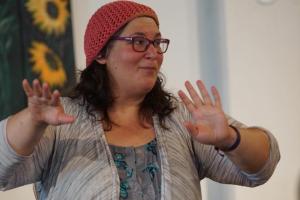
Founder and president of Fat Torah, Rabbi Minna Bromberg, PhD is passionate about bringing her three decades of experience in fat activism to writing, teaching and change-making at the nexus of Judaism and body liberation. Her forthcoming book is Every Body Beloved: a call for fat liberation in Jewish life. Minna received her doctorate in sociology from Northwestern University, with a dissertation on identity formation in interfaith couples, and was ordained at Hebrew College in 2010. She lives in Jerusalem with her husband, Rabbi Dr. Alan Abrams, and their two children.
Previous Post

June 14, 2022
Chutzpah and Healing
Next Post

June 28, 2022 The Blossoming Almond Staff of Aaron
Browse Our Archives
Select a Category Uncategorized
Select a Month April 2026 March 2026 December 2025 November 2025 October 2025 September 2025 August 2025 July 2025 June 2025 May 2025 April 2025 March 2025 February 2025 January 2025 December 2024 November 2024 October 2024 September 2024 August 2024 July 2024 June 2024 May 2024 April 2024 March 2024 February 2024 January 2024 December 2023 November 2023 October 2023 September 2023 August 2023 July 2023 June 2023 May 2023 April 2023 March 2023 February 2023 January 2023 December 2022 November 2022 October 2022 September 2022 August 2022 July 2022 June 2022 May 2022 April 2022 March 2022 February 2022 January 2022 December 2021 November 2021 October 2021 September 2021 August 2021 July 2021 June 2021 May 2021 April 2021 March 2021 February 2021 January 2021 December 2020 November 2020 October 2020 September 2020 August 2020 July 2020 June 2020 May 2020 April 2020 March 2020 February 2020 January 2020 December 2019 November 2019 October 2019 September 2019 August 2019 July 2019 June 2019 May 2019 April 2019 March 2019 February 2019 January 2019 December 2018 November 2018 October 2018 September 2018 August 2018 July 2018 June 2018 May 2018 April 2018 March 2018 February 2018 January 2018 December 2017 November 2017 October 2017 September 2017 August 2017 July 2017 June 2017
Follow Us!
TAKE THE
Religious Wisdom Quiz
Four beasts rose from the sea—one like a lion with eagle's wings, one like a bear, one like a leopard, and a fourth terrifying beast. What did these represent?
Select your answer to see how you score.
Four kings Four ages Four kingdoms Four judgments
Related posts from Seventy Faces of Torah

The Holy Art of World Building

Parashat Tzav: Keeping the Sacred Fire Burning

Color Theory: What Joseph’s Coat Reveals
TRENDING AT PATHEOS Jewish

Building a Little Ark in a Frightening World
This past Shabbat, we read about Noah. I love this story. The...

Yom Kippur : Is There Always Room for...
Making Room for Forgiveness Every year as Yom Kippur approaches, I find...

This Rosh Hashanah: Can I Find New Meaning?
A Sunrise, a New Year, and a Question On our way to...

Killing Amalek: The Torah’s Most Misunderstood Commandment
Few passages of the Torah have provoked more confusion, polemic, and misuse...

I have never trusted a first draft. I don’t mean that...

Back to School, Back to Reality—and a New...
A New School Year Begins… Back to Reality A new school year...
view all Jewish blogs
Ad-Free & Subscriber Log-In Subscription Support
- About Us
- 2026 Calendar
- Videos
- Podcasts
- Library of World Religions
- Faith In Media Tracker
- Advertise With Us
- Write for Us
- Privacy Policy
- Terms of Service
- Do Not Sell My Data
- Contact Us
- Radiant Digital
- Manage Newsletter Subscriptions
- Unsubscribe From Notifications
- Sitemap
Copyright 2008-2026, Patheos. All rights reserved.
Subscription Support Ad-Free & Subscriber Log-In
Follow Patheos