
BuddhistCatholicContemplativeEvangelicalGeneral ChristianHinduJewishLatter-day SaintMuslimNew VisionsProgressive Christian
Beliefs
- Buddhist
- Catholic
- Contemplative
- Evangelical
- General Christian
- Hindu
- Jewish
- Latter-day Saint
- More Voices
- Muslim
- New Visions
- Pagan
- Progressive Christian
Topics
- Religion News
- Food and Religion
- Sports and Religion
- Religious Art
- Religious Music and Entertainment
- Religious Events
- History and Religion
- Style and Religion
- Politics and Religion
- Women in Religion
- Recreation Outdoors and Religion
- Business Finance and Religion
- Careers Workplace and Religion
- Education and Religion
- Family Parenting and Religion
- Health Fitness and Religion
- Home and Religion
- Relationships and Religion
- Technology and Religion
- Travel and Religion
Columnists
- Buddhist Columnists
- Business Finance and Religion Columnists
- Careers Workplace and Religion Columnists
- Catholic Columnists
- Contemplative Columnists
- Education and Religion Columnists
- Evangelists Columnists
- Family Parenting and Religion Columnists
- General Christian Columnists
- Health Fitness and Religion Columnists
- Hindu Columnists
- History and Religion Columnists
- Home and Religion Columnists
- Jewish Columnists
- More Voices Columnists
- Latter Day Columnists
- Muslim Columnists
- New Visions Columnists
- Nonreligious Columnists
- Pagan Columnists
- Politics and Religion Columnists
- Progressive Columnists
- Recreation Outdoors and Religion Columnists
- Relationships and Religion Columnists
- Religion News Columnists
- Religious Art Columnists
- Religious Events Columnists
- Religious Music and Entertainment Columnists
- Sports and Religion Columnists
- Style and Religion Columnists
- Technology and Religion Columnists
- Travel and Religion Columnists
- Women in Religion Columnists
Resource Library
- 2026 Calendar
- Library of World Religions
- The 100 Most Holy Places on Earth
- Patheos Answers
- Podcasts
- Videos
- Faith Leaders Database
- Anglican Episcopalian
- Bahai
- Baptist
- Buddhism
- Christianity
- Confucianism
- Eastern Orthodoxy
- Hinduism
- Holiness and Pentecostal
- ISKCON
- Islam
- Judaism
- Lutheran
- Methodist
- The Church of Jesus Christ of Latter-day Saints
- New Age
- Paganism
- Presbytarian and Reformed
- Protestantism
- Religion Behind the Scenes
- Roman Catholic
- Scientology
- Shia Islam
- Sikhism
- Sufism
- Sunni Islam
- Taoism
- Zen
- See all religions
Research Tools
 Ad-Free & Subscriber Log-In Subscription Support
Follow Patheos 

- Trending:
- Advent
- |
- Forgiveness
- |
- Thanksgiving
- |
- Election
- |
- Seasonal Holidays
- |
- Marriage

- Home
- About Hebrew College
- The Rabbinical School of Hebrew College
- The Book of Psalms
- FREE NEWSLETTER
- Home
- Jewish
- The Languages We Speak
The Languages We Speak
Last updated on: November 11, 2021 at 12:09 pm by Hebrew College
The Languages We Speak 2021-11-11T12:09:24-04:00 Hebrew College
Patheos Explore the world's faith through different perspectives on religion and spirituality! Patheos has the views of the prevalent religions and spiritualities of the world.
Parashat Vayetze (Genesis 28:10-32:3)
By Leah Carnow | November 9, 2021
As I write, I am in Jerusalem, studying during my third year of rabbinical school. Each day here I am reminded of how much I love the way Hebrew feels on my tongue, how much joy I derive from using Hebrew to talk about both the most mundane and the most meaningful experiences of life. Speaking in Hebrew makes me feel proud, like I belong here. And each day, as I take the bus, shop at the grocery store, and walk the streets, I am reminded that the words I use to talk about anything—and the language I use to say those words—matters, especially here. My ability to speak Hebrew, in addition to being a white Jew of Ashkenazi descent, gives me a particular privilege in Israel, one that not everyone shares.
Another (and very different) privilege that I have here is the privilege of being a rabbinical student, which means that I have access to incredible programming and educational opportunities specifically targeted at rabbinical students. Two weeks ago, I had the fortune of attending a T’ruah event with two performers from Beit System Ali, an arts and educational organization that uses the power of language and music for activism. Band members rap in many languages, including Arabic, Russian, Yiddish, English, and Hebrew. In educational workshops, they teach students how to write, collaborate, and create music in their own native languages.
Our teaching artists at the T’ruah workshop told stories of students prohibited from speaking languages like Russian and Arabic at school, and they shared with us the way that their work encourages the students they teach to reclaim their own languages and identities. System Ali’s performances and community-based work create environments in which “the encounter and confrontation between different languages, stories, and identities” is a source of learning and inspiration for social change. Their work reminds us that words have power. The language that we choose to speak—or are allowed to speak—itself speaks stories.
At the end of this week’s parasha, Vayetze, the significance of language takes center stage. Jacob is on the run, yet again, this time from his father-in-law, Laban. After 20 years of service to Laban, which includes two marriages and multiple children, Jacob has packed up his family and his flocks and fled. Laban catches up with Jacob and they argue. Laban is furious at Jacob for running away without letting Laban say goodbye to his children and grandchildren. Jacob defends himself and accuses Laban of changing his wages over and over again. Finally, they decide to make a covenant, a brit. The Torah teaches:
Thereupon Jacob took a stone and set it up as a pillar.
And Jacob said to his kinsmen, “Gather stones.” So they took stones and made a mound; and they partook of a meal there by the mound.
Laban named it Yegar-sahadutha, but Jacob named it Gal-ed.
(Genesis 31:45-47)
The covenant begins with Jacob and Laban building a monument and sharing a meal together. But then the text takes a different turn as the two men name the site. Laban calls it Yegar-sahadutha. Jacob calls it Gal-ed. Two totally different names.
Why the multiple names? After all, they are supposed to be making a covenant— shouldn’t they at least be able to agree on the name of the place? Yegar-sahadutha. Gal-ed. It seems as if they are not communicating. How is this covenant supposed to work if they can’t even agree? Perhaps their 20 years of distrust continues even here, as they try to outdo the other with their words.
It turns out, however, that what they are saying is actually the same thing, but in two different languages. Gal-ed is the Hebrew word for “Mound of Witness.” Yegar-sahadutha is the Aramaic word for “Mound of Witness.” Two languages, two names, one shared meaning to describe the act of building a place to witness a new moment in their relationship. This brit will allow them to move forward in their lives, simultaneously together and away from each other.
It’s beautiful, even inspiring, to see Jacob and Laban come together despite their pain and anger and for us as readers to see them agreeing through their bilingual naming. But do Jacob and Laban know that they are using the same name for this place? I’d like to think that they do. I like to think that it is this moment that truly begins the process of them honoring each others’ differences. They implicitly recognize that choosing the same name in the same language would erase something about the other. Only one person would win. And this is a covenant, a moment of holy reconciliation. They each contribute a name to the place, and thereby they each contribute a piece of themselves. No one wins, but no one loses either. They realize that they do not have to speak the same language—they don’t even have to share the same space—but they can respect each other. The multiplicity of languages in the story makes the covenant that much more meaningful and more lasting.
May Laban and Jacob’s covenant at Yegar-sahadutha/Gal-Ed remind us of the simple privilege we have to speak and to be understood. May it inspire us to jump into opportunities to learn, to speak, and to reclaim our own historical languages—whether Hebrew or Aramaic, Yiddish or Arabic, Ladino or Amharic—and languages that we may not yet feel connected to. May we celebrate the languages that we grow up speaking, and the stories those languages tell about ourselves, our families, and our journeys. And as Jacob and Laban recognize each other’s names for the Mound of Witness, may we too recognize the many names our Holy Land is and has been called, as well as the many names of the places within it. And may we also learn to recognize when the languages we speak may be drowning out the languages, voices, and stories of those we do not know or yet know how to listen to. Let us listen, even when we don’t fully understand. We may be surprised. We may even be saying—and wanting—the same thing.
Leah Carnow (she/her) is a rabbinical student in her third year of school at Hebrew College. Originally from Los Angeles, Leah has lived in the Boston area for over 10 years, where she has worked as a yoga teacher, actor, director, healthcare professional, and Jewish educator. Last year, she served as the rabbinic intern at Temple Sinai in Brookline. Leah is currently studying in Jerusalem.
Want to learn more about our rabbinical program?
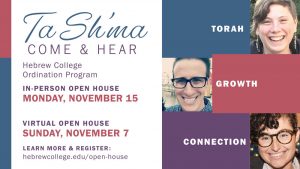 Join us for one of our November Open Houses. Learn more and register here.
Previous Post

November 4, 2021
The Voice of Jacob, the Hands of Esau
Next Post

November 18, 2021 Say You Met An Angel
Browse Our Archives
Select a Category Uncategorized
Select a Month April 2026 March 2026 December 2025 November 2025 October 2025 September 2025 August 2025 July 2025 June 2025 May 2025 April 2025 March 2025 February 2025 January 2025 December 2024 November 2024 October 2024 September 2024 August 2024 July 2024 June 2024 May 2024 April 2024 March 2024 February 2024 January 2024 December 2023 November 2023 October 2023 September 2023 August 2023 July 2023 June 2023 May 2023 April 2023 March 2023 February 2023 January 2023 December 2022 November 2022 October 2022 September 2022 August 2022 July 2022 June 2022 May 2022 April 2022 March 2022 February 2022 January 2022 December 2021 November 2021 October 2021 September 2021 August 2021 July 2021 June 2021 May 2021 April 2021 March 2021 February 2021 January 2021 December 2020 November 2020 October 2020 September 2020 August 2020 July 2020 June 2020 May 2020 April 2020 March 2020 February 2020 January 2020 December 2019 November 2019 October 2019 September 2019 August 2019 July 2019 June 2019 May 2019 April 2019 March 2019 February 2019 January 2019 December 2018 November 2018 October 2018 September 2018 August 2018 July 2018 June 2018 May 2018 April 2018 March 2018 February 2018 January 2018 December 2017 November 2017 October 2017 September 2017 August 2017 July 2017 June 2017
Follow Us!
TAKE THE
Religious Wisdom Quiz
In 3 John, what does John say he has no greater joy than?
Select your answer to see how you score.
Serving the church Seeing souls saved Hearing that his children are walking in the truth Preaching the gospel
Related posts from Seventy Faces of Torah
The Holy Art of World Building
Parashat Tzav: Keeping the Sacred Fire Burning
Color Theory: What Joseph’s Coat Reveals
TRENDING AT PATHEOS Jewish

Building a Little Ark in a Frightening World
This past Shabbat, we read about Noah. I love this story. The...

Yom Kippur : Is There Always Room for...
Making Room for Forgiveness Every year as Yom Kippur approaches, I find...

This Rosh Hashanah: Can I Find New Meaning?
A Sunrise, a New Year, and a Question On our way to...
Killing Amalek: The Torah’s Most Misunderstood Commandment
Few passages of the Torah have provoked more confusion, polemic, and misuse...

I have never trusted a first draft. I don’t mean that...

Back to School, Back to Reality—and a New...
A New School Year Begins… Back to Reality A new school year...
view all Jewish blogs
Ad-Free & Subscriber Log-In Subscription Support
- About Us
- 2026 Calendar
- Videos
- Podcasts
- Library of World Religions
- Faith In Media Tracker
- Advertise With Us
- Write for Us
- Privacy Policy
- Terms of Service
- Do Not Sell My Data
- Contact Us
- Radiant Digital
- Manage Newsletter Subscriptions
- Unsubscribe From Notifications
- Sitemap
Copyright 2008-2026, Patheos, part of the Radiant Digital network of media brands. All rights reserved.
Subscription Support Ad-Free & Subscriber Log-In
Follow Patheos