
BuddhistCatholicContemplativeEvangelicalGeneral ChristianHinduJewishLatter-day SaintMuslimNew VisionsProgressive Christian
Beliefs
- Buddhist
- Catholic
- Contemplative
- Evangelical
- General Christian
- Hindu
- Jewish
- Latter-day Saint
- More Voices
- Muslim
- New Visions
- Pagan
- Progressive Christian
Topics
- Religion News
- Food and Religion
- Sports and Religion
- Religious Art
- Religious Music and Entertainment
- Religious Events
- History and Religion
- Style and Religion
- Politics and Religion
- Women in Religion
- Recreation Outdoors and Religion
- Business Finance and Religion
- Careers Workplace and Religion
- Education and Religion
- Family Parenting and Religion
- Health Fitness and Religion
- Home and Religion
- Relationships and Religion
- Technology and Religion
- Travel and Religion
Columnists
- Buddhist Columnists
- Business Finance and Religion Columnists
- Careers Workplace and Religion Columnists
- Catholic Columnists
- Contemplative Columnists
- Education and Religion Columnists
- Evangelists Columnists
- Family Parenting and Religion Columnists
- General Christian Columnists
- Health Fitness and Religion Columnists
- Hindu Columnists
- History and Religion Columnists
- Home and Religion Columnists
- Jewish Columnists
- More Voices Columnists
- Latter Day Columnists
- Muslim Columnists
- New Visions Columnists
- Nonreligious Columnists
- Pagan Columnists
- Politics and Religion Columnists
- Progressive Columnists
- Recreation Outdoors and Religion Columnists
- Relationships and Religion Columnists
- Religion News Columnists
- Religious Art Columnists
- Religious Events Columnists
- Religious Music and Entertainment Columnists
- Sports and Religion Columnists
- Style and Religion Columnists
- Technology and Religion Columnists
- Travel and Religion Columnists
- Women in Religion Columnists
Resource Library
- 2026 Calendar
- Library of World Religions
- The 100 Most Holy Places on Earth
- Patheos Answers
- Podcasts
- Videos
- Faith Leaders Database
- Anglican Episcopalian
- Bahai
- Baptist
- Buddhism
- Christianity
- Confucianism
- Eastern Orthodoxy
- Hinduism
- Holiness and Pentecostal
- ISKCON
- Islam
- Judaism
- Lutheran
- Methodist
- The Church of Jesus Christ of Latter-day Saints
- New Age
- Paganism
- Presbytarian and Reformed
- Protestantism
- Religion Behind the Scenes
- Roman Catholic
- Scientology
- Shia Islam
- Sikhism
- Sufism
- Sunni Islam
- Taoism
- Zen
- See all religions
Research Tools
 Ad-Free & Subscriber Log-In Subscription Support
Ad-Free & Subscriber Log-In Subscription Support
Follow Patheos 

- Trending:
- Forgiveness
- |
- Marriage
- |
- Consciousness
- |
- Death Penalty
- |
- Election
- |
- Halloween

- Home
- About Hebrew College
- The Rabbinical School of Hebrew College
- The Book of Psalms
- FREE NEWSLETTER
- Home
- Jewish
- Life in a Spiral
Life in a Spiral
Last updated on: October 15, 2021 at 10:27 am by Hebrew College
Life in a Spiral 2021-10-15T10:27:29-04:00 Hebrew College
Patheos Explore the world's faith through different perspectives on religion and spirituality! Patheos has the views of the prevalent religions and spiritualities of the world.
Parshat Lech Lecha (Genesis 12:1–17:27)
Yael Werber | Oct 12, 2021
Eleven years ago, I moved to New York City, young, naive, and without any idea of where I was going next. The first apartment I moved into turned out to be uninhabitable, so, two days into my New York City adventure, I was left without a home, a job, or a place to spend the night. Thankfully, I had a relative in Washington Heights who took me in and gave me a bed to sleep in for a few months.
That chapter of my life was highly educational, but not necessarily one I would want to repeat. Ironically, however, my life seems to have repeated itself on its own accord. Two months ago, I found myself moving again to New York, this time part time, for a rabbinical school internship, and realized again that the place I had lined up to stay was uninhabitable. Soon after, another opportunity emerged to stay in a new apartment, in Washington Heights—yet again—and that’s where I will be living over the next 10 months. I shared this story with a friend, lamenting that I seem to be doomed to repeat my own (sometimes fraught) history. She responded that I’m not repeating my life in a flat line, but rather, I’m repeating life in a spiral.
This image of spirals was in my head as I read the iconic opening line of this week’s parsha: “וַיֹּ֤אמֶר יְהֹוָה֙ אֶל־אַבְרָ֔ם לֶךְ־לְךָ֛ מֵאַרְצְךָ֥ וּמִמּֽוֹלַדְתְּךָ֖ וּמִבֵּ֣ית אָבִ֑יךָ אֶל־הָאָ֖רֶץ אֲשֶׁ֥ר אַרְאֶֽךָּ׃”—“The LORD said to Abram, “Go forth from your native land and from your father’s house to the land that I will show you.” (Genesis 12:1, JPS translation). In order to fulfill this commandment from God, in order to go toward Canaan, Abram must separate from his father and his homeland. In exchange, God promises to bless Abram’s offspring in the future.
It is the small words right at the beginning of God’s command—Lech Lecha—that are so provocative. What does it mean for God to command Abram not just to go (which could simply be written as lech), but rather to go towards himself—lech lecha. The words themselves call to mind a spiral—go towards yourself, getting closer and closer to yourself each time you choose a new path.
The text is remarkably silent on Abram’s emotional state during this intense period of transition, but as I read through the parsha, I couldn’t help but imagine Abram in an emotional crisis; I could almost hear his words, mirroring my own feelings on moving, seeking reassurance. I am being instructed to leave everything I have ever known behind. I know this is the right move, but how can I truly move forward with confidence?
Looking for responses to both of our crises, I came upon the book Tiny Beautiful Things: Advice on Love and Life from Dear Sugar, a compilation of advice letters by author and podcaster Cheryl Strayed. Thankfully, on the subject of leaving, Strayed isn’t silent at all. “Go” she writes in one of her letters. “Go, even though there is nowhere to go. Go, even though you don’t know exactly why you can’t stay. Go, because you want to. Go because wanting to leave is enough.” Lech Lecha indeed.
Later on in the parsha, chapter 13, verse 12, Abram once again makes a separation from a family member, this time from his nephew Lot. The text again tells us that Abram will stay in Canaan while his family will be elsewhere. And, afterward, God, once again, tells Abram that he and his offspring will be blessed. This time, God says they will be as plentiful as the dust of the earth. It seems that, like me in New York, Abram is also living a weird time warp of his own life. After Abram separates from Lot, God commands him in Genesis 13:17: “ק֚וּם הִתְהַלֵּ֣ךְ בָּאָ֔רֶץ לְאׇרְכָּ֖הּ וּלְרׇחְבָּ֑הּ כִּ֥י לְךָ֖ אֶתְּנֶֽנָּה”—“Get up and walk about the land, its’ length and it’s breadth for I give it to you” Abram is being commanded to pick up and go all over again.
The rabbis of Breshit Rabbah suggest that it is at this moment, when Abrham is told to go a second time, that he truly acquires the land of Canaan—perhaps because this time he has the conviction to get up and go all over again. When Abram is willing to re-experience the hardships of setting out on his own, re-confront the difficulties of leaving, and renew his commitments to God, he is able to fully receive the blessing of the land of Canaan. This is not something that can be done one time only, it has to be undertaken again and again, with new challenges, and new lessons presenting themselves to him, as he moves further and further along the spiral of his life.
Indeed, the words of lech lecha themselves are a repetition—go, again and again, it seems to suggest. Rashi writes that this particular phrase means not just going, but going for yourself, for your own sake and for your own benefit. Sometimes the only thing compelling us to return to a situation is our own inner desire, and here we can trust the words of God (and Cheryl Strayed) to guide us: Go again, even if it’s just for yourself.
At the end of Lech Lecha, Abram gets one final blessing from God and becomes Abraham. With his new name, it is now clear that he is a changed man. But his new self (and name) contains his old self within it. He carries all the old versions of Abram with him into his new life as Abraham. I, too, will be a different version of myself this time around in New York, perhaps not as young, not as naive, and perhaps more ready to receive blessings from the same place than I was before.
Yael Werber is a fifth year rabbinical student at Hebrew College. She is interning this year at Congregation Beit Simchat Torah (CBST) in Manhattan.
Want to learn more about our rabbinical program?
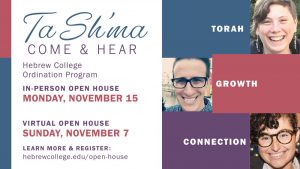 Join us for one of our November Open Houses. Learn more and register here.
Previous Post

October 5, 2021
Beautiful & Broken: Abram’s Vision
Next Post

October 21, 2021 It Takes Practice to Be Surprised
(Parashat Vayeira (Genesis 18:1-22:24)
Browse Our Archives
Select a Category Uncategorized
Select a Month April 2026 March 2026 December 2025 November 2025 October 2025 September 2025 August 2025 July 2025 June 2025 May 2025 April 2025 March 2025 February 2025 January 2025 December 2024 November 2024 October 2024 September 2024 August 2024 July 2024 June 2024 May 2024 April 2024 March 2024 February 2024 January 2024 December 2023 November 2023 October 2023 September 2023 August 2023 July 2023 June 2023 May 2023 April 2023 March 2023 February 2023 January 2023 December 2022 November 2022 October 2022 September 2022 August 2022 July 2022 June 2022 May 2022 April 2022 March 2022 February 2022 January 2022 December 2021 November 2021 October 2021 September 2021 August 2021 July 2021 June 2021 May 2021 April 2021 March 2021 February 2021 January 2021 December 2020 November 2020 October 2020 September 2020 August 2020 July 2020 June 2020 May 2020 April 2020 March 2020 February 2020 January 2020 December 2019 November 2019 October 2019 September 2019 August 2019 July 2019 June 2019 May 2019 April 2019 March 2019 February 2019 January 2019 December 2018 November 2018 October 2018 September 2018 August 2018 July 2018 June 2018 May 2018 April 2018 March 2018 February 2018 January 2018 December 2017 November 2017 October 2017 September 2017 August 2017 July 2017 June 2017
Follow Us!
TAKE THE
Religious Wisdom Quiz
Who did God call to lead the Israelites out of Egypt?
Select your answer to see how you score.
David Aaron Moses Joseph
Related posts from Seventy Faces of Torah

The Holy Art of World Building

Parashat Tzav: Keeping the Sacred Fire Burning

Color Theory: What Joseph’s Coat Reveals
TRENDING AT PATHEOS Jewish

Building a Little Ark in a Frightening World
This past Shabbat, we read about Noah. I love this story. The...

Yom Kippur : Is There Always Room for...
Making Room for Forgiveness Every year as Yom Kippur approaches, I find...

This Rosh Hashanah: Can I Find New Meaning?
A Sunrise, a New Year, and a Question On our way to...

Killing Amalek: The Torah’s Most Misunderstood Commandment
Few passages of the Torah have provoked more confusion, polemic, and misuse...

I have never trusted a first draft. I don’t mean that...

Back to School, Back to Reality—and a New...
A New School Year Begins… Back to Reality A new school year...
view all Jewish blogs
Ad-Free & Subscriber Log-In Subscription Support
- About Us
- 2026 Calendar
- Videos
- Podcasts
- Library of World Religions
- Faith In Media Tracker
- Advertise With Us
- Write for Us
- Privacy Policy
- Terms of Service
- Do Not Sell My Data
- Contact Us
- Radiant Digital
- Manage Newsletter Subscriptions
- Unsubscribe From Notifications
- Sitemap
Copyright 2008-2026, Patheos. All rights reserved.
Subscription Support Ad-Free & Subscriber Log-In
Follow Patheos