
BuddhistCatholicContemplativeEvangelicalGeneral ChristianHinduJewishLatter-day SaintMuslimNew VisionsProgressive Christian
Beliefs
- Buddhist
- Catholic
- Contemplative
- Evangelical
- General Christian
- Hindu
- Jewish
- Latter-day Saint
- More Voices
- Muslim
- New Visions
- Pagan
- Progressive Christian
Topics
- Religion News
- Food and Religion
- Sports and Religion
- Religious Art
- Religious Music and Entertainment
- Religious Events
- History and Religion
- Style and Religion
- Politics and Religion
- Women in Religion
- Recreation Outdoors and Religion
- Business Finance and Religion
- Careers Workplace and Religion
- Education and Religion
- Family Parenting and Religion
- Health Fitness and Religion
- Home and Religion
- Relationships and Religion
- Technology and Religion
- Travel and Religion
Columnists
- Buddhist Columnists
- Business Finance and Religion Columnists
- Careers Workplace and Religion Columnists
- Catholic Columnists
- Contemplative Columnists
- Education and Religion Columnists
- Evangelists Columnists
- Family Parenting and Religion Columnists
- General Christian Columnists
- Health Fitness and Religion Columnists
- Hindu Columnists
- History and Religion Columnists
- Home and Religion Columnists
- Jewish Columnists
- More Voices Columnists
- Latter Day Columnists
- Muslim Columnists
- New Visions Columnists
- Nonreligious Columnists
- Pagan Columnists
- Politics and Religion Columnists
- Progressive Columnists
- Recreation Outdoors and Religion Columnists
- Relationships and Religion Columnists
- Religion News Columnists
- Religious Art Columnists
- Religious Events Columnists
- Religious Music and Entertainment Columnists
- Sports and Religion Columnists
- Style and Religion Columnists
- Technology and Religion Columnists
- Travel and Religion Columnists
- Women in Religion Columnists
Resource Library
- 2026 Calendar
- Library of World Religions
- The 100 Most Holy Places on Earth
- Patheos Answers
- Podcasts
- Videos
- Faith Leaders Database
- Anglican Episcopalian
- Bahai
- Baptist
- Buddhism
- Christianity
- Confucianism
- Eastern Orthodoxy
- Hinduism
- Holiness and Pentecostal
- ISKCON
- Islam
- Judaism
- Lutheran
- Methodist
- The Church of Jesus Christ of Latter-day Saints
- New Age
- Paganism
- Presbytarian and Reformed
- Protestantism
- Religion Behind the Scenes
- Roman Catholic
- Scientology
- Shia Islam
- Sikhism
- Sufism
- Sunni Islam
- Taoism
- Zen
- See all religions
Research Tools
 Ad-Free & Subscriber Log-In Subscription Support
Ad-Free & Subscriber Log-In Subscription Support
Follow Patheos 

- Trending:
- Forgiveness
- |
- Marriage
- |
- Consciousness
- |
- Death Penalty
- |
- Election
- |
- Halloween

- Home
- About Hebrew College
- The Rabbinical School of Hebrew College
- The Book of Psalms
- FREE NEWSLETTER
- Home
- Jewish
- I’m a Stranger Here Myself
I’m a Stranger Here Myself
Last updated on: October 27, 2021 at 5:44 pm by Hebrew College
I’m a Stranger Here Myself 2021-10-27T17:44:26-04:00 Hebrew College
Patheos Explore the world's faith through different perspectives on religion and spirituality! Patheos has the views of the prevalent religions and spiritualities of the world.
Chayei Sarah (Genesis 23:1–25:18)
By Naomi Gurt Lind | Oct 25, 2021
“People are strange when you’re a stranger. Faces look ugly, when you’re alone.” —Jim Morrison, The Doors
Jim Morrison’s classic lyrics from his bout with depression in 1967 have been playing in my mind recently. There is so much that is unsettling about the time that we are in, as we come out of the pandemic, but don’t. We are meeting in person now, but skittishly. We smile through our masks and hug, and then back up to six feet away. It all feels so strange.
Our tradition pays a good deal of attention to the experience of strangeness, and to the feelings of the stranger. We are told, over and over, “Do not oppress the stranger, for you yourselves were strangers in the land of Egypt.” What does it mean to feel like we are not where we belong, and what is it to persist despite this feeling? Where does the Jewish emphasis on the strange and the stranger begin?
Two weeks ago, we encountered in Lech Lecha the Torah’s first usage of the word גֵר (ger), stranger. God has come to Avram (not yet Avraham) in a vision to strike up the covenant which lies at the heart of our history. By way of introduction, we read:
וַיֹּאמֶר לְאַבְרָם יָדֹעַ תֵּדַע כִּי־גֵר יִהְיֶה זַרְעֲךָ בְּאֶרֶץ לֹא לָהֶם וַעֲבָדוּם וְעִנּוּ אֹתָם אַרְבַּע מֵאוֹת שָׁנָה׃
And God said to Avram: Know well that your descendents will be strangers in a land not their own, and will struggle there for four hundred years. (Genesis 15:13)
Notice here the word גֵר (in bold), meaning stranger. The destiny of our people, part of the accord formed between God and our first patriarch, includes being isolated and displaced, planted in unfamiliar soil. God goes on to promise Avram that eventually his descendants will go free, and will prosper, and that a homeland will be theirs. Yet this sense of struggle will remain in our collective soul, and will form part of our communal identity.
The emphasis on treating the stranger with kindness is the moral core of empathy. When God teaches us repeatedly not to oppress the stranger—because we know the feelings of the stranger—we are called to rise above the human impulses of indifference, insularity, and revenge. As Rabbi Shai Held wrote:
The Torah could have . . . said, since you were tyrannized and exploited and no one did anything to help you, you don’t owe anything to anyone; how dare anyone ask anything of you? But it chooses the opposite path: Since you were exploited and oppressed, you must never be among the exploiters and degraders. You must remember what it feels like to be a stranger. Empathy must animate and intensify your commitment to the dignity and wellbeing of the weak and vulnerable.
Our Torah returns and returns to this lesson in empathy.
This week, in Chayei Sarah, the word גֵר (ger), stranger, returns. Sarah has just died, and our patriarch, now known as Avraham, is in mourning. As he begins negotiations with the Hittites to purchase a cemetery plot for her he says these words,
“גֵּר־וְתוֹשָׁב אָנֹכִי עִמָּכֶם תְּנוּ לִי אֲחֻזַּת־קֶבֶר עִמָּכֶם וְאֶקְבְּרָה מֵתִי מִלְּפָנָי׃”
I am a sojourning stranger with you; grant me a burial plot with you, and let me bury my dead from before me. (Genesis 23:4)
After the trauma of the Binding of Isaac, and the death of his beloved wife, Avraham comes to feel like the stranger God predicted his descendents would be. His life has begun to feel like it doesn’t quite fit.
Yet he persists. Perhaps in this experience of being a גֵר, he begins to develop some remorse, and even empathy. His life is nearing its end. He is broken in so many ways, yet he tries to repair what can be repaired. He sends his servant Eliezer to find a wife for poor, beloved, traumatized Yitschak. His intuition about finding Yitschak a wife from his homeland, the land he left just two parshiyot ago, proves canny; Yitschak is finally happy, with the woman he loves. Avraham makes every effort to protect Yitschak from further pain. And when he dies, his estranged sons, Yitschak and Yishmael, unite to bury him, in the very field where he first became a stranger.
Looking for these slivers of hope in a complicated and bleak landscape infuses the experience of the stranger, of strangeness, with value. When we can persist and lift up the moral qualities that make for compassion and concord, we redeem the pain of the strangeness we face, the strangeness we have always faced. Like Avraham, we can seek to use the difficulties of our current reality to awaken empathy, and to inspire us, too, to repair what can be repaired.
Naomi Gurt Lind has been an opera singer, a synagogue executive and a stay-at-home mother, and is currently in Shanah Bet at the Rabbinical School of Hebrew College. In addition to her studies, Naomi sings with the Zamir Chorale, serves on the LimmudBoston Board of Directors, and volunteers at JCDS, Boston’s Jewish Community Day School. When she has a free moment, she enjoys solving crossword puzzles (in pencil!), writing divrei Torah on her blog Jewish Themes, and spending time with her hilarious and delightful children.
Want to learn more about our rabbinical program?
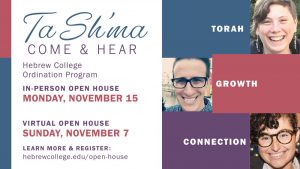 Join us for one of our November Open Houses. Learn more and register here.

Next Post

November 4, 2021 The Voice of Jacob, the Hands of Esau
Browse Our Archives
Select a Category Uncategorized
Select a Month April 2026 March 2026 December 2025 November 2025 October 2025 September 2025 August 2025 July 2025 June 2025 May 2025 April 2025 March 2025 February 2025 January 2025 December 2024 November 2024 October 2024 September 2024 August 2024 July 2024 June 2024 May 2024 April 2024 March 2024 February 2024 January 2024 December 2023 November 2023 October 2023 September 2023 August 2023 July 2023 June 2023 May 2023 April 2023 March 2023 February 2023 January 2023 December 2022 November 2022 October 2022 September 2022 August 2022 July 2022 June 2022 May 2022 April 2022 March 2022 February 2022 January 2022 December 2021 November 2021 October 2021 September 2021 August 2021 July 2021 June 2021 May 2021 April 2021 March 2021 February 2021 January 2021 December 2020 November 2020 October 2020 September 2020 August 2020 July 2020 June 2020 May 2020 April 2020 March 2020 February 2020 January 2020 December 2019 November 2019 October 2019 September 2019 August 2019 July 2019 June 2019 May 2019 April 2019 March 2019 February 2019 January 2019 December 2018 November 2018 October 2018 September 2018 August 2018 July 2018 June 2018 May 2018 April 2018 March 2018 February 2018 January 2018 December 2017 November 2017 October 2017 September 2017 August 2017 July 2017 June 2017
Follow Us!
TAKE THE
Religious Wisdom Quiz
What acrostic device is used in many Psalms and Proverbs?
Select your answer to see how you score.
Numerical sequence Reversed order Chronological order Alphabetic order
Related posts from Seventy Faces of Torah

The Holy Art of World Building

Parashat Tzav: Keeping the Sacred Fire Burning

Color Theory: What Joseph’s Coat Reveals
TRENDING AT PATHEOS Jewish

Yom Kippur : Is There Always Room for...
Making Room for Forgiveness Every year as Yom Kippur approaches, I find...

This Rosh Hashanah: Can I Find New Meaning?
A Sunrise, a New Year, and a Question On our way to...

Killing Amalek: The Torah’s Most Misunderstood Commandment
Few passages of the Torah have provoked more confusion, polemic, and misuse...

I have never trusted a first draft. I don’t mean that...

Back to School, Back to Reality—and a New...
A New School Year Begins… Back to Reality A new school year...

Out-Crowleying Crowley: The Emptiness of the O9A
O9A Neo-Crowley Racial Cosplay and Edgelord Atrocitism Aleister Crowley did not create...
view all Jewish blogs
Ad-Free & Subscriber Log-In Subscription Support
- About Us
- 2026 Calendar
- Videos
- Podcasts
- Library of World Religions
- Faith In Media Tracker
- Advertise With Us
- Write for Us
- Privacy Policy
- Terms of Service
- Do Not Sell My Data
- Contact Us
- Radiant Digital
- Manage Newsletter Subscriptions
- Unsubscribe From Notifications
- Sitemap
Copyright 2008-2026, Patheos. All rights reserved.
Subscription Support Ad-Free & Subscriber Log-In
Follow Patheos