
BuddhistCatholicContemplativeEvangelicalGeneral ChristianHinduJewishLatter-day SaintMuslimNew VisionsProgressive Christian
Beliefs
- Buddhist
- Catholic
- Contemplative
- Evangelical
- General Christian
- Hindu
- Jewish
- Latter-day Saint
- More Voices
- Muslim
- New Visions
- Pagan
- Progressive Christian
Topics
- Religion News
- Food and Religion
- Sports and Religion
- Religious Art
- Religious Music and Entertainment
- Religious Events
- History and Religion
- Style and Religion
- Politics and Religion
- Women in Religion
- Recreation Outdoors and Religion
- Business Finance and Religion
- Careers Workplace and Religion
- Education and Religion
- Family Parenting and Religion
- Health Fitness and Religion
- Home and Religion
- Relationships and Religion
- Technology and Religion
- Travel and Religion
Columnists
- Buddhist Columnists
- Business Finance and Religion Columnists
- Careers Workplace and Religion Columnists
- Catholic Columnists
- Contemplative Columnists
- Education and Religion Columnists
- Evangelists Columnists
- Family Parenting and Religion Columnists
- General Christian Columnists
- Health Fitness and Religion Columnists
- Hindu Columnists
- History and Religion Columnists
- Home and Religion Columnists
- Jewish Columnists
- More Voices Columnists
- Latter Day Columnists
- Muslim Columnists
- New Visions Columnists
- Nonreligious Columnists
- Pagan Columnists
- Politics and Religion Columnists
- Progressive Columnists
- Recreation Outdoors and Religion Columnists
- Relationships and Religion Columnists
- Religion News Columnists
- Religious Art Columnists
- Religious Events Columnists
- Religious Music and Entertainment Columnists
- Sports and Religion Columnists
- Style and Religion Columnists
- Technology and Religion Columnists
- Travel and Religion Columnists
- Women in Religion Columnists
Resource Library
- 2026 Calendar
- Library of World Religions
- The 100 Most Holy Places on Earth
- Patheos Answers
- Podcasts
- Videos
- Faith Leaders Database
- Anglican Episcopalian
- Bahai
- Baptist
- Buddhism
- Christianity
- Confucianism
- Eastern Orthodoxy
- Hinduism
- Holiness and Pentecostal
- ISKCON
- Islam
- Judaism
- Lutheran
- Methodist
- The Church of Jesus Christ of Latter-day Saints
- New Age
- Paganism
- Presbytarian and Reformed
- Protestantism
- Religion Behind the Scenes
- Roman Catholic
- Scientology
- Shia Islam
- Sikhism
- Sufism
- Sunni Islam
- Taoism
- Zen
- See all religions
Research Tools
 Ad-Free & Subscriber Log-In Subscription Support
Ad-Free & Subscriber Log-In Subscription Support
Follow Patheos 

- Trending:
- Forgiveness
- |
- Marriage
- |
- Consciousness
- |
- Death Penalty
- |
- Election
- |
- Halloween

- Home
- About Hebrew College
- The Rabbinical School of Hebrew College
- The Book of Psalms
- FREE NEWSLETTER
- Home
- Jewish
- Words of Love and Truth
Words of Love and Truth
Last updated on: September 8, 2021 at 9:23 pm by Hebrew College
Words of Love and Truth 2021-09-08T21:23:38-04:00 Hebrew College
Patheos Explore the world's faith through different perspectives on religion and spirituality! Patheos has the views of the prevalent religions and spiritualities of the world.
Parashat VaYelech (Deuteronomy 31:1-31:30)
By Rabbi Ebn Leader | September 8, 2021
As the Torah winds up its narrative towards the death of Moshe, it offers a few final examples of his leadership. These include his teaching of the song of Ha’azinu in next week’s parasha (Devarim 32:1-43), and his blessings to the tribes in the final parasha.
Yet this week’s reading introduces the song with a very dark moment. In Devarim 31:16, God says to Moshe: After you die “this People will rise, and stray after the foreign Gods of the people in the land that they enter—they will leave me and betray the covenant I have made with them.” In response, God will desert the people and hide God’s face from them leading to terrible suffering (ibid, verse 17). The song of Ha’azinu depicts both the process of Israel’s betrayal and the suffering that follows with great pathos. It is, however, interesting to note, that neither the text of the song of Ha’azinu, nor God, when presenting it to Moshe, have anything to say about a possible reconciliation between the people and God. This contrasts with the detailed rebuke of Devarim 28, whose stated purpose is to dissuade the people from betraying the covenant (verses 15 and 58), or the rebuke of Vayikra 26, which culminates with the people acknowledging their guilt and God re-affirming the covenant (verses 40-45), or even the beautiful description of reconciliation in Devarim 30:1-11.
In this week’s parasha, Israel’s betrayal and the following suffering are presented as inevitable. There is also no description of the suffering leading to reconciliation between God and the people. The end of the song describes God taking revenge on the nations who destroyed Israel, but that is mostly because they do not acknowledge that the power they have comes from God, and not because a relationship with Israel has been reestablished.
What then is the point of the song?
This is explained in Verse 21 of Chapter 31: “It shall be, when (Israel) is overcome by great evil and suffering, this song will confront them as a witness, for their descendants shall never forget it.” The point of the song is therefore to negate the possibility of any future misunderstanding of the situation. Israel’s suffering was foreseen and is completely the result of their own sins. The text does not propose that this understanding will lead the people to change their ways and find a way back. God will take revenge on God’s enemies (Verse 41) and wants God’s power and role to be acknowledged in the process.
I am not proposing that these paragraphs express an absolute biblical theology. Indeed, as I have pointed out, in other places in the book, even just 2 chapters away, a different theology is presented. It is, however, in the context of the narrative, a moment of deep despair from the people’s capacity to change and be different. As Moshe says in verse 27: I know your rebellious nature today; it will not change after I die.
This limited role of prophecy can be seen in other biblical narratives as well. In one of his prophecies reflecting on his role as prophet, Ezekiel sets clear limits to his responsibility as a prophet. (Ezekiel, Ch. 33) Although he is still calling for the people to change their ways, he is very clear that he is a watchman whose role is to sound the alarm, to speak God’s warning to the people. (Verses 10-21) He will be held accountable only for not speaking out—he is not responsible for those who ignore his warning (Verses 1-10). What then is the point of speaking to those who treat the prophet’s words like a performance “a beautiful love song with good music”? (Verse 32)
To this Ezekiel answers: “When (the tragedy) comes, for it is coming, they will know that there was a prophet amongst them.” (Verse 33)
As mentioned above, when Moshe presents the song to people he is caught up, as it were, in the Divine despair. Yet when he finishes teaching the song to the people he has a different message, a message of hope. Listen carefully to this story, Moshe says, your lives depend on it. By internalizing this story and teaching it to your children, you can avoid this outcome and lengthen your years on the land God is giving you. (Devarim 32:44-47)
How are we to understand the difference between the way Moshe speaks before and after teaching the song? For this, we go back again to Ezekiel, for while Ezekiel has a particular understanding of the limits of his own responsibility, he also knows of other forms of leadership, which he holds to different standards. In the chapter following his reflection on the role of the prophet, Ezekiel rebukes in the harshest of terms those “Shepherds of Israel” who did not “strengthen the weak, heal the sick, bandage the broken, return the stray, and seek for the lost.” (Ezekiel 34:4) It is worth noticing the difference between the two metaphors of leadership that Ezekiel employs. The prophet is a watchman, whose responsibility is to his role not to the wellbeing of the people. As long as he has pointed out the danger, spoken the truth, he has done what is required of him. If the people do not act wisely in response to his warning, he cannot be held responsible for that. In the words of his prophecy: “You (the prophet) have saved your own soul.” (Ezekiel 33:10)
Although this may seem like a heartless depiction of the prophetic voice, it has some resonance with the biblical narrative in which Ezekiel, Jeremiah, and most every other prophet sent to the people of Israel, failed at bringing about the social change that would have averted the tragedy they saw coming. While they spoke with great courage and endured great dangers and left behind words that we have found inspiring for many generations, one after another, they mostly failed their own generations. Is it possible that the shadow side of speaking God’s word or speaking Truth, is that upper-case Truth is so compelling to the speaker that they may forget that words must be modulated so that they can be heard in specific circumstances by specific people? Is that how we are to understand Ezekiel’s sense of being accountable to the word, not to people’s response to it?
Ezekiel’s model of the shepherd has a very different valence. The shepherd is a caretaker, and the “failure” of the sheep is the failure of the shepherd as articulated so strongly by Ezekiel. If a sheep wanders off, the shepherd must run after it, if one cannot keep up with the herd the shepherd must find a way to strengthen it. If the herd is decimated, Ezekiel will hold the shepherds of Israel responsible.
Moshe, In Rabbinic legend, is chosen to lead the people of Israel precisely because he is a compassionate, caring and responsible shepherd who will not let even a single lamb get lost. (Shemot Rabbah 2:2) Still, it is easy to imagine one who has struggled so much with both personal and leadership disappointments, hearing God’s declaration that the people will ultimately fail, and going into his darkest places. Yet by the time he finishes teaching the song, when the story ends with no other benefit than “you should know that God foretold your failure and it was totally your fault,” he cannot end there. Because Moshe, the servant of God, loves the people, and cannot succeed when they fail. (Devarim 34:5) He reclaims his role as shepherd having fallen for a short time into the limitations of Ezekiel’s prophetic voice.
And thus Moshe teaches us Teshuvah (repentance). Ezekiel’s distinction—you are either a watchman or a shepherd, is too simple. We must ask, how do we move between different voices? There is a particular challenge in our generation as the internet has given the theoretical possibility of an endless platform to any individual who has access and can type. It is easy to feel—my voice must be heard! I must put these truths out into the public square of one kind or the other social media! It can even feel like a responsibility to voice that particular truth.
And there may be moments when there actually is such a responsibility. But, I dare say, they are less than some of us sometimes imagine. . . . I look to Moshe who heard Truth from God’s own mouth, but as he was speaking realized—This may be true, but it is not useful . . . .
At this time, when reading or listening to the news makes me feel that we are marching briskly from one failure to the next, I feel deeply that we need fewer prophets and many many more shepherds. . . . So whenever I speak out, I try to remember to ask myself: Do I love the people I am speaking to? Do I feel responsible for them? Am I speaking in such a way that my words can be heard? Is what I am saying actually useful for those I am speaking to?
May we all be blessed this year to hear words spoken with love and to speak words that can be heard.
Shanah Tovah.
Rabbi Ebn Leader is a faculty member in the rabbinical program at Hebrew College.
Want to learn more about our rabbinical program?
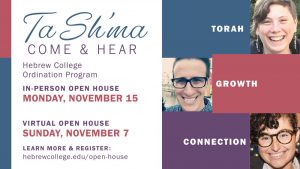 Join us for one of our November Open Houses. Learn more and register here.
Previous Post

August 31, 2021
Choosing Transformation—Over and Over Again
Next Post

September 17, 2021 Remembrance and Teshuvah
Browse Our Archives
Select a Category Uncategorized
Select a Month April 2026 March 2026 December 2025 November 2025 October 2025 September 2025 August 2025 July 2025 June 2025 May 2025 April 2025 March 2025 February 2025 January 2025 December 2024 November 2024 October 2024 September 2024 August 2024 July 2024 June 2024 May 2024 April 2024 March 2024 February 2024 January 2024 December 2023 November 2023 October 2023 September 2023 August 2023 July 2023 June 2023 May 2023 April 2023 March 2023 February 2023 January 2023 December 2022 November 2022 October 2022 September 2022 August 2022 July 2022 June 2022 May 2022 April 2022 March 2022 February 2022 January 2022 December 2021 November 2021 October 2021 September 2021 August 2021 July 2021 June 2021 May 2021 April 2021 March 2021 February 2021 January 2021 December 2020 November 2020 October 2020 September 2020 August 2020 July 2020 June 2020 May 2020 April 2020 March 2020 February 2020 January 2020 December 2019 November 2019 October 2019 September 2019 August 2019 July 2019 June 2019 May 2019 April 2019 March 2019 February 2019 January 2019 December 2018 November 2018 October 2018 September 2018 August 2018 July 2018 June 2018 May 2018 April 2018 March 2018 February 2018 January 2018 December 2017 November 2017 October 2017 September 2017 August 2017 July 2017 June 2017
Follow Us!
TAKE THE
Religious Wisdom Quiz
Who said, "Let not your hearts be troubled"?
Select your answer to see how you score.
John Peter Paul Jesus
Related posts from Seventy Faces of Torah

The Holy Art of World Building

Parashat Tzav: Keeping the Sacred Fire Burning

Color Theory: What Joseph’s Coat Reveals
TRENDING AT PATHEOS Jewish

Yom Kippur : Is There Always Room for...
Making Room for Forgiveness Every year as Yom Kippur approaches, I find...

This Rosh Hashanah: Can I Find New Meaning?
A Sunrise, a New Year, and a Question On our way to...

Killing Amalek: The Torah’s Most Misunderstood Commandment
Few passages of the Torah have provoked more confusion, polemic, and misuse...

I have never trusted a first draft. I don’t mean that...

Back to School, Back to Reality—and a New...
A New School Year Begins… Back to Reality A new school year...

Out-Crowleying Crowley: The Emptiness of the O9A
O9A Neo-Crowley Racial Cosplay and Edgelord Atrocitism Aleister Crowley did not create...
view all Jewish blogs
Ad-Free & Subscriber Log-In Subscription Support
- About Us
- 2026 Calendar
- Videos
- Podcasts
- Library of World Religions
- Faith In Media Tracker
- Advertise With Us
- Write for Us
- Privacy Policy
- Terms of Service
- Do Not Sell My Data
- Contact Us
- Radiant Digital
- Manage Newsletter Subscriptions
- Unsubscribe From Notifications
- Sitemap
Copyright 2008-2026, Patheos. All rights reserved.
Subscription Support Ad-Free & Subscriber Log-In
Follow Patheos