
BuddhistCatholicContemplativeEvangelicalGeneral ChristianHinduJewishLatter-day SaintMuslimNew VisionsProgressive Christian
Beliefs
- Buddhist
- Catholic
- Contemplative
- Evangelical
- General Christian
- Hindu
- Jewish
- Latter-day Saint
- More Voices
- Muslim
- New Visions
- Pagan
- Progressive Christian
Topics
- Religion News
- Food and Religion
- Sports and Religion
- Religious Art
- Religious Music and Entertainment
- Religious Events
- History and Religion
- Style and Religion
- Politics and Religion
- Women in Religion
- Recreation Outdoors and Religion
- Business Finance and Religion
- Careers Workplace and Religion
- Education and Religion
- Family Parenting and Religion
- Health Fitness and Religion
- Home and Religion
- Relationships and Religion
- Technology and Religion
- Travel and Religion
Columnists
- Buddhist Columnists
- Business Finance and Religion Columnists
- Careers Workplace and Religion Columnists
- Catholic Columnists
- Contemplative Columnists
- Education and Religion Columnists
- Evangelists Columnists
- Family Parenting and Religion Columnists
- General Christian Columnists
- Health Fitness and Religion Columnists
- Hindu Columnists
- History and Religion Columnists
- Home and Religion Columnists
- Jewish Columnists
- More Voices Columnists
- Latter Day Columnists
- Muslim Columnists
- New Visions Columnists
- Nonreligious Columnists
- Pagan Columnists
- Politics and Religion Columnists
- Progressive Columnists
- Recreation Outdoors and Religion Columnists
- Relationships and Religion Columnists
- Religion News Columnists
- Religious Art Columnists
- Religious Events Columnists
- Religious Music and Entertainment Columnists
- Sports and Religion Columnists
- Style and Religion Columnists
- Technology and Religion Columnists
- Travel and Religion Columnists
- Women in Religion Columnists
Resource Library
- 2026 Calendar
- Library of World Religions
- The 100 Most Holy Places on Earth
- Patheos Answers
- Podcasts
- Videos
- Faith Leaders Database
- Anglican Episcopalian
- Bahai
- Baptist
- Buddhism
- Christianity
- Confucianism
- Eastern Orthodoxy
- Hinduism
- Holiness and Pentecostal
- ISKCON
- Islam
- Judaism
- Lutheran
- Methodist
- The Church of Jesus Christ of Latter-day Saints
- New Age
- Paganism
- Presbytarian and Reformed
- Protestantism
- Religion Behind the Scenes
- Roman Catholic
- Scientology
- Shia Islam
- Sikhism
- Sufism
- Sunni Islam
- Taoism
- Zen
- See all religions
Research Tools
 Ad-Free & Subscriber Log-In Subscription Support
Ad-Free & Subscriber Log-In Subscription Support
Follow Patheos 

- Trending:
- Forgiveness
- |
- Marriage
- |
- Consciousness
- |
- Death Penalty
- |
- Election
- |
- Halloween

- Home
- About Hebrew College
- The Rabbinical School of Hebrew College
- The Book of Psalms
- FREE NEWSLETTER
- Home
- Jewish
- Returning to Our Neighbors—To See or Not to See?
Returning to Our Neighbors—To See or Not to See?
Last updated on: August 17, 2021 at 5:28 pm by Hebrew College
Returning to Our Neighbors—To See or Not to See? 2021-08-17T17:28:56-04:00 Hebrew College
Patheos Explore the world's faith through different perspectives on religion and spirituality! Patheos has the views of the prevalent religions and spiritualities of the world.
Parshat Ki Teitzei (Deuteronomy 21:10-25:19)
By Rabbi Shira Shazeer | August 17, 2021
It is the month of Elul. In just a few weeks we’ll reach the High Holy Days, our yearly attempt to start fresh, to get things right. As I write these words though, I am keenly aware, and I imagine you are too, of the baggage that we, as a global society, will be bringing with us into the new year. Each Yom Kippur, we repeat the vidui, the liturgical, alphabetical list of things we as a community have gotten wrong, unloading that baggage so that we may move forward less burdened. In some communities, the practice of selichot, of rising early to get a jump start on the work of repentance, has already begun, including this enumeration of sins on a daily basis.
Years ago, I adapted the vidui into English for children, listing a relatable childhood transgression for each letter of the ABCs. And when I’ve reflected on the “song” with children, they quickly tell me that they have not done all of the things listed. Many, though not all, do admit that they’ve done some of the things. Even small children understand that it is uncomfortable to think about all of the imperfect things we do—even things that we might not have done ourselves, but that we can relate to. I also find it uncomfortable to think of anyone in my community, let alone myself, doing some of the awful transgressions that are listed in the vidui. And yet to face the new year honestly means acknowledging that people do some truly terrible and embarrassing things, and that in some way, communally, we all play a part in them.
Ki Teitzei, this week’s parsha, presents mitzvot for an array of situations that might occur within a society, guiding us through the most just, respectful, or compassionate responses to each one. Some of these situations inspire pride and warm fuzzy feelings—mitzvot like building a parapet on one’s roof, treating farm animals kindly, paying workers in a timely manner, and keeping honest weights and measures in one’s business dealings. Others, like the sins we confess in the vidui, make us uncomfortable—like mitzvot governing the results of capturing a beautiful woman in war, executing a son who has grown wild and out of control, and various acts of impropriety in intimate relationships.
When we read the Torah as a spiritual practice, looking for inspiration and positive feelings, we run up against this inconvenient reality. The Torah is written as a guide, addressing real people who live in the real world, who do real things that in our most noble moments we would like to imagine people would not do. Some of the situations look different in our day, but, at its core, the Torah reminds us that within any society, situations will occur that need to be handled and sorted out in the kindest, fairest way possible, even though no resolution to these situations can live up to our ideal.
Wishing not to discuss the uncomfortable mitzvot of this parsha, I thought about focusing this piece on one of the more feel-good mitzvot, hashavat avedah, the obligation to return lost objects. In this short passage (Deuteronomy 22:1-3), one recurring word caught my eye, the word l’hitalem, to conceal oneself, or to conceal from oneself. In its first occurrence, Chapter 22, verse 1 reads: “Do not watch idly as your brother’s ox or sheep goes astray, and conceal yourself from them. You should certainly return them to your brother.” The idea of concealing oneself caught the attention of the rabbis long ago, perhaps because the verse would seem to work just as well without that phrase. It seems similarly extraneous when it appears again two verses later, clarifying that any lost object must be returned in the same way as a lost ox or sheep, tacking on at the end, “you must not (or perhaps will not be able to) conceal it from yourself.”
When I first started pondering the connection between this self-concealment and the impulse to avoid helping others, I thought of the way in which we distance ourselves from the concerns of people around us today. I’ve been struck by the animosity that has developed between people advocating a return to a life free of the restrictions of the pandemic, and those struggling to hold onto those restrictions and the relative safety they represent. I’ve been amazed at how difficult it has become to understand the perspective of the other, and how easy it has become to vilify and dehumanize them. Rather than seeing the yearning for connection, the suffering from isolation, the concern for health and life, the worry over children and immune-compromised loved ones, we’ve come to see each other as adversaries, fools, tyrants.
Perhaps in placing this imperative not to conceal ourselves, or to conceal the concerns of others from ourselves, in the middle of this parsha full of the problems we wish society would not have, the Torah hints at a deeper truth about all of these situations: it is in our nature to remain focused on ourselves, to avoid seeing and understanding each other, because, if we were to see and understand, there is no way we could rationalize to ourselves not going out of our way to help. We need the reminder to keep our eyes, and our hearts, and souls open, because in our efforts to protect ourselves, we may sometimes choose not to see.
The rabbis, however, read v’hitalamta in verse one differently. The negative, “Do not” appears in the beginning of the verse and doesn’t repeat before the second verb, so while it can be read as a continuation of the negative, “do not conceal yourself,” it can also be read as a switch to the positive, “conceal yourself.” The rabbis understand this as a concession, that in some situations, it is appropriate to conceal yourself, to not see. They present three situations. First, if a cohen, who is prohibited from entering a cemetery, sees an ox lost in a cemetery, he would not be required to go in and get it. Or, if the person was an elder, and chasing after donkeys would not be fitting for them, or if the time a particular person would spend returning the lost item, for which the owner would be obligated to repay them, is worth more than the item itself, they would not have the obligation to see the item and return it.
Over the past year, I’ve felt guilty at times of letting so much of what is broken in the world pass me by, without fully seeing it, without taking responsibility to do something about it. I’ve focused on what is closest to me and concealed from myself much of the suffering that I know is going on beyond my home and family. I also know that if I were to see, truly and deeply, all of the suffering and imperfection that I am aware of on a superficial level, I still could only do so much about it, and I would exhaust and overwhelm my capacity to care and to act. Reading the rabbis’ understanding that sometimes you can’t not see, and sometimes you must not see, I hope that I choose wisely and appropriately. And I understand that choosing to see it all most likely leads to failure to act on anything.
I started thinking about seeing and not seeing in relation to the swelling Delta wave of Covid-19, and the push and pull between both politicians and individuals. As it comes time to share my thoughts with you, we’ve watched a new (and old) tragedy beginning to unfold in Afghanistan, and the questions of when to see, how much, and when it is our responsibility to act are rising to the surface again, in a different way.
As we return this year to our communal vidui, recounting in alphabetical order the ways we have failed to reach our ideal, and aiming to start afresh, may we be unable to conceal from ourselves the realities and the complications of our world, of our society. May we take that moment to, at least superficially, see it all. May we be especially unable to conceal from ourselves that both we, ourselves, and the people we instinctively blame are one. May this be the year that we return to each other these things that we have lost: our respect, our shared humanity, our choice to see and be seen.
Rabbi Shira Shazeer spent this summer traveling and blogging on Shlepn Nakhes, the Great American Pandemic Road Trip with her husband and three children. She studied in the Scholars Circle at Drisha Institute for Jewish Education, received rabbinic ordination from the Rabbinical School of Hebrew College in 2010, and looks forward to completing an additional masters in Jewish Education, with a focus on special education, in the coming year. After many years serving as school rabbi of a small Jewish day school, Rabbi Shazeer is looking forward to new professional adventures teaching in the learning center at Gann Academy starting this fall.
Want to learn more about our rabbinical program?
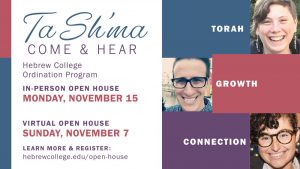 Join us for one of our November Open Houses. Learn more and register here.
Previous Post

August 9, 2021
Elul, T’shuvah, and Shame: The Eglah Arufah
Next Post

August 23, 2021 Our Evolving Relationship To Prayer
Browse Our Archives
Select a Category Uncategorized
Select a Month April 2026 March 2026 December 2025 November 2025 October 2025 September 2025 August 2025 July 2025 June 2025 May 2025 April 2025 March 2025 February 2025 January 2025 December 2024 November 2024 October 2024 September 2024 August 2024 July 2024 June 2024 May 2024 April 2024 March 2024 February 2024 January 2024 December 2023 November 2023 October 2023 September 2023 August 2023 July 2023 June 2023 May 2023 April 2023 March 2023 February 2023 January 2023 December 2022 November 2022 October 2022 September 2022 August 2022 July 2022 June 2022 May 2022 April 2022 March 2022 February 2022 January 2022 December 2021 November 2021 October 2021 September 2021 August 2021 July 2021 June 2021 May 2021 April 2021 March 2021 February 2021 January 2021 December 2020 November 2020 October 2020 September 2020 August 2020 July 2020 June 2020 May 2020 April 2020 March 2020 February 2020 January 2020 December 2019 November 2019 October 2019 September 2019 August 2019 July 2019 June 2019 May 2019 April 2019 March 2019 February 2019 January 2019 December 2018 November 2018 October 2018 September 2018 August 2018 July 2018 June 2018 May 2018 April 2018 March 2018 February 2018 January 2018 December 2017 November 2017 October 2017 September 2017 August 2017 July 2017 June 2017
Follow Us!
TAKE THE
Religious Wisdom Quiz
Who was Jacob's firstborn son?
Select your answer to see how you score.
Judah Joseph Levi Reuben
Related posts from Seventy Faces of Torah

The Holy Art of World Building

Parashat Tzav: Keeping the Sacred Fire Burning

Color Theory: What Joseph’s Coat Reveals
TRENDING AT PATHEOS Jewish

Building a Little Ark in a Frightening World
This past Shabbat, we read about Noah. I love this story. The...

Yom Kippur : Is There Always Room for...
Making Room for Forgiveness Every year as Yom Kippur approaches, I find...

This Rosh Hashanah: Can I Find New Meaning?
A Sunrise, a New Year, and a Question On our way to...

Killing Amalek: The Torah’s Most Misunderstood Commandment
Few passages of the Torah have provoked more confusion, polemic, and misuse...

I have never trusted a first draft. I don’t mean that...

Back to School, Back to Reality—and a New...
A New School Year Begins… Back to Reality A new school year...
view all Jewish blogs
Ad-Free & Subscriber Log-In Subscription Support
- About Us
- 2026 Calendar
- Videos
- Podcasts
- Library of World Religions
- Faith In Media Tracker
- Advertise With Us
- Write for Us
- Privacy Policy
- Terms of Service
- Do Not Sell My Data
- Contact Us
- Radiant Digital
- Manage Newsletter Subscriptions
- Unsubscribe From Notifications
- Sitemap
Copyright 2008-2026, Patheos. All rights reserved.
Subscription Support Ad-Free & Subscriber Log-In
Follow Patheos