
BuddhistCatholicContemplativeEvangelicalGeneral ChristianHinduJewishLatter-day SaintMuslimNew VisionsProgressive Christian
Beliefs
- Buddhist
- Catholic
- Contemplative
- Evangelical
- General Christian
- Hindu
- Jewish
- Latter-day Saint
- More Voices
- Muslim
- New Visions
- Pagan
- Progressive Christian
Topics
- Religion News
- Food and Religion
- Sports and Religion
- Religious Art
- Religious Music and Entertainment
- Religious Events
- History and Religion
- Style and Religion
- Politics and Religion
- Women in Religion
- Recreation Outdoors and Religion
- Business Finance and Religion
- Careers Workplace and Religion
- Education and Religion
- Family Parenting and Religion
- Health Fitness and Religion
- Home and Religion
- Relationships and Religion
- Technology and Religion
- Travel and Religion
Columnists
- Buddhist Columnists
- Business Finance and Religion Columnists
- Careers Workplace and Religion Columnists
- Catholic Columnists
- Contemplative Columnists
- Education and Religion Columnists
- Evangelists Columnists
- Family Parenting and Religion Columnists
- General Christian Columnists
- Health Fitness and Religion Columnists
- Hindu Columnists
- History and Religion Columnists
- Home and Religion Columnists
- Jewish Columnists
- More Voices Columnists
- Latter Day Columnists
- Muslim Columnists
- New Visions Columnists
- Nonreligious Columnists
- Pagan Columnists
- Politics and Religion Columnists
- Progressive Columnists
- Recreation Outdoors and Religion Columnists
- Relationships and Religion Columnists
- Religion News Columnists
- Religious Art Columnists
- Religious Events Columnists
- Religious Music and Entertainment Columnists
- Sports and Religion Columnists
- Style and Religion Columnists
- Technology and Religion Columnists
- Travel and Religion Columnists
- Women in Religion Columnists
Resource Library
- 2026 Calendar
- Library of World Religions
- The 100 Most Holy Places on Earth
- Patheos Answers
- Podcasts
- Videos
- Faith Leaders Database
- Anglican Episcopalian
- Bahai
- Baptist
- Buddhism
- Christianity
- Confucianism
- Eastern Orthodoxy
- Hinduism
- Holiness and Pentecostal
- ISKCON
- Islam
- Judaism
- Lutheran
- Methodist
- The Church of Jesus Christ of Latter-day Saints
- New Age
- Paganism
- Presbytarian and Reformed
- Protestantism
- Religion Behind the Scenes
- Roman Catholic
- Scientology
- Shia Islam
- Sikhism
- Sufism
- Sunni Islam
- Taoism
- Zen
- See all religions
Research Tools
 Ad-Free & Subscriber Log-In Subscription Support
Ad-Free & Subscriber Log-In Subscription Support
Follow Patheos 

- Trending:
- Forgiveness
- |
- Marriage
- |
- Consciousness
- |
- Death Penalty
- |
- Election
- |
- Halloween

- Home
- About Hebrew College
- The Rabbinical School of Hebrew College
- The Book of Psalms
- FREE NEWSLETTER
- Home
- Jewish
- Our Evolving Relationship To Prayer
Our Evolving Relationship To Prayer
Last updated on: August 23, 2021 at 1:37 pm by Hebrew College
Our Evolving Relationship To Prayer 2021-08-23T13:37:19-04:00 Hebrew College
Patheos Explore the world's faith through different perspectives on religion and spirituality! Patheos has the views of the prevalent religions and spiritualities of the world.
Ki Tavo (Exodus 26:1-29:8)
By Rabbi Brian Besser | August 23, 2021
During upcoming High Holiday services, we will shortly confront one of the most theologically disturbing prayers in all Jewish liturgy, the Unetaneh Tokef, which begins: “On Rosh Hashanah it is written and on Yom Kippur it is decreed . . . who shall live and who shall die . . . . ” One year, a congregant, Jen Richler, came to me to discuss the spiritual disaffection that the Unetaneh Tokef provoked in her after the untimely death of her young mother in a freak accident. She refused to utter any longer a prayer that implied “God had taken my mother’s life because she hadn’t sufficiently repented, prayed, and/or performed righteous acts.” (Jen, a freelance writer, compiled her reflections into an article for Tablet, Why I Stopped Saying the Unetaneh Tokef, and Why I’m Ready To Say It Again, published in 2014.)
The difficulties generated by the Unetaneh Tokef apply to prayer in general, of which the Unetaneh Tokef is but one particularly problematic example. Should I recite a prayer if I disagree with its meaning? If a prayer upsets me but I say it anyway, am I a hypocrite? To whom am I praying? Why should I pray at all?
The Torah provides only a smattering of fixed liturgy (most Jewish prayers were composed centuries later during the Rabbinic period), but one example appears in this week’s Torah portion, Ki Tavo. While presenting the first fruits of the harvest to the priest, the Israelite farmer is supposed to recite a formulaic declaration of gratitude that is worth examining closely. The text contains subtle shifts in language that guide the speaker along a path of increasing engagement with the Jewish people, Jewish tradition, and God.
First, the farmer says to the priest:
I acknowledge this day before Adonai your God that I have entered the land that Adonai swore to our ancestors to give us. (Deuteronomy 28: 3)
This is a little peculiar, because Adonai is not merely “Adonai your God,” the God of the priest, but the farmer’s God as well! Next, the farmer continues:
My father . . . went down to Egypt . . . and became a populous nation. The Egyptians oppressed us . . . and we cried to Adonai*, the God of our ancestors, and* Adonai heard our plea . . . and brought us out of Egypt. (Deuteronomy 28:5-8)
In this middle section, the language invoking God has shifted; the speaker no longer refers to “Adonai your God” but “Adonai, the God of our ancestors.” Additionally, the declaration, largely formulated until now in the first-person singular (“My father went down to Egypt”), suddenly shifts to the first-person plural (“The Egyptians oppressed us, and we cried to Adonai, and Adonai heard our plea and brought us out of Egypt”). What’s more, the declaration’s formulation makes the speaker identify with earlier generations, because the events it specifies did not happen to the speaker directly but took place long before.
The farmer concludes:
God has brought us to this place and given us this land . . . Wherefore I now bring the first fruits of the soil which You, Adonai*, have given me.* (Deuteronomy 28:9-10)
In this final section, the grammatical formulation reverts from first-person plural (“God has brought us to this place and given us this land”) back to first-person singular (“I bring the first fruits which You have given me.”) More spectacularly, the speaker no longer casts God onto the official religious representative with the expression “Adonai your God,” and has even progressed beyond the middle ground of admitting the God of yesteryear with the expression, “Adonai, the God of our ancestors.” The speaker now comes to address God as an ongoing Presence in the speaker’s own life: “You, Adonai.”
The progression in the textual formulation of the farmer’s ritual declaration in Ki Tavo can serve as a blueprint for our evolving relationship to fixed prayer in general, especially for those of us who start from a place of deep alienation or skepticism. At first, we may relate to the words in the prayer book, or to organized religion as a whole, in terms of “Adonai your God.” We might say to ourselves: “This stuff is fine for Rabbis, pious folk, and the ones at services who seem to be able to utter these words straightforwardly week after week, but they’re not for me.”
If we don’t reject the received text out of hand but stick with it long enough, we may allow our perspective to shift until we are at least able to admit the power of tradition. It’s no longer “Adonai your God” but “Adonai the God of our ancestors.” We can recite these words even if we don’t personally subscribe to them, because, by vocalizing the exact phraseology uttered by Jews everywhere for centuries, we link ourselves to the Jewish people across all time and space. Thus, the language of prayer shifts from first-person singular to first-person plural.
If we persevere by struggling with the implications of the text itself, we may eventually mold a personal relationship with the words on the page. It’s at that point that we can call upon the subject of our address with sincerity and integrity as “Adonai my God.” The language of prayer reverts to first-person singular, because each one of us can now genuinely assert: “I claim these words for myself.”
It turns out that my congregant Jen progressed through the three stages outlined above in her own evolving relationship with the Unetaneh Tokef. At first, she rejected the prayer altogether. Later on, she was able to admit the emotional power of communal ritual, reciting the common language of fixed prayer even if it didn’t resonate with her personally. However, as a professional writer who prized the principle of intellectual integrity, Jen ultimately did not come to terms with the Unetaneh Tokef until she unearthed an interpretation of its actual words that she could embrace as her own. (Specifically, the prayer’s conclusion did not imply that God was punishing Jen’s mother for failure to repent, pray, or perform righteous acts, but, rather, that these activities can help us transcend life’s many tragedies, including death, and perhaps even transform them into blessing.)
This last leap—appropriating communal prayer for ourselves—is surely the most challenging, as well as the most rewarding. Each one of us will take away a different message. That’s the thing about Judaism: it is an undogmatic religion that comprises as many pathways as practitioners.
Rabbi Arthur Green relates that he once saw the following bumper sticker: “God said it. I believe it. That settles it.” He knew immediately the driver couldn’t be Jewish. The Jewish bumper sticker would say: “God said it. I believe it. Now let’s talk about what it might mean.”
Rabbi Green’s observation about Torah, which never prescribed one authoritative meaning but was always multifariously interpreted, also holds true regarding traditional liturgy. We are not supposed to remain passive consumers of the received text. Judaism demands much more of us—active reflection, involvement and struggle.
At High Holiday services this year, if you find yourself indifferent or even antagonistic to what you read in the prayer book, consider this. Maybe the words on the page are merely the jumping off point. Maybe the true prayer is the one that emerges from the heart after you have argued with its words, cast them aside, and picked them up once again, but this time in your own voice.
Rabbi Brian Besser`10, an alumnus of The Rabbinical School of Hebrew College, is the spiritual leader of Congregation Beth Shalom in Bloomington, IN.
Want to learn more about our rabbinical program?
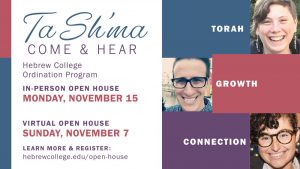 Join us for one of our November Open Houses. Learn more and register here.
Previous Post

August 17, 2021
Returning to Our Neighbors—To See or Not to See?
Next Post

August 31, 2021 Choosing Transformation—Over and Over Again
Browse Our Archives
Select a Category Uncategorized
Select a Month April 2026 March 2026 December 2025 November 2025 October 2025 September 2025 August 2025 July 2025 June 2025 May 2025 April 2025 March 2025 February 2025 January 2025 December 2024 November 2024 October 2024 September 2024 August 2024 July 2024 June 2024 May 2024 April 2024 March 2024 February 2024 January 2024 December 2023 November 2023 October 2023 September 2023 August 2023 July 2023 June 2023 May 2023 April 2023 March 2023 February 2023 January 2023 December 2022 November 2022 October 2022 September 2022 August 2022 July 2022 June 2022 May 2022 April 2022 March 2022 February 2022 January 2022 December 2021 November 2021 October 2021 September 2021 August 2021 July 2021 June 2021 May 2021 April 2021 March 2021 February 2021 January 2021 December 2020 November 2020 October 2020 September 2020 August 2020 July 2020 June 2020 May 2020 April 2020 March 2020 February 2020 January 2020 December 2019 November 2019 October 2019 September 2019 August 2019 July 2019 June 2019 May 2019 April 2019 March 2019 February 2019 January 2019 December 2018 November 2018 October 2018 September 2018 August 2018 July 2018 June 2018 May 2018 April 2018 March 2018 February 2018 January 2018 December 2017 November 2017 October 2017 September 2017 August 2017 July 2017 June 2017
Follow Us!
TAKE THE
Religious Wisdom Quiz
Who was thrown into a den of lions?
Select your answer to see how you score.
Joseph Daniel Jonah David
Related posts from Seventy Faces of Torah

The Holy Art of World Building

Parashat Tzav: Keeping the Sacred Fire Burning

Color Theory: What Joseph’s Coat Reveals
TRENDING AT PATHEOS Jewish

Building a Little Ark in a Frightening World
This past Shabbat, we read about Noah. I love this story. The...

Yom Kippur : Is There Always Room for...
Making Room for Forgiveness Every year as Yom Kippur approaches, I find...

This Rosh Hashanah: Can I Find New Meaning?
A Sunrise, a New Year, and a Question On our way to...

Killing Amalek: The Torah’s Most Misunderstood Commandment
Few passages of the Torah have provoked more confusion, polemic, and misuse...

I have never trusted a first draft. I don’t mean that...

Back to School, Back to Reality—and a New...
A New School Year Begins… Back to Reality A new school year...
view all Jewish blogs
Ad-Free & Subscriber Log-In Subscription Support
- About Us
- 2026 Calendar
- Videos
- Podcasts
- Library of World Religions
- Faith In Media Tracker
- Advertise With Us
- Write for Us
- Privacy Policy
- Terms of Service
- Do Not Sell My Data
- Contact Us
- Radiant Digital
- Manage Newsletter Subscriptions
- Unsubscribe From Notifications
- Sitemap
Copyright 2008-2026, Patheos. All rights reserved.
Subscription Support Ad-Free & Subscriber Log-In
Follow Patheos