
BuddhistCatholicContemplativeEvangelicalGeneral ChristianHinduJewishLatter-day SaintMuslimNew VisionsProgressive Christian
Beliefs
- Buddhist
- Catholic
- Contemplative
- Evangelical
- General Christian
- Hindu
- Jewish
- Latter-day Saint
- More Voices
- Muslim
- New Visions
- Pagan
- Progressive Christian
Topics
- Religion News
- Food and Religion
- Sports and Religion
- Religious Art
- Religious Music and Entertainment
- Religious Events
- History and Religion
- Style and Religion
- Politics and Religion
- Women in Religion
- Recreation Outdoors and Religion
- Business Finance and Religion
- Careers Workplace and Religion
- Education and Religion
- Family Parenting and Religion
- Health Fitness and Religion
- Home and Religion
- Relationships and Religion
- Technology and Religion
- Travel and Religion
Columnists
- Buddhist Columnists
- Business Finance and Religion Columnists
- Careers Workplace and Religion Columnists
- Catholic Columnists
- Contemplative Columnists
- Education and Religion Columnists
- Evangelists Columnists
- Family Parenting and Religion Columnists
- General Christian Columnists
- Health Fitness and Religion Columnists
- Hindu Columnists
- History and Religion Columnists
- Home and Religion Columnists
- Jewish Columnists
- More Voices Columnists
- Latter Day Columnists
- Muslim Columnists
- New Visions Columnists
- Nonreligious Columnists
- Pagan Columnists
- Politics and Religion Columnists
- Progressive Columnists
- Recreation Outdoors and Religion Columnists
- Relationships and Religion Columnists
- Religion News Columnists
- Religious Art Columnists
- Religious Events Columnists
- Religious Music and Entertainment Columnists
- Sports and Religion Columnists
- Style and Religion Columnists
- Technology and Religion Columnists
- Travel and Religion Columnists
- Women in Religion Columnists
Resource Library
- 2026 Calendar
- Library of World Religions
- The 100 Most Holy Places on Earth
- Patheos Answers
- Podcasts
- Videos
- Faith Leaders Database
- Anglican Episcopalian
- Bahai
- Baptist
- Buddhism
- Christianity
- Confucianism
- Eastern Orthodoxy
- Hinduism
- Holiness and Pentecostal
- ISKCON
- Islam
- Judaism
- Lutheran
- Methodist
- The Church of Jesus Christ of Latter-day Saints
- New Age
- Paganism
- Presbytarian and Reformed
- Protestantism
- Religion Behind the Scenes
- Roman Catholic
- Scientology
- Shia Islam
- Sikhism
- Sufism
- Sunni Islam
- Taoism
- Zen
- See all religions
Research Tools
 Ad-Free & Subscriber Log-In Subscription Support
Ad-Free & Subscriber Log-In Subscription Support
Follow Patheos 

- Trending:
- Forgiveness
- |
- Marriage
- |
- Consciousness
- |
- Death Penalty
- |
- Election
- |
- Halloween

- Home
- About Hebrew College
- The Rabbinical School of Hebrew College
- The Book of Psalms
- FREE NEWSLETTER
- Home
- Jewish
- Choosing Transformation—Over and Over Again
Choosing Transformation—Over and Over Again
Last updated on: August 31, 2021 at 3:36 pm by Hebrew College
Choosing Transformation—Over and Over Again 2021-08-31T15:36:14-04:00 Hebrew College
Patheos Explore the world's faith through different perspectives on religion and spirituality! Patheos has the views of the prevalent religions and spiritualities of the world.
Parashat Nitzavim (Deuteronomy 29:9–30:20)
By Rabbi Becky Silverstein | August 31, 2021
This summer, my family and I spent four nights at my mom and step dad’s house in Vermont. For two of the nights we were there, our group consisted of 11 adults and 4 children, ranging in age from 14 months to 7 years old. I spent a lot of time thinking about food. What will we feed our toddler for lunch? Do we have enough bananas? (We never have enough bananas.) Does someone else want these leftovers? Why didn’t [redacted] do their dishes? What is the right timing for getting together toppings and then grilling pizzas for all of us? Watching my family plan, cook, and clean up after meals continues to be one of my most profound, tangible experiences of being part of a collective.
The need to balance my individual needs and desires with that of a collective has never felt more acute to me. The ongoing global struggles with COVID, climate change, and refugee crises bring this need to my mind in a more concrete, material way. This moment in our Jewish calendar, en route from the collective grief of Tisha B’Av to Rosh Hashanah and Yom Kippur, where we will collectively celebrate the beginning of a new year, atone for our shortcomings, and set intentions for the coming year, brings this to my mind in a spiritual sense. The categories of concrete, material, and spiritual are not mutually exclusive; neither are our experiences of the world and our religious calendar.
This week’s Torah portion, Nitzavim, invites us to think about the ways in which these tensions—between ourselves as individuals with needs and desires and as members of various communities—can be transformative. In its opening we are immediately invited into the collective:
אַתֶּם נִצָּבִים הַיּוֹם כֻּלְּכֶם…
You who are standing today, all of you, before YHVH your God—your heads, your tribes, your elders, and your officers, all the men of Israel, your children, your wives, the stranger within your camp, from woodchopper to water drawer. (Deuteronomy 29:9-10).
These verses draw me into a palpable collective. I imagine myself as part of the “you,” one of the masses staring up and listening intently. I can feel the crowd pushing against each other, and sense those who have zoned out during the initial parts of Moses’ farewell address snapping to attention at the word “אַתֶּם (you).” In the words of Rabbi Samson Raphael Hirsch (19th C, Germany), the root of the word “נִצָּבִים (standing)” denotes that the Israelites are “standing firmly, standing powerfully with energetic perseverance.” Yes.
Our text continues with an invitation into collective purpose and transformation.
לְעָבְרְךָ בִּבְרִית — to enter into the covenant of YHVH your God, which YHVH your God is enacting with you today. (Deuterotomy 29:11)
The covenant is the source of collective purpose; an invitation to transformation. Here, too, I am drawing on Hirsch, who comments on the use of the verb “לְעׇבְרְךָ֗ (to pass over or to go over),” translated above as “to enter.” Hirsch teaches: “Once you entered into a covenant with Gd, your standpoint is fundamentally different from the one you held before.” Whether we call it a covenant, a relationship with Gd, or a sense of collective purpose, the Torah is opening the possibility of our being in a transformative relationship with the world we live in.
It is near impossible to live in our world and not be transformed by that experience—to have our hearts opened by fear, grief, joy, awe, beauty, song, connection with each other and the physical world, and so many other facets of being human.
Many of us have been living in a transformative relationship with the world for a long time, opening ourselves to the greater context in which we live and allowing ourselves to be changed by it. Others have resisted this change, perhaps out of a sense of self preservation, a bulwark against the overwhelming experience of being human. There is so much surrounding us. Currently, conversations about vaccine and mask mandates, as well as the ethics of global vaccine distribution, highlight the tension between our individual experience and a collective call. How many refugees a given country will take positions one set of people against another, and climate change highlights the way our world is interconnected.
In her recent piece, “’Personal Choice’ Won’t Stop The Climate Crisis. Join A Movement Instead,” my friend and teacher Rabbi Shoshana Meira Friedman demonstrates the ways in which a collective conscience and individual action can be mutually reinforcing. Rabbi Friedman urges us to commit to collective action by supporting youth-led climate movements. She also elevates the way in which individual action can help cultivate the conditions for a collective response:
When my family brings glass containers for take-out or saves up for an electric car, we don’t do it because it changes the world. We do it because it changes us. Buying local, insulating, forgoing plane trips, eating less meat, and the like build our integrity and our relationships. They make for more resilient communities. They are the baby sprouts of a more life-affirming, sustainable society.
One of the things about our world that pains me the most is that we do not seem to have a collective understanding of what it means to build a more just and equitable world, what it means for all people to live lives of dignity, and what it means to value human life. It would be easy to say that the Ancient Israelites had it easier, but we know from the prophets that they will forsake this covenant.
The truth is that my family is at its best when we have a clear sense of our meal plan and various responsibilities. And I’m not sure what to make about the lack of global understanding, even about the simplest truths, that seems to permeate our news cycle. I do know that Jewish tradition is a foundation from which we can “stand firmly and powerfully, with energetic perseverance.” (Hirsch on Deuteronomy 29:9) The Torah provides a framework for valuing our individual lives, the lives of our various communities, and the earth we live in. Our daily liturgy offers us the possibility of reconnecting to our covenant with Gd and each other and our yearly calendar deepens our human experience by calling attention to different aspects of our humanity.
This Rosh Hashanah, may the sound of the shofar awaken us to the possibility of the moment, and as we celebrate the re-coronation of Gd as king, may we reaffirm our presence in a covenant with the divine and our commitment to living into that covenant. May we commit הַיּוֹם (today) and every day to stand confidently as ourselves, look out at the world, and do the best we can for ourselves and each other.
Rabbi Becky Silverstein`14, a graduate of Hebrew College, is the rabbi/founder of Beyn Kodesh l’Chol, and chair of the boards of SVARA and The Jewish Studio Project.
Want to learn more about our rabbinical program?
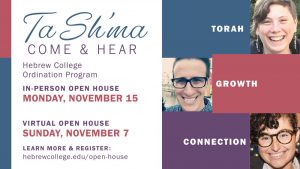 Join us for one of our November Open Houses. Learn more and register here.
Previous Post
August 23, 2021
Our Evolving Relationship To Prayer
Next Post
September 8, 2021 Words of Love and Truth
Browse Our Archives
Select a Category Uncategorized
Select a Month April 2026 March 2026 December 2025 November 2025 October 2025 September 2025 August 2025 July 2025 June 2025 May 2025 April 2025 March 2025 February 2025 January 2025 December 2024 November 2024 October 2024 September 2024 August 2024 July 2024 June 2024 May 2024 April 2024 March 2024 February 2024 January 2024 December 2023 November 2023 October 2023 September 2023 August 2023 July 2023 June 2023 May 2023 April 2023 March 2023 February 2023 January 2023 December 2022 November 2022 October 2022 September 2022 August 2022 July 2022 June 2022 May 2022 April 2022 March 2022 February 2022 January 2022 December 2021 November 2021 October 2021 September 2021 August 2021 July 2021 June 2021 May 2021 April 2021 March 2021 February 2021 January 2021 December 2020 November 2020 October 2020 September 2020 August 2020 July 2020 June 2020 May 2020 April 2020 March 2020 February 2020 January 2020 December 2019 November 2019 October 2019 September 2019 August 2019 July 2019 June 2019 May 2019 April 2019 March 2019 February 2019 January 2019 December 2018 November 2018 October 2018 September 2018 August 2018 July 2018 June 2018 May 2018 April 2018 March 2018 February 2018 January 2018 December 2017 November 2017 October 2017 September 2017 August 2017 July 2017 June 2017
Follow Us!
TAKE THE
Religious Wisdom Quiz
Which couple taught Apollos more accurately about Jesus in Ephesus?
Select your answer to see how you score.
Mary and Joseph Lydia and Titus Priscilla and Aquila Ananias and Sapphira
Related posts from Seventy Faces of Torah

The Holy Art of World Building

Parashat Tzav: Keeping the Sacred Fire Burning

Color Theory: What Joseph’s Coat Reveals
TRENDING AT PATHEOS Jewish

Yom Kippur : Is There Always Room for...
Making Room for Forgiveness Every year as Yom Kippur approaches, I find...

This Rosh Hashanah: Can I Find New Meaning?
A Sunrise, a New Year, and a Question On our way to...

Killing Amalek: The Torah’s Most Misunderstood Commandment
Few passages of the Torah have provoked more confusion, polemic, and misuse...

I have never trusted a first draft. I don’t mean that...

Back to School, Back to Reality—and a New...
A New School Year Begins… Back to Reality A new school year...

Out-Crowleying Crowley: The Emptiness of the O9A
O9A Neo-Crowley Racial Cosplay and Edgelord Atrocitism Aleister Crowley did not create...
view all Jewish blogs
Ad-Free & Subscriber Log-In Subscription Support
- About Us
- 2026 Calendar
- Videos
- Podcasts
- Library of World Religions
- Faith In Media Tracker
- Advertise With Us
- Write for Us
- Privacy Policy
- Terms of Service
- Do Not Sell My Data
- Contact Us
- Radiant Digital
- Manage Newsletter Subscriptions
- Unsubscribe From Notifications
- Sitemap
Copyright 2008-2026, Patheos. All rights reserved.
Subscription Support Ad-Free & Subscriber Log-In
Follow Patheos