
BuddhistCatholicContemplativeEvangelicalGeneral ChristianHinduJewishLatter-day SaintMuslimNew VisionsProgressive Christian
Beliefs
- Buddhist
- Catholic
- Contemplative
- Evangelical
- General Christian
- Hindu
- Jewish
- Latter-day Saint
- More Voices
- Muslim
- New Visions
- Pagan
- Progressive Christian
Topics
- Religion News
- Food and Religion
- Sports and Religion
- Religious Art
- Religious Music and Entertainment
- Religious Events
- History and Religion
- Style and Religion
- Politics and Religion
- Women in Religion
- Recreation Outdoors and Religion
- Business Finance and Religion
- Careers Workplace and Religion
- Education and Religion
- Family Parenting and Religion
- Health Fitness and Religion
- Home and Religion
- Relationships and Religion
- Technology and Religion
- Travel and Religion
Columnists
- Buddhist Columnists
- Business Finance and Religion Columnists
- Careers Workplace and Religion Columnists
- Catholic Columnists
- Contemplative Columnists
- Education and Religion Columnists
- Evangelists Columnists
- Family Parenting and Religion Columnists
- General Christian Columnists
- Health Fitness and Religion Columnists
- Hindu Columnists
- History and Religion Columnists
- Home and Religion Columnists
- Jewish Columnists
- More Voices Columnists
- Latter Day Columnists
- Muslim Columnists
- New Visions Columnists
- Nonreligious Columnists
- Pagan Columnists
- Politics and Religion Columnists
- Progressive Columnists
- Recreation Outdoors and Religion Columnists
- Relationships and Religion Columnists
- Religion News Columnists
- Religious Art Columnists
- Religious Events Columnists
- Religious Music and Entertainment Columnists
- Sports and Religion Columnists
- Style and Religion Columnists
- Technology and Religion Columnists
- Travel and Religion Columnists
- Women in Religion Columnists
Resource Library
- 2026 Calendar
- Library of World Religions
- The 100 Most Holy Places on Earth
- Patheos Answers
- Podcasts
- Videos
- Faith Leaders Database
- Anglican Episcopalian
- Bahai
- Baptist
- Buddhism
- Christianity
- Confucianism
- Eastern Orthodoxy
- Hinduism
- Holiness and Pentecostal
- ISKCON
- Islam
- Judaism
- Lutheran
- Methodist
- The Church of Jesus Christ of Latter-day Saints
- New Age
- Paganism
- Presbytarian and Reformed
- Protestantism
- Religion Behind the Scenes
- Roman Catholic
- Scientology
- Shia Islam
- Sikhism
- Sufism
- Sunni Islam
- Taoism
- Zen
- See all religions
Research Tools
 Ad-Free & Subscriber Log-In Subscription Support
Ad-Free & Subscriber Log-In Subscription Support
Follow Patheos 

- Trending:
- Forgiveness
- |
- Marriage
- |
- Consciousness
- |
- Death Penalty
- |
- Election
- |
- Halloween

- Home
- About Hebrew College
- The Rabbinical School of Hebrew College
- The Book of Psalms
- FREE NEWSLETTER
- Home
- Jewish
- A Broken Peace—The Brit Shalom with Pinchas
A Broken Peace—The Brit Shalom with Pinchas
Last updated on: July 1, 2021 at 11:06 am by Hebrew College
A Broken Peace—The Brit Shalom with Pinchas 2021-07-01T11:06:24-04:00 Hebrew College
Patheos Explore the world's faith through different perspectives on religion and spirituality! Patheos has the views of the prevalent religions and spiritualities of the world.
Parashat Pinchas (Numbers 25:10-30:1)
By Rachel Adelman | June 30, 2021
I dedicate this essay to two of my BeMidbar students, Ken Richmond (spring 2020) and Sara Blumenthal (spring 2021), who presented on this topic in my class and inspired many of these insights.
The story of Pinchas and the apostasy of Baal Peor straddles two Torah readings: the end of Parashat Balak (Numbers 25:1-9) and the opening of this week’s reading, Parashat Pinchas (25:10-15). The story begins when the Israelites encamped at Shittim and were assailed by a bevy of Moabite women, who lured them into worshipping the god of Baal Peor. Incensed, the God of Israel ordered Moses to “take all the ringleaders and have them publicly impaled before the LORD, so that the LORD’s wrath may turn away from Israel.” (Numbers 25:4) But, flouting Moses’ orders, an Israelite man took a Midianite woman, presumably for sexual relations (later identified as Zimri, a chieftain of the tribe of Shimon, and Cozbi a Midianite princess, vv. 14-15).
Pinchas, the grandson of Aaron, then stepped into the chamber with his spear and skewered the couple en flagrante delicto, thereby averting God’s wrath. Only then do we hear, in retrospect, that a plague had been raging through the camp and that the consequent death toll was 24,000 (v. 9). This is truly the nadir of the Israelites’ sojourn in the desert! Moses fails to punish the leaders and control the mob and Pinchas steps into the breach, operating outside any court sanction, command from Moses, or even orders from On High.
I am intensely uncomfortable with this expression of religious conviction—as were the Rabbis two millennia ago; and identify, rather, with the words of the Irish poet, W. B. Yeats: “the best lack all conviction, while the worst/ are full of passionate intensity.”
How could this vigilante act of violence effectively stay the plague? The answer lies in the gap between the two resolutions to the story that straddle the two Torah portions. The first ends last week’s reading (Balak); the plague ceases because of what Pinchas does (v. 9). The second opens this week’s eponymous Torah reading; Pinchas is rewarded with the covenant of peace and he and his descendants inherit the High Priesthood (vv. 11-13). In this resolution to the story, God turns to Moses and says . . . .
Pinchas, son of Eleazar, son of Aaron the priest, has turned back my wrath from the Israelites by manifesting such zeal [be-qan’o ’et qin’ati] among them on my behalf that in my jealousy [qin’ati] I did not consume the Israelites. Therefore say, ‘I hereby grant him my covenant of peace [briti shalom]. It shall be for him and for his descendants after him a covenant of perpetual priesthood [brit kehunat ‘olam], because he was zealous for his God, and made atonement [va-yekhapper] for the Israelites. (Numbers 25:11-13, NRSV trans. adapted).
Lest we have any doubts about Pinchas’ zeal [qin’a], these divine words affirm that he acted on behalf of God’s jealousy [qin’a]. As we know from the Decalogue, the Israelites are forbidden to worship any other god, for “I the LORD your God am a jealous God [’El qan’a]” (Exodus 20:5, Deuteronomy 5:9; cf. 4:29, 6:15; 32:16, 19, and 21). Religious zealotry [qin’a] channels the passion of God’s possessive and exclusive relationship with Israel.
To demonstrate that Heaven has his back, so to speak, God affirms Pinchas’ priestly lineage—the son of Elazar, son of Aaron (vv. 11, as in v. 7)—and grants him “my covenant of peace [briti shalom]” (v. 12). How strange to respond to violence with the gift of peace [shalom]! What peace, well-being, or wholeness [shalom] can emerge out of religious violence? Based on the narrative and these words, Pinchas’ act would only be condoned if it turned away the wrath of God when a plague is raging. Consider, similarly, the episode when the Levites turn on the people engaged in worshipping the Golden Calf, killing three thousand (Exodus 34:26-28). Then, too, God sent a plague in response to Israel’s apostasy (v. 35). After Korah’s rebellion, Moses orders Aaron to run through the camp with his firepan of incense, weaving between the living and dead to stay the plague; 14,700 Israelites died that time (Num. 17:11-14). This is the same power of atonement [kapparah] enacted on behalf of the collective Jewish body on Yom Kippur by the Cohen Gadol (high priest) with incense and prayer. The Cohen single-handedly shifts God from the Throne of Judgment [din] to the Throne of Compassion [raḥamim]. Ibn Ezra understands the briti shalom as equivalent to the “covenant of perpetual priesthood [brit kehunat ‘olam]” (v. 13). Pinchas and his descendants will henceforth carry that mantle of the high priest.
This is, nevertheless, an irresolute peace. According to tradition, the Masoretes (the scribes, responsible for adding vocalization, musical notation, and other filigrees to the Torah scroll), mark the Hebrew word shalom—peace, wholeness, well-being—with a severed letter (vav katiyah).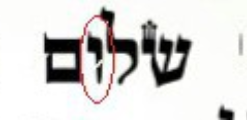
Drawing upon the insights of my students, I would like to give that broken letter a new significance. Throughout the millennia, religious violence has been justified to preserve the integrity of the tradition and the people—cutting, or “skewering” (as Pinchas does with his spear), for the sake of the integrity of the whole. Yet the shockwaves of that violence leave that whole fragile; a broken peace, symbolized by the severed line, a white gap in the letter vav. In the wake of such death, nothing can be a simple connector between Earth and Heaven, Heaven and Earth, again. Only in the End of Days will that peace be whole, as Ezekiel avers: “I will make of covenant of peace/friendship [brit shalom] with them and it shall be an everlasting covenant with them—I will establish them and multiply them, and I will place My Sanctuary among them forever. My Presence shall rest over them; I will be their God and they shall be my people” (Ezekiel 37:26-27). Only in this shalom is the letter vav continuously unbroken; a direct vertical alignment between Earth and Heaven.
We now live in an era without a divine mandate—in the absence of prophecy, of miracles, of any echo from the skies—where the answer is “not in Heaven,” but, according to the Jewish tradition, in rabbinic majority rule (Deuteronomy 30:12, b. Bava Metzia 59b). We do not condone religious violence; no one may lay claim to an unalloyed sense of what is right and wrong.
So what stays the plague in this day and age? Not a vigilante’s spear or a firepan of incense, but the voice of rationality and science. Schooled in questioning and uncertainty, in laboratories and trials, “truth springs up from the Earth” (Psalm 85:12). And so we try to adhere to the CDC and guidelines for global travel, and, of course, encourage widespread vaccination. This is the only “voice from Heaven” we may hear in this world of fragile peace, the shalom with a severed vav. Yet it too may yield, in the words of Leonard Cohen, “a broken Hallelujah.”
Shabbat Shalom!
Rachel Adelman is associate professor of Hebrew Bible at the Hebrew College Rabbinical School. She received her PhD at Hebrew University, in Jerusalem. When she is not writing books, articles, or divrei torah, it is poetry that flows from her pen.
Previous Post

June 23, 2021
The Illusion
Next Post

July 7, 2021 Vows that Divide
Browse Our Archives
Select a Category Uncategorized
Select a Month April 2026 March 2026 December 2025 November 2025 October 2025 September 2025 August 2025 July 2025 June 2025 May 2025 April 2025 March 2025 February 2025 January 2025 December 2024 November 2024 October 2024 September 2024 August 2024 July 2024 June 2024 May 2024 April 2024 March 2024 February 2024 January 2024 December 2023 November 2023 October 2023 September 2023 August 2023 July 2023 June 2023 May 2023 April 2023 March 2023 February 2023 January 2023 December 2022 November 2022 October 2022 September 2022 August 2022 July 2022 June 2022 May 2022 April 2022 March 2022 February 2022 January 2022 December 2021 November 2021 October 2021 September 2021 August 2021 July 2021 June 2021 May 2021 April 2021 March 2021 February 2021 January 2021 December 2020 November 2020 October 2020 September 2020 August 2020 July 2020 June 2020 May 2020 April 2020 March 2020 February 2020 January 2020 December 2019 November 2019 October 2019 September 2019 August 2019 July 2019 June 2019 May 2019 April 2019 March 2019 February 2019 January 2019 December 2018 November 2018 October 2018 September 2018 August 2018 July 2018 June 2018 May 2018 April 2018 March 2018 February 2018 January 2018 December 2017 November 2017 October 2017 September 2017 August 2017 July 2017 June 2017
Follow Us!
TAKE THE
Religious Wisdom Quiz
Which tribe of Israel did NOT receive a land inheritance?
Select your answer to see how you score.
Benjamin Gad Judah Levi
Related posts from Seventy Faces of Torah

The Holy Art of World Building

Parashat Tzav: Keeping the Sacred Fire Burning

Color Theory: What Joseph’s Coat Reveals
TRENDING AT PATHEOS Jewish

Building a Little Ark in a Frightening World
This past Shabbat, we read about Noah. I love this story. The...

Yom Kippur : Is There Always Room for...
Making Room for Forgiveness Every year as Yom Kippur approaches, I find...

This Rosh Hashanah: Can I Find New Meaning?
A Sunrise, a New Year, and a Question On our way to...

Killing Amalek: The Torah’s Most Misunderstood Commandment
Few passages of the Torah have provoked more confusion, polemic, and misuse...

I have never trusted a first draft. I don’t mean that...

Back to School, Back to Reality—and a New...
A New School Year Begins… Back to Reality A new school year...
view all Jewish blogs
Ad-Free & Subscriber Log-In Subscription Support
- About Us
- 2026 Calendar
- Videos
- Podcasts
- Library of World Religions
- Faith In Media Tracker
- Advertise With Us
- Write for Us
- Privacy Policy
- Terms of Service
- Do Not Sell My Data
- Contact Us
- Radiant Digital
- Manage Newsletter Subscriptions
- Unsubscribe From Notifications
- Sitemap
Copyright 2008-2026, Patheos. All rights reserved.
Subscription Support Ad-Free & Subscriber Log-In
Follow Patheos