
BuddhistCatholicContemplativeEvangelicalGeneral ChristianHinduJewishLatter-day SaintMuslimNew VisionsProgressive Christian
Beliefs
- Buddhist
- Catholic
- Contemplative
- Evangelical
- General Christian
- Hindu
- Jewish
- Latter-day Saint
- More Voices
- Muslim
- New Visions
- Pagan
- Progressive Christian
Topics
- Religion News
- Food and Religion
- Sports and Religion
- Religious Art
- Religious Music and Entertainment
- Religious Events
- History and Religion
- Style and Religion
- Politics and Religion
- Women in Religion
- Recreation Outdoors and Religion
- Business Finance and Religion
- Careers Workplace and Religion
- Education and Religion
- Family Parenting and Religion
- Health Fitness and Religion
- Home and Religion
- Relationships and Religion
- Technology and Religion
- Travel and Religion
Columnists
- Buddhist Columnists
- Business Finance and Religion Columnists
- Careers Workplace and Religion Columnists
- Catholic Columnists
- Contemplative Columnists
- Education and Religion Columnists
- Evangelists Columnists
- Family Parenting and Religion Columnists
- General Christian Columnists
- Health Fitness and Religion Columnists
- Hindu Columnists
- History and Religion Columnists
- Home and Religion Columnists
- Jewish Columnists
- More Voices Columnists
- Latter Day Columnists
- Muslim Columnists
- New Visions Columnists
- Nonreligious Columnists
- Pagan Columnists
- Politics and Religion Columnists
- Progressive Columnists
- Recreation Outdoors and Religion Columnists
- Relationships and Religion Columnists
- Religion News Columnists
- Religious Art Columnists
- Religious Events Columnists
- Religious Music and Entertainment Columnists
- Sports and Religion Columnists
- Style and Religion Columnists
- Technology and Religion Columnists
- Travel and Religion Columnists
- Women in Religion Columnists
Resource Library
- 2026 Calendar
- Library of World Religions
- The 100 Most Holy Places on Earth
- Patheos Answers
- Podcasts
- Videos
- Faith Leaders Database
- Anglican Episcopalian
- Bahai
- Baptist
- Buddhism
- Christianity
- Confucianism
- Eastern Orthodoxy
- Hinduism
- Holiness and Pentecostal
- ISKCON
- Islam
- Judaism
- Lutheran
- Methodist
- The Church of Jesus Christ of Latter-day Saints
- New Age
- Paganism
- Presbytarian and Reformed
- Protestantism
- Religion Behind the Scenes
- Roman Catholic
- Scientology
- Shia Islam
- Sikhism
- Sufism
- Sunni Islam
- Taoism
- Zen
- See all religions
Research Tools
 Ad-Free & Subscriber Log-In Subscription Support
Ad-Free & Subscriber Log-In Subscription Support
Follow Patheos 

- Trending:
- Forgiveness
- |
- Marriage
- |
- Consciousness
- |
- Death Penalty
- |
- Election
- |
- Halloween

- Home
- About Hebrew College
- The Rabbinical School of Hebrew College
- The Book of Psalms
- FREE NEWSLETTER
- Home
- Jewish
- Rekindling the Flame
Rekindling the Flame
Last updated on: April 29, 2021 at 9:16 am by Hebrew College
Rekindling the Flame 2021-04-29T09:16:16-04:00 Hebrew College
Patheos Explore the world's faith through different perspectives on religion and spirituality! Patheos has the views of the prevalent religions and spiritualities of the world.
Emor (Leviticus 21:1–24:23)
By Joshua Jacobson | April 28, 2021
In this week’s Torah portion of Emor we find the second reference to what many people think of as a sacred object called in Hebrew ner tamid, often translated into English as “eternal light.”
When Jews hear these two words, we often think of the lamp—often a decorative lamp—by the same name hanging by the eastern wall in synagogue sanctuaries throughout the world. This light is perpetually lit, symbolizing God’s eternal presence. But that is not the full story of the origins of this ritual item.
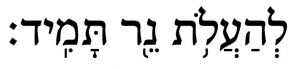
In this week’s portion, there is a lengthy set of instructions for how the priests are to carry out their divine service in the mishkan, the portable desert sanctuary. This includes the lighting of the lamps in the lampstand, known as the menorah. “Command the Israelite people to take for yourself clear oil of beaten olives for lighting, for kindling lamps regularly.” The last three words in the Hebrew original, leha’alot ner tamid, mean “for kindling lamps regularly,” not “for kindling an eternal light,” as we commonly interpret the phrase today. In this context, the word tamid is not an adjective (“eternal”) but an adverb (“regularly”).
This is how the medieval scholars known as the Masoretes read this text. These sages created the system of cantillation we use to this very day—the symbolic marks in our Bible that indicate not only how to chant the words of the Torah, but also how to punctuate them. Without getting overly technical, if tamid had been an adjective modifying ner (“eternal light”) it would have been punctuated with merekha, thus grouping the two words together. But the word ner is actually punctuated with tippeha, indicating that it is separated from tamid. Thus, the Masoretic reading of leha’alot ner tamid is “for kindling lamps regularly.”
If that is the case, why are these words so often mistranslated?
Let’s go back a few verses to Leviticus 6:6, where it states, “A perpetual fire on the altar shall be kept burning, not to go out.” So there was an eternal light, but it wasn’t a lamp, it wasn’t the menorah—it was a fire on the altar, esh tamid, from which the lamps would be kindled each and every day. And it was never to be extinguished (lo tikhbe).
Does this distinction have any relevance for us today?
The desert sanctuary was eventually replaced by the Jerusalem Temple (Bet Ha-mikdash), and then by the synagogue, which has been called a mikdash me’at, “minor temple.” The practice of hanging an “eternal light” in our synagogues, a custom that emerged some four centuries ago, conveys the powerful sentiment that God’s presence is both eternal and inextinguishable. We can also find symbolic meaning in the original sense of leha’alot ner tamid—to kindle lamps unfailingly, regularly, day after day. God’s presence is not to be taken for granted; it needs to be acknowledged in a heartfelt manner. It is for this reason that our sages (Pirkey Avot 2:13) warned us not to let our prayers become mere rote recitation, what they called keva. Our connection with the Divine must be renewed daily, continuously.
Further, every morning in our prayers we state that God “lovingly renews creation daily, continuously.” This serves as an invitation to us to look at the world through fresh eyes each morning as darkness yields to light. Just as God renews creation every day, tamid, continuously, it is incumbent on us to reciprocate by seeking out the light and actively working to increase or expand this sacred light—in our hearts, in our homes, and in our communities. Like the biblical priests we must tend carefully to the divine fire, harnessing the energy in our service of the Divine.
The Torah portion of Emor teaches us that we must seek out, give praise for, and renew God’s light—tamid!
Joshua Jacobson is founder and director of the Zamir Chorale of Boston. He served for 45 years as professor of music and Director of Choral Activities at Northeastern University. He has guest conducted the Boston Pops Orchestra, the Bulgarian National Symphony and Chorus, the New England Conservatory Orchestra, and the Boston Lyric Opera Company. He is also a visiting professor at Hebrew College, where he was awarded the Benjamin Shevach Award for Distinguished Achievement in Jewish Educational Leadership in 1994. This commentary was edited by Rabbi Or Rose.
Previous Post

April 21, 2021
Rebuilding toward Holiness
Next Post

April 29, 2021 Lag BaOmer: Starting Over Yet Again
Browse Our Archives
Select a Category Uncategorized
Select a Month April 2026 March 2026 December 2025 November 2025 October 2025 September 2025 August 2025 July 2025 June 2025 May 2025 April 2025 March 2025 February 2025 January 2025 December 2024 November 2024 October 2024 September 2024 August 2024 July 2024 June 2024 May 2024 April 2024 March 2024 February 2024 January 2024 December 2023 November 2023 October 2023 September 2023 August 2023 July 2023 June 2023 May 2023 April 2023 March 2023 February 2023 January 2023 December 2022 November 2022 October 2022 September 2022 August 2022 July 2022 June 2022 May 2022 April 2022 March 2022 February 2022 January 2022 December 2021 November 2021 October 2021 September 2021 August 2021 July 2021 June 2021 May 2021 April 2021 March 2021 February 2021 January 2021 December 2020 November 2020 October 2020 September 2020 August 2020 July 2020 June 2020 May 2020 April 2020 March 2020 February 2020 January 2020 December 2019 November 2019 October 2019 September 2019 August 2019 July 2019 June 2019 May 2019 April 2019 March 2019 February 2019 January 2019 December 2018 November 2018 October 2018 September 2018 August 2018 July 2018 June 2018 May 2018 April 2018 March 2018 February 2018 January 2018 December 2017 November 2017 October 2017 September 2017 August 2017 July 2017 June 2017
Follow Us!
TAKE THE
Religious Wisdom Quiz
I made a rash vow that cost me my only child after a military victory. Who am I?
Select your answer to see how you score.
Jephthah Barak Samson Gideon
Related posts from Seventy Faces of Torah

The Holy Art of World Building

Parashat Tzav: Keeping the Sacred Fire Burning

Color Theory: What Joseph’s Coat Reveals
TRENDING AT PATHEOS Jewish

Yom Kippur : Is There Always Room for...
Making Room for Forgiveness Every year as Yom Kippur approaches, I find...

This Rosh Hashanah: Can I Find New Meaning?
A Sunrise, a New Year, and a Question On our way to...

Killing Amalek: The Torah’s Most Misunderstood Commandment
Few passages of the Torah have provoked more confusion, polemic, and misuse...

I have never trusted a first draft. I don’t mean that...

Back to School, Back to Reality—and a New...
A New School Year Begins… Back to Reality A new school year...

Out-Crowleying Crowley: The Emptiness of the O9A
O9A Neo-Crowley Racial Cosplay and Edgelord Atrocitism Aleister Crowley did not create...
view all Jewish blogs
Ad-Free & Subscriber Log-In Subscription Support
- About Us
- 2026 Calendar
- Videos
- Podcasts
- Library of World Religions
- Faith In Media Tracker
- Advertise With Us
- Write for Us
- Privacy Policy
- Terms of Service
- Do Not Sell My Data
- Contact Us
- Radiant Digital
- Manage Newsletter Subscriptions
- Unsubscribe From Notifications
- Sitemap
Copyright 2008-2026, Patheos. All rights reserved.
Subscription Support Ad-Free & Subscriber Log-In
Follow Patheos