
BuddhistCatholicContemplativeEvangelicalGeneral ChristianHinduJewishLatter-day SaintMuslimNew VisionsProgressive Christian
Beliefs
- Buddhist
- Catholic
- Contemplative
- Evangelical
- General Christian
- Hindu
- Jewish
- Latter-day Saint
- More Voices
- Muslim
- New Visions
- Pagan
- Progressive Christian
Topics
- Religion News
- Food and Religion
- Sports and Religion
- Religious Art
- Religious Music and Entertainment
- Religious Events
- History and Religion
- Style and Religion
- Politics and Religion
- Women in Religion
- Recreation Outdoors and Religion
- Business Finance and Religion
- Careers Workplace and Religion
- Education and Religion
- Family Parenting and Religion
- Health Fitness and Religion
- Home and Religion
- Relationships and Religion
- Technology and Religion
- Travel and Religion
Columnists
- Buddhist Columnists
- Business Finance and Religion Columnists
- Careers Workplace and Religion Columnists
- Catholic Columnists
- Contemplative Columnists
- Education and Religion Columnists
- Evangelists Columnists
- Family Parenting and Religion Columnists
- General Christian Columnists
- Health Fitness and Religion Columnists
- Hindu Columnists
- History and Religion Columnists
- Home and Religion Columnists
- Jewish Columnists
- More Voices Columnists
- Latter Day Columnists
- Muslim Columnists
- New Visions Columnists
- Nonreligious Columnists
- Pagan Columnists
- Politics and Religion Columnists
- Progressive Columnists
- Recreation Outdoors and Religion Columnists
- Relationships and Religion Columnists
- Religion News Columnists
- Religious Art Columnists
- Religious Events Columnists
- Religious Music and Entertainment Columnists
- Sports and Religion Columnists
- Style and Religion Columnists
- Technology and Religion Columnists
- Travel and Religion Columnists
- Women in Religion Columnists
Resource Library
- 2026 Calendar
- Library of World Religions
- The 100 Most Holy Places on Earth
- Patheos Answers
- Podcasts
- Videos
- Faith Leaders Database
- Anglican Episcopalian
- Bahai
- Baptist
- Buddhism
- Christianity
- Confucianism
- Eastern Orthodoxy
- Hinduism
- Holiness and Pentecostal
- ISKCON
- Islam
- Judaism
- Lutheran
- Methodist
- The Church of Jesus Christ of Latter-day Saints
- New Age
- Paganism
- Presbytarian and Reformed
- Protestantism
- Religion Behind the Scenes
- Roman Catholic
- Scientology
- Shia Islam
- Sikhism
- Sufism
- Sunni Islam
- Taoism
- Zen
- See all religions
Research Tools
 Ad-Free & Subscriber Log-In Subscription Support
Ad-Free & Subscriber Log-In Subscription Support
Follow Patheos 

- Trending:
- Forgiveness
- |
- Marriage
- |
- Consciousness
- |
- Death Penalty
- |
- Election
- |
- Halloween

- Home
- About Hebrew College
- The Rabbinical School of Hebrew College
- The Book of Psalms
- FREE NEWSLETTER
- Home
- Jewish
- Praying for Rain
Praying for Rain
Last updated on: October 7, 2020 at 11:36 am by Hebrew College
Praying for Rain 2020-10-07T11:36:28-04:00 Hebrew College
Patheos Explore the world's faith through different perspectives on religion and spirituality! Patheos has the views of the prevalent religions and spiritualities of the world.
Shemini Atzeret
By Rabbi Daniel Berman | October 07, 2020
Eight years ago I wrote a short d’var Torah for Shmini Atzeret. The topic was rain. Highlighting the theme that we’re not quite as powerful as we think, which is at the center of Sukkot and Kohelet, I wrote, “when it rains, it rains, and when there’s sun, there’s sun, and, for the most part, there’s not a thing in the world we can do to change that.”
My wife, Sarah, an educator and advocate in sustainable energy at MIT, and my daughter, Elie, an environmental activist, have taught me a lot about the impact of the warming of the climate on our ecosystem. I know by now that we actually have immense power to influence our climate, including rain.
Questions of human power in relationship to the earth and water are at the center of ancient rabbinic texts on Sukkot. In the agrarian society in which our tradition emerged, religious ritual was connected to the cycles of the bounty of the earth. During this time of year, particularly for those finishing their summer harvest, trimming perennial plants, and waiting for the rain to moisten the soil and strengthen the roots in their fields, rain was at the center of their thoughts and prayers.
At the end of Sukkot, during Shemini Atzeret, we add a verse to the second blessing of the Amidah called “gevurot geshamim,” meaning the power of rain. The verse—“*mashiv ha’ruach u’morid hagashem”—*offers praise to God for the blessing of rain.
In mishna Taanit, our ancient rabbis debated the timing of adding this verse to the Amidah. Rabbi Eliezar taught that we should add these words from the first day of Yom Tov Sukkot. Rabbi Yehoshua disagreed: no, we should begin to praise God for rain on the last day of Sukkot, as rain during Sukkot would be a “*siman k’lalah”—*a curse on the festival; it would prevent us from dwelling in our sukkah. (A parallel teaching in mishna Sukkah adds a humorous but unnerving image: rain during Sukkot is like a servant who comes to fill a cup for his master and the master pours the ladle in his face).
When Rabbi Eliezar clarified that he was not referring to prayer requesting rain, but rather praising God’s power to bring rain, Rabbi Yehoshua was ready with a response: if so, we should say this prayer all year long! No, gevurot geshamim should only be said when rain is actually a blessing. I tend to agree, particularly during Sukkot.
But our mishna goes on to present a more serious problem than rain falling during Sukkot: what happens if the rainy season commences and the rains never come? What then?
To begin, particular individuals take on three fasts. If the next month (Rosh Hodesh Kislev) arrives and there’s still no rain, the Court decrees three fasts for the whole community. If these fasts pass “and were not answered,” the Court decrees three more fasts, then another three, then an additional seven—now 13 fasts for the community.
What is this about?
First, there is a clear practical concern: fasting preserves the resources of the community. Mirroring the narrative of Joseph in Egypt, the community cuts back on its consumption of the resources it will need in case of sustained drought.
Second, there is a reaffirmation that religious ritual, including fasting and prayer, have meaning and purpose in sustaining the community. While our theology of prayer has grown over generations, this is a time of year when we’re called to the possibility that prayer can change us. The biblical stories of Hannah and Jonah, two of our haftarot during the Yamim Noraim, reveal prayer to be transformational: after Hannah prays, she conceives, and after Jonah prays, he is re-birthed into the world from the belly of a fish. At the very least, their prayers enter both Hannah and Jonah into new spiritual realities.
Lastly, it’s telling that the Court decreed full communal fasts. I imagine members of the community coming together, seeking solace in one another, sharing experiences, praying, and relying on their collective strength.
We know much more now, of course, about our power to affect the rains and the earth. To prayer, fasting and preservation of resources, we add buying less, purchasing sustainable products, eating plants, conserving energy, composting, recycling and reusing. But to live in the kind of relationship with the natural world that Torah and our ancient rabbis place at the heart of the human experience, our spiritual posture needs to remain exactly the same: to stand humbly and responsibly before God, as we tend lovingly to the earth.
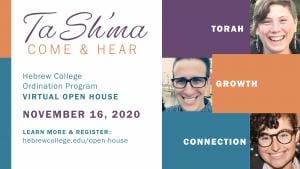
Rabbi Dan Berman is rabbi at Temple Reyim in Newton, MA. He was ordained in 2010 graduate by Hebrew College. Learn more about Hebrew College’s rabbinical and cantorial programs at our virtual Open House, Ta Sh’ma (Come & Hear) on November 16, 2020.
Previous Post

September 30, 2020
The Walls That Surround Us
Next Post

October 13, 2020 “In the beginning…”: Returning to the Wild Depths of Creation
Browse Our Archives
Select a Category Uncategorized
Select a Month April 2026 March 2026 December 2025 November 2025 October 2025 September 2025 August 2025 July 2025 June 2025 May 2025 April 2025 March 2025 February 2025 January 2025 December 2024 November 2024 October 2024 September 2024 August 2024 July 2024 June 2024 May 2024 April 2024 March 2024 February 2024 January 2024 December 2023 November 2023 October 2023 September 2023 August 2023 July 2023 June 2023 May 2023 April 2023 March 2023 February 2023 January 2023 December 2022 November 2022 October 2022 September 2022 August 2022 July 2022 June 2022 May 2022 April 2022 March 2022 February 2022 January 2022 December 2021 November 2021 October 2021 September 2021 August 2021 July 2021 June 2021 May 2021 April 2021 March 2021 February 2021 January 2021 December 2020 November 2020 October 2020 September 2020 August 2020 July 2020 June 2020 May 2020 April 2020 March 2020 February 2020 January 2020 December 2019 November 2019 October 2019 September 2019 August 2019 July 2019 June 2019 May 2019 April 2019 March 2019 February 2019 January 2019 December 2018 November 2018 October 2018 September 2018 August 2018 July 2018 June 2018 May 2018 April 2018 March 2018 February 2018 January 2018 December 2017 November 2017 October 2017 September 2017 August 2017 July 2017 June 2017
Follow Us!
TAKE THE
Religious Wisdom Quiz
What does "Selah," found often in Psalms, likely mean?
Select your answer to see how you score.
Sing loudly Give thanks Forever Pause or reflect
Related posts from Seventy Faces of Torah

The Holy Art of World Building

Parashat Tzav: Keeping the Sacred Fire Burning

Color Theory: What Joseph’s Coat Reveals
TRENDING AT PATHEOS Jewish

Building a Little Ark in a Frightening World
This past Shabbat, we read about Noah. I love this story. The...

Yom Kippur : Is There Always Room for...
Making Room for Forgiveness Every year as Yom Kippur approaches, I find...

This Rosh Hashanah: Can I Find New Meaning?
A Sunrise, a New Year, and a Question On our way to...

Killing Amalek: The Torah’s Most Misunderstood Commandment
Few passages of the Torah have provoked more confusion, polemic, and misuse...

I have never trusted a first draft. I don’t mean that...

Back to School, Back to Reality—and a New...
A New School Year Begins… Back to Reality A new school year...
view all Jewish blogs
Ad-Free & Subscriber Log-In Subscription Support
- About Us
- 2026 Calendar
- Videos
- Podcasts
- Library of World Religions
- Faith In Media Tracker
- Advertise With Us
- Write for Us
- Privacy Policy
- Terms of Service
- Do Not Sell My Data
- Contact Us
- Radiant Digital
- Manage Newsletter Subscriptions
- Unsubscribe From Notifications
- Sitemap
Copyright 2008-2026, Patheos. All rights reserved.
Subscription Support Ad-Free & Subscriber Log-In
Follow Patheos