
BuddhistCatholicContemplativeEvangelicalGeneral ChristianHinduJewishLatter-day SaintMuslimNew VisionsProgressive Christian
Beliefs
- Buddhist
- Catholic
- Contemplative
- Evangelical
- General Christian
- Hindu
- Jewish
- Latter-day Saint
- More Voices
- Muslim
- New Visions
- Pagan
- Progressive Christian
Topics
- Religion News
- Food and Religion
- Sports and Religion
- Religious Art
- Religious Music and Entertainment
- Religious Events
- History and Religion
- Style and Religion
- Politics and Religion
- Women in Religion
- Recreation Outdoors and Religion
- Business Finance and Religion
- Careers Workplace and Religion
- Education and Religion
- Family Parenting and Religion
- Health Fitness and Religion
- Home and Religion
- Relationships and Religion
- Technology and Religion
- Travel and Religion
Columnists
- Buddhist Columnists
- Business Finance and Religion Columnists
- Careers Workplace and Religion Columnists
- Catholic Columnists
- Contemplative Columnists
- Education and Religion Columnists
- Evangelists Columnists
- Family Parenting and Religion Columnists
- General Christian Columnists
- Health Fitness and Religion Columnists
- Hindu Columnists
- History and Religion Columnists
- Home and Religion Columnists
- Jewish Columnists
- More Voices Columnists
- Latter Day Columnists
- Muslim Columnists
- New Visions Columnists
- Nonreligious Columnists
- Pagan Columnists
- Politics and Religion Columnists
- Progressive Columnists
- Recreation Outdoors and Religion Columnists
- Relationships and Religion Columnists
- Religion News Columnists
- Religious Art Columnists
- Religious Events Columnists
- Religious Music and Entertainment Columnists
- Sports and Religion Columnists
- Style and Religion Columnists
- Technology and Religion Columnists
- Travel and Religion Columnists
- Women in Religion Columnists
Resource Library
- 2026 Calendar
- Library of World Religions
- The 100 Most Holy Places on Earth
- Patheos Answers
- Podcasts
- Videos
- Faith Leaders Database
- Anglican Episcopalian
- Bahai
- Baptist
- Buddhism
- Christianity
- Confucianism
- Eastern Orthodoxy
- Hinduism
- Holiness and Pentecostal
- ISKCON
- Islam
- Judaism
- Lutheran
- Methodist
- The Church of Jesus Christ of Latter-day Saints
- New Age
- Paganism
- Presbytarian and Reformed
- Protestantism
- Religion Behind the Scenes
- Roman Catholic
- Scientology
- Shia Islam
- Sikhism
- Sufism
- Sunni Islam
- Taoism
- Zen
- See all religions
Research Tools
 Ad-Free & Subscriber Log-In Subscription Support
Ad-Free & Subscriber Log-In Subscription Support
Follow Patheos 

- Trending:
- Forgiveness
- |
- Marriage
- |
- Consciousness
- |
- Death Penalty
- |
- Election
- |
- Halloween

- Home
- About Hebrew College
- The Rabbinical School of Hebrew College
- The Book of Psalms
- FREE NEWSLETTER
- Home
- Jewish
- Building Towers to Knock Them Down
Building Towers to Knock Them Down
Last updated on: October 21, 2020 at 10:25 am by Hebrew College
Building Towers to Knock Them Down 2020-10-21T10:25:19-04:00 Hebrew College
Patheos Explore the world's faith through different perspectives on religion and spirituality! Patheos has the views of the prevalent religions and spiritualities of the world.
Parashat Noach (Genesis 6:9-11:32)
By Rabbi Becky SIlverstein | Oct 20, 2020
From the floor on which I sit stacking blocks one on top of the other, I have a clear view of our bookshelves. I can see the complete Talmud set that my spouse bought me as a wedding present, a collection of bell hooks’ works that I’ve only barely begun to dig into, sets of Midrash Rabbah and Netivot Shalom with beautiful bindings, and a stack of Octavia Butler. Out of the corner of my eye, I catch our almost-one-year-old coming towards me. She has that “I AM INFANT. I WILL KNOCK DOWN TOWER. DO NOT TRY TO STOP ME!” look in her eyes. I don’t stop her. The tower crashes down.
As she picks up a long blue rectangle to put in her mouth, I start my tower over. There is no doubt in my mind that Edie will knock this one down too, just as she did the last and likely will the next. This time, as my mind wanders, it hovers on the things I would do if only, if only, I wasn’t sitting on the floor building toddler towers. I would teach more Talmud. I would write teshuvot that addresses the intersection of trans-experience and Jewish religious expression. I would be a more accountable board chair. I would be a more effective organizer. I would be a more efficient philanthropist. I would . . . I would . . . BANG. Edie has knocked over my tower again!
Let us build a tower and make a name for ourselves, they say. If we do not, we will be scattered all over the world. (Genesis 11:4)
I hear the fear in the voices of the tower builders, a response to the possibility of being separated from each other and their land. I hear their ambition, the rationale that making a name for themselves will mean they get to stay or will have the power to make their own decisions. I imagine individuals, each with their own stories, attaching themselves to this project, a false idol built to hold the reality of living in a world with a history of trauma, specifically Gd’s flooding of the world, at bay.
We are living in a world that straddles a continuously unfolding history of trauma and a striving toward equity, justice, and dignity for all of its inhabitants and the earth itself. This ongoing moment of pandemic, of uprising, of election uncertainty, of so much more hatred and oppression—I could never list it all—is shining a light on the deeply-flawed structures upon which our lives have come to depend, as well as on the possibility of new systems and new ways of being.
The ultimate Jewish expression of a world of new possibilities is olam haba, the world to come. It is the necessary conclusion to the trials of our Biblical ancestors whose stories of moving through famine, slavery, and lapses of faith—to name a few—form the backbone of our theology. It is the fulfillment of the covenant that Abraham makes with Gd and that Gd makes with all of Israel at Mt. Sinai. Olam haba, the world to come, is the vision that we are working towards, even as there is disagreement on how to get there.
Mishnah Sanhedrin 10:1 teaches that “all of Israel has a place in the world to come.” Let that soak in. All of Israel has a place in the world to come—all of us. [Bracket, for just a moment, harmful conversations about who is in the “us” and the challenge of chosenness.] Each person in our broad community has a place in a world of liberation. Considering the vast diversity in our community with regards to race, gender, ability, and ethnicity—this is no small thing. Considering the vast diversity with regards to how we would go about bringing this world into existence, how we believe we can achieve dignity for all, this statement is all the more impactful. But even within this same text, the rabbis begin to list those who don’t have a part in olam haba: the one who says that resurrection of the dead does not come from the Torah, the one who says that the Torah was not from the heavens, and the heretic. The list goes on. In Mishnah 3, we learn that the generation that was scattered as a result of building the Tower will not have a place in the olam haba, the world to come, either.
The world to come is both a vision of what we are striving for and a reality that we can live in. Rabbinic texts teach that each Shabbat is a taste of the world to come. Each policy victory, each community sing, each transfer of power to those who have been marginalized, each protected part of the earth—these are all tastes of olam haba, the world to come.
One way each of us can play a role in building olam haba is by working to dismantle the systems of oppression that our world is constructed on—racism, misogyny, antisemitism, capitalism. These systems of oppression are our collective towers, being built brick by brick, policy by policy, in an attempt to create stability where there is none. All of us are constricted by these systems and, therefore, all of us have the potential to experience liberation. To not have a place in the world to come, then, is to be closed off to the liberation that the dismantling of these systems and the creation of new ways of organizing ourselves will bring. It is to not have access to the healing and transformation that freedom can bring. It is to not participate in the communities of love and justice that will organize and vote and sing us along our road to olam haba.
Many of us are trying to live into our own personal world to come and building personal towers to get there. We are acutely feeling the big questions of life: Who am I? Why am I here? What is my role in this world? What will I do if the violence of the world begins or continues to impact my life more closely? We are afraid and unsure. In Crash Theory, Rabbi Benay Lappe asks us to consider the following questions that apply to our individual, communal, and global contexts: How do we respond when our master story is being challenged—when what we know to be true about life, about our life, is questioned at even the most basic level? Some of us will build walls and towers based on the foundations we have always known. Some of us will jump into a new story and live there until it crashes. Some of us will take what we have learned and create something new. We will knock down the towers that aren’t serving our vision of the world. We will build new towers and pray for the wisdom to know when we need to knock them down.
Rabbi Becky Silverstein, an alumnus of the Rabbinical School of Hebrew College, is the rabbi/founder of Beyn Kodesh l’Chol, and chair of the boards of SVARA and The Jewish Studio Project.
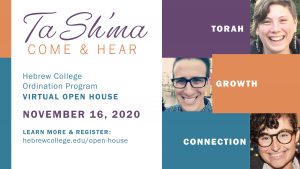 Learn about Hebrew College’s rabbinical and cantorial programs at our virtual Open House, Ta Sh’ma (Come & Hear) on November 16, 2020.
Previous Post

October 13, 2020
“In the beginning…”: Returning to the Wild Depths of Creation
Next Post

October 26, 2020 Journeying towards the new world we are being shown
Browse Our Archives
Select a Category Uncategorized
Select a Month April 2026 March 2026 December 2025 November 2025 October 2025 September 2025 August 2025 July 2025 June 2025 May 2025 April 2025 March 2025 February 2025 January 2025 December 2024 November 2024 October 2024 September 2024 August 2024 July 2024 June 2024 May 2024 April 2024 March 2024 February 2024 January 2024 December 2023 November 2023 October 2023 September 2023 August 2023 July 2023 June 2023 May 2023 April 2023 March 2023 February 2023 January 2023 December 2022 November 2022 October 2022 September 2022 August 2022 July 2022 June 2022 May 2022 April 2022 March 2022 February 2022 January 2022 December 2021 November 2021 October 2021 September 2021 August 2021 July 2021 June 2021 May 2021 April 2021 March 2021 February 2021 January 2021 December 2020 November 2020 October 2020 September 2020 August 2020 July 2020 June 2020 May 2020 April 2020 March 2020 February 2020 January 2020 December 2019 November 2019 October 2019 September 2019 August 2019 July 2019 June 2019 May 2019 April 2019 March 2019 February 2019 January 2019 December 2018 November 2018 October 2018 September 2018 August 2018 July 2018 June 2018 May 2018 April 2018 March 2018 February 2018 January 2018 December 2017 November 2017 October 2017 September 2017 August 2017 July 2017 June 2017
Follow Us!
TAKE THE
Religious Wisdom Quiz
What root attitude does Paul say is the "root of all kinds of evil"?
Select your answer to see how you score.
Love of music Love of money Love of animals Love of wisdom
Related posts from Seventy Faces of Torah

The Holy Art of World Building

Parashat Tzav: Keeping the Sacred Fire Burning

Color Theory: What Joseph’s Coat Reveals
TRENDING AT PATHEOS Jewish

Yom Kippur : Is There Always Room for...
Making Room for Forgiveness Every year as Yom Kippur approaches, I find...

This Rosh Hashanah: Can I Find New Meaning?
A Sunrise, a New Year, and a Question On our way to...

Killing Amalek: The Torah’s Most Misunderstood Commandment
Few passages of the Torah have provoked more confusion, polemic, and misuse...

I have never trusted a first draft. I don’t mean that...

Back to School, Back to Reality—and a New...
A New School Year Begins… Back to Reality A new school year...

Out-Crowleying Crowley: The Emptiness of the O9A
O9A Neo-Crowley Racial Cosplay and Edgelord Atrocitism Aleister Crowley did not create...
view all Jewish blogs
Ad-Free & Subscriber Log-In Subscription Support
- About Us
- 2026 Calendar
- Videos
- Podcasts
- Library of World Religions
- Faith In Media Tracker
- Advertise With Us
- Write for Us
- Privacy Policy
- Terms of Service
- Do Not Sell My Data
- Contact Us
- Radiant Digital
- Manage Newsletter Subscriptions
- Unsubscribe From Notifications
- Sitemap
Copyright 2008-2026, Patheos. All rights reserved.
Subscription Support Ad-Free & Subscriber Log-In
Follow Patheos