
BuddhistCatholicContemplativeEvangelicalGeneral ChristianHinduJewishLatter-day SaintMuslimNew VisionsProgressive Christian
Beliefs
- Buddhist
- Catholic
- Contemplative
- Evangelical
- General Christian
- Hindu
- Jewish
- Latter-day Saint
- More Voices
- Muslim
- New Visions
- Pagan
- Progressive Christian
Topics
- Religion News
- Food and Religion
- Sports and Religion
- Religious Art
- Religious Music and Entertainment
- Religious Events
- History and Religion
- Style and Religion
- Politics and Religion
- Women in Religion
- Recreation Outdoors and Religion
- Business Finance and Religion
- Careers Workplace and Religion
- Education and Religion
- Family Parenting and Religion
- Health Fitness and Religion
- Home and Religion
- Relationships and Religion
- Technology and Religion
- Travel and Religion
Columnists
- Buddhist Columnists
- Business Finance and Religion Columnists
- Careers Workplace and Religion Columnists
- Catholic Columnists
- Contemplative Columnists
- Education and Religion Columnists
- Evangelists Columnists
- Family Parenting and Religion Columnists
- General Christian Columnists
- Health Fitness and Religion Columnists
- Hindu Columnists
- History and Religion Columnists
- Home and Religion Columnists
- Jewish Columnists
- More Voices Columnists
- Latter Day Columnists
- Muslim Columnists
- New Visions Columnists
- Nonreligious Columnists
- Pagan Columnists
- Politics and Religion Columnists
- Progressive Columnists
- Recreation Outdoors and Religion Columnists
- Relationships and Religion Columnists
- Religion News Columnists
- Religious Art Columnists
- Religious Events Columnists
- Religious Music and Entertainment Columnists
- Sports and Religion Columnists
- Style and Religion Columnists
- Technology and Religion Columnists
- Travel and Religion Columnists
- Women in Religion Columnists
Resource Library
- 2026 Calendar
- Library of World Religions
- The 100 Most Holy Places on Earth
- Patheos Answers
- Podcasts
- Videos
- Faith Leaders Database
- Anglican Episcopalian
- Bahai
- Baptist
- Buddhism
- Christianity
- Confucianism
- Eastern Orthodoxy
- Hinduism
- Holiness and Pentecostal
- ISKCON
- Islam
- Judaism
- Lutheran
- Methodist
- The Church of Jesus Christ of Latter-day Saints
- New Age
- Paganism
- Presbytarian and Reformed
- Protestantism
- Religion Behind the Scenes
- Roman Catholic
- Scientology
- Shia Islam
- Sikhism
- Sufism
- Sunni Islam
- Taoism
- Zen
- See all religions
Research Tools
 Ad-Free & Subscriber Log-In Subscription Support
Ad-Free & Subscriber Log-In Subscription Support
Follow Patheos 

- Trending:
- Forgiveness
- |
- Marriage
- |
- Consciousness
- |
- Death Penalty
- |
- Election
- |
- Halloween

- Home
- About Hebrew College
- The Rabbinical School of Hebrew College
- The Book of Psalms
- FREE NEWSLETTER
- Home
- Jewish
- Jacob’s Ladder: Finding Wonder in Life’s Highs, Lows, and Middles Too
Jacob’s Ladder: Finding Wonder in Life’s Highs, Lows, and Middles Too
Last updated on: December 4, 2019 at 8:55 am by Hebrew College
Jacob’s Ladder: Finding Wonder in Life’s Highs, Lows, and Middles Too 2019-12-04T08:55:59-04:00 Hebrew College
Patheos Explore the world's faith through different perspectives on religion and spirituality! Patheos has the views of the prevalent religions and spiritualities of the world.
 Parashat Vayeitzei (Genesis 28:10-32:3)
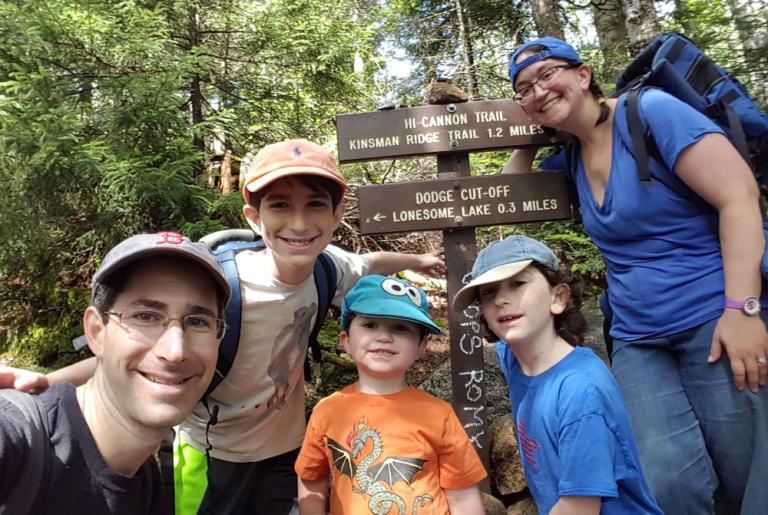
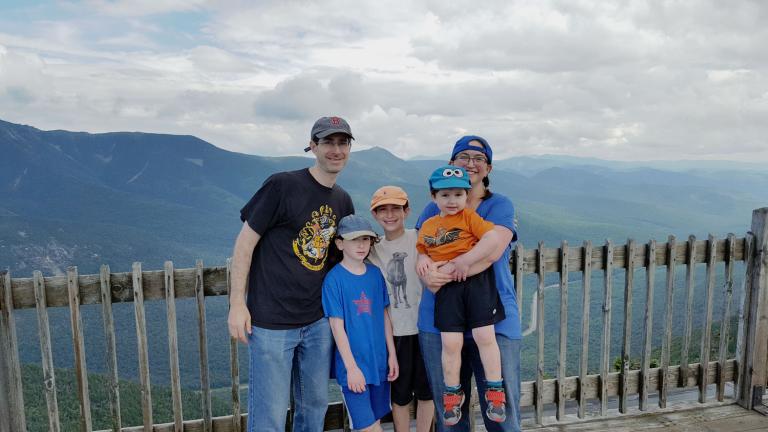
A few summers ago, my family was camping in Franconia Notch in New Hampshire’s White Mountains. We had spent many hours hiking up Cannon Mountain. As we reached the top, we climbed the lookout tower which enables one, on a clear day, to see for miles around into several states. Upon seeing the view, our youngest son shouted out in Yiddish (our family language), word by word, “Ikh! Ken! Zen! Di! Gantse! Velt!” “I! Can! See! The! Whole! World!”
I think of my then almost-four-year old’s natural expression of wonder as being much like Jacob’s exclamation in our Torah portion, when he awakens, awestruck after his dream of angels ascending and descending a ladder, and says (Gen. 28:17) “Ma nora hamakom hazeh! Ein zeh ki im beit Elohim, v’zeh sha’ar hashamayim!” “How awe-inspiring is this place! This is none other than a house of God, and that is the gate of heaven!” I don’t always shout when I reach the top of a mountain, but this sentiment, this awe and wonder, is exactly why I like to drag myself, and sometimes my family, up mountains, when given the opportunity. One can sense God’s presence anywhere and everywhere, but how can you not sense God’s presence on a mountain top, when you feel like you’re looking out over the whole world, and m’lo chol ha’arets k’vodo, the whole world is full of God’s glory.
A mountain top, literally a peak experience, may be especially conducive to communing with the Divine, but where does that leave us when we’re coming down off of that high? In the opposite situation, when we are feeling low, dealing with illness, setbacks, grief, stress, and estrangements, we may feel alienated from God or abandoned. Jacob’s encounter with God in our parsha can also serve as a model for reconnecting with God when we are in trouble. Jacob is alone, cut off from his family, fearing for his life, without material possessions, sleeping in the desert with a rock for a pillow. Sometimes, like Jacob, we may encounter God when we least expect it, as expressed in Gen. 28:16: “Vayikatz Ya’akov mish’nato vayomer: ‘Achein, yesh Adonai bamakom hazeh, v’anochi lo yadati.’” “Yaakov awoke from his sleep and said: ‘Why, YHWH is in this place, and I, I did not know it!’” This rekindling of a relationship with the Divine when we need it most may pull us up from the depths, providing us a way out of our narrowest places.
If both our emotional peaks, and paradoxically, our nadirs, may lead us to connect with something greater than ourselves, what about the majority of the time when we’re feeling middling? In Jon Levenson’s chapter in “Jewish Spirituality from the Bible through the Middle Ages (edited by Hebrew College Rector Rabbi Art Green),” he sets up two contrasting Jewish ideas of spirituality which I think may guide us through the middle: the “settlement tradition” and the “Sinai tradition.”
The settlement tradition is the quest, unfulfilled in the Torah, to reach and settle the land of Israel. This idea embodies striving for achievement, improvement, and enlightenment by trying to reach new territory. Even if and when one attains one’s goal, one then needs to set one’s sights farther. What Levenson calls the “Sinai tradition” or the “priestly tradition” is an enduring means of access to God, forged at Sinai, and kept up through daily rituals — sacrifices in Biblical times, and prayer, study, and mitzvot today — all ways of keeping the fires burning through repetition, constancy, and intimacy. This method of connection is less dramatic but more compatible with day-to-day life. Levenson says that both the distant objectives and the reachable routines are necessary, and that the two spiritual paths of pursuing long-term dreams and cultivating daily habits can complement and amplify each other. If we also view his two categories as a distinction between peak experiences and everyday ones, I would propose that Sinai itself —- the ultimate peak experience — belongs in both categories, as a symbol of intimate Divine-human relationship and of an experience, far-off in time and place, that we can aspire to and yearn to recapture.
The Mishna in Berachot 9:2 includes this instruction among blessings to be said upon viewing various wonders of the world: “[Upon seeing] mountains, hills, seas, rivers, and deserts, say, “Baruch oseih ma’asei v’reisheet.” “Blessed is [the One] who makes the works of Creation.” In medieval times, Rabbi Abraham ben Moses (Maimonides’ son) advised seeking out these places, saying: “In order to serve God, one needs access to the enjoyment of the beauties of nature, such as the contemplation of flower-decorated meadows, majestic mountains, flowing rivers…for all these are essential to the spiritual development of even the holiest people.”
May we have the opportunity to follow Rabbi Abraham ben Moses’ advice to seek beauty in the natural world. And may connecting with the Divine through physical and emotional highs remind us of our ability to connect at unexpected times, when we are feeling especially low, or ensconced in the routines of our day-to-day existence. We can’t always be on a mountain top — even the angels on Jacob’s ladder have their ups and downs — but may the miracles of creation that we witness on the high vistas remind us of the everyday miracles that are always available to us, should we open our eyes to them.
Ken Richmond has been the Cantor of Temple Israel of Natick since 2006, and has also served since then as adjunct faculty in Hebrew College’s cantorial program. He is currently using sabbatical time to study at Hebrew College’s Rabbinical School.
Previous Post

November 25, 2019
Viewing Life Through A Lens of Abundance
Next Post
December 16, 2019 I Dreamed a Dream
Browse Our Archives
Select a Category Uncategorized
Select a Month April 2026 March 2026 December 2025 November 2025 October 2025 September 2025 August 2025 July 2025 June 2025 May 2025 April 2025 March 2025 February 2025 January 2025 December 2024 November 2024 October 2024 September 2024 August 2024 July 2024 June 2024 May 2024 April 2024 March 2024 February 2024 January 2024 December 2023 November 2023 October 2023 September 2023 August 2023 July 2023 June 2023 May 2023 April 2023 March 2023 February 2023 January 2023 December 2022 November 2022 October 2022 September 2022 August 2022 July 2022 June 2022 May 2022 April 2022 March 2022 February 2022 January 2022 December 2021 November 2021 October 2021 September 2021 August 2021 July 2021 June 2021 May 2021 April 2021 March 2021 February 2021 January 2021 December 2020 November 2020 October 2020 September 2020 August 2020 July 2020 June 2020 May 2020 April 2020 March 2020 February 2020 January 2020 December 2019 November 2019 October 2019 September 2019 August 2019 July 2019 June 2019 May 2019 April 2019 March 2019 February 2019 January 2019 December 2018 November 2018 October 2018 September 2018 August 2018 July 2018 June 2018 May 2018 April 2018 March 2018 February 2018 January 2018 December 2017 November 2017 October 2017 September 2017 August 2017 July 2017 June 2017
Follow Us!
TAKE THE
Religious Wisdom Quiz
What does "Jubilee" mean?
Select your answer to see how you score.
Blessed year Offering Ram's horn Restoration
Related posts from Seventy Faces of Torah

The Holy Art of World Building

Parashat Tzav: Keeping the Sacred Fire Burning

Color Theory: What Joseph’s Coat Reveals
TRENDING AT PATHEOS Jewish

Building a Little Ark in a Frightening World
This past Shabbat, we read about Noah. I love this story. The...

Yom Kippur : Is There Always Room for...
Making Room for Forgiveness Every year as Yom Kippur approaches, I find...

This Rosh Hashanah: Can I Find New Meaning?
A Sunrise, a New Year, and a Question On our way to...

Killing Amalek: The Torah’s Most Misunderstood Commandment
Few passages of the Torah have provoked more confusion, polemic, and misuse...

I have never trusted a first draft. I don’t mean that...

Back to School, Back to Reality—and a New...
A New School Year Begins… Back to Reality A new school year...
view all Jewish blogs
Ad-Free & Subscriber Log-In Subscription Support
- About Us
- 2026 Calendar
- Videos
- Podcasts
- Library of World Religions
- Faith In Media Tracker
- Advertise With Us
- Write for Us
- Privacy Policy
- Terms of Service
- Do Not Sell My Data
- Contact Us
- Radiant Digital
- Manage Newsletter Subscriptions
- Unsubscribe From Notifications
- Sitemap
Copyright 2008-2026, Patheos. All rights reserved.
Subscription Support Ad-Free & Subscriber Log-In
Follow Patheos