
BuddhistCatholicContemplativeEvangelicalGeneral ChristianHinduJewishLatter-day SaintMuslimNew VisionsProgressive Christian
Beliefs
- Buddhist
- Catholic
- Contemplative
- Evangelical
- General Christian
- Hindu
- Jewish
- Latter-day Saint
- More Voices
- Muslim
- New Visions
- Pagan
- Progressive Christian
Topics
- Religion News
- Food and Religion
- Sports and Religion
- Religious Art
- Religious Music and Entertainment
- Religious Events
- History and Religion
- Style and Religion
- Politics and Religion
- Women in Religion
- Recreation Outdoors and Religion
- Business Finance and Religion
- Careers Workplace and Religion
- Education and Religion
- Family Parenting and Religion
- Health Fitness and Religion
- Home and Religion
- Relationships and Religion
- Technology and Religion
- Travel and Religion
Columnists
- Buddhist Columnists
- Business Finance and Religion Columnists
- Careers Workplace and Religion Columnists
- Catholic Columnists
- Contemplative Columnists
- Education and Religion Columnists
- Evangelists Columnists
- Family Parenting and Religion Columnists
- General Christian Columnists
- Health Fitness and Religion Columnists
- Hindu Columnists
- History and Religion Columnists
- Home and Religion Columnists
- Jewish Columnists
- More Voices Columnists
- Latter Day Columnists
- Muslim Columnists
- New Visions Columnists
- Nonreligious Columnists
- Pagan Columnists
- Politics and Religion Columnists
- Progressive Columnists
- Recreation Outdoors and Religion Columnists
- Relationships and Religion Columnists
- Religion News Columnists
- Religious Art Columnists
- Religious Events Columnists
- Religious Music and Entertainment Columnists
- Sports and Religion Columnists
- Style and Religion Columnists
- Technology and Religion Columnists
- Travel and Religion Columnists
- Women in Religion Columnists
Resource Library
- 2026 Calendar
- Library of World Religions
- The 100 Most Holy Places on Earth
- Patheos Answers
- Podcasts
- Videos
- Faith Leaders Database
- Anglican Episcopalian
- Bahai
- Baptist
- Buddhism
- Christianity
- Confucianism
- Eastern Orthodoxy
- Hinduism
- Holiness and Pentecostal
- ISKCON
- Islam
- Judaism
- Lutheran
- Methodist
- The Church of Jesus Christ of Latter-day Saints
- New Age
- Paganism
- Presbytarian and Reformed
- Protestantism
- Religion Behind the Scenes
- Roman Catholic
- Scientology
- Shia Islam
- Sikhism
- Sufism
- Sunni Islam
- Taoism
- Zen
- See all religions
Research Tools
 Ad-Free & Subscriber Log-In Subscription Support
Ad-Free & Subscriber Log-In Subscription Support
Follow Patheos 

- Trending:
- Forgiveness
- |
- Marriage
- |
- Consciousness
- |
- Death Penalty
- |
- Election
- |
- Halloween

- Home
- About Hebrew College
- The Rabbinical School of Hebrew College
- The Book of Psalms
- FREE NEWSLETTER
- Home
- Jewish
- Little Robes for the New Year
Little Robes for the New Year
Last updated on: October 22, 2019 at 5:40 pm by Hebrew College
Little Robes for the New Year 2019-10-22T17:40:28-04:00 Hebrew College
Patheos Explore the world's faith through different perspectives on religion and spirituality! Patheos has the views of the prevalent religions and spiritualities of the world.
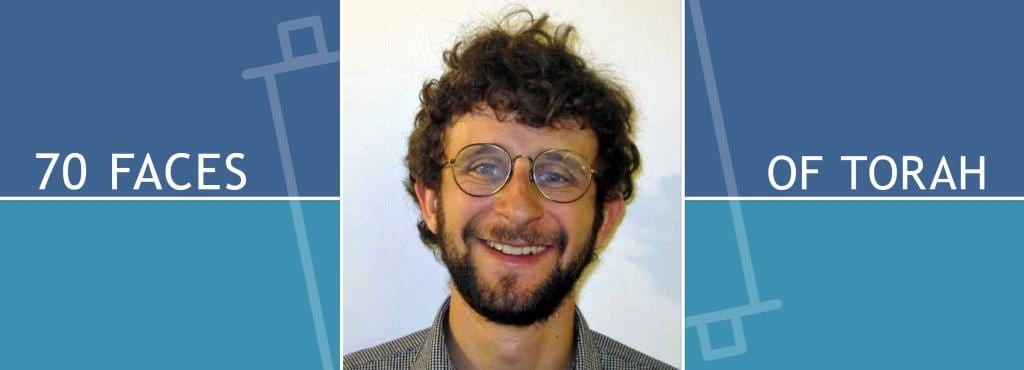
By Joey Glick
Parashat B’reishit (Genesis 1:1-6:8)
I said to the sun tell me about the Big Bang The sun said, “It hurts to become.” – Andrea Gibson, I Sing the Body Electric
On the first day of the Hebrew month of Elul, I was sitting in the lobby of the Cambridge city courthouse. The night before, I had been arrested with a group of Jews at a protest in solidarity with undocumented immigrants. My fellow protesters and I were waiting for our case to be called when an old, disheveled-looking man walked up to us. “Are you students” he asked with a strong Boston accent. One of us snarked back, “No, we’re criminal defendants.” “You better listen to me,” he replied, “maybe I am the voice of God.” The rabbinical students present quickly perked up. “Ok, take out your phone,” he said, “go to the webpage Astronomy Picture of the Day. Type in your birthday. The computer will show you a picture of what the cosmos looked like on the day that you were born.” He continued, “Now send that picture to your mom as a belated Mother’s Day gift. Tell her ‘this is what space looked like on the day that you gave birth to me — this is the stardust that I come from, the stardust out of which I was made by the great, mighty, divine God…ess, The Godess! Because only a woman could do something so painful and loving as creating the whole world.’”
As I opened the Book of Genesis this week, the old man’s diatribe came back to me. From the little he said about her, I liked his vision of God.1 If I followed her, I suspected this God might have something to teach me about the broken world in which we live, the world She created. I wanted to ask her:
How did it feel to give birth to creation? Was it painful? Were you afraid?
It was difficult to locate answers to my questions in the Bible’s first creation story. The story of the birth of the world seems to involve little-to-no laboring. Intention, “Let there be light,” leads plainly to creation, “and there was light.” The emotional language of these passages is spare, to say the least. All we hear is that “it is good” or “very good.”
In a lecture at Hebrew College, the literary theorist Joy Ladin suggested that this creation passage falls into a broader literary pattern. She argued that in the sections of the Bible in which God is most present, there tends to be very little emotional language. In turn, in narratives like Esther and The Song of Songs, where God recedes, there’s sex, love, suffering and longing. In her book Soul of the Stranger, Laden links this lack of emotive language to her vision of God as the ultimate stranger, an entity who struggles to be known and understood by humanity. In light of my courthouse encounter, I might put it in somewhat different terms: God’s narrative style feels similar to that of a grizzled matriarch from the old country, who grew up through pogroms and displacements, through death and scarcity. When you ask her how she did it, she shrugs and offers you another helping of manna.
All week, I’ve been wondering how to get Grandma God to talk. On the way to school one day, I asked my carpool buddy about her favorite stories of mothering in the Bible. I hoped that I might be able to locate in human birth stories the emotional landscapes that God conceals from the Genesis narrative. My carpool companion sighed for a long beat. “I have something to share with you,” she said, “but it will cause me to weep. The only thing that shakes me more is the moment that Aaragon bows to the Hobbits.” She then told me the story of “little robes.”
On Rosh Hashanah, we read about Hannah, a woman who desperately wants to have children but is unable to conceive. Hannah pleads with God, telling God that if she becomes pregnant, she will give over her child to the Temple. Her prayer works, she gives birth to her son Samuel, cares for him for a few years and eventually sends him off to serve as a priest. Through tears, my friend drew my attention to the postscript to this story, an episode that we do not read on Rosh Hashanah:
“And a little robe would [Samuel’s] mother make him and would bring up to him year after year when she came up with her husband to offer the yearly sacrifice.”2
Once a year, Hannah makes her son a little robe, and then, once a year, she goes up to the Temple, sees her son and gives him his new garment:
Rosh Hashanah is not only the day that Hannah gave birth to Samuel. According to the Rosh Hashanah liturgy, it is also the day that God gave birth to (or “conceived”) the world. I’ve spent the days since my friend told me about Hannah’s little robes hoping that this story might serve as an opening through which God might share something with me about divine mothering. I have found myself asking Hannah for permission to borrow her story, to place it, as it were, on God. This is the story I heard:
Before time, God prayed, in all-ness and aloneness for something beyond Herself. Over seven days, God’s prayers were met; She finally gave birth to creation. But in order to create, God needed to separate, to make something distinct from God, something distant from Herself. Ever since, this God longs for Her creation. Once a year, God prepares for the time that She allows Herself to be closest to creation. She crafts a little robe, a small piece of Herself. As She works, She estimates the shape and size, color and texture that will keep creation strong and safe, wise and holy in the year to come. Each year, on Her creation’s birthday, on Rosh Hashanah, God draws close and lays a little robe over creation.
May our new robe keep us strong and safe, wise and holy in 5780.
[1] I use any and all pronouns for God with trepidation knowing the dangers of attempting to name the Ineffable. Further, I fear alienating readers from this complicated discussion by speaking about God and human experience in binary terms. While holding these concerns, I use she/her pronouns here to describe the Divine as reflected in my mother, grandmother and other women that birthed and have nurtured me.
[2] 1 Samuel 2:19. Translation by Robert Alter, 2018.
Joey Glick is a rabbinical student at the Rabbinical School of Hebrew College in Newton Centre, MA.
Previous Post

October 16, 2019
Building Our Sukkot, Rebuilding Ourselves
Next Post
October 29, 2019 Belief and Disbelief in the Face of Climate Change
Browse Our Archives
Select a Category Uncategorized
Select a Month April 2026 March 2026 December 2025 November 2025 October 2025 September 2025 August 2025 July 2025 June 2025 May 2025 April 2025 March 2025 February 2025 January 2025 December 2024 November 2024 October 2024 September 2024 August 2024 July 2024 June 2024 May 2024 April 2024 March 2024 February 2024 January 2024 December 2023 November 2023 October 2023 September 2023 August 2023 July 2023 June 2023 May 2023 April 2023 March 2023 February 2023 January 2023 December 2022 November 2022 October 2022 September 2022 August 2022 July 2022 June 2022 May 2022 April 2022 March 2022 February 2022 January 2022 December 2021 November 2021 October 2021 September 2021 August 2021 July 2021 June 2021 May 2021 April 2021 March 2021 February 2021 January 2021 December 2020 November 2020 October 2020 September 2020 August 2020 July 2020 June 2020 May 2020 April 2020 March 2020 February 2020 January 2020 December 2019 November 2019 October 2019 September 2019 August 2019 July 2019 June 2019 May 2019 April 2019 March 2019 February 2019 January 2019 December 2018 November 2018 October 2018 September 2018 August 2018 July 2018 June 2018 May 2018 April 2018 March 2018 February 2018 January 2018 December 2017 November 2017 October 2017 September 2017 August 2017 July 2017 June 2017
Follow Us!
TAKE THE
Religious Wisdom Quiz
How many total plagues did God send on Egypt?
Select your answer to see how you score.
Ten Five Twelve Seven
Related posts from Seventy Faces of Torah

The Holy Art of World Building

Parashat Tzav: Keeping the Sacred Fire Burning

Color Theory: What Joseph’s Coat Reveals
TRENDING AT PATHEOS Jewish

Yom Kippur : Is There Always Room for...
Making Room for Forgiveness Every year as Yom Kippur approaches, I find...

This Rosh Hashanah: Can I Find New Meaning?
A Sunrise, a New Year, and a Question On our way to...

Killing Amalek: The Torah’s Most Misunderstood Commandment
Few passages of the Torah have provoked more confusion, polemic, and misuse...

I have never trusted a first draft. I don’t mean that...

Back to School, Back to Reality—and a New...
A New School Year Begins… Back to Reality A new school year...

Out-Crowleying Crowley: The Emptiness of the O9A
O9A Neo-Crowley Racial Cosplay and Edgelord Atrocitism Aleister Crowley did not create...
view all Jewish blogs
Ad-Free & Subscriber Log-In Subscription Support
- About Us
- 2026 Calendar
- Videos
- Podcasts
- Library of World Religions
- Faith In Media Tracker
- Advertise With Us
- Write for Us
- Privacy Policy
- Terms of Service
- Do Not Sell My Data
- Contact Us
- Radiant Digital
- Manage Newsletter Subscriptions
- Unsubscribe From Notifications
- Sitemap
Copyright 2008-2026, Patheos. All rights reserved.
Subscription Support Ad-Free & Subscriber Log-In
Follow Patheos