
BuddhistCatholicContemplativeEvangelicalGeneral ChristianHinduJewishLatter-day SaintMuslimNew VisionsProgressive Christian
Beliefs
- Buddhist
- Catholic
- Contemplative
- Evangelical
- General Christian
- Hindu
- Jewish
- Latter-day Saint
- More Voices
- Muslim
- New Visions
- Pagan
- Progressive Christian
Topics
- Religion News
- Food and Religion
- Sports and Religion
- Religious Art
- Religious Music and Entertainment
- Religious Events
- History and Religion
- Style and Religion
- Politics and Religion
- Women in Religion
- Recreation Outdoors and Religion
- Business Finance and Religion
- Careers Workplace and Religion
- Education and Religion
- Family Parenting and Religion
- Health Fitness and Religion
- Home and Religion
- Relationships and Religion
- Technology and Religion
- Travel and Religion
Columnists
- Buddhist Columnists
- Business Finance and Religion Columnists
- Careers Workplace and Religion Columnists
- Catholic Columnists
- Contemplative Columnists
- Education and Religion Columnists
- Evangelists Columnists
- Family Parenting and Religion Columnists
- General Christian Columnists
- Health Fitness and Religion Columnists
- Hindu Columnists
- History and Religion Columnists
- Home and Religion Columnists
- Jewish Columnists
- More Voices Columnists
- Latter Day Columnists
- Muslim Columnists
- New Visions Columnists
- Nonreligious Columnists
- Pagan Columnists
- Politics and Religion Columnists
- Progressive Columnists
- Recreation Outdoors and Religion Columnists
- Relationships and Religion Columnists
- Religion News Columnists
- Religious Art Columnists
- Religious Events Columnists
- Religious Music and Entertainment Columnists
- Sports and Religion Columnists
- Style and Religion Columnists
- Technology and Religion Columnists
- Travel and Religion Columnists
- Women in Religion Columnists
Resource Library
- 2026 Calendar
- Library of World Religions
- The 100 Most Holy Places on Earth
- Patheos Answers
- Podcasts
- Videos
- Faith Leaders Database
- Anglican Episcopalian
- Bahai
- Baptist
- Buddhism
- Christianity
- Confucianism
- Eastern Orthodoxy
- Hinduism
- Holiness and Pentecostal
- ISKCON
- Islam
- Judaism
- Lutheran
- Methodist
- The Church of Jesus Christ of Latter-day Saints
- New Age
- Paganism
- Presbytarian and Reformed
- Protestantism
- Religion Behind the Scenes
- Roman Catholic
- Scientology
- Shia Islam
- Sikhism
- Sufism
- Sunni Islam
- Taoism
- Zen
- See all religions
Research Tools
 Ad-Free & Subscriber Log-In Subscription Support
Ad-Free & Subscriber Log-In Subscription Support
Follow Patheos 

- Trending:
- Forgiveness
- |
- Marriage
- |
- Consciousness
- |
- Death Penalty
- |
- Election
- |
- Halloween

- Home
- About Hebrew College
- The Rabbinical School of Hebrew College
- The Book of Psalms
- FREE NEWSLETTER
- Home
- Jewish
- When the Earth Opened her Mouth
When the Earth Opened her Mouth
Last updated on: July 2, 2019 at 9:04 am by Hebrew College
When the Earth Opened her Mouth 2019-07-02T09:04:54-04:00 Hebrew College
Patheos Explore the world's faith through different perspectives on religion and spirituality! Patheos has the views of the prevalent religions and spiritualities of the world.
Parshat Korach, Numbers 16:1-18:32
By Rachel Adelman, PhD
The earth hath bubbles, as the water has, And these are of them. Whither are they vanish’d? (Macbeth, Act I;i)
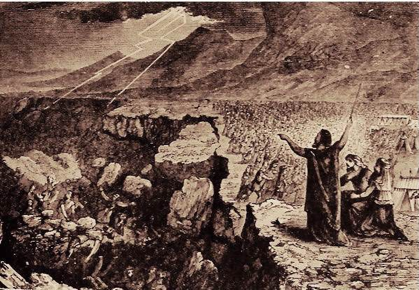
Destruction of Korah Dathan and Abiram, illustration from the 1890 Holman Bible
This week’s Torah reading features a complex rebellion against the leadership of Moses and Aaron—led, on the one hand, by Korah and a band a non-priestly Levites (16:3-7), and on the other, by the brothers Dathan and Abiram primarily against Moses and the whole Exodus project. The Rabbis hold this rebellion up as an example of “a dispute that is not for the sake of Heaven [machloket she’ayno leshem shamayim]” (Pirkei Avot 5:17). What is the difference between a dispute for Heaven’s sake (as in the machloket between Hillel and Shamai)—and a dispute that is not? The Mishnah goes on to explain that the difference lies in their endurance; the debate for Heaven’s sake persists while the other is subject to oblivion. Yet do we not read the story of Korah every year? It is part of the biblical canon! The fate of Dathan and Abiram—swallowed by the mouth of the earth—gestures at what is meant by “its end will not endure [ayn sofa lehitkayem]”.
The claims of the two rebels are rife with irony. The diagnostic test of the opening of the earth’s mouth serves as a punishment meted out, measure-for-measure, for their outrageous use of language. Moses summons them but they respond: “We will not come up [l’o na‘aleh]! Is it too little that you have brought us up [he‘elitanu] from a land flowing with milk and honey to kill us in the wilderness, that you must also lord it over us? Not only have you not brought us into a land flowing with milk and honey, or given us an inheritance of fields and vineyards, but you would gouge out the eyes of these men!?! We will not come up [l’o na‘aleh]!” (Num. 16:12b-14).
The rhetorical flourish in their refusal – “We will not come up [l’o na‘aleh]” which frames their speech – may refer to an elevated place, perhaps the Tent of Meeting outside the camp where Moses situates himself. Alternatively, they are expressing a vehement impiety, refusing to be subject to the figurative ascent towards God’s house or to the judgment of Moses who holds the higher moral ground. But the image of vertical ascent also resonates with their rejection of the project of ‘going up’ towards the Promised Land (‘aliyah), which they accuse Moses of failing to fulfill (v. 14). According to divine decree, in response to the debacle of the spies, this generation is doomed to die in the desert—“In this very wilderness shall [their] carcasses fall” (Num. 14:29). With their eyes figuratively gouged out, they will never see the “land flowing with milk and honey” – an epithet here Dathan and Abiram ironically attribute to Egypt. But as Rashi pithily notes (on v. 12), they damn themselves by their own words; in refusing to go up, they have nowhere else to go but down.
One might read Dathan and Abiram as the last representatives of the spies, who believed that Egypt and even the Wilderness were better than the true “Land flowing with milk and honey”. In their torpor of anxiety, the spies spread calumnies [dibah] about the land, claiming that it was “a land that consumes its inhabitants” (13:32). While the spies, whom Dathan and Abiram join ideologically, feared the Land of Israel devoured its inhabitants, they themselves are devoured by the desert.
Moses then sets up an audacious test, a supernatural intervention. Addressing Dathan and Abiram as they stand at the entrance of their tents, he orders the congregation to distance themselves from the perpetrators:
By this you shall know that it was the LORD who sent me to do all these things; that they are not of my own devising: if these men die as all men do, if their lot be the common fate of all mankind, it was not the LORD who sent me. But if the LORD creates something new [’im beri’ah yivr’a], so that the ground burst opens its mouth [u’fatztah ha’adamah piha] and swallows them up with all that belongs to them, and they go down alive into Sheol, you shall know that these men have spurned the LORD. (Num. 16:29-30).
Moses calls for a miracle, a new creation [beri’ah]—we have not seen this root [br’] since the Six Days of Creation (Genesis 1). According to midrash, this “mouth of the earth [pi ha-‘aretz]” was not new at all, but is among one of the ten things created at Twilight on the Sixth Day of Creation (M. Avot 5:6). It has been waiting since Primordial Time to open up its maw to swallow the rebels in order to undermine their claim and testify to Moses’ divinely ordained leadership. But why is the earth the site punishment? A natural death, “to die as all men do”, would entail burial in the earth [adamah], from which ha-Adam was taken, “for dust your are and to dust you must return” (Gen. 3:19)—and at a gravesite, memory endures. But here the earth splits asunder and swallows them and all their possessions, and “the earth closed over them and they vanished from the midst of the congregation” (Num. 16:33).
Throughout the Tanakh, the ground is personified as having a mouth that cries out, or swallows, or vomits up the casualties of human tragedy. The earth opened her mouth to swallow the blood of Abel, bearing witness to the original fratricide; from that cursed ground Cain is exiled, condemned to wander the world as a fugitive (Gen. 4:10-11). In his poignant cris de coeur, Job calls for the earth not to cover his blood or silence his cries so that the injustice of his suffering might ascend to Heaven (Job 16:18). Further, the violation of God’s Laws concerned with holiness would contaminate the Land and force it to vomit the people out (Lev. 18:28, 20:22). But now those who rejected the whole Exodus project are swallowed alive. In refusing to test the ground (so to speak) of ‘aliyah to the Promised Land, they go down, down, down, to Sheol, to “the undiscovered country from whose bourn no traveler returns.” No bodies to mourn. No testimonial to natural death. No grave to mark their passing. The face of the earth returns, seamlessly, to its mute state as if never rent asunder. Unlike other sinkholes in the earth, this “mouth of the earth” swallowed the combatants and closed up again, leaving no trace.
This is the destiny of claims that are “not for the sake of heaven [macholoket she’ayno leshem shamayim],” where language has no compass of truth—no orientation of above and below, of forward and backward in either time of space. Pirkei Avot avers that such a debate will not endure—“ayn sofa lehitkayem”—though the haunting story of the claimants’ fate persists.
 Dr. Rachel Adelman (PhD Hebrew University of Jerusalem), is Associate Professor of Bible at the Rabbinical School of Hebrew College, Newton, MA
[1]Outside of this context, the expression “a land flowing with milk and honey אֶרֶץ זָבַת חָלָב וּדְבַשׁ “ is used exclusively with respect to Land of Israel: Exod. 3:8,17; 13:5 and 33:3; Lev. 20:4, Deut. 6:3, 11:9, 26:9,15 and 27:3. Josh 5:6, Jer. 11:5, 33:22.
[1] This idea was inspired by an essay by Yonatan Grossman, “The Symbolic Significance of the Earth ‘Opening her Mouth’”, https://www.etzion.org.il/en/symbolic-significance-earth-opening-her-mouth.
Previous Post

June 26, 2019
On Grasshoppers and Angels
Next Post
July 9, 2019 Go Ahead and Ask Anyway
Browse Our Archives
Select a Category Uncategorized
Select a Month April 2026 March 2026 December 2025 November 2025 October 2025 September 2025 August 2025 July 2025 June 2025 May 2025 April 2025 March 2025 February 2025 January 2025 December 2024 November 2024 October 2024 September 2024 August 2024 July 2024 June 2024 May 2024 April 2024 March 2024 February 2024 January 2024 December 2023 November 2023 October 2023 September 2023 August 2023 July 2023 June 2023 May 2023 April 2023 March 2023 February 2023 January 2023 December 2022 November 2022 October 2022 September 2022 August 2022 July 2022 June 2022 May 2022 April 2022 March 2022 February 2022 January 2022 December 2021 November 2021 October 2021 September 2021 August 2021 July 2021 June 2021 May 2021 April 2021 March 2021 February 2021 January 2021 December 2020 November 2020 October 2020 September 2020 August 2020 July 2020 June 2020 May 2020 April 2020 March 2020 February 2020 January 2020 December 2019 November 2019 October 2019 September 2019 August 2019 July 2019 June 2019 May 2019 April 2019 March 2019 February 2019 January 2019 December 2018 November 2018 October 2018 September 2018 August 2018 July 2018 June 2018 May 2018 April 2018 March 2018 February 2018 January 2018 December 2017 November 2017 October 2017 September 2017 August 2017 July 2017 June 2017
Follow Us!
TAKE THE
Religious Wisdom Quiz
What did Jesus do at the wedding in Cana?
Select your answer to see how you score.
Healed a sick child Fed the guests Walked on water Turned water into wine
Related posts from Seventy Faces of Torah

The Holy Art of World Building

Parashat Tzav: Keeping the Sacred Fire Burning

Color Theory: What Joseph’s Coat Reveals
TRENDING AT PATHEOS Jewish

Building a Little Ark in a Frightening World
This past Shabbat, we read about Noah. I love this story. The...

Yom Kippur : Is There Always Room for...
Making Room for Forgiveness Every year as Yom Kippur approaches, I find...

This Rosh Hashanah: Can I Find New Meaning?
A Sunrise, a New Year, and a Question On our way to...

Killing Amalek: The Torah’s Most Misunderstood Commandment
Few passages of the Torah have provoked more confusion, polemic, and misuse...

I have never trusted a first draft. I don’t mean that...

Back to School, Back to Reality—and a New...
A New School Year Begins… Back to Reality A new school year...
view all Jewish blogs
Ad-Free & Subscriber Log-In Subscription Support
- About Us
- 2026 Calendar
- Videos
- Podcasts
- Library of World Religions
- Faith In Media Tracker
- Advertise With Us
- Write for Us
- Privacy Policy
- Terms of Service
- Do Not Sell My Data
- Contact Us
- Radiant Digital
- Manage Newsletter Subscriptions
- Unsubscribe From Notifications
- Sitemap
Copyright 2008-2026, Patheos. All rights reserved.
Subscription Support Ad-Free & Subscriber Log-In
Follow Patheos