
BuddhistCatholicContemplativeEvangelicalGeneral ChristianHinduJewishLatter-day SaintMuslimNew VisionsProgressive Christian
Beliefs
- Buddhist
- Catholic
- Contemplative
- Evangelical
- General Christian
- Hindu
- Jewish
- Latter-day Saint
- More Voices
- Muslim
- New Visions
- Pagan
- Progressive Christian
Topics
- Religion News
- Food and Religion
- Sports and Religion
- Religious Art
- Religious Music and Entertainment
- Religious Events
- History and Religion
- Style and Religion
- Politics and Religion
- Women in Religion
- Recreation Outdoors and Religion
- Business Finance and Religion
- Careers Workplace and Religion
- Education and Religion
- Family Parenting and Religion
- Health Fitness and Religion
- Home and Religion
- Relationships and Religion
- Technology and Religion
- Travel and Religion
Columnists
- Buddhist Columnists
- Business Finance and Religion Columnists
- Careers Workplace and Religion Columnists
- Catholic Columnists
- Contemplative Columnists
- Education and Religion Columnists
- Evangelists Columnists
- Family Parenting and Religion Columnists
- General Christian Columnists
- Health Fitness and Religion Columnists
- Hindu Columnists
- History and Religion Columnists
- Home and Religion Columnists
- Jewish Columnists
- More Voices Columnists
- Latter Day Columnists
- Muslim Columnists
- New Visions Columnists
- Nonreligious Columnists
- Pagan Columnists
- Politics and Religion Columnists
- Progressive Columnists
- Recreation Outdoors and Religion Columnists
- Relationships and Religion Columnists
- Religion News Columnists
- Religious Art Columnists
- Religious Events Columnists
- Religious Music and Entertainment Columnists
- Sports and Religion Columnists
- Style and Religion Columnists
- Technology and Religion Columnists
- Travel and Religion Columnists
- Women in Religion Columnists
Resource Library
- 2026 Calendar
- Library of World Religions
- The 100 Most Holy Places on Earth
- Patheos Answers
- Podcasts
- Videos
- Faith Leaders Database
- Anglican Episcopalian
- Bahai
- Baptist
- Buddhism
- Christianity
- Confucianism
- Eastern Orthodoxy
- Hinduism
- Holiness and Pentecostal
- ISKCON
- Islam
- Judaism
- Lutheran
- Methodist
- The Church of Jesus Christ of Latter-day Saints
- New Age
- Paganism
- Presbytarian and Reformed
- Protestantism
- Religion Behind the Scenes
- Roman Catholic
- Scientology
- Shia Islam
- Sikhism
- Sufism
- Sunni Islam
- Taoism
- Zen
- See all religions
Research Tools
 Ad-Free & Subscriber Log-In Subscription Support
Ad-Free & Subscriber Log-In Subscription Support
Follow Patheos 

- Trending:
- Forgiveness
- |
- Marriage
- |
- Consciousness
- |
- Death Penalty
- |
- Election
- |
- Halloween

- Home
- About Hebrew College
- The Rabbinical School of Hebrew College
- The Book of Psalms
- FREE NEWSLETTER
- Home
- Jewish
- Valuing Work and Setting Limits
Valuing Work and Setting Limits
Last updated on: January 23, 2019 at 10:07 am by Hebrew College
Valuing Work and Setting Limits 2019-01-23T10:07:02-04:00 Hebrew College
Patheos Explore the world's faith through different perspectives on religion and spirituality! Patheos has the views of the prevalent religions and spiritualities of the world.
 Parashat Yitro (Exodus 18:1-20:23)
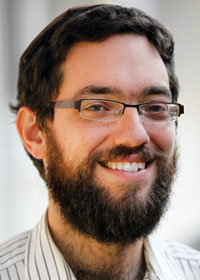
By Rabbi Micha’el Rosenberg
I write these words on a Saturday night, after my kids have gone to sleep. I’m a rabbi, a teacher in a rabbinical school; I learn and teach Torah, write about it, for a living. In other words, this is my job. This is me, working on a Saturday night. Pretty depressing.
And on the other hand: I’m a Jew who loves Torah. I love my work, and I think it provides some value to the world. Even if I didn’t have a deadline, there’s a reasonable chance I’d be thinking about the upcoming week’s Torah reading anyway. And in any event, it has to get done.
The Talmud (Tractate Shabbat 10a) tells a story of two sages, Rav Hisda and Rabbah son of Rav Huna, who would spend all day—“from morning until evening”—fulfilling their roles as judges for the Babylonian Jewish community. An early post-talmudic work called the She’iltot explains that these two sages were under the impression that they had to live up to the standard set by Moses in the opening of this week’s parashah: “Moses sat to perform judgment for the people, and the people gathered to Moses from morning until evening” (Exod 18:13). Moses set the standard; if he was willing to work nonstop on behalf of the people, then we too, reason our Babylonian rabbis, must toil in service of the community, without rest.
And so, in what might be the most unsurprising next line of a story ever, the Talmud reports: “Their hearts became weak.” They got tired. Luckily, another rabbi was around to provide them with some sage advice. Rabbi Hiyya son of Rav, from Difti, points out that the verse about Moses clearly cannot be understood literally: “Is it possible that Moses sat all day in judgment? When did he learn Torah? When did he teach Torah?” In the rabbinic imagination, it is impossible that Moses’s administrative duties would have expanded so much that they would leave no time for the study and teaching of Torah. Rather, Rabbi Hiyya reports, the point of the phrase “morning until evening” in the verse is not to teach something about Moses’s literal daily practice, but to send you, the reader, back to the first chapter of the book of Genesis: “It was evening, it was morning, one day.” What does that have to do with the story of Moses’s judging the people? “To teach you that any judge who renders a judgment that gets to the truth of the matter, even if for only one hour, it is as if they are a partner with the Holy One in the work of creation.”
Says Rabbi Hiyya: You don’t need to work so much. It’s enough to do your job “even if for only one hour,” so long as you’re doing it right.
But if I’m being honest, that’s not really so interesting. The message of quality over quantity is one that most of us get, at least intellectually. Sure, I might not live up to that standard, I might not set clear limits, such that the boundary between my work and my identity gets blurred, so that I no longer know when my time ends and my work begins. But at least in principle, I get it.
What’s most striking about Rabbi Hiyya’s response to the overworked sages, though, is that he encourages them to set boundaries not by denigrating the value of their work, not by saying “It’s not that important,” but by upping the ante. If you do it the right way, he says, there’s nothing more important on earth. It’s as if you’ve taken part in creating a world. It is because what you are doing is so important that you can’t reasonably spend all day engaged in it.
The nineteenth-century scholar Rabbi Naftali Tzvi Yehuda Berlin, also known as the Netziv, raises a problem, however, with comparison of Moses and the latter-day Babylonian sages. According to another passage in the Talmud, Moses was considered equivalent to the Great Sanhedrin, the rabbinic supreme court that was uniquely responsible for judging capital cases. And unlike other courts, the Great Sanhedrin was supposed to sit in session literally all day. Rav Hisda and Rabbah, sitting in Babylonia, were not judging capital cases, and therefore need not have looked to Moses as their model. And recognizing the distinction between Moses, on the one hand, and our Babylonian rabbis on the other, means that there may indeed be circumstances in which toil from sunrise to sunset is called for. It may be that living your mission in the world, when done with passion and limits, is an act on par with the creation of the very world. And even so, there remain specific tasks so important, so singular, that they indeed place on you what would otherwise seem an impossible expectation.
The challenge, of course, is knowing when you’re the Great Sanhedrin, engaged in work so potent and dangerous that you must push yourself up to and even beyond your limits, and when are you “merely” engaged in creating the world. There are no easy answers to that question. If you find yourself acting like Moses most days, though, you’re probably doing it wrong.
Rabbi Micha’el Rosenberg is an assistant professor of rabbinics at Hebrew College’s Rabbinical School.
Interested in a possible career in the rabbinate? Read Rabbi Dan Judson’s article “Jewish Lessons on Meaningful Work.“ Rabbi Judson is Dean of the Rabbinical School of Hebrew College. He has a PhD in Jewish history from Brandeis University.
Previous Post

January 16, 2019
Less talking, more walking: Deliberation and Exodus
Next Post
January 30, 2019 New Perspective, New Lens
Browse Our Archives
Select a Category Uncategorized
Select a Month April 2026 March 2026 December 2025 November 2025 October 2025 September 2025 August 2025 July 2025 June 2025 May 2025 April 2025 March 2025 February 2025 January 2025 December 2024 November 2024 October 2024 September 2024 August 2024 July 2024 June 2024 May 2024 April 2024 March 2024 February 2024 January 2024 December 2023 November 2023 October 2023 September 2023 August 2023 July 2023 June 2023 May 2023 April 2023 March 2023 February 2023 January 2023 December 2022 November 2022 October 2022 September 2022 August 2022 July 2022 June 2022 May 2022 April 2022 March 2022 February 2022 January 2022 December 2021 November 2021 October 2021 September 2021 August 2021 July 2021 June 2021 May 2021 April 2021 March 2021 February 2021 January 2021 December 2020 November 2020 October 2020 September 2020 August 2020 July 2020 June 2020 May 2020 April 2020 March 2020 February 2020 January 2020 December 2019 November 2019 October 2019 September 2019 August 2019 July 2019 June 2019 May 2019 April 2019 March 2019 February 2019 January 2019 December 2018 November 2018 October 2018 September 2018 August 2018 July 2018 June 2018 May 2018 April 2018 March 2018 February 2018 January 2018 December 2017 November 2017 October 2017 September 2017 August 2017 July 2017 June 2017
Follow Us!
TAKE THE
Religious Wisdom Quiz
Who was the younger brother of Moses?
Select your answer to see how you score.
David Joshua Solomon Aaron
Related posts from Seventy Faces of Torah

The Holy Art of World Building

Parashat Tzav: Keeping the Sacred Fire Burning

Color Theory: What Joseph’s Coat Reveals
TRENDING AT PATHEOS Jewish

Building a Little Ark in a Frightening World
This past Shabbat, we read about Noah. I love this story. The...

Yom Kippur : Is There Always Room for...
Making Room for Forgiveness Every year as Yom Kippur approaches, I find...

This Rosh Hashanah: Can I Find New Meaning?
A Sunrise, a New Year, and a Question On our way to...

Killing Amalek: The Torah’s Most Misunderstood Commandment
Few passages of the Torah have provoked more confusion, polemic, and misuse...

I have never trusted a first draft. I don’t mean that...

Back to School, Back to Reality—and a New...
A New School Year Begins… Back to Reality A new school year...
view all Jewish blogs
Ad-Free & Subscriber Log-In Subscription Support
- About Us
- 2026 Calendar
- Videos
- Podcasts
- Library of World Religions
- Faith In Media Tracker
- Advertise With Us
- Write for Us
- Privacy Policy
- Terms of Service
- Do Not Sell My Data
- Contact Us
- Radiant Digital
- Manage Newsletter Subscriptions
- Unsubscribe From Notifications
- Sitemap
Copyright 2008-2026, Patheos. All rights reserved.
Subscription Support Ad-Free & Subscriber Log-In
Follow Patheos