
BuddhistCatholicContemplativeEvangelicalGeneral ChristianHinduJewishLatter-day SaintMuslimNew VisionsProgressive Christian
Beliefs
- Buddhist
- Catholic
- Contemplative
- Evangelical
- General Christian
- Hindu
- Jewish
- Latter-day Saint
- More Voices
- Muslim
- New Visions
- Pagan
- Progressive Christian
Topics
- Religion News
- Food and Religion
- Sports and Religion
- Religious Art
- Religious Music and Entertainment
- Religious Events
- History and Religion
- Style and Religion
- Politics and Religion
- Women in Religion
- Recreation Outdoors and Religion
- Business Finance and Religion
- Careers Workplace and Religion
- Education and Religion
- Family Parenting and Religion
- Health Fitness and Religion
- Home and Religion
- Relationships and Religion
- Technology and Religion
- Travel and Religion
Columnists
- Buddhist Columnists
- Business Finance and Religion Columnists
- Careers Workplace and Religion Columnists
- Catholic Columnists
- Contemplative Columnists
- Education and Religion Columnists
- Evangelists Columnists
- Family Parenting and Religion Columnists
- General Christian Columnists
- Health Fitness and Religion Columnists
- Hindu Columnists
- History and Religion Columnists
- Home and Religion Columnists
- Jewish Columnists
- More Voices Columnists
- Latter Day Columnists
- Muslim Columnists
- New Visions Columnists
- Nonreligious Columnists
- Pagan Columnists
- Politics and Religion Columnists
- Progressive Columnists
- Recreation Outdoors and Religion Columnists
- Relationships and Religion Columnists
- Religion News Columnists
- Religious Art Columnists
- Religious Events Columnists
- Religious Music and Entertainment Columnists
- Sports and Religion Columnists
- Style and Religion Columnists
- Technology and Religion Columnists
- Travel and Religion Columnists
- Women in Religion Columnists
Resource Library
- 2026 Calendar
- Library of World Religions
- The 100 Most Holy Places on Earth
- Patheos Answers
- Podcasts
- Videos
- Faith Leaders Database
- Anglican Episcopalian
- Bahai
- Baptist
- Buddhism
- Christianity
- Confucianism
- Eastern Orthodoxy
- Hinduism
- Holiness and Pentecostal
- ISKCON
- Islam
- Judaism
- Lutheran
- Methodist
- The Church of Jesus Christ of Latter-day Saints
- New Age
- Paganism
- Presbytarian and Reformed
- Protestantism
- Religion Behind the Scenes
- Roman Catholic
- Scientology
- Shia Islam
- Sikhism
- Sufism
- Sunni Islam
- Taoism
- Zen
- See all religions
Research Tools
 Ad-Free & Subscriber Log-In Subscription Support
Ad-Free & Subscriber Log-In Subscription Support
Follow Patheos 

- Trending:
- Forgiveness
- |
- Marriage
- |
- Consciousness
- |
- Death Penalty
- |
- Election
- |
- Halloween

- Home
- About Hebrew College
- The Rabbinical School of Hebrew College
- The Book of Psalms
- FREE NEWSLETTER
- Home
- Jewish
- Angels in the Wilderness
Angels in the Wilderness
Last updated on: September 19, 2017 at 1:22 pm by Hebrew College
Angels in the Wilderness 2017-09-19T13:22:23-04:00 Hebrew College
Patheos Explore the world's faith through different perspectives on religion and spirituality! Patheos has the views of the prevalent religions and spiritualities of the world.
 Ha’azinu/Shabbat Shuva, Deuteronomy 32:1-52
By Rabbi Alyson Solomon
Early in Genesis we find Hagar, with dust in her hair and on her feet. Hagar is Abraham’s handmaid, pregnant with his first and oldest son, running from her master’s home. She runs furiously into the wilderness and stops by an עֵין הַמַּיִם, a spring or more literally, an eye of water. In Genesis 16:7-8 we read:
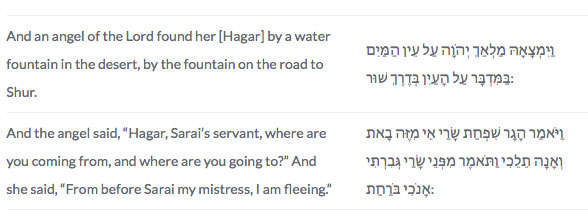
Suddenly an angel appears and says to Hagar, “From where are you coming and to where are you going?” On this verse, Rashi, our great 11th century commentator, teaches that actually the angel, of course, knew where Hagar was coming from, so the question had two functions. First, to give her an opening to start talking with him and second, on a deeper level, אֵי מִזֶּה [literally: where from this] means: “Where is the place about which you can say, ‘From this place I have come.’”
Hagar responds, I imagine somewhat breathlessly, “I am fleeing my master’s house.” Each time I read this section of Torah I wonder if this is simply Hagar’s opening statement or a deeper description of where she was coming from on a soul level.
Either way, she does not give her destination, perhaps because she doesn’t know where she’s headed. Perhaps her heart is broken, angry or numb.
This time of year, especially on Shabbat Shuva, the Shabbat of Return, the Shabbat that finds us between Rosh Hashana and Yom Kippur, we find ourselves, personally and communally asking ourselves, as if stopped by an angel in the wilderness, “Where am I coming from and where am I going?” The image is full of wild momentum, pregnant with the unknown, layered with texture all coming together at an “eye of water,” a moment of hydration, to hear a messenger of the Holy One ask, “Wait, pause a moment. Where are you?” This moment to check our soul-GPS is one that reminds me of even earlier in Genesis when Creator calls out, speaking to humanity for the very first time, primarily for our benefit, אַיֶּֽכָּה, ayeka, where are you? To me, this question is both eternal and urgent.
As I kid, I remember being very confused by the high holidays. Growing up in Portland, Oregon, Rosh Hashana was a time of crisp breezes, leaves turning from green to yellow, muddy grass and searching for shiny chestnuts. School likely had just begun or was about to begin, meaning fresh school supplies, new shoes and my birthday. Rosh Hashana was sweetened with family and apples, honey and new beginnings.
Then came Yom Kippur. It seemed like the party ended just as the guests arrived. Everyone got very serious and solemn, we knocked on our chests to say we were sorry and reflect on the year that had pasted. Our rabbi gave an earth-trembling sermon about justice and our responsibility to make a difference. We sang about who would die and who would live and the shofar blasted and blasted until it rang in our ears, even as we occasionally glazed over, counting the light bulbs in the majestic cathedral dome.
Why, I wondered, and still sometimes wonder, did the holidays come in this order? Shouldn’t we look back and reflect, apologize and recognize our fragility first and then experience new possibilities and new beginnings? At least this way we could take out the trash and then enjoy the party—instead of going through a giant mud puddle upon leaving the car wash, or getting into an argument with someone outside of yoga class.
But the curators of our Jewish calendar were very thoughtful and very real. It was understood then and now that, actually, we need to experience newness and possibility, birth and creativity, redemption and frankly hope, so that we can do the amends, make the repairs, forgive and reaffirm our vision for the New Year.
In the way that Torah portions end on a nechemtas, an uplift, the New Year, Rosh Hashana, begins on one. We reconnect with life, with possibility, with renewal, and in this way, we jumpstart our prospects for return. We fortify our desire and resilience to do the hard, deep work of Shabbat Shuva, the Shabbat of Return. On this Shabbat alone we are given an extra vitamin, a brand new toothbrush, support to gird our loins. We renew our listening – literally this is the Shabbat Ha’azinu, the Shabbat of Our Listening – in order to hear what Moshe said in his final days. His final telling becomes our new beginning. In hearing his words anew, we solidify our אֵי מִזֶּה, the place about which we can say, ‘From this place I have come.’”
As she flees through the wildness, Hagar receives an essential question and eternal question, especially at this season and Shabbat of Return, of Listening. Shabbat Shuva is a moment to slow down, dust off our feet and have a glass of water long enough to respond the questions: from where are you coming and to where are you going?
Minister Victoria Safford in Minnesota preaches it like this:
“Our mission is to plant ourselves at the gates of hope. Not the prudent gates of optimism, which are somewhat narrower. Not the stalwart, boring gates of common sense; nor the strident gates of self-righteousness, which creak on shrill and angry hinges, (people cannot hear us there; they cannot pass through) nor the cheerful, flimsy garden gate of “Everything is gonna’ be all right.” But a different, sometimes lonely place, the place of truth-telling, about your own soul first of all and its condition. The place of resistance and defiance, the piece of ground from which you see the world both as it is and as it could be as it will be; the place from which you glimpse not only struggle, but the joy of the struggle. And we stand there, beckoning and calling, telling people what we are seeing asking people what they see.”
Whether it’s a dusty desert angel, the mezuzah on our door, a child pulling on our legs, a speeding ticket or lab results… whatever the speed bump in the road, perhaps it might be just in time to save our lives, to hydrate our spirits. Or, at least, make our trek more meaningful, more full of hope.
Rabbi Alyson Solomon was ordained by the Rabbinical School of Hebrew College in 2009. She is Associate Rabbi at Beth Israel in San Diego and founder of the spiritual coaching and consulting practice, thisisRAS.com.
Looking for inspiration for the High Holidays? The Hebrew College High Holiday Companion (published in August 2017) is available now for study and reflection during the High Holidays. Learn more. If you are interested in learning more about the Rabbinical School of Hebrew College, we invite you to our Fall Open House and Day of Learning, Ta Sh’ma (Come & Hear) on November 6.
Previous Post

September 12, 2017
Not in Heaven: Neutrality or Responsibility
Next Post
September 25, 2017 The Weight of Our Wrongs
Browse Our Archives
Select a Category Uncategorized
Select a Month April 2026 March 2026 December 2025 November 2025 October 2025 September 2025 August 2025 July 2025 June 2025 May 2025 April 2025 March 2025 February 2025 January 2025 December 2024 November 2024 October 2024 September 2024 August 2024 July 2024 June 2024 May 2024 April 2024 March 2024 February 2024 January 2024 December 2023 November 2023 October 2023 September 2023 August 2023 July 2023 June 2023 May 2023 April 2023 March 2023 February 2023 January 2023 December 2022 November 2022 October 2022 September 2022 August 2022 July 2022 June 2022 May 2022 April 2022 March 2022 February 2022 January 2022 December 2021 November 2021 October 2021 September 2021 August 2021 July 2021 June 2021 May 2021 April 2021 March 2021 February 2021 January 2021 December 2020 November 2020 October 2020 September 2020 August 2020 July 2020 June 2020 May 2020 April 2020 March 2020 February 2020 January 2020 December 2019 November 2019 October 2019 September 2019 August 2019 July 2019 June 2019 May 2019 April 2019 March 2019 February 2019 January 2019 December 2018 November 2018 October 2018 September 2018 August 2018 July 2018 June 2018 May 2018 April 2018 March 2018 February 2018 January 2018 December 2017 November 2017 October 2017 September 2017 August 2017 July 2017 June 2017
Follow Us!
TAKE THE
Religious Wisdom Quiz
What is the ecumenical council where Roman Catholicism addressed modernization in the 1960s?
Select your answer to see how you score.
Vatican II Trent Ephesus Council of Nicaea
Related posts from Seventy Faces of Torah

The Holy Art of World Building

Parashat Tzav: Keeping the Sacred Fire Burning

Color Theory: What Joseph’s Coat Reveals
TRENDING AT PATHEOS Jewish

Building a Little Ark in a Frightening World
This past Shabbat, we read about Noah. I love this story. The...

Yom Kippur : Is There Always Room for...
Making Room for Forgiveness Every year as Yom Kippur approaches, I find...

This Rosh Hashanah: Can I Find New Meaning?
A Sunrise, a New Year, and a Question On our way to...

Killing Amalek: The Torah’s Most Misunderstood Commandment
Few passages of the Torah have provoked more confusion, polemic, and misuse...

I have never trusted a first draft. I don’t mean that...

Back to School, Back to Reality—and a New...
A New School Year Begins… Back to Reality A new school year...
view all Jewish blogs
Ad-Free & Subscriber Log-In Subscription Support
- About Us
- 2026 Calendar
- Videos
- Podcasts
- Library of World Religions
- Faith In Media Tracker
- Advertise With Us
- Write for Us
- Privacy Policy
- Terms of Service
- Do Not Sell My Data
- Contact Us
- Radiant Digital
- Manage Newsletter Subscriptions
- Unsubscribe From Notifications
- Sitemap
Copyright 2008-2026, Patheos. All rights reserved.
Subscription Support Ad-Free & Subscriber Log-In
Follow Patheos