
BuddhistCatholicContemplativeEvangelicalGeneral ChristianHinduJewishLatter-day SaintMuslimNew VisionsProgressive Christian
Beliefs
- Buddhist
- Catholic
- Contemplative
- Evangelical
- General Christian
- Hindu
- Jewish
- Latter-day Saint
- More Voices
- Muslim
- New Visions
- Pagan
- Progressive Christian
Topics
- Religion News
- Food and Religion
- Sports and Religion
- Religious Art
- Religious Music and Entertainment
- Religious Events
- History and Religion
- Style and Religion
- Politics and Religion
- Women in Religion
- Recreation Outdoors and Religion
- Business Finance and Religion
- Careers Workplace and Religion
- Education and Religion
- Family Parenting and Religion
- Health Fitness and Religion
- Home and Religion
- Relationships and Religion
- Technology and Religion
- Travel and Religion
Columnists
- Buddhist Columnists
- Business Finance and Religion Columnists
- Careers Workplace and Religion Columnists
- Catholic Columnists
- Contemplative Columnists
- Education and Religion Columnists
- Evangelists Columnists
- Family Parenting and Religion Columnists
- General Christian Columnists
- Health Fitness and Religion Columnists
- Hindu Columnists
- History and Religion Columnists
- Home and Religion Columnists
- Jewish Columnists
- More Voices Columnists
- Latter Day Columnists
- Muslim Columnists
- New Visions Columnists
- Nonreligious Columnists
- Pagan Columnists
- Politics and Religion Columnists
- Progressive Columnists
- Recreation Outdoors and Religion Columnists
- Relationships and Religion Columnists
- Religion News Columnists
- Religious Art Columnists
- Religious Events Columnists
- Religious Music and Entertainment Columnists
- Sports and Religion Columnists
- Style and Religion Columnists
- Technology and Religion Columnists
- Travel and Religion Columnists
- Women in Religion Columnists
Resource Library
- 2026 Calendar
- Library of World Religions
- The 100 Most Holy Places on Earth
- Patheos Answers
- Podcasts
- Videos
- Faith Leaders Database
- Anglican Episcopalian
- Bahai
- Baptist
- Buddhism
- Christianity
- Confucianism
- Eastern Orthodoxy
- Hinduism
- Holiness and Pentecostal
- ISKCON
- Islam
- Judaism
- Lutheran
- Methodist
- The Church of Jesus Christ of Latter-day Saints
- New Age
- Paganism
- Presbytarian and Reformed
- Protestantism
- Religion Behind the Scenes
- Roman Catholic
- Scientology
- Shia Islam
- Sikhism
- Sufism
- Sunni Islam
- Taoism
- Zen
- See all religions
Research Tools
 Ad-Free & Subscriber Log-In Subscription Support
Ad-Free & Subscriber Log-In Subscription Support
Follow Patheos 

- Trending:
- Forgiveness
- |
- Marriage
- |
- Consciousness
- |
- Death Penalty
- |
- Election
- |
- Halloween
 Dowsing for Divinity
-
Books
- Home
- Pagan
- Creating Meaningful Public Ritual
Creating Meaningful Public Ritual
Last updated on: September 7, 2016 at 8:30 am by Yvonne Aburrow
Creating Meaningful Public Ritual 2016-09-07T08:30:04-04:00 Yvonne Aburrow
Patheos Explore the world's faith through different perspectives on religion and spirituality! Patheos has the views of the prevalent religions and spiritualities of the world.
If I had a dollar for every bad ritual I have ever attended, I would have a lot of dollars. And I tend to spend a couple of hours after every bad ritual going over the reasons that it was bad. So all in all, that could be three or four hours of my life that I won’t get back.
We have all been to rituals that fell flat, or didn’t work as intended. We have all facilitated such rituals, and hopefully learnt from them.
John Halstead wrote that the aim of a good ritual is
to put us in connection with something bigger than ourselves — whether that be the Earth itself, the wider Cosmos, the community of more-than-human beings, our deeper Selves, or even just one another. Good ritual takes us out of our little isolated egos and expands our souls.
I agree with John H that half-assed elements in your ritual will make it bad – but often it is because the facilitators haven’t thought through what those ritual elements mean, or don’t know how to make the energetic connection necessary to make them work, not because those ritual elements are inherently bad in themselves.
Jason Mankey replied that sometimes the aim of a large public ritual is just to create community, and might not be focused on putting us in contact with something bigger than ourselves.
Well, even connecting with community is putting us in touch with something bigger than ourselves, so the ritual really ought to get that right.
Pagan ritual facilitates the incarnation, consecration, and integration [of] the daemonic or shadow elements of our individual or collective psyche. And finally, on [a] “mystical” level, Pagan ritual can be used to effect a (controlled) dis-integration of the ego. This is the ego-death and the oceanic sense of oneness that the mystics describe.
And I agree with John that all Pagan ritual should have this effect, not just rituals for initiated Wiccans.
One difference that I have observed between a small group of Wiccans who are experienced with focusing energy and a large group of people who are not so experienced is that the less experienced group will create fuzzier energy, but that’s not a massive problem.
Both authors are right that the techniques used in small-group Wiccan ritual don’t translate well to a larger group.
So here are some techniques that I have developed for getting everyone involved in the ritual, not just standing around feeling bored and watching a small group of people do the ritual (which will probably be inaudible anyway). Note that none of my suggestions include drumming, because I hate drumming.
Check-in
I stole this idea from the UUs. Go round the circle and everyone says their name and one word to describe how they are feeling.
Creating sacred space
Get everyone to join hands and pass energy around the circle. For added effect, they could also stomp around in a clockwise direction (don’t let it get too fast though, as slower movers will find it uncomfortable).
Ask all the participants to go to the North if they feel Earthy; East if they feel Airy; South if they feel Fiery; West if they feel Watery (or to the appropriate quarter if you have assigned different elements to the directions). The people in each quarter then meditate on that element, and when they have finished, open their eyes. Then everyone moves round to the next quarter (moving clockwise) until they have meditated on all four elements.
The main ritual
Various different techniques can be used here. Keep things like visualization very simple and short. One visualization that I use is to close your eyes and visualize your aura changing color from red, to orange, to yellow, to green, to blue, to violet. I also use grounding and centering.
Raising energy: There are many different ways of doing this, including synergy (the energy of everyone in the group forming a whole), resonance (the coming-together of similar energies), and polarity (the interaction of two opposing energies). If you are using polarity, it is more inclusive to divide the group into groups other than male and female (e.g. morning people and evening people, tea-drinkers and coffee drinkers, etc) and ask them to focus on the idea of the thing they like, merge their energy together, and then bringing the energy of the two groups together.
Mime: I once facilitated a Lammas ritual where I divided a group of thirty up into five groups of six, and asked them to come up with a mime describing an aspect of the John Barleycorn story. One group mimed the death of the Corn King; another group mimed the wheat being cut down by reapers; and so on. It was very moving. You could also do this for Autumn Equinox, perhaps with the story of Hades and Persephone.
Games: Another Lammas ritual idea is to divide the group into reapers, wheat, and a hare. (I did this by putting a lot of twigs into a bag. Twigs with bark on them were reapers; twigs without bark were wheat; the hare was a twig wrapped in silver foil. Parts were allocated by people pulling twigs out of the bag.) The game is that the reapers must try to catch the hare, and the wheat must try to hide him (it’s a bit like the game of Tag, or “It” as it was called in my childhood). This is based on the idea that the hare is the vegetation-spirit who hides in the last sheaf of wheat, and the reapers would always treat the last sheaf of wheat with special ritual. When the hare has been caught, all the reapers throw darts of grass at him, and he falls over, and is carried off with great lamentation.
Extemporized contributions: invite people to contribute their thoughts on the meaning of the festival, or a short devotional call to a deity.
Closing
Shared food: have the whole group bless the shared food, whether it is cakes and wine, or something else. Make sure the blessed food and drink can be distributed quickly so that there isn’t a lot of standing around. The easiest way to do this is to have four people and get them to serve a quarter of the circle each. Another way is just to pass the food and drink from one person to the next, perhaps with some kind of blessing.
Farewell to the quarters: gather again in the quarter where you started, face outwards, and say “Hail and Farewell” (or something similar). Then move around to the next quarter, until you have said goodbye to all of them.
Closing the sacred space: Have people hold hands again and say some kind of closing words (either all together, or the facilitator can say them).
Public ritual doesn’t have to be dull and lacking in transcendence, and it needn’t involve a lot of standing around being bored. And it absolutely should be a transformative and meaningful experience that makes us feel more connected to the numinous, to Nature, to the gods, and to our community.
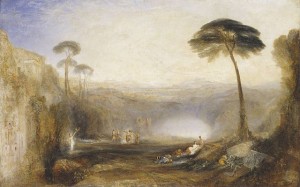
“The Golden Bough” by J. M. W. Turner, Public Domain.
THE ALLERGIC PAGAN: Gods Save Us from Bad Pagan Rituals: 10 Signs You’re Half-Assing Your Mabon Ritual
RAISE THE HORNS: Do Your Bad Pagan Ritual (bad ritual is better than no ritual)
THE ALLERGIC PAGAN: Lowered Expectations Is Not the Answer to Bad Pagan Rituals
Previous Post
September 3, 2016
Living Traditions
Next Post

September 15, 2016 "Good" people do bad things: statement on the Frosts
Browse Our Archives
Select a Category A Beginner's Guide Announcements Conversations Creative Endarkenment Embodied Spirituality General Interviews My Story News Commentary Pagan Studies Poetry Praxis Related topics Reviews Ritual Sacred Endarkenment Storytime Theology
Select a Month February 2017 December 2016 November 2016 October 2016 September 2016 August 2016 July 2016 June 2016 May 2016 April 2016 March 2016 February 2016 January 2016 December 2015 November 2015 October 2015 September 2015 August 2015 July 2015 June 2015 May 2015 April 2015 March 2015 February 2015 January 2015 December 2014 November 2014 October 2014 September 2014 August 2014 July 2014 June 2014 May 2014 April 2014 March 2014 February 2014 January 2014 December 2013 November 2013 October 2013 September 2013 August 2013 July 2013 June 2013 May 2013 April 2013 March 2013 February 2013 January 2013 December 2012 November 2012
Follow Us!
TAKE THE
Religious Wisdom Quiz
Which book of the Bible contains the Ten Plagues of Egypt?
Select your answer to see how you score.
Genesis Exodus Deuteronomy Leviticus
Related posts from Dowsing for Divinity


A Meditation: The Trees and the Forest

The safety pin: a reminder to resist bigotry
TRENDING AT PATHEOS Pagan

I was recently chatting with someone on Instagram. She asked me what...

While there are many people who share their results, the end of...

On July 23, I saw Christopher Nolan's The Odyssey which is Homer’s...

As I write this two big events have just finished up. One...

Restoring the Watershed of Divine Love
Perhaps cooperation is not something we manufacture through legislation, ideology, or moral...

Many UUs don’t pray because of bad experiences in a previous religion,...
view all Pagan blogs
Ad-Free & Subscriber Log-In Subscription Support
- About Us
- 2026 Calendar
- Videos
- Podcasts
- Library of World Religions
- Faith In Media Tracker
- Advertise With Us
- Write for Us
- Privacy Policy
- Terms of Service
- Do Not Sell My Data
- Contact Us
- Radiant Digital
- Manage Newsletter Subscriptions
- Unsubscribe From Notifications
- Sitemap
Copyright 2008-2026, Patheos. All rights reserved.
Subscription Support Ad-Free & Subscriber Log-In
Follow Patheos