
BuddhistCatholicContemplativeEvangelicalGeneral ChristianHinduJewishLatter-day SaintMuslimNew VisionsProgressive Christian
Beliefs
- Buddhist
- Catholic
- Contemplative
- Evangelical
- General Christian
- Hindu
- Jewish
- Latter-day Saint
- More Voices
- Muslim
- New Visions
- Pagan
- Progressive Christian
Topics
- Religion News
- Food and Religion
- Sports and Religion
- Religious Art
- Religious Music and Entertainment
- Religious Events
- History and Religion
- Style and Religion
- Politics and Religion
- Women in Religion
- Recreation Outdoors and Religion
- Business Finance and Religion
- Careers Workplace and Religion
- Education and Religion
- Family Parenting and Religion
- Health Fitness and Religion
- Home and Religion
- Relationships and Religion
- Technology and Religion
- Travel and Religion
Columnists
- Buddhist Columnists
- Business Finance and Religion Columnists
- Careers Workplace and Religion Columnists
- Catholic Columnists
- Contemplative Columnists
- Education and Religion Columnists
- Evangelists Columnists
- Family Parenting and Religion Columnists
- General Christian Columnists
- Health Fitness and Religion Columnists
- Hindu Columnists
- History and Religion Columnists
- Home and Religion Columnists
- Jewish Columnists
- More Voices Columnists
- Latter Day Columnists
- Muslim Columnists
- New Visions Columnists
- Nonreligious Columnists
- Pagan Columnists
- Politics and Religion Columnists
- Progressive Columnists
- Recreation Outdoors and Religion Columnists
- Relationships and Religion Columnists
- Religion News Columnists
- Religious Art Columnists
- Religious Events Columnists
- Religious Music and Entertainment Columnists
- Sports and Religion Columnists
- Style and Religion Columnists
- Technology and Religion Columnists
- Travel and Religion Columnists
- Women in Religion Columnists
Resource Library
- 2026 Calendar
- Library of World Religions
- The 100 Most Holy Places on Earth
- Patheos Answers
- Podcasts
- Videos
- Faith Leaders Database
- Anglican Episcopalian
- Bahai
- Baptist
- Buddhism
- Christianity
- Confucianism
- Eastern Orthodoxy
- Hinduism
- Holiness and Pentecostal
- ISKCON
- Islam
- Judaism
- Lutheran
- Methodist
- The Church of Jesus Christ of Latter-day Saints
- New Age
- Paganism
- Presbytarian and Reformed
- Protestantism
- Religion Behind the Scenes
- Roman Catholic
- Scientology
- Shia Islam
- Sikhism
- Sufism
- Sunni Islam
- Taoism
- Zen
- See all religions
Research Tools
 Ad-Free & Subscriber Log-In Subscription Support
Ad-Free & Subscriber Log-In Subscription Support
Follow Patheos 

- Trending:
- Forgiveness
- |
- Marriage
- |
- Consciousness
- |
- Death Penalty
- |
- Election
- |
- Halloween
 Dowsing for Divinity
-
Books
- Home
- Pagan
- Hospitality for the Stranger
Hospitality for the Stranger
Last updated on: August 10, 2016 at 5:10 pm by Yvonne Aburrow
Hospitality for the Stranger 2016-08-10T17:10:50-04:00 Yvonne Aburrow
Patheos Explore the world's faith through different perspectives on religion and spirituality! Patheos has the views of the prevalent religions and spiritualities of the world.
Editors’ Note: This article is part of the Patheos Public Square on Immigration and Refugees. Read other perspectives here.
What does your faith perspective teach you about refugees? How do your politics and your religious convictions come together to inform policy and shape your attitude?
Every ancient pagan culture had very strong traditions of hospitality. These were often reinforced by telling stories of gods, goddesses, and angels disguised as mortals visiting people.
The Greeks had a strong tradition of xenia care for the stranger. This carried its own obligations and traditions. When Nausica found Odysseus washed up on the shore, her care for him was very much in the tradition of xenia.
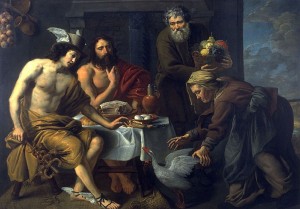
Mercury and Jupiter in the House of Philemon and Baucis, by Jacob van Oost (I) – Fine Arts Museums of San Francisco, Public Domain.
The Hávamál, which means ‘the speech of the High One’ (Odinn) also contains stanzas about hospitality, and the duties of both host and guest.
Ultimately, the two words, host and guest, are derived from the same Indo-European root word, and so imply that they were viewed as inseparable parts of the same relationship. I like to think of them as the two halves of a hinge. The relationship of guest and host is reciprocal, with sacred obligations on both sides.
The concept and practice of hospitality are very important in India too, which suggests that the practice is very ancient indeed. Both Pakistan and Germany (and other places too) have the tradition of the guest-gift, where a guest will give you a gift the first time they visit your home. People from Latvia have a tradition of giving bead and salt as a gift when you have a new house. The sharing of bread and salt are considered sacred in many cultures. Once they have been shared, the relationship of guest and host is established and sacred.
If we think back to the times when small villages were scattered among great forests, the arrival of a stranger with news from other places, new stories, new songs, and new jokes, maybe even new farming or weaving or metalworking techniques, must have been very welcome.
There were also great movements of people in ancient times: Goths, Visigoths, Vandals, and Alans; settlers from the rest of Europe and North Africa who came with the Romans; Angles, Saxons, and Jutes who fled the rising waters of the North Sea and settled in Britain. More recently, there were silver miners from Germany who settled in the Mendips; many African and Middle Eastern people; the Huguenots fleeing persecution in France; Sephardic Jews from Amsterdam, Ashkenazi Jews from Eastern Europe, who began to arrive after the interdict against Jews was lifted in 1654 (it was put in place by King John in 1290 because he didn’t want to repay loans from Jewish bankers – who were forced to enter banking as other professions were closed to them).
Everyone in Britain probably has a refugee or an economic migrant in their ancestry somewhere, if you go back far enough. Even Kate Middleton is related to a prominent Huguenot family. And both refugees and economic migrants have contributed hugely to the UK by creating jobs and boosting the economy with their spending power and tax contributions (and if they are not from the EU, they have “no recourse to public funds” stamped in their visa – so they receive no benefits and no free NHS).
And in the US and Canada of course, unless you are 100% Native, you are an immigrant or descended from immigrants.
I feel instinctively that openness to other cultures, and welcoming the stranger and the refugee, are good things. What kind of civilisation would we be if we were not open and hospitable? One that was both ethically and culturally impoverished, would be my answer.
But I think that the gods and goddesses of Paganism – who frequently come to Earth to test the hospitality of mortals, and reward those who are hospitable, and punish those who are not – would agree that hospitality is a sacred practice and should be held in high honour.
Of course, in the case of migration to other lands, there is the point of transition from guest to resident. Here again, we see the process of reciprocity at work. The migrant has paid their tax, contributed work and money to the system, and in many cases their food style and folk customs to the culture, and so after a time they become a member of the community. In societies that welcome immigrants, such as Canada, this is expected and encouraged; and education has been geared towards welcoming diversity for the last 25 years. More xenophobic countries (such as the UK) go to extraordinary lengths to prevent the transition from guest to resident.
Both hospitality and reciprocity are Pagan virtues and have been since ancient times. Honour is also important in many Pagan traditions, and I think the honourable thing to do is to welcome the stranger. Hoarding wealth was frowned upon in ancient societies; wealth was displayed by the generosity of the ‘ring-giving lord’ who gave gold arm rings to his thegns, and the loaf-giver (hlaf-diga, the origin of the word lady). The social fabric was woven through the sacred practices of hospitality, fosterage, gift exchange, and reciprocity. We would do well to cultivate these virtues instead of xenophobia and suspicion. So I would definitely say that Pagan religions encourage us to show hospitality towards migrants and compassion for refugees.
See also:
Previous Post

July 29, 2016
Poem on a Birthday
Next Post

August 17, 2016 My Polytheism
Browse Our Archives
Select a Category A Beginner's Guide Announcements Conversations Creative Endarkenment Embodied Spirituality General Interviews My Story News Commentary Pagan Studies Poetry Praxis Related topics Reviews Ritual Sacred Endarkenment Storytime Theology
Select a Month February 2017 December 2016 November 2016 October 2016 September 2016 August 2016 July 2016 June 2016 May 2016 April 2016 March 2016 February 2016 January 2016 December 2015 November 2015 October 2015 September 2015 August 2015 July 2015 June 2015 May 2015 April 2015 March 2015 February 2015 January 2015 December 2014 November 2014 October 2014 September 2014 August 2014 July 2014 June 2014 May 2014 April 2014 March 2014 February 2014 January 2014 December 2013 November 2013 October 2013 September 2013 August 2013 July 2013 June 2013 May 2013 April 2013 March 2013 February 2013 January 2013 December 2012 November 2012
Follow Us!
TAKE THE
Religious Wisdom Quiz
Who fell out of a window and was restored to life by Paul?
Select your answer to see how you score.
Silas Barnabas Eutychus Timothy
Related posts from Dowsing for Divinity

Imagining Other Possible Worlds

You say you want a revolution? (Review)

A Meditation: The Trees and the Forest

TRENDING AT PATHEOS Pagan

I was recently chatting with someone on Instagram. She asked me what...

While there are many people who share their results, the end of...

On July 23, I saw Christopher Nolan's The Odyssey which is Homer’s...

As I write this two big events have just finished up. One...

Restoring the Watershed of Divine Love
Perhaps cooperation is not something we manufacture through legislation, ideology, or moral...

Many UUs don’t pray because of bad experiences in a previous religion,...
view all Pagan blogs
Ad-Free & Subscriber Log-In Subscription Support
- About Us
- 2026 Calendar
- Videos
- Podcasts
- Library of World Religions
- Faith In Media Tracker
- Advertise With Us
- Write for Us
- Privacy Policy
- Terms of Service
- Do Not Sell My Data
- Contact Us
- Radiant Digital
- Manage Newsletter Subscriptions
- Unsubscribe From Notifications
- Sitemap
Copyright 2008-2026, Patheos. All rights reserved.
Subscription Support Ad-Free & Subscriber Log-In
Follow Patheos