
BuddhistCatholicContemplativeEvangelicalGeneral ChristianHinduJewishLatter-day SaintMuslimNew VisionsProgressive Christian
Beliefs
- Buddhist
- Catholic
- Contemplative
- Evangelical
- General Christian
- Hindu
- Jewish
- Latter-day Saint
- More Voices
- Muslim
- New Visions
- Pagan
- Progressive Christian
Topics
- Religion News
- Food and Religion
- Sports and Religion
- Religious Art
- Religious Music and Entertainment
- Religious Events
- History and Religion
- Style and Religion
- Politics and Religion
- Women in Religion
- Recreation Outdoors and Religion
- Business Finance and Religion
- Careers Workplace and Religion
- Education and Religion
- Family Parenting and Religion
- Health Fitness and Religion
- Home and Religion
- Relationships and Religion
- Technology and Religion
- Travel and Religion
Columnists
- Buddhist Columnists
- Business Finance and Religion Columnists
- Careers Workplace and Religion Columnists
- Catholic Columnists
- Contemplative Columnists
- Education and Religion Columnists
- Evangelists Columnists
- Family Parenting and Religion Columnists
- General Christian Columnists
- Health Fitness and Religion Columnists
- Hindu Columnists
- History and Religion Columnists
- Home and Religion Columnists
- Jewish Columnists
- More Voices Columnists
- Latter Day Columnists
- Muslim Columnists
- New Visions Columnists
- Nonreligious Columnists
- Pagan Columnists
- Politics and Religion Columnists
- Progressive Columnists
- Recreation Outdoors and Religion Columnists
- Relationships and Religion Columnists
- Religion News Columnists
- Religious Art Columnists
- Religious Events Columnists
- Religious Music and Entertainment Columnists
- Sports and Religion Columnists
- Style and Religion Columnists
- Technology and Religion Columnists
- Travel and Religion Columnists
- Women in Religion Columnists
Resource Library
- 2026 Calendar
- Library of World Religions
- The 100 Most Holy Places on Earth
- Patheos Answers
- Podcasts
- Videos
- Faith Leaders Database
- Anglican Episcopalian
- Bahai
- Baptist
- Buddhism
- Christianity
- Confucianism
- Eastern Orthodoxy
- Hinduism
- Holiness and Pentecostal
- ISKCON
- Islam
- Judaism
- Lutheran
- Methodist
- The Church of Jesus Christ of Latter-day Saints
- New Age
- Paganism
- Presbytarian and Reformed
- Protestantism
- Religion Behind the Scenes
- Roman Catholic
- Scientology
- Shia Islam
- Sikhism
- Sufism
- Sunni Islam
- Taoism
- Zen
- See all religions
Research Tools
 Ad-Free & Subscriber Log-In Subscription Support
Ad-Free & Subscriber Log-In Subscription Support
Follow Patheos 

- Trending:
- Forgiveness
- |
- Marriage
- |
- Consciousness
- |
- Death Penalty
- |
- Election
- |
- Halloween
 Dowsing for Divinity
-
Books
- Home
- Pagan
- What Does An Inclusive Coven Look Like?
What Does An Inclusive Coven Look Like?
Last updated on: May 17, 2016 at 11:39 am by Yvonne Aburrow
What Does An Inclusive Coven Look Like? 2016-05-17T11:39:04-04:00 Yvonne Aburrow
Patheos Explore the world's faith through different perspectives on religion and spirituality! Patheos has the views of the prevalent religions and spiritualities of the world.
A lot of people seem to think that inclusive means “I’ve got some gay people in my coven”. That is certainly welcoming – but is it really inclusive? I think there’s a spectrum of inclusivity – so one coven might score 100% and another might score 80% – but I think we have to accept that different people will have different ideas and priorities. However, it would avoid a lot of heartbreak all round if people stated upfront how inclusive their coven actually is.

Inclusive Wicca (design by Yvonne Aburrow)
An inclusive coven ticks some or all of the following boxes:
- Understands that diversity has a place in celebration, theology and cosmology.
- Understands that gender identity, gender expression, sex/gender assigned at birth, and biological characteristics are distinct (when I say distinct, I mean noticeably different, but interpermeable and with fuzzy boundaries).
- Understands that you can make energy through polarity (tension of opposites), resonance (two similar people), or synergy (joining the energies of the whole group).
- Understands that polarity can be made by two or more people of any gender and sexual orientation, and by two or more people of the same gender, and that polarity exists on a spectrum where Person A may be yang in relation to Person B, but yin in relation to Person C.
- Understands that you can make polarity with any pair of opposite qualities (e.g. morning people and evening people, cat lovers and dog lovers, tea drinkers and coffee drinkers, air signs and earth signs, fire signs and water signs).
- Understands that fertility is not strictly biological and may refer to creativity (and that you don’t need a male body & a female body to produce fertility on a symbolic level – e.g. when blessing crops).
- Allows invocation of any gender deity onto any gender human.
- Allows gender fluidity in ritual roles & doesn’t make people stand boy/girl/boy/girl in circle.
- Does cakes & wine with reference to lover & beloved, or using two cups, or on the understanding that we all contain both ‘masculine’ and ‘feminine’ energies, or some other inclusive variation, and can be done by two people of any gender.
- Accommodates difference (e.g. neurodivergence, dyslexia, left-handedness, aphantasia) and disability. Bonus points for embracing the social model of disability.
- Is open to other cultures and ethnicities and does not insist on a genetic basis for culture (e.g. anyone can worship gods from any culture). Bonus points for being aware of the concept of systemic racism.
- Tries to avoid cultural appropriation.
- Is accepting of kink, polyamory, and monogamy.
- Promotes consent culture.
- Welcomes members of all ages (over 18) and accommodates older members’ needs.
- Does not automatically exclude people with mental health issues.
- Accommodates different theological perspectives (animism, atheism, pantheism, polytheism, duotheism etc).
- Body-positive: does not allow fat-shaming or body-shaming.
- Is prepared to accommodate coven members who are less well-off (by not organising expensive social activities, or having a massive and expensive reading list, for example).
- Does not insist that its members reach a particular educational level or belong to a particular socio-economic class.
- Listens to the views of all the members.
- Values the contributions and ideas of all the members.
Summary
Inclusive Wicca is about being inclusive towards everyone.
There isn’t a competition over who is more oppressed, and there is no queue for liberation. We can work on small issues and large issues at the same time – I am not suggesting that all the categories mentioned in the list receive the same degree of oppression in society – they are included in the list because at some point, they have been excluded from some Wiccan circles for some reason.
Also, please note that inclusive Wicca is not a new or separate tradition; it is a tendency within existing Wiccan traditions. (Though just to confuse matters, in Australia, there actually is a tradition called Inclusive Wicca, which is unconnected to the inclusive tendency – though it may have similar goals.)
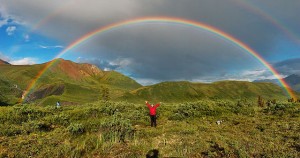
Double rainbow in Alaska. Photo by Eric Rolph at English Wikipedia – English Wikipedia, CC BY-SA 2.5.
Thanks to Alder Lyncurium, Anna Hammarlund, Anya Read, Brian Paisley, Francois Schaut, Lirilin Lee, Susan Harper, for suggestions and comments on the first draft of this.
UPDATE: I have now created an inclusive Wicca website.
Previous Post
May 11, 2016
Creative Endarkenment: the Need to Ground and Shield
Next Post

May 20, 2016 City of Refuge, by Starhawk (Book Review)
Browse Our Archives
Select a Category A Beginner's Guide Announcements Conversations Creative Endarkenment Embodied Spirituality General Interviews My Story News Commentary Pagan Studies Poetry Praxis Related topics Reviews Ritual Sacred Endarkenment Storytime Theology
Select a Month February 2017 December 2016 November 2016 October 2016 September 2016 August 2016 July 2016 June 2016 May 2016 April 2016 March 2016 February 2016 January 2016 December 2015 November 2015 October 2015 September 2015 August 2015 July 2015 June 2015 May 2015 April 2015 March 2015 February 2015 January 2015 December 2014 November 2014 October 2014 September 2014 August 2014 July 2014 June 2014 May 2014 April 2014 March 2014 February 2014 January 2014 December 2013 November 2013 October 2013 September 2013 August 2013 July 2013 June 2013 May 2013 April 2013 March 2013 February 2013 January 2013 December 2012 November 2012
Follow Us!
TAKE THE
Religious Wisdom Quiz
Who sat at the Beautiful Gate begging before Peter healed him?
Select your answer to see how you score.
A rich ruler A blind man A lame man A Roman centurion
Related posts from Dowsing for Divinity

Review of Queer Paganism by Jo Green

The safety pin: a reminder to resist bigotry
Creating Meaningful Public Ritual
TRENDING AT PATHEOS Pagan

I was recently chatting with someone on Instagram. She asked me what...

While there are many people who share their results, the end of...

On July 23, I saw Christopher Nolan's The Odyssey which is Homer’s...

As I write this two big events have just finished up. One...

Restoring the Watershed of Divine Love
Perhaps cooperation is not something we manufacture through legislation, ideology, or moral...

Many UUs don’t pray because of bad experiences in a previous religion,...
view all Pagan blogs
Ad-Free & Subscriber Log-In Subscription Support
- About Us
- 2026 Calendar
- Videos
- Podcasts
- Library of World Religions
- Faith In Media Tracker
- Advertise With Us
- Write for Us
- Privacy Policy
- Terms of Service
- Do Not Sell My Data
- Contact Us
- Radiant Digital
- Manage Newsletter Subscriptions
- Unsubscribe From Notifications
- Sitemap
Copyright 2008-2026, Patheos. All rights reserved.
Subscription Support Ad-Free & Subscriber Log-In
Follow Patheos