
BuddhistCatholicContemplativeEvangelicalGeneral ChristianHinduJewishLatter-day SaintMuslimNew VisionsProgressive Christian
Beliefs
- Buddhist
- Catholic
- Contemplative
- Evangelical
- General Christian
- Hindu
- Jewish
- Latter-day Saint
- More Voices
- Muslim
- New Visions
- Pagan
- Progressive Christian
Topics
- Religion News
- Food and Religion
- Sports and Religion
- Religious Art
- Religious Music and Entertainment
- Religious Events
- History and Religion
- Style and Religion
- Politics and Religion
- Women in Religion
- Recreation Outdoors and Religion
- Business Finance and Religion
- Careers Workplace and Religion
- Education and Religion
- Family Parenting and Religion
- Health Fitness and Religion
- Home and Religion
- Relationships and Religion
- Technology and Religion
- Travel and Religion
Columnists
- Buddhist Columnists
- Business Finance and Religion Columnists
- Careers Workplace and Religion Columnists
- Catholic Columnists
- Contemplative Columnists
- Education and Religion Columnists
- Evangelists Columnists
- Family Parenting and Religion Columnists
- General Christian Columnists
- Health Fitness and Religion Columnists
- Hindu Columnists
- History and Religion Columnists
- Home and Religion Columnists
- Jewish Columnists
- More Voices Columnists
- Latter Day Columnists
- Muslim Columnists
- New Visions Columnists
- Nonreligious Columnists
- Pagan Columnists
- Politics and Religion Columnists
- Progressive Columnists
- Recreation Outdoors and Religion Columnists
- Relationships and Religion Columnists
- Religion News Columnists
- Religious Art Columnists
- Religious Events Columnists
- Religious Music and Entertainment Columnists
- Sports and Religion Columnists
- Style and Religion Columnists
- Technology and Religion Columnists
- Travel and Religion Columnists
- Women in Religion Columnists
Resource Library
- 2026 Calendar
- Library of World Religions
- The 100 Most Holy Places on Earth
- Patheos Answers
- Podcasts
- Videos
- Faith Leaders Database
- Anglican Episcopalian
- Bahai
- Baptist
- Buddhism
- Christianity
- Confucianism
- Eastern Orthodoxy
- Hinduism
- Holiness and Pentecostal
- ISKCON
- Islam
- Judaism
- Lutheran
- Methodist
- The Church of Jesus Christ of Latter-day Saints
- New Age
- Paganism
- Presbytarian and Reformed
- Protestantism
- Religion Behind the Scenes
- Roman Catholic
- Scientology
- Shia Islam
- Sikhism
- Sufism
- Sunni Islam
- Taoism
- Zen
- See all religions
Research Tools
 Ad-Free & Subscriber Log-In Subscription Support
Ad-Free & Subscriber Log-In Subscription Support
Follow Patheos 

- Trending:
- Forgiveness
- |
- Marriage
- |
- Consciousness
- |
- Death Penalty
- |
- Election
- |
- Halloween
 Dowsing for Divinity
-
Books
- Home
- Pagan
- The Moon and the Sea
The Moon and the Sea
Last updated on: May 10, 2016 at 12:28 am by Yvonne Aburrow
The Moon and the Sea 2016-05-09T17:28:34-04:00 Yvonne Aburrow
Patheos Explore the world's faith through different perspectives on religion and spirituality! Patheos has the views of the prevalent religions and spiritualities of the world.
For as long as I can remember, the Moon has seemed like a source of mystery and magic. I have always had a bit of a thing about the Moon, and everything associated with the lunar side of life: poetry, intuition, silver, water, dreams, and stars. I always assumed that cats were lunar until I discovered that dogs are lunar and cats are solar. But I still prefer cats. The Moon represents the twilight half of consciousness (memories, dreams, intuition, rhythm). And of course, witches have always been associated with the Moon, and with a whole cohort of animals and birds who are also associated with the Moon, especially hares, bats, and owls.
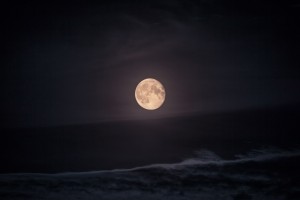
Full Moon, Sky, Sea, Waves. Pexel.com. CC0, Public Domain
The Moon in poetry
The silvery light of the Moon transforms the landscape into a mysterious deep twilight blue. The moonpath (the reflection of the Moon on the sea) may lead to mysterious other realms. It certainly did for Lucius Apuleius when the great goddess Isis appeared to him as the full Moon over the sea, and transformed him back into a human being, releasing him from the enchantment that had turned him into an ass.
“Behold Lucius I am come, thy weeping and prayers has moved me to succor thee. I am she that is the natural mother of all things, mistress and governess of all the elements, the initial progeny of worlds, chief of powers divine, Queen of heaven, the principal of the Gods celestial, the light of the goddesses: at my will the planets of the air, the wholesome winds of the Seas, and the silences of hell be disposed; my name, my divinity is adored throughout all the world in divers manners, in variable customs and in many names, for the Phrygians call me Pessinuntica, the mother of the Gods: the Athenians call me Cecropian Artemis: the Cyprians, Paphian Aphrodite: the Candians, Dictyanna: the Sicilians , Stygian Proserpine: and the Eleusians call me Mother of the Corn. Some call me Juno, others Bellona of the Battles, and still others Hecate. Principally the Ethiopians which dwell in the Orient, and the Egyptians which are excellent in all kind of ancient doctrine, and by their proper ceremonies accustomed to worship me, do call me Queen Isis.”
This theme was picked up by Dion Fortune in her wonderful book, The Sea Priestess:
I am that soundless, boundless, bitter sea.
All tides are mine, and answer unto me.
Tides of the airs, tides of the inner earth;
The secret, silent tides of death and birth.
Tides of men’s souls, and dreams, and destiny –
Isis Veiled, and Rhea, Binah, Ge.The hour of the high full moon draws near;
I hear the invoking words, hear and appear —
Isis Unveiled, and Rhea, Binah, Ge.
I come unto the priest that calleth me.
There is a wonderful poem by Sylvia Plath, The Moon and the Yew Tree, which describes the contrast between the Moon, who is “bald and wild” and “terribly upset”, and Mary, who is “sweet”:
The yew tree points up, it has a Gothic shape.
The eyes lift after it and find the moon.
The moon is my mother. She is not sweet like Mary.
Her blue garments unloose small bats and owls.
Actually I rather suspect that Sylvia Plath’s poetry is a contributory factor in my being being a Pagan and a Wiccan. She also wrote a wonderful poem about the Horned God, called Faun, which also evokes the Moon:
Haunched like a faun, he hooed
From grove of moon-glint and fen-frost
Until all owls in the twigged forest
Flapped black to look and brood
On the call this man made.
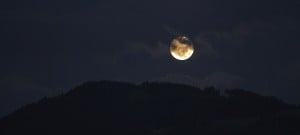
Sky, Clouds, Moon, Horizon. Pexel.com. CC0, Public Domain.
Serious Moonlight
In times past, the moonlight was needed because of a lack of streetlights, and the Lunar Society (Erasmus Darwin, Watt, Bolton, Wedgwood, Priestley, etc) met on full moon nights in order to be able to travel at night. The Carmina Gadelica praises the Moon as ‘the glorious lamp of the poor’, and there are four prayers to the Moon in the collection.
There are many Moon deities, both male and female. In Wicca, we tend to regard the Moon as female and the Sun as male; in Heathenry, the Sun is female and the Moon is male. Many other cultures have a male Moon deity too – Chandra in India, Shin in Mesopotamia, Tsukuyomi in Japan.There are also many Moon goddesses: the Greek goddesses Phoebe, Artemis, Selene, and Hecate; and the Chinese goddess Chang’e. Some of these deities are associated with witches.
In ancient times, people would kiss their hand to the New Moon. (It’s mentioned in the Hebrew Bible, Job 31: 26-28.) The Moon was believed to govern growth and fertility, so that planting should always be done at the New Moon, so that the plant would grow with the waxing Moon. Many plants are associated with the Moon, especially white flowers that give off a scent at night, and ones that are traditionally used in witchcraft.
For me, the Moon is the source and origin of witchcraft: the lunar energy, the mysterious qualities of the Moon, and the association with the night, wildness, freedom, spirituality, and sexuality:
O, my love
Come silently in the middle of the night
As gliding moonlight…
– Nazrul Islam
Poets and mystics of all religions have praised the beauty of the Moon – especially the Sufis, who also have a mystical relationship with the night.
The phases of the Moon are also important. The Moon rules the tides of the sea; but she is also believed to rule the tides of the mind. Magic for increase should always be done on the waxing Moon; magic for decrease, on the waning Moon.
The Moon rules the twilight side of life, the wild, the uncanny, the preternatural. Civilisation tries to ignore the Moon, because she is the liberator of the oppressed and shines her light into the nooks and crannies, revealing the deeds that are done by night. But the Moon always returns with her messages from the subconscious, from the endless sea of dreams.
Previous Post
May 9, 2016
Finding a Compromise: Keeping Places
Next Post

May 11, 2016 Creative Endarkenment: the Need to Ground and Shield
Browse Our Archives
Select a Category A Beginner's Guide Announcements Conversations Creative Endarkenment Embodied Spirituality General Interviews My Story News Commentary Pagan Studies Poetry Praxis Related topics Reviews Ritual Sacred Endarkenment Storytime Theology
Select a Month February 2017 December 2016 November 2016 October 2016 September 2016 August 2016 July 2016 June 2016 May 2016 April 2016 March 2016 February 2016 January 2016 December 2015 November 2015 October 2015 September 2015 August 2015 July 2015 June 2015 May 2015 April 2015 March 2015 February 2015 January 2015 December 2014 November 2014 October 2014 September 2014 August 2014 July 2014 June 2014 May 2014 April 2014 March 2014 February 2014 January 2014 December 2013 November 2013 October 2013 September 2013 August 2013 July 2013 June 2013 May 2013 April 2013 March 2013 February 2013 January 2013 December 2012 November 2012
Follow Us!
TAKE THE
Religious Wisdom Quiz
What is the largest Christian denomination in the world?
Select your answer to see how you score.
Catholic Protestant Lutheran Orthodox
Related posts from Dowsing for Divinity

Imagining Other Possible Worlds
You say you want a revolution? (Review)


A Meditation: The Trees and the Forest
TRENDING AT PATHEOS Pagan

I was recently chatting with someone on Instagram. She asked me what...

While there are many people who share their results, the end of...

On July 23, I saw Christopher Nolan's The Odyssey which is Homer’s...

As I write this two big events have just finished up. One...

Restoring the Watershed of Divine Love
Perhaps cooperation is not something we manufacture through legislation, ideology, or moral...

Many UUs don’t pray because of bad experiences in a previous religion,...
view all Pagan blogs
Ad-Free & Subscriber Log-In Subscription Support
- About Us
- 2026 Calendar
- Videos
- Podcasts
- Library of World Religions
- Faith In Media Tracker
- Advertise With Us
- Write for Us
- Privacy Policy
- Terms of Service
- Do Not Sell My Data
- Contact Us
- Radiant Digital
- Manage Newsletter Subscriptions
- Unsubscribe From Notifications
- Sitemap
Copyright 2008-2026, Patheos. All rights reserved.
Subscription Support Ad-Free & Subscriber Log-In
Follow Patheos