
BuddhistCatholicContemplativeEvangelicalGeneral ChristianHinduJewishLatter-day SaintMuslimNew VisionsProgressive Christian
Beliefs
- Buddhist
- Catholic
- Contemplative
- Evangelical
- General Christian
- Hindu
- Jewish
- Latter-day Saint
- More Voices
- Muslim
- New Visions
- Pagan
- Progressive Christian
Topics
- Religion News
- Food and Religion
- Sports and Religion
- Religious Art
- Religious Music and Entertainment
- Religious Events
- History and Religion
- Style and Religion
- Politics and Religion
- Women in Religion
- Recreation Outdoors and Religion
- Business Finance and Religion
- Careers Workplace and Religion
- Education and Religion
- Family Parenting and Religion
- Health Fitness and Religion
- Home and Religion
- Relationships and Religion
- Technology and Religion
- Travel and Religion
Columnists
- Buddhist Columnists
- Business Finance and Religion Columnists
- Careers Workplace and Religion Columnists
- Catholic Columnists
- Contemplative Columnists
- Education and Religion Columnists
- Evangelists Columnists
- Family Parenting and Religion Columnists
- General Christian Columnists
- Health Fitness and Religion Columnists
- Hindu Columnists
- History and Religion Columnists
- Home and Religion Columnists
- Jewish Columnists
- More Voices Columnists
- Latter Day Columnists
- Muslim Columnists
- New Visions Columnists
- Nonreligious Columnists
- Pagan Columnists
- Politics and Religion Columnists
- Progressive Columnists
- Recreation Outdoors and Religion Columnists
- Relationships and Religion Columnists
- Religion News Columnists
- Religious Art Columnists
- Religious Events Columnists
- Religious Music and Entertainment Columnists
- Sports and Religion Columnists
- Style and Religion Columnists
- Technology and Religion Columnists
- Travel and Religion Columnists
- Women in Religion Columnists
Resource Library
- 2026 Calendar
- Library of World Religions
- The 100 Most Holy Places on Earth
- Patheos Answers
- Podcasts
- Videos
- Faith Leaders Database
- Anglican Episcopalian
- Bahai
- Baptist
- Buddhism
- Christianity
- Confucianism
- Eastern Orthodoxy
- Hinduism
- Holiness and Pentecostal
- ISKCON
- Islam
- Judaism
- Lutheran
- Methodist
- The Church of Jesus Christ of Latter-day Saints
- New Age
- Paganism
- Presbytarian and Reformed
- Protestantism
- Religion Behind the Scenes
- Roman Catholic
- Scientology
- Shia Islam
- Sikhism
- Sufism
- Sunni Islam
- Taoism
- Zen
- See all religions
Research Tools
 Ad-Free & Subscriber Log-In Subscription Support
Ad-Free & Subscriber Log-In Subscription Support
Follow Patheos 

- Trending:
- Forgiveness
- |
- Marriage
- |
- Consciousness
- |
- Death Penalty
- |
- Election
- |
- Halloween
 Dowsing for Divinity
-
Books
- Home
- Pagan
- Making Meaning at the Movies
Making Meaning at the Movies
Last updated on: February 16, 2016 at 1:08 am by Yvonne Aburrow
Making Meaning at the Movies 2016-02-06T00:21:44-05:00 Yvonne Aburrow
Patheos Explore the world's faith through different perspectives on religion and spirituality! Patheos has the views of the prevalent religions and spiritualities of the world.
The Patheos Public Square question for this month is:
Has Hollywood Become Our National Conscience? Many 21st-century movies—both animated children’s films and big production feature films—have tackled moral and cultural questions in ways that have shaped the public conversation. Is this good and helpful or dangerous? In what ways has Hollywood asked the right questions and shaped the discourse? Can the art of movie-making be an act of social justice?
My answer is, I suppose, “it depends”. If the agenda of the film is generally progressive and inclusive, that’s great — but there are also some harmful tropes in Hollywood movies, and some disappointing things.
Superheroes
Honestly – if I never see another uncritical superhero movie, that’ll be just fine. I am fed up of lone vigilantes and their superpowers. Give me the complex and multifaceted heroes of the Marvel universe, like the X-Men (and women), and that’s much more interesting and diverse. The notion that we will all be saved by Superman or Batman is deeply flawed and annoying. My favourite superhero movie is of course The Incredibles. I also really liked Megamind, because it was ultra-critical of the squeaky-clean superhero. The problem with the whole notion of superheroes like Superman is that they promote the notion that problems can only be solved by a single individual with superpowers, and that there is some evolutionary arc that points towards the appearance of superheroes.
Revenge
One of the worst things about Hollywood movies is the idea that a man who has been wronged can and should go out like a lone vigilante and take revenge. This is found in film after film and seems to be regarded as mostly unproblematic. Vengeful people end up hurting innocent bystanders and they don’t actually benefit the person they are trying to take vengeance for. It is also part of the rugged individualism that is often claimed to be part of the American psyche. Really, you should all be slightly grumpy and moany like the English. It’s much more fun.
White saviour complex
Another really bad trope is “white people solve racism”, because according to this trope, obviously Black people couldn’t have been resisting and organising on their own, they clearly need a “white saviour” to come and rescue them. Hence we have films about white anti-slavery and anti-racism activists, but not so many about Black activists. The situation is improving here – but the dire example of the film The Help tells you everything you need to know about this phenomenon.
Everyone in the movies is white, male, and straight
A related phenomenon is the notion that everyone in the future is white. Obviously Gene Roddenberry (Star Trek) did his very best to kick this notion into the long grass, with the wonderful Ahura (played by Nichelle Nichols), and other great characters. Firefly and Babylon 5 also get honourable mentions here for having more than one excellent black character (the doctor in Babylon 5, and Zoe and Shepherd Book in Firefly). But other films and TV shows quite frequently have an overwhelming number of white characters. But where are the LGBT characters?
I was very excited by the new Star Wars movie, The Force Awakens, from the perspective of equality. There’s a film that passes the Bechdel Test.
For those who are unfamiliar with it, the Bechdel Test
asks whether a work of fiction features at least two women who talk to each other about something other than a man. The requirement that the two women must be named is sometimes added.
Another measure of representation is the DuVernay Test:
… named after critically-acclaimed director Ava DuVernay behind 2014’s Martin Luther King, Jr. biopic Selma.
Newly coined by the New York Times writer Manohla Dargis, the DuVernay test passes if a film portrays “fully realized” African Americans and other minorities who have their own plotlines, motivations, desires, and actions that are not informed by white characters.
However, the fact that we needed a Bechdel Test and a DuVernay Test in the first place, because there are so few films that have well-rounded female characters or people of colour in them, is sad.
A Tumblr blog, Every Single Word, has highlighted the lack of representation of people of colour in Hollywood films. Buzzfeed’s Fiona Rutherford explains:
The project’s founder, Dylan Marron, cuts and edits movies to remove all lines spoken by Caucasians – and the resulting clips are pretty depressing.
In the Biblical epic Noah, for example, there are no speaking roles at all for people of colour.
Films like Selma have been redressing the balance a little bit, as did Steven Spielberg’s film Amistad, which mainly focused on the black characters liberating themselves.
But then we get absolute face-palm moments like the fact that the film Suffragette completely failed to include any women of colour in it, despite the fact that there have been Black and Asian people in Britain for centuries (though not as many as there are now), and ignoring the fact that Sophia Duleep Singh was the next President of the Committee of the Suffragette Fellowship after Mrs Pankhurst’s death, and was active as a suffragette around the time depicted by the film.
There is an equivalent test for LGBT inclusion in films, called the Russo Test:
- The film contains a character that is identifiably lesbian, gay, bisexual and/or transgender.
- That character must not be solely or predominantly defined by their sexual orientation or gender identity (i.e. the character is made up of the same sort of unique character traits commonly used to differentiate straight characters).
- The LGBT character must be tied into the plot in such a way that their removal would have a significant effect.
The obvious film that would pass this test would be the recent film Pride, which was totally awesome and most of the characters were gay and lesbian (though there were no bisexuals or transgender people). It wasn’t a Hollywood film though, it was a British film.
Apparently the film Stonewall (about the Stonewall Riots) was really disappointing, in that it made all the trans people (who were most of the main instigators of the riot) into gay characters instead. And reviews of Dallas Buyers’ Club (in which the main character was trans) were mixed, but it was widely agreed that the trans character should have been played by a trans person.
However, things are looking up: back in the day, LGBT, Black, and women’s films were considered niche and special interest. Now they are making big bucks at the box office, that notion is being gradually overturned. But the fact that Suffragette, Stonewall, and similar films were made at all – even with the massive flaws that they had – is encouraging. They could still have been a lot better, though. On balance, I would say that Hollywood these days is generally progressive, but could try harder.
The under-represented, the misrepresented, and the invisible
What about making a decent film about Native Americans (and no, Dances with Wolves does not qualify). Films about trans characters seem woefully thin on the ground, and I can’t remember ever seeing a film about a bisexual character. And some films about Pagans that represent us as something other than teen witches whose spells go horribly wrong (like in The Craft) or witches who never actually do any rituals (like Practical Magic) or witches who summon a demon Jack Nicholson (is there any other kind?) or sex-mad Pagans desperate for a sacrifice (The Wicker Man).
What about the environment?
I would also like to see more films that deal seriously with climate change and the environment. Avatar was alright, but we need more films that inspire people to care for the Earth and the environment. I can’t even think of any recent films about our relationship with Nature right now. Though I really liked The Emerald Forest (1985), and the screenplay was by Rob Holdstock.
Feelgood factor
I don’t like zombie films, horror films, war films, films about the inner workings of capitalism and the law. The kind of films I like are the ones that are quirky and funny and show unexpected solidarity and community between people. Most of the films that I have loved over the last decade or so were made by the excellent Working Title, not Hollywood. I like films where the underdog wins the day, and the powerful are brought low. I like science fiction where interesting characters struggle against dystopias. I like films that question the notion of superheroes, and show solidarity being the key to overcoming oppression.
The great thing about science fiction is that it can show us alternative worlds, both good and bad. Science fiction holds up a mirror to our contemporary dilemmas and mores, and asks “but why does it have to be this way?” Science fiction isn’t about the future, it is about the present. It says, “Don’t dream it – be it.”
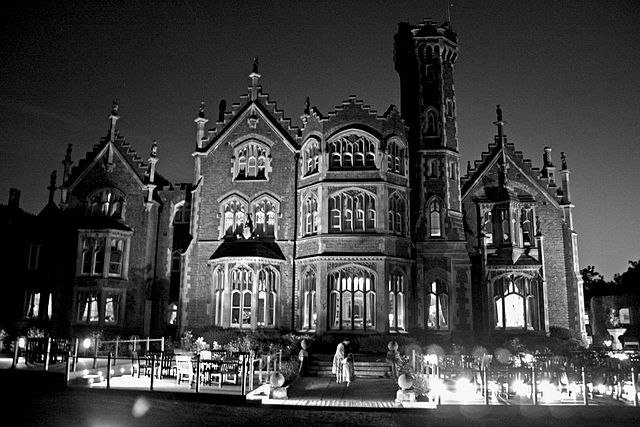
Oakley Court, the house in The Rocky Horror Picture Show. Photo by George Grinsted on Flickr.com, CC BY-SA 2.0, via Wikimedia Commons
Previous Post

February 11, 2016
Should Public Expressions of Religion Be Allowed?
Next Post
February 19, 2016 PAGAN CONSENT CULTURE Anthology Is Available!
Browse Our Archives
Select a Category A Beginner's Guide Announcements Conversations Creative Endarkenment Embodied Spirituality General Interviews My Story News Commentary Pagan Studies Poetry Praxis Related topics Reviews Ritual Sacred Endarkenment Storytime Theology
Select a Month February 2017 December 2016 November 2016 October 2016 September 2016 August 2016 July 2016 June 2016 May 2016 April 2016 March 2016 February 2016 January 2016 December 2015 November 2015 October 2015 September 2015 August 2015 July 2015 June 2015 May 2015 April 2015 March 2015 February 2015 January 2015 December 2014 November 2014 October 2014 September 2014 August 2014 July 2014 June 2014 May 2014 April 2014 March 2014 February 2014 January 2014 December 2013 November 2013 October 2013 September 2013 August 2013 July 2013 June 2013 May 2013 April 2013 March 2013 February 2013 January 2013 December 2012 November 2012
Follow Us!
TAKE THE
Religious Wisdom Quiz
Who wore a coat of many colors?
Select your answer to see how you score.
Jacob Moses Abel Joseph
Related posts from Dowsing for Divinity

Imagining Other Possible Worlds

You say you want a revolution? (Review)

A Meditation: The Trees and the Forest

TRENDING AT PATHEOS Pagan

I was recently chatting with someone on Instagram. She asked me what...

While there are many people who share their results, the end of...

On July 23, I saw Christopher Nolan's The Odyssey which is Homer’s...

As I write this two big events have just finished up. One...

Restoring the Watershed of Divine Love
Perhaps cooperation is not something we manufacture through legislation, ideology, or moral...

Many UUs don’t pray because of bad experiences in a previous religion,...
view all Pagan blogs
Ad-Free & Subscriber Log-In Subscription Support
- About Us
- 2026 Calendar
- Videos
- Podcasts
- Library of World Religions
- Faith In Media Tracker
- Advertise With Us
- Write for Us
- Privacy Policy
- Terms of Service
- Do Not Sell My Data
- Contact Us
- Radiant Digital
- Manage Newsletter Subscriptions
- Unsubscribe From Notifications
- Sitemap
Copyright 2008-2026, Patheos. All rights reserved.
Subscription Support Ad-Free & Subscriber Log-In
Follow Patheos