
BuddhistCatholicContemplativeEvangelicalGeneral ChristianHinduJewishLatter-day SaintMuslimNew VisionsProgressive Christian
Beliefs
- Buddhist
- Catholic
- Contemplative
- Evangelical
- General Christian
- Hindu
- Jewish
- Latter-day Saint
- More Voices
- Muslim
- New Visions
- Pagan
- Progressive Christian
Topics
- Religion News
- Food and Religion
- Sports and Religion
- Religious Art
- Religious Music and Entertainment
- Religious Events
- History and Religion
- Style and Religion
- Politics and Religion
- Women in Religion
- Recreation Outdoors and Religion
- Business Finance and Religion
- Careers Workplace and Religion
- Education and Religion
- Family Parenting and Religion
- Health Fitness and Religion
- Home and Religion
- Relationships and Religion
- Technology and Religion
- Travel and Religion
Columnists
- Buddhist Columnists
- Business Finance and Religion Columnists
- Careers Workplace and Religion Columnists
- Catholic Columnists
- Contemplative Columnists
- Education and Religion Columnists
- Evangelists Columnists
- Family Parenting and Religion Columnists
- General Christian Columnists
- Health Fitness and Religion Columnists
- Hindu Columnists
- History and Religion Columnists
- Home and Religion Columnists
- Jewish Columnists
- More Voices Columnists
- Latter Day Columnists
- Muslim Columnists
- New Visions Columnists
- Nonreligious Columnists
- Pagan Columnists
- Politics and Religion Columnists
- Progressive Columnists
- Recreation Outdoors and Religion Columnists
- Relationships and Religion Columnists
- Religion News Columnists
- Religious Art Columnists
- Religious Events Columnists
- Religious Music and Entertainment Columnists
- Sports and Religion Columnists
- Style and Religion Columnists
- Technology and Religion Columnists
- Travel and Religion Columnists
- Women in Religion Columnists
Resource Library
- 2026 Calendar
- Library of World Religions
- The 100 Most Holy Places on Earth
- Patheos Answers
- Podcasts
- Videos
- Faith Leaders Database
- Anglican Episcopalian
- Bahai
- Baptist
- Buddhism
- Christianity
- Confucianism
- Eastern Orthodoxy
- Hinduism
- Holiness and Pentecostal
- ISKCON
- Islam
- Judaism
- Lutheran
- Methodist
- The Church of Jesus Christ of Latter-day Saints
- New Age
- Paganism
- Presbytarian and Reformed
- Protestantism
- Religion Behind the Scenes
- Roman Catholic
- Scientology
- Shia Islam
- Sikhism
- Sufism
- Sunni Islam
- Taoism
- Zen
- See all religions
Research Tools
 Ad-Free & Subscriber Log-In Subscription Support
Ad-Free & Subscriber Log-In Subscription Support
Follow Patheos 

- Trending:
- Forgiveness
- |
- Marriage
- |
- Consciousness
- |
- Death Penalty
- |
- Election
- |
- Halloween
 Dowsing for Divinity
-
Books
- Home
- Pagan
- Why We Need Black History Month
Why We Need Black History Month
Last updated on: January 30, 2016 at 12:52 am by Yvonne Aburrow
Why We Need Black History Month 2016-01-25T16:08:13-05:00 Yvonne Aburrow
Patheos Explore the world's faith through different perspectives on religion and spirituality! Patheos has the views of the prevalent religions and spiritualities of the world.
Every so often, some ill-informed person opines that we don’t need Black History Month, or International Women’s Day, or LGBT History Month, or the BET Awards. Sure, we wouldn’t need any of them if white privilege, male privilege, and straight privilege didn’t exist. But they do exist.
People who argue that Black history has been “relegated” to Black History Month are missing the point. Prior to the creation of a special month, Black History was completely ignored, except as a footnote to white history. The month is an attempt to get a foot in the door – a door that was previously slammed in the face of Black history.
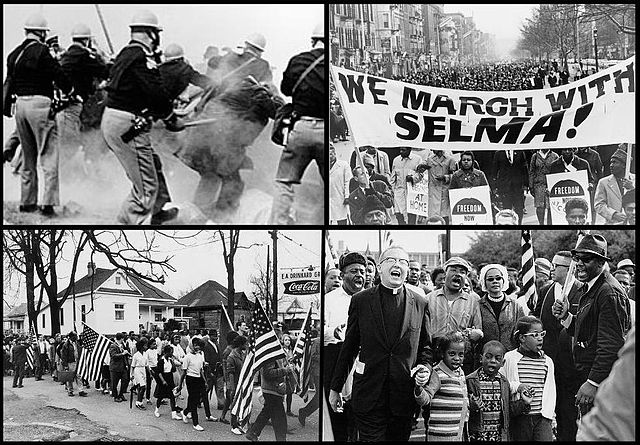
Top left: Alabama police attack Selma to Montgomery marchers, known as “Bloody Sunday,” in 1965 Top right: Marchers carrying banner “We march with Selma!” on street in Harlem, New York City, New York in 1965 Bottom left: Participants in the Selma to Montgomery march in Alabama during 1965 Bottom right: Dr. Martin Luther King, Dr. Ralph David Abernathy, their families, and others leading the Selma to Montgomery march in 1965, Public Domain, CC0. Collage created by Mitchumch
If “mainstream” history didn’t focus almost exclusively on straight white men, then we wouldn’t need days or months that focused on the people who are usually left out of the history books. But only recently, a British student launched a petition to persuade an exam board in the UK to feature female composers on the GCSE music syllabus. The petition was successful, but she shouldn’t have needed to create a petition: it should have been obvious that female composers should be included.
A great deal of art, music, and literature has been produced by women, Black people, and LGBT people, yet school, college, and university syllabuses frequently focus exclusively on art, music, and literature produced by straight white men. It is not that the artistic productions of straight white men are superior to those produced by Black people, women, and LGBT people – it is because the straight white male view of the world is deemed normal and normative, and anything that doesn’t fit within it is deemed niche or uninteresting.
It is time for the marginalised to be restored to the historical account. Black people have been denied a history, and erased from history. David Olusoga writes:
No other people see history in quite the same way because no other people have had their history so comprehensively denied and disavowed. Among the many justifications for slavery, and later for the colonisation of Africa, was the assertion that Africans were a people without a history. The German philosopher Hegel, writing in the 1830s, claimed that: “Africa … is no historical part of the world.” Other peoples have seen their cultures dismissed as backward or barbarous, but the antiquity of those cultures has rarely been so repudiated.
The erasure of African history and culture is similar to the erasure of the stories of the pagan cultures of antiquity. Only cultures that built in stone and used writing were deemed worthy of the lofty title of ‘civilisation’. Only cultures that were Christian were deemed civilised – everyone else was just barbarian hordes.
So, until the educational syllabuses are reformed root and branch, there will continue to be a vicious cycle of the straight white male view being presented as normative, and the situation will be perpetuated from generation to generation. Ideally, so-called minority history should be integrated throughout the syllabus and presented in context, but until that happens, we still need a special focus. As Andrea Stuart writes (in response to David Cameron claiming the British abolition of slavery as a triumph, despite the fact that Britain started the Transatlantic slave trade), Black History Month can only be declared a success once it’s redundant:
So why does this ignorance persist, 25 years after Black History Month was launched in Britain? This month we’ve seen events that range from the sublime, such as the award-winning American musical The Scottsboro Boys, to the tokenistic. At my children’s school, many heart-warming pictures of Nelson Mandela, Desmond Tutu and Doreen Lawrence have been produced, as well as innumerable portraits of black sportsmen from Usain Bolt to Theo Walcott. At a friend’s school, the pupils have been encouraged to turn up dressed as a black pop star. Most of our children have become familiar with the travails of Mary Seacole. But these stories of individual triumph, however uplifting, don’t do nearly enough to fill the knowledge gap. We need to integrate black history across the educational curriculum, and among adults, so that people like our prime minister will also comprehend it.
It also perpetuates the lie that Black people, women, and LGBT people didn’t do anything much in history. And it promotes the idea that change happens when those in power graciously decide to give rights to the oppressed. Whereas the truth is that every single right we possess was wrested out of the hands of the powerful as a result of a protracted struggle by the oppressed. Black History tends to focus on safe and sanitised Black heroes, rather than the lives of ordinary people, or of revolutionaries like Toussaint L’Ouverture. These heroes are presented out of context, writes David Olusoga:
There’s no doubt that black British history, as celebrated during Black History Month, has helped thousands of black children understand their place within the British story. Each year it provides journalists and broadcasters with a topical hook on which to hang stories about black people and black history that might otherwise go untold. And the stories of remarkable men and women – from Britain and around the world – become counterweights against the tsunami of negative stereotypes that wash over black children growing up in this country. But the problem is that biography, especially heroic biography, can at times displace and obscure history rather than explain or deepen it. This is because the life stories of the men and women who make up the pantheon of black heroes are not wide enough, even when viewed together, to encompass the global scale and variety of black history.
The promotion of history as the story of straight white men erases and denies the oppression suffered by Black people, LGBT people, and women, and erases and denies their struggles to overcome that oppression.
That is why I support Black History Month, and especially Crystal Blanton’s Thirty Day Real Black History Challenge. It is why I support LGBT History Month and International Women’s Day and Women’s History Month.
Black History Month is in November in the UK, and in February in the USA and Canada.
LGBT History Month is in February in the UK, and in October in the USA.
Women’s History Month is celebrated during March in the USA, the UK, and Australia, to include International Women’s Day on 8 March, and during October in Canada.
Previous Post

January 28, 2016
Embodied Spirituality: Compassion
Next Post

February 2, 2016 If You Have A Racist Friend
Browse Our Archives
Select a Category A Beginner's Guide Announcements Conversations Creative Endarkenment Embodied Spirituality General Interviews My Story News Commentary Pagan Studies Poetry Praxis Related topics Reviews Ritual Sacred Endarkenment Storytime Theology
Select a Month February 2017 December 2016 November 2016 October 2016 September 2016 August 2016 July 2016 June 2016 May 2016 April 2016 March 2016 February 2016 January 2016 December 2015 November 2015 October 2015 September 2015 August 2015 July 2015 June 2015 May 2015 April 2015 March 2015 February 2015 January 2015 December 2014 November 2014 October 2014 September 2014 August 2014 July 2014 June 2014 May 2014 April 2014 March 2014 February 2014 January 2014 December 2013 November 2013 October 2013 September 2013 August 2013 July 2013 June 2013 May 2013 April 2013 March 2013 February 2013 January 2013 December 2012 November 2012
Follow Us!
TAKE THE
Religious Wisdom Quiz
What does Proverbs 23:4-5 warn against pursuing too much?
Select your answer to see how you score.
Status Knowledge Wealth Power
Related posts from Dowsing for Divinity

The safety pin: a reminder to resist bigotry
Creating Meaningful Public Ritual

TRENDING AT PATHEOS Pagan

I was recently chatting with someone on Instagram. She asked me what...

While there are many people who share their results, the end of...

On July 23, I saw Christopher Nolan's The Odyssey which is Homer’s...

As I write this two big events have just finished up. One...

Restoring the Watershed of Divine Love
Perhaps cooperation is not something we manufacture through legislation, ideology, or moral...

Many UUs don’t pray because of bad experiences in a previous religion,...
view all Pagan blogs
Ad-Free & Subscriber Log-In Subscription Support
- About Us
- 2026 Calendar
- Videos
- Podcasts
- Library of World Religions
- Faith In Media Tracker
- Advertise With Us
- Write for Us
- Privacy Policy
- Terms of Service
- Do Not Sell My Data
- Contact Us
- Radiant Digital
- Manage Newsletter Subscriptions
- Unsubscribe From Notifications
- Sitemap
Copyright 2008-2026, Patheos. All rights reserved.
Subscription Support Ad-Free & Subscriber Log-In
Follow Patheos