
BuddhistCatholicContemplativeEvangelicalGeneral ChristianHinduJewishLatter-day SaintMuslimNew VisionsProgressive Christian
Beliefs
- Buddhist
- Catholic
- Contemplative
- Evangelical
- General Christian
- Hindu
- Jewish
- Latter-day Saint
- More Voices
- Muslim
- New Visions
- Pagan
- Progressive Christian
Topics
- Religion News
- Food and Religion
- Sports and Religion
- Religious Art
- Religious Music and Entertainment
- Religious Events
- History and Religion
- Style and Religion
- Politics and Religion
- Women in Religion
- Recreation Outdoors and Religion
- Business Finance and Religion
- Careers Workplace and Religion
- Education and Religion
- Family Parenting and Religion
- Health Fitness and Religion
- Home and Religion
- Relationships and Religion
- Technology and Religion
- Travel and Religion
Columnists
- Buddhist Columnists
- Business Finance and Religion Columnists
- Careers Workplace and Religion Columnists
- Catholic Columnists
- Contemplative Columnists
- Education and Religion Columnists
- Evangelists Columnists
- Family Parenting and Religion Columnists
- General Christian Columnists
- Health Fitness and Religion Columnists
- Hindu Columnists
- History and Religion Columnists
- Home and Religion Columnists
- Jewish Columnists
- More Voices Columnists
- Latter Day Columnists
- Muslim Columnists
- New Visions Columnists
- Nonreligious Columnists
- Pagan Columnists
- Politics and Religion Columnists
- Progressive Columnists
- Recreation Outdoors and Religion Columnists
- Relationships and Religion Columnists
- Religion News Columnists
- Religious Art Columnists
- Religious Events Columnists
- Religious Music and Entertainment Columnists
- Sports and Religion Columnists
- Style and Religion Columnists
- Technology and Religion Columnists
- Travel and Religion Columnists
- Women in Religion Columnists
Resource Library
- 2026 Calendar
- Library of World Religions
- The 100 Most Holy Places on Earth
- Patheos Answers
- Podcasts
- Videos
- Faith Leaders Database
- Anglican Episcopalian
- Bahai
- Baptist
- Buddhism
- Christianity
- Confucianism
- Eastern Orthodoxy
- Hinduism
- Holiness and Pentecostal
- ISKCON
- Islam
- Judaism
- Lutheran
- Methodist
- The Church of Jesus Christ of Latter-day Saints
- New Age
- Paganism
- Presbytarian and Reformed
- Protestantism
- Religion Behind the Scenes
- Roman Catholic
- Scientology
- Shia Islam
- Sikhism
- Sufism
- Sunni Islam
- Taoism
- Zen
- See all religions
Research Tools
 Ad-Free & Subscriber Log-In Subscription Support
Ad-Free & Subscriber Log-In Subscription Support
Follow Patheos 

- Trending:
- Forgiveness
- |
- Marriage
- |
- Consciousness
- |
- Death Penalty
- |
- Election
- |
- Halloween
 Dowsing for Divinity
-
Books
- Home
- Pagan
- Embodied Spirituality: Walking The Labyrinth
Embodied Spirituality: Walking The Labyrinth
Last updated on: March 23, 2016 at 1:14 pm by Yvonne Aburrow
Embodied Spirituality: Walking The Labyrinth 2016-03-23T13:14:07-04:00 Yvonne Aburrow
Patheos Explore the world's faith through different perspectives on religion and spirituality! Patheos has the views of the prevalent religions and spiritualities of the world.
Walking the labyrinth is a very ancient form of meditation, very relaxing, and it’s well worth giving it a try. It’s very personal and inwardly focussed, and yet shared with your fellow-travellers in a wordless communion.
Each person’s journey into the labyrinth is unique, although the labyrinth has a single pathway to the centre. We all travel on the same pathway, but each person goes at a different speed, travelling in a different way. Rather like life, the path twists and turns, in and out, and you never know how close to the centre you are. When the path appears to take you furthest away from the centre, you are nearer, and when you appear to be closest, you are actually further away.
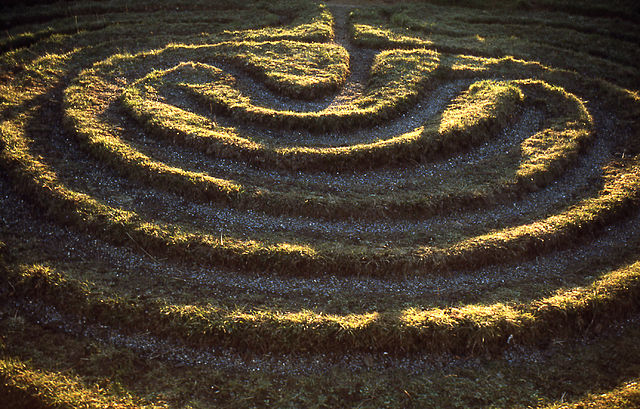
“Dalby City of Troy turf maze” by User:SiGarb – This is a scan of a transparency which I took in the 1970s, scanned and uploaded 8 May 2005. It has been slightly cleaned-up in Photoshop.. Licensed under Public Domain via Commons.

The centre – the goal of the journey – can mean different things to different people. For me, it is a metaphor for the Divine: always present, always hidden. In Pagan labyrinths, the centre symbolises the underworld, the inner realm; in Christian labyrinths, it represents the goal of the pilgrim, Jerusalem, with Christ at the centre.
The centre is a place to meditate and reflect on the journey, connect with the Divine, or just look into yourself. The space at the centre is shaped like a flower, or like the rose window of a cathedral. Each of its petals represents one of six kingdoms: mineral, vegetable, animal, human, angelic and the unknown.
The journey back from the centre depicts bringing back the blessing and insight from the other realm to share with your community. As you cross the threshold once more into the outer world, it is a good idea to meditate on the experience, and only gradually ease back into normal conversation.
Pagan labyrinths generally have the path winding through one quadrant at a time, possibly so the walker can meditate on each of the four elements in turn. Christian labyrinths have the path winding back and forth between the quadrants, so that you never know where you are. This is in many ways a more powerful experience, because you never know how close you are to the goal of the journey, so it is a revelation when you reach it. One such labyrinth is the one in Chartres Cathedral, which was constructed around 1200.
The oldest labyrinth design is the Cretan labyrinth, which is a very simple design and can be drawn quite quickly; it is easy to make out of pebbles in your garden or at a camp.
A brief history of mazes and labyrinths
Mazes are recorded in Egypt, Rome, Scandinavia, England, India, and the American Southwest. They are generally believed to symbolise the soul’s journey through life, or the journey of the dead to the underworld.
There are two types of maze: the unicursal (single path) maze and the puzzle maze. Both of these are referred to as both a labyrinth and a maze. However, in the myth of the Minotaur, the labyrinth in which the Minotaur dwells is clearly a puzzle maze (i.e. having dead ends), as Theseus needs a thread to find his way through to the centre. Apparently the legend of Theseus and the Minotaur refers to the maze-like palace at Knossos, which burned to the ground in the 15th century BCE.
The Classical Maze comes in four types, the Serpentine, Spiral, Simple Meander, and Complex Meander. The Roman ones were usually square, but these designs work as circular mazes too.
The principle of the maze was probably discovered in the Neolithic. The earliest recorded mazes were in Crete, 4000 years ago. In Egypt, there was a huge palace complex on the shores of a lake seven days journey up the Nile from the pyramids in form of a labyrinth. This was built by pharaoh Amenemhet III in the 19th century BCE. It consisted of thousands of rooms and twelve large maze-like courtyards, which were probably intended to keep out unwelcome visitors. Amenemhet also created a maze inside his nearby pyramid to thwart tomb robbers. Most Roman labyrinths, on the other hand, were too small to have been walked, and are typically found on the floor near the entrances to houses and villas; many have small city walls (perhaps indicating the walls of Troy) drawn around them. This suggests they served a protective function, and were perhaps believed to have warded off evil influences or intruders — a common function of the labyrinth in many other cultures as well. The tomb of Lars Porsenna (an Etruscan king) at Chiusi in Italy was said to be surrounded by a labyrinth.
The turf mazes of Britain and Scandinavia may have served a similar purpose, but in the Middle Ages they acquired an additional association with May games; hence the name “Robin Hood’s Race” or “Julian’s Bower”. The Celtic name for a maze was Caer Droia, the place of turning, and this was transliterated into English as Troy Town. It was widely believed that England was founded by Brutus fleeing Troy, and the mazes were believed to represent Troy. Mazes in Finland were often called Jericho, referring to the legend that it was destroyed by the Israelite army marching around it seven times. A maze called ‘the walls of Jericho’ also appears in a Hebrew manuscript.
Previous Post

December 31, 2015
Five Memorable Blogposts of 2015
Next Post

January 4, 2016 Embodied Spirituality: Meditative Walking
Browse Our Archives
Select a Category A Beginner's Guide Announcements Conversations Creative Endarkenment Embodied Spirituality General Interviews My Story News Commentary Pagan Studies Poetry Praxis Related topics Reviews Ritual Sacred Endarkenment Storytime Theology
Select a Month February 2017 December 2016 November 2016 October 2016 September 2016 August 2016 July 2016 June 2016 May 2016 April 2016 March 2016 February 2016 January 2016 December 2015 November 2015 October 2015 September 2015 August 2015 July 2015 June 2015 May 2015 April 2015 March 2015 February 2015 January 2015 December 2014 November 2014 October 2014 September 2014 August 2014 July 2014 June 2014 May 2014 April 2014 March 2014 February 2014 January 2014 December 2013 November 2013 October 2013 September 2013 August 2013 July 2013 June 2013 May 2013 April 2013 March 2013 February 2013 January 2013 December 2012 November 2012
Follow Us!
TAKE THE
Religious Wisdom Quiz
Who had a colorful coat from his father?
Select your answer to see how you score.
David Joseph Daniel Isaac
Related posts from Dowsing for Divinity

The safety pin: a reminder to resist bigotry

Creating Meaningful Public Ritual

Paganism and the Body Class Sneak Peek
TRENDING AT PATHEOS Pagan

I was recently chatting with someone on Instagram. She asked me what...

While there are many people who share their results, the end of...

On July 23, I saw Christopher Nolan's The Odyssey which is Homer’s...

As I write this two big events have just finished up. One...

Restoring the Watershed of Divine Love
Perhaps cooperation is not something we manufacture through legislation, ideology, or moral...

Many UUs don’t pray because of bad experiences in a previous religion,...
view all Pagan blogs
Ad-Free & Subscriber Log-In Subscription Support
- About Us
- 2026 Calendar
- Videos
- Podcasts
- Library of World Religions
- Faith In Media Tracker
- Advertise With Us
- Write for Us
- Privacy Policy
- Terms of Service
- Do Not Sell My Data
- Contact Us
- Radiant Digital
- Manage Newsletter Subscriptions
- Unsubscribe From Notifications
- Sitemap
Copyright 2008-2026, Patheos. All rights reserved.
Subscription Support Ad-Free & Subscriber Log-In
Follow Patheos