
BuddhistCatholicContemplativeEvangelicalGeneral ChristianHinduJewishLatter-day SaintMuslimNew VisionsProgressive Christian
Beliefs
- Buddhist
- Catholic
- Contemplative
- Evangelical
- General Christian
- Hindu
- Jewish
- Latter-day Saint
- More Voices
- Muslim
- New Visions
- Pagan
- Progressive Christian
Topics
- Religion News
- Food and Religion
- Sports and Religion
- Religious Art
- Religious Music and Entertainment
- Religious Events
- History and Religion
- Style and Religion
- Politics and Religion
- Women in Religion
- Recreation Outdoors and Religion
- Business Finance and Religion
- Careers Workplace and Religion
- Education and Religion
- Family Parenting and Religion
- Health Fitness and Religion
- Home and Religion
- Relationships and Religion
- Technology and Religion
- Travel and Religion
Columnists
- Buddhist Columnists
- Business Finance and Religion Columnists
- Careers Workplace and Religion Columnists
- Catholic Columnists
- Contemplative Columnists
- Education and Religion Columnists
- Evangelists Columnists
- Family Parenting and Religion Columnists
- General Christian Columnists
- Health Fitness and Religion Columnists
- Hindu Columnists
- History and Religion Columnists
- Home and Religion Columnists
- Jewish Columnists
- More Voices Columnists
- Latter Day Columnists
- Muslim Columnists
- New Visions Columnists
- Nonreligious Columnists
- Pagan Columnists
- Politics and Religion Columnists
- Progressive Columnists
- Recreation Outdoors and Religion Columnists
- Relationships and Religion Columnists
- Religion News Columnists
- Religious Art Columnists
- Religious Events Columnists
- Religious Music and Entertainment Columnists
- Sports and Religion Columnists
- Style and Religion Columnists
- Technology and Religion Columnists
- Travel and Religion Columnists
- Women in Religion Columnists
Resource Library
- 2026 Calendar
- Library of World Religions
- The 100 Most Holy Places on Earth
- Patheos Answers
- Podcasts
- Videos
- Faith Leaders Database
- Anglican Episcopalian
- Bahai
- Baptist
- Buddhism
- Christianity
- Confucianism
- Eastern Orthodoxy
- Hinduism
- Holiness and Pentecostal
- ISKCON
- Islam
- Judaism
- Lutheran
- Methodist
- The Church of Jesus Christ of Latter-day Saints
- New Age
- Paganism
- Presbytarian and Reformed
- Protestantism
- Religion Behind the Scenes
- Roman Catholic
- Scientology
- Shia Islam
- Sikhism
- Sufism
- Sunni Islam
- Taoism
- Zen
- See all religions
Research Tools
 Ad-Free & Subscriber Log-In Subscription Support
Ad-Free & Subscriber Log-In Subscription Support
Follow Patheos 

- Trending:
- Forgiveness
- |
- Marriage
- |
- Consciousness
- |
- Death Penalty
- |
- Election
- |
- Halloween
 Dowsing for Divinity
-
Books
- Home
- Pagan
- Embodied Spirituality: Magical Tools
Embodied Spirituality: Magical Tools
Last updated on: March 23, 2016 at 1:12 pm by Yvonne Aburrow
Embodied Spirituality: Magical Tools 2016-03-23T13:12:26-04:00 Yvonne Aburrow
Patheos Explore the world's faith through different perspectives on religion and spirituality! Patheos has the views of the prevalent religions and spiritualities of the world.
The other day, I saw a meme which said that you don’t need magical tools, initiation, or a Book of Shadows to be a Wiccan. Well, maybe you don’t need these things, but they are what people think of when they think of Wicca. They are among the things that get you recognised as being part of the Wiccan community, because they are symbols and experiences and ideas that we all share. They are also useful. You don’t need a knife and fork to eat your dinner, but it makes it a lot easier. You don’t need an address book to write your friends’ addresses in – but it makes it a lot easier to remember where they live and post them Yule cards. And you don’t need a rite of passage to help you feel like an adult – but it makes it easier if a definite transition has been marked.
I would like there to be as broad an interpretation of the term “Wiccan” as possible, and an even broader interpretation of the term “witch”, because that is how they were originally intended to be used (the term Wiccan was not coined exclusively for the use of Gardnerian Wiccans, or even Alexandrian plus Gardnerian – it was intended to refer to all witches, as Ethan Doyle White has shown from his historical research). I am okay with people identifying as Wiccan without initiation – but if you want to be part of the initiatory Wiccan community, or another initiatory community such as Feri, then you need initiation. Initiation is a powerful transformational ritual.
The purpose of a Book of Shadows is not to prescribe how you should do your rituals, but to record powerful rituals that you have done, and to transmit powerful rituals written by past Wiccans. Each witch’s book should be unique to them, although it will also contain the rituals that have been passed down to them. A Book of Shadows is a magical tool for recording and transmitting good rituals.
What about tools such as wands, athames, swords, chalices, and so on? There are several reasons why they are helpful. I do think that a good witch should be able to do a spell or ritual without any tools in an emergency – but I still use tools when they are available.
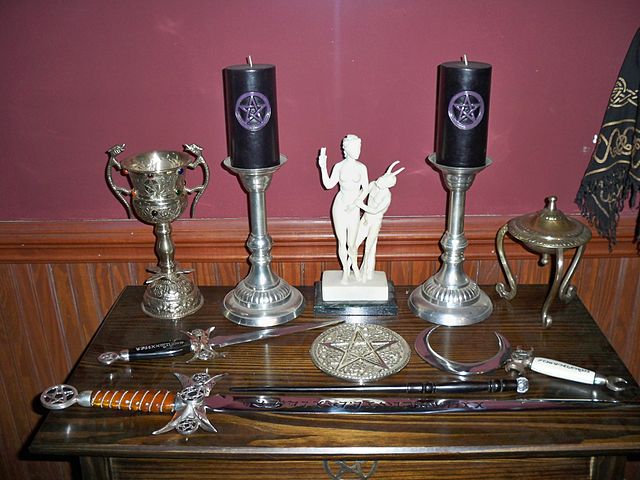
Wiccan Altar, by Fer Doirich – Own work, CC0.
Humans are tool-using animals. One of the things that helps us to think and solve problems is our tool-using propensities. Look at other animals who use tools. We tend to think they are cleverer than animals who don’t use tools, because they can manipulate more of their environment.
According to Tool Use in Animals: Cognition and Ecology:
The last decade has witnessed remarkable discoveries and advances in our understanding of the tool using behaviour of animals. Wild populations of capuchin monkeys have been observed to crack open nuts with stone tools, similar to the skills of chimpanzees and humans. Corvids have been observed to use and make tools that rival in complexity the behaviours exhibited by the great apes. Excavations of the nut cracking sites of chimpanzees have been dated to around 4-5 thousand years ago.
Think about how we use physical tools such as screwdrivers, hammers, brooms, milk-frothers, egg-stiffeners, paint-stirrers, and so on, and how difficult life would be without those tools. Think about how chimpanzees have been seen getting ants out of ant-hills with a straw, or cracking nuts open with a rock. Frequently, tool use involves remembering that you saw a useful-looking rock, or a hollow blade of grass, going to fetch it, and bringing it to where the food is. So tool use involves the use of cognitive skills such as memory, comparison, and visualisation.
My partner Bob pointed out that it is much is easier to do a task (magical or mundane) without a tool when you have learnt to do it with a tool.
Tools are levers for affecting the world. You can’t tighten a screw without a screwdriver. You need a wooden spoon to stir a pan of soup or stew, otherwise you would burn your fingers. You can cast a magical circle without a sword or a wand – but it feels like a better and more magical circle when it has been cast with the appropriate tool. The subtle energies involved in magic are affected by physical tools in much the same way as denser matter is affected by tools.
Magic is not all in the mind – the body is part of it too. The people who claim you don’t need tools also tend to claim that doing magic is a purely mental process. The conceptual separation of mind and body, spirit and matter, is a Western phenomenon which has been a disaster for our civilisation in so many ways, involving the denigration of sexuality and sensuality, the denial of the pleasures of the flesh, a dysfunctional relationship with food, and behaving as if the Earth, the other animals, birds, and plants with whom we share it are expendable. Using magical tools helps to remind us that magic is an embodied spirituality, and to involve our bodies in the process of creating magical energy. Indeed, some of the tools used in Wicca have specific uses for enhancing the sense of being in the body.
Tools are powerful symbols. Much of magic and ritual is about engaging with and awakening the poetic and symbolic aspects of the mind (the “right-brain” functions). The use of tools as symbols speaks to these aspects of the mind (sometimes referred to as “Younger Self”). Tools are part of a complex set of magical associations involving directions, elements, planets, deities, trees, and so on, all of which speak to the poetic, mystical, and symbolic side of our natures. They are part of a poetic language of witchcraft. The process of getting into the twilight consciousness required for ritual is assisted and enhanced by the use of familiar words, tools, imagery, and physical movements, evoking muscle memory and awareness of space.
So, maybe you don’t need tools, but why would you want to do without them?
Previous Post

January 24, 2016
Spirits of the Land
Next Post

January 28, 2016 Embodied Spirituality: Compassion
Browse Our Archives
Select a Category A Beginner's Guide Announcements Conversations Creative Endarkenment Embodied Spirituality General Interviews My Story News Commentary Pagan Studies Poetry Praxis Related topics Reviews Ritual Sacred Endarkenment Storytime Theology
Select a Month February 2017 December 2016 November 2016 October 2016 September 2016 August 2016 July 2016 June 2016 May 2016 April 2016 March 2016 February 2016 January 2016 December 2015 November 2015 October 2015 September 2015 August 2015 July 2015 June 2015 May 2015 April 2015 March 2015 February 2015 January 2015 December 2014 November 2014 October 2014 September 2014 August 2014 July 2014 June 2014 May 2014 April 2014 March 2014 February 2014 January 2014 December 2013 November 2013 October 2013 September 2013 August 2013 July 2013 June 2013 May 2013 April 2013 March 2013 February 2013 January 2013 December 2012 November 2012
Follow Us!
TAKE THE
Religious Wisdom Quiz
What king was killed by an arrow in battle, fulfilling Elijah's prophecy?
Select your answer to see how you score.
Ahab Ahaziah Joash Jeroboam
Related posts from Dowsing for Divinity

Review of Queer Paganism by Jo Green


The safety pin: a reminder to resist bigotry

TRENDING AT PATHEOS Pagan

I was recently chatting with someone on Instagram. She asked me what...

While there are many people who share their results, the end of...

On July 23, I saw Christopher Nolan's The Odyssey which is Homer’s...

As I write this two big events have just finished up. One...

Restoring the Watershed of Divine Love
Perhaps cooperation is not something we manufacture through legislation, ideology, or moral...

Many UUs don’t pray because of bad experiences in a previous religion,...
view all Pagan blogs
Ad-Free & Subscriber Log-In Subscription Support
- About Us
- 2026 Calendar
- Videos
- Podcasts
- Library of World Religions
- Faith In Media Tracker
- Advertise With Us
- Write for Us
- Privacy Policy
- Terms of Service
- Do Not Sell My Data
- Contact Us
- Radiant Digital
- Manage Newsletter Subscriptions
- Unsubscribe From Notifications
- Sitemap
Copyright 2008-2026, Patheos. All rights reserved.
Subscription Support Ad-Free & Subscriber Log-In
Follow Patheos