
BuddhistCatholicContemplativeEvangelicalGeneral ChristianHinduJewishLatter-day SaintMuslimNew VisionsProgressive Christian
Beliefs
- Buddhist
- Catholic
- Contemplative
- Evangelical
- General Christian
- Hindu
- Jewish
- Latter-day Saint
- More Voices
- Muslim
- New Visions
- Pagan
- Progressive Christian
Topics
- Religion News
- Food and Religion
- Sports and Religion
- Religious Art
- Religious Music and Entertainment
- Religious Events
- History and Religion
- Style and Religion
- Politics and Religion
- Women in Religion
- Recreation Outdoors and Religion
- Business Finance and Religion
- Careers Workplace and Religion
- Education and Religion
- Family Parenting and Religion
- Health Fitness and Religion
- Home and Religion
- Relationships and Religion
- Technology and Religion
- Travel and Religion
Columnists
- Buddhist Columnists
- Business Finance and Religion Columnists
- Careers Workplace and Religion Columnists
- Catholic Columnists
- Contemplative Columnists
- Education and Religion Columnists
- Evangelists Columnists
- Family Parenting and Religion Columnists
- General Christian Columnists
- Health Fitness and Religion Columnists
- Hindu Columnists
- History and Religion Columnists
- Home and Religion Columnists
- Jewish Columnists
- More Voices Columnists
- Latter Day Columnists
- Muslim Columnists
- New Visions Columnists
- Nonreligious Columnists
- Pagan Columnists
- Politics and Religion Columnists
- Progressive Columnists
- Recreation Outdoors and Religion Columnists
- Relationships and Religion Columnists
- Religion News Columnists
- Religious Art Columnists
- Religious Events Columnists
- Religious Music and Entertainment Columnists
- Sports and Religion Columnists
- Style and Religion Columnists
- Technology and Religion Columnists
- Travel and Religion Columnists
- Women in Religion Columnists
Resource Library
- 2026 Calendar
- Library of World Religions
- The 100 Most Holy Places on Earth
- Patheos Answers
- Podcasts
- Videos
- Faith Leaders Database
- Anglican Episcopalian
- Bahai
- Baptist
- Buddhism
- Christianity
- Confucianism
- Eastern Orthodoxy
- Hinduism
- Holiness and Pentecostal
- ISKCON
- Islam
- Judaism
- Lutheran
- Methodist
- The Church of Jesus Christ of Latter-day Saints
- New Age
- Paganism
- Presbytarian and Reformed
- Protestantism
- Religion Behind the Scenes
- Roman Catholic
- Scientology
- Shia Islam
- Sikhism
- Sufism
- Sunni Islam
- Taoism
- Zen
- See all religions
Research Tools
 Ad-Free & Subscriber Log-In Subscription Support
Ad-Free & Subscriber Log-In Subscription Support
Follow Patheos 

- Trending:
- Forgiveness
- |
- Marriage
- |
- Consciousness
- |
- Death Penalty
- |
- Election
- |
- Halloween
 Dowsing for Divinity
-
Books
- Home
- Pagan
- Possession, Depossession, and Divine Relationships by Diana L. Paxson (Book Review)
Possession, Depossession, and Divine Relationships by Diana L. Paxson (Book Review)
Last updated on: December 1, 2015 at 5:00 am by Christine Kraemer
Possession, Depossession, and Divine Relationships by Diana L. Paxson (Book Review) 2015-11-30T17:58:40-05:00 Christine Kraemer
Patheos Explore the world's faith through different perspectives on religion and spirituality! Patheos has the views of the prevalent religions and spiritualities of the world.
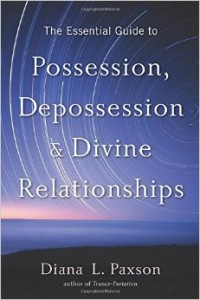 Diana L. Paxson’s Possession, Depossession, and Divine Relationships is a practical and informational text on possessory work with spirits and gods. The first section of the book deals with preparation for deep spiritual and magical work of any kind: practices designed to stabilize and strengthen the self. Next, Paxson guides the reader through the process of contacting gods and spirits and developing a devotional relationship. The third section looks at possessory practices around the world (including among Pagans in the United States) for models of how groups successfully negotiate possession. The final section of the book outlines practices for preparing for possession, gaining skill as a medium, and building a group container in which possession can successfully and safely occur. The book is written from a hard polytheist perspective (treating the gods as separately existing beings with their own agency), but Paxson also discusses archetypal approaches to possession work and does not insist that practitioners hold any particular theology.
As I read the book, I found myself in turns feeling impressed and uncomfortable. Paxson’s extensive reading and personal experience of possession make her a convincing authority on the subject (which, having personally witnessed her in action as an oracle, I can confirm). I appreciated the historical and contemporary information she gives on possession practices, with particular attention to Spiritualism, Spiritism, and Afro-Caribbean traditions.
I was also intrigued by the detailed cross-cultural information on models of the multi-part soul. Paxson encourages the reader to approach the spiritual self as an entity of many parts, organically and complexly relating. She recommends bringing each part under the influence of protective forces as part of her regimen of spiritual strengthening, prior to seeking out divine relationships. The book as a whole demonstrates a breadth of knowledge of religion and spirituality that can make it easy to trust Paxson as an expert.
In some ways, however, the book’s very breadth makes me uneasy. It is of medium length—about 250 pages—and its goals are lofty: to help readers prepare for a dangerous and taxing spiritual practice; to educate them about possession globally; to guide them into healthy relationships with gods and spirits; and finally, to enable them to practice possession as safely as possible. Any of these topics could be a book in itself (and in some cases, there are such books already). The need to keep the book a manageable length lends itself to questionable generalizations, such as the statement that “Most religions hold that the purpose of our life is to become closer to God” (21), or the implication that Plato’s theory of forms and Jung’s theory of archetypes are functionally identical (40). A book that aims to be broad and encompassing inevitably lacks nuance, and as I read, I wondered what nuance was missing from Paxson’s presentation of the primary subject.
I only become more uneasy when I think of a solitary individual or an isolated group attempting to use this book to attempt possession work. The book’s first two sections are a compressed curriculum for a course of spiritual development work that takes most people years. Though the book gives no time frame for that work, the section’s relative brevity suggests that the work should take only a few months. This is simply not enough preparation for such a demanding spiritual activity.
Having had a small amount of training in possessory technique and having assisted in possessory rituals a number of times, I approach possession as exhilarating but dangerously unpredictable. If a group happens to include a talented but basically untrained medium, it would be easy to skate too quickly through the book’s opening sections to “get to the good part”—in which case the group could find themselves struggling with experiences that traumatized the medium, the other group members, or both.
On the other hand, groups that pick up this book because problematic possession has already happened will likely find its resources to be helpful, as it has concrete suggestions for how to set boundaries with spirits and gods. A group that has no “god-bothered” members (no members, in other words, who experience the gods whether they want to or not) will only get results from this book with dedicated effort, and probably only then if they use the resources it provides to seek in-person help and training.
I was most pleased with the guide to building divine relationships. Paxson provides a framework for approaching gods and spirits while clearly signaling that the work will evolve and expand as the relationship does. The text presents itself not as a definitive program of training, but rather as a guide to an experience that must be unique to the individuals involved.
The book’s final section, in which Paxson discusses how one might attempt possession work, is even more open-ended. Paxson shares some of her own journal entries, allowing the reader to appreciate that her development of skill as a medium took many years and required the support of many teachers, friends, and experienced groups of people. She demonstrates that the journey of a medium is completely individual and cannot be accomplished by working through a curriculum. Paxson also emphasizes that historically and in contemporary religions, possession work is done as a service to a community. For her, possession is not a solitary practice.
Paxson discusses some of the dangers of possession, such as damage to the medium’s mental, spiritual, and/or physical health, as well as the possibility of “horsetalk,” where a medium brings through a message that comes mostly from the medium herself, not from a god. Paxson appropriately encourages people who develop health problems or who are traumatized in the course of mediumship to stop (or at least set boundaries) until they are healed or strengthened. In response to the problem of “horsetalk,” she gives guidelines for those who receive the messages to validate them—by getting second or third opinions from other diviners, by looking at lore, and by testing them against one’s own sense of truth.
However, I found myself wishing she had dealt in more depth with the group-shattering dynamics that can result from attempts at possession. For example, unethical but charismatic leaders may feign possession in order to manipulate group members. Possessions may also be partial, leaving some members sure that the experience was genuine while others suspect “horsetalk.” Even when all members agree that a possession is genuine, success does not guarantee a pleasant experience. Unpredictable behavior on the part of the possessed (especially with an underprepared support team) can result in participants feeling violated or simply uncomfortable with the person who was being ridden. Paxson also does not substantially discuss the dangers of improperly warded ritual spaces or attempts to invoke deities with whom there is no strong pre-existing relationship. Groups that have not carefully prepared for possession work may find one of their members possessed by someone or something other than the Person they intended to call—who may delight in causing mischief.
Overall, Possession, Depossession, and Divine Relationships would make an excellent supporting text for an individual who is pursuing mediumship training with a teacher or group. The information is well-organized and Paxson’s approach is sensible and sane. Paxson also draws appropriately on the wisdom of other Pagan mediums through a series of interviews that she quotes throughout the text. I suspect the book would be very much of help to the “god-bothered” who wish to tone down or better control their contact with the divine. When I think of a reader or a small group using the book to pursue possession without a pressing need or experienced help, however, the best I can say is that it may be better than nothing. Such readers would be best served by reading everything in the book’s bibliography—and then, hopefully, seeking a teacher.
Previous Post

November 18, 2015
When We Are Birthing, It Helps to Breathe Through the Pain
Next Post

December 3, 2015 Not In My Name
Browse Our Archives
Select a Category A Beginner's Guide Announcements Conversations Creative Endarkenment Embodied Spirituality General Interviews My Story News Commentary Pagan Studies Poetry Praxis Related topics Reviews Ritual Sacred Endarkenment Storytime Theology
Select a Month February 2017 December 2016 November 2016 October 2016 September 2016 August 2016 July 2016 June 2016 May 2016 April 2016 March 2016 February 2016 January 2016 December 2015 November 2015 October 2015 September 2015 August 2015 July 2015 June 2015 May 2015 April 2015 March 2015 February 2015 January 2015 December 2014 November 2014 October 2014 September 2014 August 2014 July 2014 June 2014 May 2014 April 2014 March 2014 February 2014 January 2014 December 2013 November 2013 October 2013 September 2013 August 2013 July 2013 June 2013 May 2013 April 2013 March 2013 February 2013 January 2013 December 2012 November 2012
Follow Us!
TAKE THE
Religious Wisdom Quiz
What does "Eli" mean in Hebrew?
Select your answer to see how you score.
Strength in God My God Holy one The Lord saves
Related posts from Dowsing for Divinity

Review of Queer Paganism by Jo Green

You say you want a revolution? (Review)


Erotic Religion: The Body and Sex for Wiccans...
TRENDING AT PATHEOS Pagan

I was recently chatting with someone on Instagram. She asked me what...

While there are many people who share their results, the end of...

On July 23, I saw Christopher Nolan's The Odyssey which is Homer’s...

As I write this two big events have just finished up. One...

Restoring the Watershed of Divine Love
Perhaps cooperation is not something we manufacture through legislation, ideology, or moral...

Many UUs don’t pray because of bad experiences in a previous religion,...
view all Pagan blogs
Ad-Free & Subscriber Log-In Subscription Support
- About Us
- 2026 Calendar
- Videos
- Podcasts
- Library of World Religions
- Faith In Media Tracker
- Advertise With Us
- Write for Us
- Privacy Policy
- Terms of Service
- Do Not Sell My Data
- Contact Us
- Radiant Digital
- Manage Newsletter Subscriptions
- Unsubscribe From Notifications
- Sitemap
Copyright 2008-2026, Patheos. All rights reserved.
Subscription Support Ad-Free & Subscriber Log-In
Follow Patheos