
BuddhistCatholicContemplativeEvangelicalGeneral ChristianHinduJewishLatter-day SaintMuslimNew VisionsProgressive Christian
Beliefs
- Buddhist
- Catholic
- Contemplative
- Evangelical
- General Christian
- Hindu
- Jewish
- Latter-day Saint
- More Voices
- Muslim
- New Visions
- Pagan
- Progressive Christian
Topics
- Religion News
- Food and Religion
- Sports and Religion
- Religious Art
- Religious Music and Entertainment
- Religious Events
- History and Religion
- Style and Religion
- Politics and Religion
- Women in Religion
- Recreation Outdoors and Religion
- Business Finance and Religion
- Careers Workplace and Religion
- Education and Religion
- Family Parenting and Religion
- Health Fitness and Religion
- Home and Religion
- Relationships and Religion
- Technology and Religion
- Travel and Religion
Columnists
- Buddhist Columnists
- Business Finance and Religion Columnists
- Careers Workplace and Religion Columnists
- Catholic Columnists
- Contemplative Columnists
- Education and Religion Columnists
- Evangelists Columnists
- Family Parenting and Religion Columnists
- General Christian Columnists
- Health Fitness and Religion Columnists
- Hindu Columnists
- History and Religion Columnists
- Home and Religion Columnists
- Jewish Columnists
- More Voices Columnists
- Latter Day Columnists
- Muslim Columnists
- New Visions Columnists
- Nonreligious Columnists
- Pagan Columnists
- Politics and Religion Columnists
- Progressive Columnists
- Recreation Outdoors and Religion Columnists
- Relationships and Religion Columnists
- Religion News Columnists
- Religious Art Columnists
- Religious Events Columnists
- Religious Music and Entertainment Columnists
- Sports and Religion Columnists
- Style and Religion Columnists
- Technology and Religion Columnists
- Travel and Religion Columnists
- Women in Religion Columnists
Resource Library
- 2026 Calendar
- Library of World Religions
- The 100 Most Holy Places on Earth
- Patheos Answers
- Podcasts
- Videos
- Faith Leaders Database
- Anglican Episcopalian
- Bahai
- Baptist
- Buddhism
- Christianity
- Confucianism
- Eastern Orthodoxy
- Hinduism
- Holiness and Pentecostal
- ISKCON
- Islam
- Judaism
- Lutheran
- Methodist
- The Church of Jesus Christ of Latter-day Saints
- New Age
- Paganism
- Presbytarian and Reformed
- Protestantism
- Religion Behind the Scenes
- Roman Catholic
- Scientology
- Shia Islam
- Sikhism
- Sufism
- Sunni Islam
- Taoism
- Zen
- See all religions
Research Tools
 Ad-Free & Subscriber Log-In Subscription Support
Ad-Free & Subscriber Log-In Subscription Support
Follow Patheos 

- Trending:
- Forgiveness
- |
- Marriage
- |
- Consciousness
- |
- Death Penalty
- |
- Election
- |
- Halloween
 Dowsing for Divinity
-
Books
- Home
- Pagan
- Embodied Spirituality: Food
Embodied Spirituality: Food
Last updated on: March 23, 2016 at 1:14 pm by Yvonne Aburrow
Embodied Spirituality: Food 2016-03-23T13:14:47-04:00 Yvonne Aburrow
Patheos Explore the world's faith through different perspectives on religion and spirituality! Patheos has the views of the prevalent religions and spiritualities of the world.
The sharing of food and drink is one of the most ancient and basic rituals of hospitality and reciprocity. It is surrounded by symbolism and ceremony.
A nice cup of tea and a sit down
The Japanese tea ceremony is the ultimate form of this spiritual practice; in it each movement is choreographed, and the tea is prepared and served mindfully and gracefully. The ritual has deep meaning and resonance for the participants.However, the preparation and drinking of tea has a restorative effect on many people. The fragrance of the tea, the effect of drinking it, and the relaxation of sitting and being focused on the pleasure of tea, is all good for you. It’s even better if it is accompanied by conversation with a friend.The title of this section is taken from the excellent website entitled “A nice cup of tea and a sit down” which extols the pleasures of this activity, or should I say inactivity?
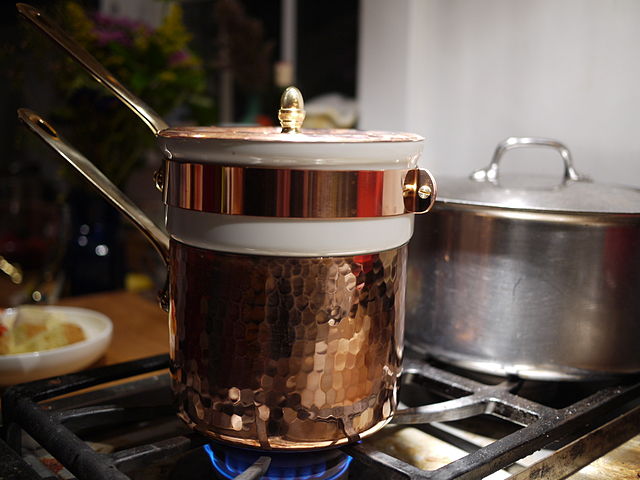
“Bain-marie” by grongar – originally posted to Flickr as Bain-marie – full. Licensed under CC BY 2.0 via Commons.

Shared meals
Many religious traditions have shared meals as part of their practice. Jewish tradition has the Seder or Passover meal, in which specific symbolic foods are eaten, representing different aspects of the Passover story. The youngest person present must ask, “Why is this night more special than all other nights?” and various other symbolic actions are performed, such as leaving the door open for Elijah, and raising a toast to the idea that one’s next Seder will take place in Jerusalem.Christianity has the Eucharist, which commemorates both the Last Supper that Jesus had with his disciples, and also the meal he is said to have shared with them at Emmaus after his Resurrection. The meal consists of bread and wine consumed in a sacred manner. There has been much conflict throughout Christian history about what the Eucharist means, who is allowed to partake of it, and what its effects are. Nevertheless it is a powerful ritual. Stephen Lingwood, a Unitarian minister, suggests that communion represents Jesus’ radical hospitality – his willingness to eat with people marginalised by society, such as prostitutes, tax collectors and publicans.
In Wicca, the shared meal is known as cakes and wine, and is usually consecrated by a woman and a man (but it can be a same-sex couple), and then shared among the participants in the ritual. A portion is kept for offering to the deities as a libation.
In some Hindu traditions, a portion of the food is offered to the deities while it is being cooked, and blessed food is known as prasadam.
The ancient Greeks had a ritual of sharing bread, which is where we get our word symposium, which literally means ‘together bread’. In ancient Rome, there were dining clubs devoted to the god Bacchus (god of wine), which presumably had a ritual or spiritual aspect.
Many religious traditions (including Buddhism, Christianity and Paganism) give thanks for their food before eating. Typically, the meal blessing might include thanks to all the beings and processes that went into creating the food, and a wish that everyone in the world might have enough to eat.
Cooking can also be a spiritual practice. It is in many ways akin to alchemy (the transformation of one thing into another); indeed, a cooking vessel invented by a medieval female alchemist – the bain-marie – founds its way from the laboratory to the kitchen. In Jewish tradition, the preparation of food has special rituals associated with it. The magic of a lovingly prepared meal is powerful stuff, restoring both body and mind.
This blogpost was originally published at UK Spirituality.
Previous Post
December 19, 2015
Embodied Spirituality: Making a Mandala
Next Post
December 24, 2015 Embodied Spirituality: Making an Altar
Browse Our Archives
Select a Category A Beginner's Guide Announcements Conversations Creative Endarkenment Embodied Spirituality General Interviews My Story News Commentary Pagan Studies Poetry Praxis Related topics Reviews Ritual Sacred Endarkenment Storytime Theology
Select a Month February 2017 December 2016 November 2016 October 2016 September 2016 August 2016 July 2016 June 2016 May 2016 April 2016 March 2016 February 2016 January 2016 December 2015 November 2015 October 2015 September 2015 August 2015 July 2015 June 2015 May 2015 April 2015 March 2015 February 2015 January 2015 December 2014 November 2014 October 2014 September 2014 August 2014 July 2014 June 2014 May 2014 April 2014 March 2014 February 2014 January 2014 December 2013 November 2013 October 2013 September 2013 August 2013 July 2013 June 2013 May 2013 April 2013 March 2013 February 2013 January 2013 December 2012 November 2012
Follow Us!
TAKE THE
Religious Wisdom Quiz
Who led the Israelites out of Egypt?
Select your answer to see how you score.
Moses Caleb Joshua Aaron
Related posts from Dowsing for Divinity

The safety pin: a reminder to resist bigotry

Creating Meaningful Public Ritual


Paganism and the Body Class Sneak Peek
TRENDING AT PATHEOS Pagan

I was recently chatting with someone on Instagram. She asked me what...

While there are many people who share their results, the end of...

On July 23, I saw Christopher Nolan's The Odyssey which is Homer’s...

As I write this two big events have just finished up. One...

Restoring the Watershed of Divine Love
Perhaps cooperation is not something we manufacture through legislation, ideology, or moral...

Many UUs don’t pray because of bad experiences in a previous religion,...
view all Pagan blogs
Ad-Free & Subscriber Log-In Subscription Support
- About Us
- 2026 Calendar
- Videos
- Podcasts
- Library of World Religions
- Faith In Media Tracker
- Advertise With Us
- Write for Us
- Privacy Policy
- Terms of Service
- Do Not Sell My Data
- Contact Us
- Radiant Digital
- Manage Newsletter Subscriptions
- Unsubscribe From Notifications
- Sitemap
Copyright 2008-2026, Patheos. All rights reserved.
Subscription Support Ad-Free & Subscriber Log-In
Follow Patheos