
BuddhistCatholicContemplativeEvangelicalGeneral ChristianHinduJewishLatter-day SaintMuslimNew VisionsProgressive Christian
Beliefs
- Buddhist
- Catholic
- Contemplative
- Evangelical
- General Christian
- Hindu
- Jewish
- Latter-day Saint
- More Voices
- Muslim
- New Visions
- Pagan
- Progressive Christian
Topics
- Religion News
- Food and Religion
- Sports and Religion
- Religious Art
- Religious Music and Entertainment
- Religious Events
- History and Religion
- Style and Religion
- Politics and Religion
- Women in Religion
- Recreation Outdoors and Religion
- Business Finance and Religion
- Careers Workplace and Religion
- Education and Religion
- Family Parenting and Religion
- Health Fitness and Religion
- Home and Religion
- Relationships and Religion
- Technology and Religion
- Travel and Religion
Columnists
- Buddhist Columnists
- Business Finance and Religion Columnists
- Careers Workplace and Religion Columnists
- Catholic Columnists
- Contemplative Columnists
- Education and Religion Columnists
- Evangelists Columnists
- Family Parenting and Religion Columnists
- General Christian Columnists
- Health Fitness and Religion Columnists
- Hindu Columnists
- History and Religion Columnists
- Home and Religion Columnists
- Jewish Columnists
- More Voices Columnists
- Latter Day Columnists
- Muslim Columnists
- New Visions Columnists
- Nonreligious Columnists
- Pagan Columnists
- Politics and Religion Columnists
- Progressive Columnists
- Recreation Outdoors and Religion Columnists
- Relationships and Religion Columnists
- Religion News Columnists
- Religious Art Columnists
- Religious Events Columnists
- Religious Music and Entertainment Columnists
- Sports and Religion Columnists
- Style and Religion Columnists
- Technology and Religion Columnists
- Travel and Religion Columnists
- Women in Religion Columnists
Resource Library
- 2026 Calendar
- Library of World Religions
- The 100 Most Holy Places on Earth
- Patheos Answers
- Podcasts
- Videos
- Faith Leaders Database
- Anglican Episcopalian
- Bahai
- Baptist
- Buddhism
- Christianity
- Confucianism
- Eastern Orthodoxy
- Hinduism
- Holiness and Pentecostal
- ISKCON
- Islam
- Judaism
- Lutheran
- Methodist
- The Church of Jesus Christ of Latter-day Saints
- New Age
- Paganism
- Presbytarian and Reformed
- Protestantism
- Religion Behind the Scenes
- Roman Catholic
- Scientology
- Shia Islam
- Sikhism
- Sufism
- Sunni Islam
- Taoism
- Zen
- See all religions
Research Tools
 Ad-Free & Subscriber Log-In Subscription Support
Ad-Free & Subscriber Log-In Subscription Support
Follow Patheos 

- Trending:
- Forgiveness
- |
- Marriage
- |
- Consciousness
- |
- Death Penalty
- |
- Election
- |
- Halloween
 Dowsing for Divinity
-
Books
- Home
- Pagan
- Magic Words: The Extraordinary Life of Alan Moore (Review)
Magic Words: The Extraordinary Life of Alan Moore (Review)
Last updated on: September 17, 2015 at 2:04 pm by Christine Kraemer
Magic Words: The Extraordinary Life of Alan Moore (Review) 2015-09-17T14:04:12-04:00 Christine Kraemer
Patheos Explore the world's faith through different perspectives on religion and spirituality! Patheos has the views of the prevalent religions and spiritualities of the world.
Do you know the work of Alan Moore? If you’re a Pagan or an occultist, you should.
Moore doesn’t think of himself as a Pagan per se, but he’s a product of the same cultural and spiritual currents that have produced contemporary Paganism. A self-declared magician and worshipper of the “sock-puppet” snake god Glycon, Moore is deeply informed by the Western occult tradition. In particular, his graphic novel series Promethea (1999-2005) is written as a primer on the classical elements, the Tarot, the kabbalistic Tree of Life, and more—all explored within the structure of a Wonder Woman-inspired superhero narrative. With a loose group of colleagues who call themselves “The Moon and Serpent Grand Egyptian Theater of Marvels,” Moore has also recorded several CDs of ritual theater, some of which have been illustrated as graphic novels.
Lest this introduction make Moore sound like a writer who writes for a niche of a niche—comics fans deeply interested in the occult—I should also say that his mainstream appeal is well-established. Best known for Watchmen (1986), a grim and satirical take on the superhero genre, Moore has profoundly influenced the direction of mainstream comics while also working to advance comics as a literary and artistic form. Several of his graphic novels have also been made into big-budget Hollywood films. These have increased Moore’s fame even as he has distanced himself from the films, which he has come to view as crassly commercial. At Moore’s demand, the film version of Watchmen (2009) does not bear his name; Moore turned over his share of the profits to Watchmen’s original artist, Dave Gibbons.
 Although Moore has been frequently interviewed over the course of his career, he has been relatively circumspect about his personal life. I turned to Lance Parkin’s Magic Words: The Extraordinary Life of Alan Moore (2013) hoping for deeper glimpses of the man behind the work. In this I was somewhat disappointed, perhaps because, as Parkin portrays him, Moore’s work has largely been his life.
The book does spend time on Moore’s childhood and psychedelic adolescence in a working-class neighborhood of Northampton, a chapter I read with interest. In many places, however, the chapter becomes simply a history of Northampton rather than a history of Moore specifically—and this may be in keeping with Moore’s impression of himself. Moore is a lifelong resident of Northampton; his novel The Voice of the Fire is set entirely on the land on which Northampton is built, though its story begins in the Neolithic. Moore is profoundly interested in what Pagans might call “the spirituality of place,” as well as in psychogeography, a playful approach to urban geography that emphasizes the shifting relationships between people and environment. For the most part, however, Parkin covers Moore’s personal life in a handful of sentences scattered throughout the book, and usually only when it directly relates to his writing. For example, The Mirror of Love (2004), Moore’s poetic celebration of same-sex love, was originally written while Moore was part of a polyamorous marriage; he and his partners published the poem in 1988 as part of a protest against Britain’s anti-LGBT Section 28. About Moore’s daughters, the book says almost nothing except to note that Leah Moore is now a comics writer herself. Moore’s current marriage to Melinda Gebbie is mostly discussed in the context of their long-term artistic collaboration, most notably on the erotic trilogy Lost Girls (2006).
Magic Words is rich in detail, however, when it comes to Moore’s often troubled professional relationships. This level of detail may prove a barrier to the more casual reader; since I am not well-versed in the British comics industry of the late 1970s, I found my eyes glazing over a bit during the chapters that cover this phase of Moore’s career. I am much more familiar with the American comics industry, however, and I found myself engrossed in Parkin’s analysis of Moore’s loss of trust in and ultimate falling-out with his original American publisher, DC Comics.
Parkin also spends quite a bit of space on literary and cultural analysis. One chapter is dedicated entirely to Watchmen, which Parkin contextualizes within Moore’s earlier humorous and satirical work. Parkin’s argument is that critics have taken Watchmen far too seriously, producing readings that miss its irony and humor. Parkin also considers the adaptation of Moore’s novels into films, which he portrays as unsuccessful artistically, but nevertheless functioning to draw attention to the graphic novels on which they are based. Some, like the V for Vendetta film (2005), have had enduring cultural impact; Moore reported pleasure at hearing that the activist group Anonymous had adopted the Guy Fawkes masks used in the book and movie.
Parkin devotes a chapter to Moore’s magical philosophy and practice. Moore sees magic as a type of language, the proper use of which gives one access to the nature of reality. The book’s treatment of Moore as a magician is a good summary of the many interviews Moore has given on the subject, and it retains Moore’s playfulness and self-deprecating humor. Parkin is a little reductionistic, however; he sees Moore’s magical practice primarily as Moore’s way of describing and codifying his creative process, not as a potentially freestanding system of spiritual exploration and development. Readers who are primarily looking for insight into Moore’s occult work will probably be better served by reading Moore’s many interviews or by watching the documentary The Mindscape of Alan Moore (2003).
Overall, I was most impressed by the way Parkin ultimately used his detailed accounts of Moore’s professional relationships to allow the reader to evaluate industry perceptions of the writer. In the last chapter of the book, Parkin presents two competing perceptions of Moore: that his stubborn nature and blind adherence to points of principle have cut him off from the rest of the industry, leading him to create work that is increasingly inaccessible; or that Moore has distanced himself from an overcommercialized and failing comics industry, which has allowed him to concentrate on experimental multimedia work while continuing to garner critical acclaim and financial success. Parkin’s meticulous history of Moore’s working life provides the context needed to potentially make a case for either side (although it is probably obvious on which one this reviewer comes down!).
Perhaps my only real quibble with the book is that it does not fully convey Moore’s warmth, which is frequently mentioned by interviewers, and which I experienced myself in Moore’s response to a fan letter I wrote to him in my early twenties. (After sending the letter, I was floored to receive a reply package containing a kind and funny note from Moore, as well as a book, an article, and CDs relating to his occult interests!) To balance that lack, I’d like to close by relating Moore’s thoughtful advice to new magicians, which was given in 2012 as part of a group videochat to raise money for a Harvey Pekar memorial.
Well, I would say, be careful, and try to remember to keep the four basic magickal weapons–and the properties that they symbolize, more importantly–with you at all times. What you need to do is work upon your discriminating intellect, and your compassion, and your basic drive–your will, if you like–and your material circumstances, and to realize that you need to have all of these things under control if you’re going to be a successful human being or a magician, because basically a magician is just a human being writ large. […] Above all, you need compassion, because even if you’ve got the other three and everything is succeeding perfectly, if you don’t have compassion, you’ll end up as a monster. If you’ve got those four basic things, then I would simply advise you to, yes, be careful, treat all this with respect, because it’s all real, at least inside your head, and that’s the only place it needs to be real. Then, progress adventurously. Don’t be afraid to think new or unorthodox things. Try to make sure that whatever magickal insights you’re receiving are applicable to ordinary, everyday life. If they are simply describing conditions in some imaginary universe that only exists to you, they’re probably not of a great deal of use. If they’re telling you things that you can actually use in your everyday interactions with other people, that you can actually use in your own creative life, then they’re probably useful and genuine. Good luck with it, good luck with it!
[If you’d like to hear the entire group chat, there’s an .avi version with a fair bit of garbling and several cut-outs here; or, leave me a comment with some contact info and I can provide a nice .mp3 of the audio only.]
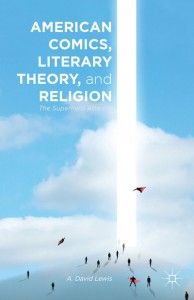 For those with a general interest in religion and comics, I’d also like to note the recent publication of American Comics, Literary Theory, and Religion: The Superhero Afterlife by my friend and colleague A. David Lewis. The book deals with portrayals of the afterlife in superhero comics–which often contrast with the afterlives of traditional Western monotheisms–as well as the evolving models of the human self that these portrayals reflect. I was involved in the editing process of the book, and I can attest that it is smart, accessible, and compelling. Plus, there’s a whole chapter on Promethea! Check it out via a university library, interlibrary loan, or Amazon.
Previous Post

September 15, 2015
Paganism for Beginners: Levels of Symbolism
Next Post

September 22, 2015 Shades of Racism
Browse Our Archives
Select a Category A Beginner's Guide Announcements Conversations Creative Endarkenment Embodied Spirituality General Interviews My Story News Commentary Pagan Studies Poetry Praxis Related topics Reviews Ritual Sacred Endarkenment Storytime Theology
Select a Month February 2017 December 2016 November 2016 October 2016 September 2016 August 2016 July 2016 June 2016 May 2016 April 2016 March 2016 February 2016 January 2016 December 2015 November 2015 October 2015 September 2015 August 2015 July 2015 June 2015 May 2015 April 2015 March 2015 February 2015 January 2015 December 2014 November 2014 October 2014 September 2014 August 2014 July 2014 June 2014 May 2014 April 2014 March 2014 February 2014 January 2014 December 2013 November 2013 October 2013 September 2013 August 2013 July 2013 June 2013 May 2013 April 2013 March 2013 February 2013 January 2013 December 2012 November 2012
Follow Us!
TAKE THE
Religious Wisdom Quiz
Who lay on his side for over a year as a prophetic sign?
Select your answer to see how you score.
Micah Hosea Ezekiel Daniel
Related posts from Dowsing for Divinity

Review of Queer Paganism by Jo Green

Imagining Other Possible Worlds

You say you want a revolution? (Review)

A Meditation: The Trees and the Forest
TRENDING AT PATHEOS Pagan

I was recently chatting with someone on Instagram. She asked me what...

While there are many people who share their results, the end of...

On July 23, I saw Christopher Nolan's The Odyssey which is Homer’s...

As I write this two big events have just finished up. One...

Restoring the Watershed of Divine Love
Perhaps cooperation is not something we manufacture through legislation, ideology, or moral...

Many UUs don’t pray because of bad experiences in a previous religion,...
view all Pagan blogs
Ad-Free & Subscriber Log-In Subscription Support
- About Us
- 2026 Calendar
- Videos
- Podcasts
- Library of World Religions
- Faith In Media Tracker
- Advertise With Us
- Write for Us
- Privacy Policy
- Terms of Service
- Do Not Sell My Data
- Contact Us
- Radiant Digital
- Manage Newsletter Subscriptions
- Unsubscribe From Notifications
- Sitemap
Copyright 2008-2026, Patheos. All rights reserved.
Subscription Support Ad-Free & Subscriber Log-In
Follow Patheos