
BuddhistCatholicContemplativeEvangelicalGeneral ChristianHinduJewishLatter-day SaintMuslimNew VisionsProgressive Christian
Beliefs
- Buddhist
- Catholic
- Contemplative
- Evangelical
- General Christian
- Hindu
- Jewish
- Latter-day Saint
- More Voices
- Muslim
- New Visions
- Pagan
- Progressive Christian
Topics
- Religion News
- Food and Religion
- Sports and Religion
- Religious Art
- Religious Music and Entertainment
- Religious Events
- History and Religion
- Style and Religion
- Politics and Religion
- Women in Religion
- Recreation Outdoors and Religion
- Business Finance and Religion
- Careers Workplace and Religion
- Education and Religion
- Family Parenting and Religion
- Health Fitness and Religion
- Home and Religion
- Relationships and Religion
- Technology and Religion
- Travel and Religion
Columnists
- Buddhist Columnists
- Business Finance and Religion Columnists
- Careers Workplace and Religion Columnists
- Catholic Columnists
- Contemplative Columnists
- Education and Religion Columnists
- Evangelists Columnists
- Family Parenting and Religion Columnists
- General Christian Columnists
- Health Fitness and Religion Columnists
- Hindu Columnists
- History and Religion Columnists
- Home and Religion Columnists
- Jewish Columnists
- More Voices Columnists
- Latter Day Columnists
- Muslim Columnists
- New Visions Columnists
- Nonreligious Columnists
- Pagan Columnists
- Politics and Religion Columnists
- Progressive Columnists
- Recreation Outdoors and Religion Columnists
- Relationships and Religion Columnists
- Religion News Columnists
- Religious Art Columnists
- Religious Events Columnists
- Religious Music and Entertainment Columnists
- Sports and Religion Columnists
- Style and Religion Columnists
- Technology and Religion Columnists
- Travel and Religion Columnists
- Women in Religion Columnists
Resource Library
- 2026 Calendar
- Library of World Religions
- The 100 Most Holy Places on Earth
- Patheos Answers
- Podcasts
- Videos
- Faith Leaders Database
- Anglican Episcopalian
- Bahai
- Baptist
- Buddhism
- Christianity
- Confucianism
- Eastern Orthodoxy
- Hinduism
- Holiness and Pentecostal
- ISKCON
- Islam
- Judaism
- Lutheran
- Methodist
- The Church of Jesus Christ of Latter-day Saints
- New Age
- Paganism
- Presbytarian and Reformed
- Protestantism
- Religion Behind the Scenes
- Roman Catholic
- Scientology
- Shia Islam
- Sikhism
- Sufism
- Sunni Islam
- Taoism
- Zen
- See all religions
Research Tools
 Ad-Free & Subscriber Log-In Subscription Support
Ad-Free & Subscriber Log-In Subscription Support
Follow Patheos 

- Trending:
- Forgiveness
- |
- Marriage
- |
- Consciousness
- |
- Death Penalty
- |
- Election
- |
- Halloween
 Dowsing for Divinity
-
Books
- Home
- Pagan
- Paganism for Beginners: Group Dynamics
Paganism for Beginners: Group Dynamics
Last updated on: September 14, 2015 at 10:59 am by Yvonne Aburrow
Paganism for Beginners: Group Dynamics 2015-09-14T10:59:16-04:00 Yvonne Aburrow
Patheos Explore the world's faith through different perspectives on religion and spirituality! Patheos has the views of the prevalent religions and spiritualities of the world.
The subject of group dynamics is complex, but one way of observing group dynamics is to ask the simple question, “Where does the power go in the group?” In other words, who is wielding the power?
In many groups, there is an elected or appointed leader. In most churches, the minister is officially the leader – but woe betide her or him if they upset the committee. In Wiccan covens, the leader is usually the high priestess. In a Druid grove or a Heathen hearth, there may be a small group of leaders, or a single leader. Quaker meetings usually have a group of elders.
In a small group, it can be an excellent idea to rotate the leadership role. Different members of the group take it in turns to write and facilitate a ritual. Most progressive and/or inclusive covens encourage their members to create and lead rituals.
Most people find that working in a group with a flat hierarchy is preferable to working in one with a very top-down hierarchy. Flat hierarchies are characterised by shared decision making and informal communication between team members.
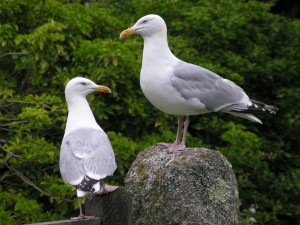
Hierarchy in the gull world
Two gulls at Ingelwidden, Cadgwith.
© Copyright Brian Whittle and
licensed for reuse under this Creative Commons Licence.
Groups often go through a process of forming, storming, norming, and performing. First the group comes together (forming). Then there is a struggle to resolve the group’s differences (storming). Once that has been resolved, the group’s values, goals, and beliefs converge (norming). Once that process is complete, the group is ready to perform. These stages can actually be a cycle rather than a linear process.
During the formation of the group and the convergence of its ideas, who is in the group, and who is outside the group, will become apparent. This is known as the in-group / out-group dynamic. The formation of the in-group can be a positive thing, in that it makes the group feel closer together, but it can be dangerous, because if the in-group projects its shadow onto the out-group, this can result in persecution of the out-group.
The projection of group members’ shadows onto other people in the group can be a dangerous dynamic. If you are the leader of a group, this a thing to watch out for, as you don’t want one person to be demonised or outcast by the rest of the group. The shadow is the aspect of our psyches that we have repressed because we don’t like that aspect of ourselves, and we often project it onto other people, especially if they resemble the repressed aspect of personality.
Another interesting dynamic in groups is “somebody has to do it” syndrome. This is where one person takes on more responsibility than the others, and an expectation is created that they will always do the task that they have taken on. This might be always being the one who leads the visualisations, or always being the one who calls the quarters, or something else less obvious, like being the person who provides a ritual if no-one else is feeling inspired. The way to break out of this dynamic is for the person who always does the thing to let go of feeling responsible for it, and for the people who never do the thing to have a go at doing it. It also means breaking the ritual tasks down into small manageable chunks so that people who might find it daunting to take on the management of a whole ritual can build up gradually by doing a small piece at a time. Luckily, Wiccan ritual lends itself well to being broken down into manageable chunks.
It is a good idea if the locus of power in a group is visible. If it is not obvious who holds the power, then it will default to the person with the loudest voice or the most stubborn resistance to new ideas.
One way to ensure a fair and balanced approach within your group is to make the rules by consensus. In this exercise (preferably on the first session of the group), ask members to suggest what the rules should be. The purpose of the rules is to make sure that everyone has the power to ask questions, to feel safe in the group, to ensure confidentiality, and to prevent conflict.
The role of the leader of a coven is to empower others and enable them to develop as priestesses or priests. This model is sometimes known as servant leadership – because the leader is mindful that the group is not there to serve them; rather they are there to create safe space for the group, to hold the space, and to empower others to be creative in that space.
Further reading
In my book, All Acts of Love and Pleasure: inclusive Wicca, I explore the issue of group dynamics extensively in the chapter on running a coven.
Inclusive Wicca is not just about including LGBTQIA people; it is also about including people of colour, people with disabilities (both visible and invisible), and working the rituals in a way that includes everyone and enables all participants to contribute.
Wiccan ethics
- Keep pure your highest ideal: personal ethics in Wicca by Alder
- Wiccan ethics – Sarah Howe
- Caveat Emptor: Money in Wicca – Sophia Boann
Model policies, group guidelines, etc
- Model guidelines for group discussion – Yvonne Aburrow
These are useful for face-to-face or online discussions - Training expectations – Kim Dent-Brown and Tracey Dent-Brown
An outline of what to expect from Wiccan training, and what will be expected of you.
Previous Post

September 12, 2015
Teaching and Learning in a Coven
Next Post

September 15, 2015 Paganism for Beginners: Levels of Symbolism
Browse Our Archives
Select a Category A Beginner's Guide Announcements Conversations Creative Endarkenment Embodied Spirituality General Interviews My Story News Commentary Pagan Studies Poetry Praxis Related topics Reviews Ritual Sacred Endarkenment Storytime Theology
Select a Month February 2017 December 2016 November 2016 October 2016 September 2016 August 2016 July 2016 June 2016 May 2016 April 2016 March 2016 February 2016 January 2016 December 2015 November 2015 October 2015 September 2015 August 2015 July 2015 June 2015 May 2015 April 2015 March 2015 February 2015 January 2015 December 2014 November 2014 October 2014 September 2014 August 2014 July 2014 June 2014 May 2014 April 2014 March 2014 February 2014 January 2014 December 2013 November 2013 October 2013 September 2013 August 2013 July 2013 June 2013 May 2013 April 2013 March 2013 February 2013 January 2013 December 2012 November 2012
Follow Us!
TAKE THE
Religious Wisdom Quiz
What was the primary form of transportation in Biblical times?
Select your answer to see how you score.
Camel Horse Donkey Chariot
Related posts from Dowsing for Divinity

Review of Queer Paganism by Jo Green


What Does An Inclusive Coven Look Like?

TRENDING AT PATHEOS Pagan

I was recently chatting with someone on Instagram. She asked me what...

While there are many people who share their results, the end of...

On July 23, I saw Christopher Nolan's The Odyssey which is Homer’s...

As I write this two big events have just finished up. One...

Restoring the Watershed of Divine Love
Perhaps cooperation is not something we manufacture through legislation, ideology, or moral...

Many UUs don’t pray because of bad experiences in a previous religion,...
view all Pagan blogs
Ad-Free & Subscriber Log-In Subscription Support
- About Us
- 2026 Calendar
- Videos
- Podcasts
- Library of World Religions
- Faith In Media Tracker
- Advertise With Us
- Write for Us
- Privacy Policy
- Terms of Service
- Do Not Sell My Data
- Contact Us
- Radiant Digital
- Manage Newsletter Subscriptions
- Unsubscribe From Notifications
- Sitemap
Copyright 2008-2026, Patheos. All rights reserved.
Subscription Support Ad-Free & Subscriber Log-In
Follow Patheos