
BuddhistCatholicContemplativeEvangelicalGeneral ChristianHinduJewishLatter-day SaintMuslimNew VisionsProgressive Christian
Beliefs
- Buddhist
- Catholic
- Contemplative
- Evangelical
- General Christian
- Hindu
- Jewish
- Latter-day Saint
- More Voices
- Muslim
- New Visions
- Pagan
- Progressive Christian
Topics
- Religion News
- Food and Religion
- Sports and Religion
- Religious Art
- Religious Music and Entertainment
- Religious Events
- History and Religion
- Style and Religion
- Politics and Religion
- Women in Religion
- Recreation Outdoors and Religion
- Business Finance and Religion
- Careers Workplace and Religion
- Education and Religion
- Family Parenting and Religion
- Health Fitness and Religion
- Home and Religion
- Relationships and Religion
- Technology and Religion
- Travel and Religion
Columnists
- Buddhist Columnists
- Business Finance and Religion Columnists
- Careers Workplace and Religion Columnists
- Catholic Columnists
- Contemplative Columnists
- Education and Religion Columnists
- Evangelists Columnists
- Family Parenting and Religion Columnists
- General Christian Columnists
- Health Fitness and Religion Columnists
- Hindu Columnists
- History and Religion Columnists
- Home and Religion Columnists
- Jewish Columnists
- More Voices Columnists
- Latter Day Columnists
- Muslim Columnists
- New Visions Columnists
- Nonreligious Columnists
- Pagan Columnists
- Politics and Religion Columnists
- Progressive Columnists
- Recreation Outdoors and Religion Columnists
- Relationships and Religion Columnists
- Religion News Columnists
- Religious Art Columnists
- Religious Events Columnists
- Religious Music and Entertainment Columnists
- Sports and Religion Columnists
- Style and Religion Columnists
- Technology and Religion Columnists
- Travel and Religion Columnists
- Women in Religion Columnists
Resource Library
- 2026 Calendar
- Library of World Religions
- The 100 Most Holy Places on Earth
- Patheos Answers
- Podcasts
- Videos
- Faith Leaders Database
- Anglican Episcopalian
- Bahai
- Baptist
- Buddhism
- Christianity
- Confucianism
- Eastern Orthodoxy
- Hinduism
- Holiness and Pentecostal
- ISKCON
- Islam
- Judaism
- Lutheran
- Methodist
- The Church of Jesus Christ of Latter-day Saints
- New Age
- Paganism
- Presbytarian and Reformed
- Protestantism
- Religion Behind the Scenes
- Roman Catholic
- Scientology
- Shia Islam
- Sikhism
- Sufism
- Sunni Islam
- Taoism
- Zen
- See all religions
Research Tools
 Ad-Free & Subscriber Log-In Subscription Support
Ad-Free & Subscriber Log-In Subscription Support
Follow Patheos 

- Trending:
- Forgiveness
- |
- Marriage
- |
- Consciousness
- |
- Death Penalty
- |
- Election
- |
- Halloween
 Dowsing for Divinity
-
Books
- Home
- Pagan
- The Dawn Of The Gods
The Dawn Of The Gods
Last updated on: November 7, 2018 at 9:16 am by Yvonne Aburrow
The Dawn Of The Gods 2018-11-07T09:16:04-05:00 Yvonne Aburrow
Patheos Explore the world's faith through different perspectives on religion and spirituality! Patheos has the views of the prevalent religions and spiritualities of the world.
In The Allegory of Love, CS Lewis wrote that in the declining years of ancient paganisms, people started to see the gods as metaphors, and then as allegorical personifications, until eventually belief in them declined. He says that “the distinction … between an abstract universal and a living spirit … was only vaguely and intermittently present to the Roman mind.” As an example, he gives the personification of Nature – “something more than a personification and less than a myth, and ready to be either or both as the stress of argument demands”. In the Thebaid of Statius, written some time between 45 CE and 96 CE, the various gods and personifications depicted in it “are all things that live and die in the inner world of the soul”.
Lewis (no friend to polytheism, but a friend to Pagan mythology), writes:
The twilight of the gods… must not be supposed to be in any sense a result of Christianity. It is already far advanced in Statius, and Statius, as a poet, but feebly reflects what philosophy had done long before him. It represents, in fact, the modus vivendi between monotheism and mythology. Monotheism should not be regarded as the rival of polytheism, but rather as its maturity. Where you find polytheism, combined with any speculative power and any leisure for speculation, monotheism will sooner or later arise as a natural development. The principle, I understand, is well illustrated in the history of Indian religion. Behind the gods arises the One, and the gods as well as the men are only his dreams. That is one way of disposing of the Many. European thought did not follow the same path, but it was faced with the same problem.
We need not agree with Lewis on the inevitability of monotheism to see that he is probably right that the allegorisation of the gods was the transitional phase between polytheism and monotheism. Of course, Lewis is being disingenuous in a way, as he clearly yearned to believe in the gods, and very likely believed in angels. (The book was written in 1936, seven years after his conversion to Christianity in 1929, but he had long been interested in Pagan mythology.)
I wonder if, in order to believe in the gods again, it has been necessary for us to pass through a phase of seeing them as metaphors and personifications, before we can see them as real again. The phase of seeing them as metaphors and archetypes has perhaps been a necessary preparation for seeing them as the face that we can perceive of vast cosmic forces, or localised manifestations of spirit.
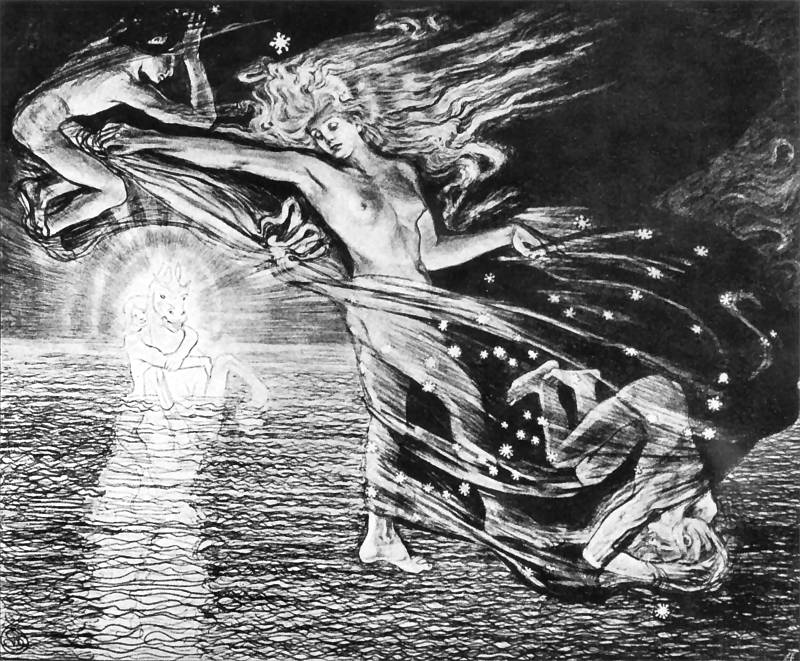
“Jutrzenka“: Eos, Phosphoros, Hesperos, Helios, black-coloured pencil drawing, The National Museum in Warsaw, 1897 by Stanisław Wyspiański. Licensed under Public Domain via Commons.
What does it mean to be real?
I have always rather liked the Velveteen Rabbit’s definition of real.
“Real isn’t how you are made,’ said the Skin Horse. ‘It’s a thing that happens to you. When a child loves you for a long, long time, not just to play with, but REALLY loves you, then you become Real.’
‘Does it hurt?’ asked the Rabbit.
‘Sometimes,’ said the Skin Horse, for he was always truthful. ‘When you are Real you don’t mind being hurt.’
‘Does it happen all at once, like being wound up,’ he asked, ‘or bit by bit?’
‘It doesn’t happen all at once,’ said the Skin Horse. ‘You become. It takes a long time. That’s why it doesn’t happen often to people who break easily, or have sharp edges, or who have to be carefully kept. Generally, by the time you are Real, most of your hair has been loved off, and your eyes drop out and you get loose in the joints and very shabby. But these things don’t matter at all, because once you are Real you can’t be ugly, except to people who don’t understand.”
― Margery Williams, The Velveteen Rabbit
But how does this apply to gods? Gods are cosmic forces with a possibly anthropomorphic interface, right? They are not a Velveteen Rabbit or a Skin Horse. No, but they are beings with whom we enter into a relationship, and that is what they have in common with the Velveteen Rabbit. They become real to us when we and they are in relationship. Doubtless they were real cosmic forces before that, but we recognise them as people when we are in relationship with them.
I have always thought that humans acquire a particular shape or identity to our personality as a result of all the social interactions we have engaged in. My theory is that the same is true for gods. They acquire the particular personality / energy signature / interests / appearance that they do as a cumulative result of all the interactions that people have had with them over the centuries. If Persephone is now the Queen of Kink, and Loki sometimes appears with dark hair instead of red hair, that’s because they are happy to fill those new images with their presence and power.
In China, when they make a statue of a deity, they make a little compartment in the back which contains special magical items to give the statue shen (the power and presence of spirit). If the statue is sent to a museum, the shen cavity is emptied prior to being transferred to the museum. Images and statues and personifications are empowered with the spirit of the deity if and when They choose to do so.
In Gnosticism and other Neo-Platonism-derived traditions, the Real sometimes refers to the spirit world, as contrasted with the physical world. I don’t think this is a very helpful definition for a non-dualistic and embodied path like Paganism, where the goal (in my view) is for spirit and matter to become more intertwined.
The Twilight, the Night, and the Dawn
During the noon-day of the gods, when the world was enchanted, people saw the gods in everything.
Once every people in the world believed that trees were divine, and could take a human or grotesque shape and dance among the shadows; and that deer, and ravens and foxes, and wolves and bears, and clouds and pools, almost all things under the sun and moon, and the sun and moon, were not less divine and changeable. They saw in the rainbow the still-bent bow of a god thrown down in his negligence; they heard in the thunder the sound of his beaten water jar, or the tumult of his chariot wheels; and when a sudden flight of wild ducks, or of crows, passed over their heads, they thought they were gazing at the dead hastening to their rest….
— William Butler Yeats
But, as C S Lewis rather wittily put it, the twilight of the gods was the mid-morning of the personifications. As our relationship with gods declined, they became seen as personifications of inner qualities. Eventually they became characters in old stories. That was the long night in which they slept.
But now the dawn is coming, and the old gods are brightening again, once more illuminating the many facets of reality, awakening from their long sleep, and interacting with us once more. For those of us who are busying ourselves making them cups of coffee and bringing them breakfast in bed, a little patience might be required while those who are still only perceiving them as archetypes or personifications catch up. We are in a transitional phase right now.

Breakfast in bed (CC-BY-SA 2.0) – Finger Lakes B&B on Flickr


Next Post

August 20, 2015 Overlapping Circles
Browse Our Archives
Select a Category A Beginner's Guide Announcements Conversations Creative Endarkenment Embodied Spirituality General Interviews My Story News Commentary Pagan Studies Poetry Praxis Related topics Reviews Ritual Sacred Endarkenment Storytime Theology
Select a Month February 2017 December 2016 November 2016 October 2016 September 2016 August 2016 July 2016 June 2016 May 2016 April 2016 March 2016 February 2016 January 2016 December 2015 November 2015 October 2015 September 2015 August 2015 July 2015 June 2015 May 2015 April 2015 March 2015 February 2015 January 2015 December 2014 November 2014 October 2014 September 2014 August 2014 July 2014 June 2014 May 2014 April 2014 March 2014 February 2014 January 2014 December 2013 November 2013 October 2013 September 2013 August 2013 July 2013 June 2013 May 2013 April 2013 March 2013 February 2013 January 2013 December 2012 November 2012
Follow Us!
TAKE THE
Religious Wisdom Quiz
What Christian group worships on Saturday instead of Sunday?
Select your answer to see how you score.
Presbyterians Seventh-day Adventists Baptists Pentecostals
Related posts from Dowsing for Divinity

A Meditation: The Trees and the Forest

Erotic Religion: The Body and Sex for Wiccans...


TRENDING AT PATHEOS Pagan

I was recently chatting with someone on Instagram. She asked me what...

While there are many people who share their results, the end of...

On July 23, I saw Christopher Nolan's The Odyssey which is Homer’s...

As I write this two big events have just finished up. One...

Restoring the Watershed of Divine Love
Perhaps cooperation is not something we manufacture through legislation, ideology, or moral...

Many UUs don’t pray because of bad experiences in a previous religion,...
view all Pagan blogs
Ad-Free & Subscriber Log-In Subscription Support
- About Us
- 2026 Calendar
- Videos
- Podcasts
- Library of World Religions
- Faith In Media Tracker
- Advertise With Us
- Write for Us
- Privacy Policy
- Terms of Service
- Do Not Sell My Data
- Contact Us
- Radiant Digital
- Manage Newsletter Subscriptions
- Unsubscribe From Notifications
- Sitemap
Copyright 2008-2026, Patheos. All rights reserved.
Subscription Support Ad-Free & Subscriber Log-In
Follow Patheos