
BuddhistCatholicContemplativeEvangelicalGeneral ChristianHinduJewishLatter-day SaintMuslimNew VisionsProgressive Christian
Beliefs
- Buddhist
- Catholic
- Contemplative
- Evangelical
- General Christian
- Hindu
- Jewish
- Latter-day Saint
- More Voices
- Muslim
- New Visions
- Pagan
- Progressive Christian
Topics
- Religion News
- Food and Religion
- Sports and Religion
- Religious Art
- Religious Music and Entertainment
- Religious Events
- History and Religion
- Style and Religion
- Politics and Religion
- Women in Religion
- Recreation Outdoors and Religion
- Business Finance and Religion
- Careers Workplace and Religion
- Education and Religion
- Family Parenting and Religion
- Health Fitness and Religion
- Home and Religion
- Relationships and Religion
- Technology and Religion
- Travel and Religion
Columnists
- Buddhist Columnists
- Business Finance and Religion Columnists
- Careers Workplace and Religion Columnists
- Catholic Columnists
- Contemplative Columnists
- Education and Religion Columnists
- Evangelists Columnists
- Family Parenting and Religion Columnists
- General Christian Columnists
- Health Fitness and Religion Columnists
- Hindu Columnists
- History and Religion Columnists
- Home and Religion Columnists
- Jewish Columnists
- More Voices Columnists
- Latter Day Columnists
- Muslim Columnists
- New Visions Columnists
- Nonreligious Columnists
- Pagan Columnists
- Politics and Religion Columnists
- Progressive Columnists
- Recreation Outdoors and Religion Columnists
- Relationships and Religion Columnists
- Religion News Columnists
- Religious Art Columnists
- Religious Events Columnists
- Religious Music and Entertainment Columnists
- Sports and Religion Columnists
- Style and Religion Columnists
- Technology and Religion Columnists
- Travel and Religion Columnists
- Women in Religion Columnists
Resource Library
- 2026 Calendar
- Library of World Religions
- The 100 Most Holy Places on Earth
- Patheos Answers
- Podcasts
- Videos
- Faith Leaders Database
- Anglican Episcopalian
- Bahai
- Baptist
- Buddhism
- Christianity
- Confucianism
- Eastern Orthodoxy
- Hinduism
- Holiness and Pentecostal
- ISKCON
- Islam
- Judaism
- Lutheran
- Methodist
- The Church of Jesus Christ of Latter-day Saints
- New Age
- Paganism
- Presbytarian and Reformed
- Protestantism
- Religion Behind the Scenes
- Roman Catholic
- Scientology
- Shia Islam
- Sikhism
- Sufism
- Sunni Islam
- Taoism
- Zen
- See all religions
Research Tools
 Ad-Free & Subscriber Log-In Subscription Support
Ad-Free & Subscriber Log-In Subscription Support
Follow Patheos 

- Trending:
- Forgiveness
- |
- Marriage
- |
- Consciousness
- |
- Death Penalty
- |
- Election
- |
- Halloween
 Dowsing for Divinity
-
Books
- Home
- Pagan
- Spiritual Healing: Run Toward Your Fear (A Book Review: #PTCS by Reba Riley)
Spiritual Healing: Run Toward Your Fear (A Book Review: #PTCS by Reba Riley)
Last updated on: August 16, 2015 at 8:00 am by Christine Kraemer
Spiritual Healing: Run Toward Your Fear (A Book Review: #PTCS by Reba Riley) 2015-08-14T17:35:41-04:00 Christine Kraemer
Patheos Explore the world's faith through different perspectives on religion and spirituality! Patheos has the views of the prevalent religions and spiritualities of the world.
This book response is part of the Patheos Book Club on Spiritual Healing and Post-Traumatic Church Syndrome. You can read the first four chapters of PTCS on Bookgrabbr.com.
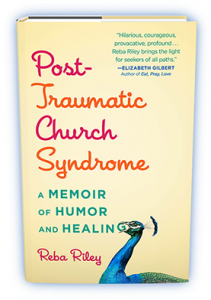 Thirty before Thirty: Reba Riley—chronically ill , spiritually destitute, and in search of healing—made it her project to visit thirty religions before her thirtieth birthday.
It might sound like a shallow project to some, as it did to one of the rabbis she visited in the course of her year. But Post-Traumatic Church Syndrome is not an attempt to catalogue the world’s religions. Rather, it’s a memoir of Reba’s attempt to get outside of her narrow sense of self, to push her boundaries by exploring the wounds she carried from leaving her childhood religion, pentecostal Christianity.
I’m not like Reba in that particular way; I left Christianity gently with no hard feelings. But I relate to this: she finds her fear and runs straight for it. And I relate to this: for Reba, spiritual growth isn’t a luxury, but a matter of life and death.
I was twenty-nine too (Saturn return!) when I left my marriage and my career and moved across the country, hoping that a change in external circumstances would shift my internal pain. And when that didn’t work, I plunged into the most intense period of spiritual practice in my life, spending at least an hour a day at my altar. As with Reba, a combination of self-observational and stillness meditation were the linchpins to finding my way out of the spiritual prison I’d made for myself. When Reba seeks the heart of Being and finds Love, I just had to cheer. I remember that journey.
What I did not have was Reba’s excellent sense of humor. PTCS is an easy read, self-deprecating and funny—so funny, in fact, that it may be hard to grasp the depth of suffering, both physical and spiritual, that she endured. There’s deep experience here, wrapped up in a bright, silly-looking package. On the cover, Reba’s spirit animal, a peacock, attempts to eat part of the title: Is this a book we’re meant to take seriously?
Unadulterated seriousness will not serve you in reading this book; nor, I think, does it speed the process of spiritual healing. Wiccans and other witches will recall that in “The Charge of the Goddess,” we are asked to carry both mirth and reverence within us (a combination that well describes Reba’s visit to a public Beltane circle, incidentally—tangled maypole and all). Spirituality has a place for laughter, for spontaneity and experimentation—but those characteristics are not incompatible with discipline. Since Reba encourages the reader to join her in making fun of herself, it’s easy to miss how challenging months-long dedication to daily meditation practice is—and this is a discipline that ultimately bears much fruit. Reba may tell her story lightly, but there is determination here, and drive. There is humor here because the task is so heavy.
Is this a book for Pagans? If you are a Pagan of the scarred, ex-conservative Christian kind, this book is definitely for you. And if you are an earnest spiritual seeker, Post-Traumatic Church Syndrome may give hope that trauma, spiritual brokenness, and debilitating illness can sometimes be healed. It is an uplifting book, not because it turns away from suffering and pain, but because it refuses to remain there.
There is one other way that PTCS provides a breath of fresh air. It is not a meaningful profile of thirty religions—the story is really about Reba’s journey. But what Reba does very well is convey how profoundly different these religions and their practitioners are seem to her. Though she doesn’t leave her home state, there is enormous variety of thought and practice in her backyard. This aspect of the book is an antidote to the claustrophobia that can come from spending too much time in one’s own religious community—using its jargon, asking its questions, pursuing its goals. (I think this is something Reba understands well, from her use of the term Christianese: the coded language in which Christians enforce their community’s norms.) It is a great relief sometimes to remember that other people have never heard of the great spiritual debates that so vex my religious community—they have their own weighty matters, their own vocabulary, and they work from completely different first principles. This reminder of the vastness of human experience can be freeing. Our differences, though so often a source of struggle, are also a source of great joy.
For Pagans with Christian families, this book may act as a bridge to open up sincere, thoughtful conversations about faith. More generally, I recommend it for anyone looking for a light and funny read that I, at least, am still reflecting on weeks later.
Hello all! I’m easing back into blogging with a series of book reviews. Next up: a biography of award-winning comics artist and occultist Alan Moore.
Post-Traumatic Church Syndrome
Previous Post

August 14, 2015
Faith and Belief
Next Post

August 18, 2015 The Dawn Of The Gods
Browse Our Archives
Select a Category A Beginner's Guide Announcements Conversations Creative Endarkenment Embodied Spirituality General Interviews My Story News Commentary Pagan Studies Poetry Praxis Related topics Reviews Ritual Sacred Endarkenment Storytime Theology
Select a Month February 2017 December 2016 November 2016 October 2016 September 2016 August 2016 July 2016 June 2016 May 2016 April 2016 March 2016 February 2016 January 2016 December 2015 November 2015 October 2015 September 2015 August 2015 July 2015 June 2015 May 2015 April 2015 March 2015 February 2015 January 2015 December 2014 November 2014 October 2014 September 2014 August 2014 July 2014 June 2014 May 2014 April 2014 March 2014 February 2014 January 2014 December 2013 November 2013 October 2013 September 2013 August 2013 July 2013 June 2013 May 2013 April 2013 March 2013 February 2013 January 2013 December 2012 November 2012
Follow Us!
TAKE THE
Religious Wisdom Quiz
How old was Abraham when Ishmael was born?
Select your answer to see how you score.
75 years 86 years 90 years 80 years
Related posts from Dowsing for Divinity

Review of Queer Paganism by Jo Green

Imagining Other Possible Worlds

You say you want a revolution? (Review)

A Meditation: The Trees and the Forest
TRENDING AT PATHEOS Pagan

I was recently chatting with someone on Instagram. She asked me what...

While there are many people who share their results, the end of...

On July 23, I saw Christopher Nolan's The Odyssey which is Homer’s...

As I write this two big events have just finished up. One...

Restoring the Watershed of Divine Love
Perhaps cooperation is not something we manufacture through legislation, ideology, or moral...

Many UUs don’t pray because of bad experiences in a previous religion,...
view all Pagan blogs
Ad-Free & Subscriber Log-In Subscription Support
- About Us
- 2026 Calendar
- Videos
- Podcasts
- Library of World Religions
- Faith In Media Tracker
- Advertise With Us
- Write for Us
- Privacy Policy
- Terms of Service
- Do Not Sell My Data
- Contact Us
- Radiant Digital
- Manage Newsletter Subscriptions
- Unsubscribe From Notifications
- Sitemap
Copyright 2008-2026, Patheos. All rights reserved.
Subscription Support Ad-Free & Subscriber Log-In
Follow Patheos