
BuddhistCatholicContemplativeEvangelicalGeneral ChristianHinduJewishLatter-day SaintMuslimNew VisionsProgressive Christian
Beliefs
- Buddhist
- Catholic
- Contemplative
- Evangelical
- General Christian
- Hindu
- Jewish
- Latter-day Saint
- More Voices
- Muslim
- New Visions
- Pagan
- Progressive Christian
Topics
- Religion News
- Food and Religion
- Sports and Religion
- Religious Art
- Religious Music and Entertainment
- Religious Events
- History and Religion
- Style and Religion
- Politics and Religion
- Women in Religion
- Recreation Outdoors and Religion
- Business Finance and Religion
- Careers Workplace and Religion
- Education and Religion
- Family Parenting and Religion
- Health Fitness and Religion
- Home and Religion
- Relationships and Religion
- Technology and Religion
- Travel and Religion
Columnists
- Buddhist Columnists
- Business Finance and Religion Columnists
- Careers Workplace and Religion Columnists
- Catholic Columnists
- Contemplative Columnists
- Education and Religion Columnists
- Evangelists Columnists
- Family Parenting and Religion Columnists
- General Christian Columnists
- Health Fitness and Religion Columnists
- Hindu Columnists
- History and Religion Columnists
- Home and Religion Columnists
- Jewish Columnists
- More Voices Columnists
- Latter Day Columnists
- Muslim Columnists
- New Visions Columnists
- Nonreligious Columnists
- Pagan Columnists
- Politics and Religion Columnists
- Progressive Columnists
- Recreation Outdoors and Religion Columnists
- Relationships and Religion Columnists
- Religion News Columnists
- Religious Art Columnists
- Religious Events Columnists
- Religious Music and Entertainment Columnists
- Sports and Religion Columnists
- Style and Religion Columnists
- Technology and Religion Columnists
- Travel and Religion Columnists
- Women in Religion Columnists
Resource Library
- 2026 Calendar
- Library of World Religions
- The 100 Most Holy Places on Earth
- Patheos Answers
- Podcasts
- Videos
- Faith Leaders Database
- Anglican Episcopalian
- Bahai
- Baptist
- Buddhism
- Christianity
- Confucianism
- Eastern Orthodoxy
- Hinduism
- Holiness and Pentecostal
- ISKCON
- Islam
- Judaism
- Lutheran
- Methodist
- The Church of Jesus Christ of Latter-day Saints
- New Age
- Paganism
- Presbytarian and Reformed
- Protestantism
- Religion Behind the Scenes
- Roman Catholic
- Scientology
- Shia Islam
- Sikhism
- Sufism
- Sunni Islam
- Taoism
- Zen
- See all religions
Research Tools
 Ad-Free & Subscriber Log-In Subscription Support
Ad-Free & Subscriber Log-In Subscription Support
Follow Patheos 

- Trending:
- Forgiveness
- |
- Marriage
- |
- Consciousness
- |
- Death Penalty
- |
- Election
- |
- Halloween
 Dowsing for Divinity
-
Books
- Home
- Pagan
- Paganism for Beginners: Things we care about
Paganism for Beginners: Things we care about
Last updated on: June 24, 2015 at 7:58 am by Yvonne Aburrow
Paganism for Beginners: Things we care about 2015-06-24T07:58:21-04:00 Yvonne Aburrow
Patheos Explore the world's faith through different perspectives on religion and spirituality! Patheos has the views of the prevalent religions and spiritualities of the world.
Pagans care about the same issues as everyone else – poverty, war, racism, homophobia, transphobia, the environment, saving indigenous lifeways, knowledge, and culture, women’s rights, cruelty to animals, and so on. Like any other movement, there are many different opinions in the Pagan movement: some Pagans don’t care about these things; some take a different view of them; and some care about them very much more than the average.
But there are some issues that are associated in people’s minds with being Pagan, the two most obvious ones being environmentalism and feminism. Many people have claimed that Paganism is a Nature religion (and many others have claimed that it’s not), and since Paganism and Nature-worship are synonymous in many people’s minds, caring for the Earth seems like an obvious thing for Pagans to want to do. And since the Earth is often viewed as a goddess, or as the Goddess, Paganism is an obvious choice for anyone who wonders why so many monotheists view their deity as exclusively male.
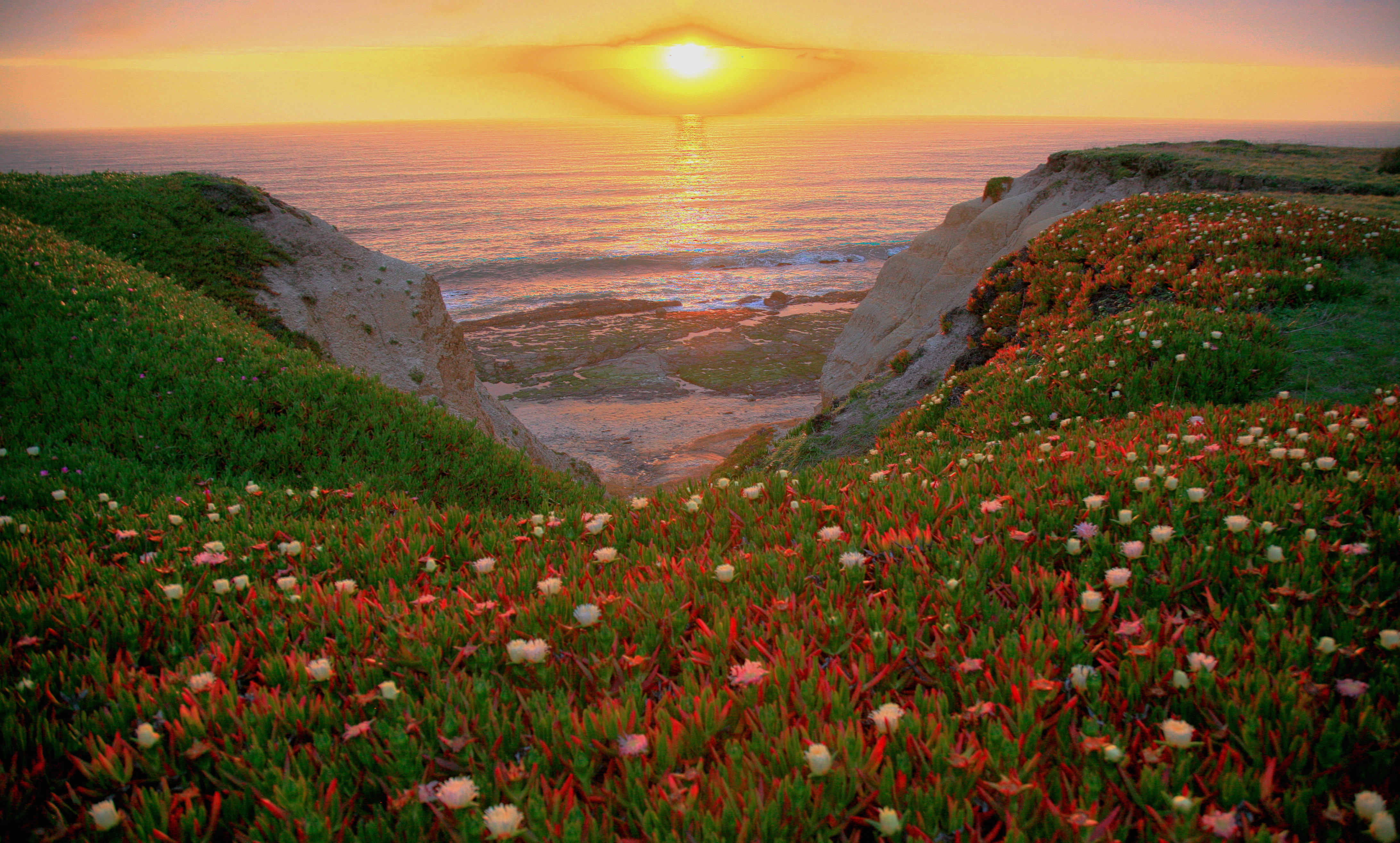
Earth Day Embrace by Steve Jurvetson [CC-BY-2.0]
Environmentalism
Pagans care about the environment for many and varied reasons. Some people became Pagans because they care about the environment; others began to care more about the environment after becoming a Pagan. Either way, Pagans recognise that the Earth is our mother, and if we don’t take care of her, we will all die, and so will many other species.
The earth is our mother,
we must take care of her.Hey yanna, ho yanna, hey yan yan.
Her sacred ground we walk upon,
with every step we take.The earth is our mother,
she will take care of us.
The causes of our current destructive course are many and complex. Some people blame capitalism; others blame consumerism; and others blame the dominionist views of conservative Christianity. I blame all three, and think they are historically interlinked.
Capitalism does not simply mean a market economy; it means the investment of surplus money in a business venture. This means that instead of being accountable to the whole community, a company becomes accountable to its shareholders, and shareholders generally want only one thing: a profit.
Consumerism is not simply wanting nice things; it is the view that only having nice things makes you happy, and the drive to acquire more and more nice things.
Dominionism is the view (derived from the book of Genesis) that God gave the Earth to humans for our use.
A major contrast with these views is deep ecology, which advocates the inherent worth of living beings regardless of their instrumental utility to human needs, and argues that this requires a radical restructuring of modern human societies. This certainly chimes in well with the Pagan world-view, and I explored the ecological and embodied world-view in two previous posts, Eco-spirituality and theology and Eco-spirituality in practice.
The language of ecology can be problematic, especially when it gets co-opted by business trying to preserve the status quo. Sustainability used to mean living in a way that prevents damage to the environment and loss of species habitat; now it has been co-opted to mean something like ‘greenwashing‘ (paying lip-service to environmental concerns while actually continuing to act in a destructive way), or buying carbon credits and continuing to release carbon dioxide into the atmosphere. The “environment” implies something that surrounds us, but which we are not necessarily part of. We are part of the environment and of ecosystems; we are not separate from our habitat.
A group of Pagans (of which I was one) have recently produced A Pagan Community Statement on the Environment, which has been translated into several different languages and has now reached around 5000 signatures. Whilst a statement will not fix things on its own, what it does is articulate the principles and practices which will help to fix things, and signing up to the statement means a commitment to its principles and to doing something for the planet.
Feminism
Some people became Pagans because they were feminists; others began to focus more on equality after becoming a Pagan. Either way, feminism is a natural bedfellow of Paganism, because most Pagan traditions worship a Goddess or goddesses, and value diversity and equality.
The roots of feminism lie in three simple premises:
- that women are equal to men,
- that women are not currently treated equally in society,
- and that we should do something about it.
However, as with any other philosophy, there is more than one flavour of feminism, because not all feminists necessarily agree on the correct tactics for getting rid of inequality, or indeed on who counts as a woman.
Variants include: Amazon, Analytical, Anarchist, Atheist, Black, Chicana, Christian, Conservative, Cultural, Cyber, Difference, Eco, Equality, Equity, Fat, French, structuralist, Global, Individualist, Islamic, Jewish, Lesbian, Liberal, Lipstick, Marxist, Material, Maternal, Mormon, Neo, New, Postcolonial, Postmodern, Poststructural, Pro-life, Proto, Radical, Separatist, Sex-positive, Social, Socialist, Standpoint, Third world, Trans, Transnational, and Womanism. There is even an online quiz for deciding what kind of feminist you are.
Here are some of the ones that share concerns with Paganism:
According to Wikipedia, “Anarcha-feminism, also called anarchist feminism and anarcho-feminism, combines anarchism with feminism. It generally views patriarchy as a manifestation of involuntary coercive hierarchy that should be replaced by decentralized free association. Anarcha-feminists believe that the struggle against patriarchy is an essential part of class struggle, and the anarchist struggle against the state. ” Historically, anarchist feminists included those who advocated free love and campaigned against marital rape and the subjugation of women.
Black feminism: Black feminist theorists argue that sexism, class oppression, and racism are inextricably bound together. The way these relate to each other is called intersectionality. The theory of intersectionality has been adopted by many other feminists and social theorists. According to Barbara Omolade, ”Black feminism is sometimes referred to as womanism because both are concerned with struggles against sexism and racism by black women who are themselves part of the black community’s efforts to achieve equity and liberty”.
Eco-feminism: According to Vandana Shiva, women have a special connection to the environment through our daily interactions. She says that women in subsistence economies who produce “wealth in partnership with nature, have been experts in their own right of holistic and ecological knowledge of nature’s processes.”
Obviously there are lots of other things that Pagans care about, but these are two areas that are fairly central to why so many people have joined the Pagan movement.
This post is part of a series, Paganism for Beginners. All the posts in this series will appear in the category ‘A Beginner’s Guide‘. You can find them by clicking on the ‘FILED UNDER’ link at the foot of the blogpost.
The next post in the series will be on controversies in the Pagan community, where I attempt to summarise all the controversies of the last few years, including racism, transphobia, Wiccanate privilege, and more.
Previous Post

June 20, 2015
A Queer Pagan Reading List
Next Post

June 27, 2015 Pagans and Money
Browse Our Archives
Select a Category A Beginner's Guide Announcements Conversations Creative Endarkenment Embodied Spirituality General Interviews My Story News Commentary Pagan Studies Poetry Praxis Related topics Reviews Ritual Sacred Endarkenment Storytime Theology
Select a Month February 2017 December 2016 November 2016 October 2016 September 2016 August 2016 July 2016 June 2016 May 2016 April 2016 March 2016 February 2016 January 2016 December 2015 November 2015 October 2015 September 2015 August 2015 July 2015 June 2015 May 2015 April 2015 March 2015 February 2015 January 2015 December 2014 November 2014 October 2014 September 2014 August 2014 July 2014 June 2014 May 2014 April 2014 March 2014 February 2014 January 2014 December 2013 November 2013 October 2013 September 2013 August 2013 July 2013 June 2013 May 2013 April 2013 March 2013 February 2013 January 2013 December 2012 November 2012
Follow Us!
TAKE THE
Religious Wisdom Quiz
What does the Bible say is better than gold?
Select your answer to see how you score.
Bread Wisdom Strength Wine
Related posts from Dowsing for Divinity

The safety pin: a reminder to resist bigotry


Misconceptions about cultural appropriation

Creating Meaningful Public Ritual
TRENDING AT PATHEOS Pagan

I was recently chatting with someone on Instagram. She asked me what...

While there are many people who share their results, the end of...

On July 23, I saw Christopher Nolan's The Odyssey which is Homer’s...

As I write this two big events have just finished up. One...

Restoring the Watershed of Divine Love
Perhaps cooperation is not something we manufacture through legislation, ideology, or moral...

Many UUs don’t pray because of bad experiences in a previous religion,...
view all Pagan blogs
Ad-Free & Subscriber Log-In Subscription Support
- About Us
- 2026 Calendar
- Videos
- Podcasts
- Library of World Religions
- Faith In Media Tracker
- Advertise With Us
- Write for Us
- Privacy Policy
- Terms of Service
- Do Not Sell My Data
- Contact Us
- Radiant Digital
- Manage Newsletter Subscriptions
- Unsubscribe From Notifications
- Sitemap
Copyright 2008-2026, Patheos. All rights reserved.
Subscription Support Ad-Free & Subscriber Log-In
Follow Patheos