
BuddhistCatholicContemplativeEvangelicalGeneral ChristianHinduJewishLatter-day SaintMuslimNew VisionsProgressive Christian
Beliefs
- Buddhist
- Catholic
- Contemplative
- Evangelical
- General Christian
- Hindu
- Jewish
- Latter-day Saint
- More Voices
- Muslim
- New Visions
- Pagan
- Progressive Christian
Topics
- Religion News
- Food and Religion
- Sports and Religion
- Religious Art
- Religious Music and Entertainment
- Religious Events
- History and Religion
- Style and Religion
- Politics and Religion
- Women in Religion
- Recreation Outdoors and Religion
- Business Finance and Religion
- Careers Workplace and Religion
- Education and Religion
- Family Parenting and Religion
- Health Fitness and Religion
- Home and Religion
- Relationships and Religion
- Technology and Religion
- Travel and Religion
Columnists
- Buddhist Columnists
- Business Finance and Religion Columnists
- Careers Workplace and Religion Columnists
- Catholic Columnists
- Contemplative Columnists
- Education and Religion Columnists
- Evangelists Columnists
- Family Parenting and Religion Columnists
- General Christian Columnists
- Health Fitness and Religion Columnists
- Hindu Columnists
- History and Religion Columnists
- Home and Religion Columnists
- Jewish Columnists
- More Voices Columnists
- Latter Day Columnists
- Muslim Columnists
- New Visions Columnists
- Nonreligious Columnists
- Pagan Columnists
- Politics and Religion Columnists
- Progressive Columnists
- Recreation Outdoors and Religion Columnists
- Relationships and Religion Columnists
- Religion News Columnists
- Religious Art Columnists
- Religious Events Columnists
- Religious Music and Entertainment Columnists
- Sports and Religion Columnists
- Style and Religion Columnists
- Technology and Religion Columnists
- Travel and Religion Columnists
- Women in Religion Columnists
Resource Library
- 2026 Calendar
- Library of World Religions
- The 100 Most Holy Places on Earth
- Patheos Answers
- Podcasts
- Videos
- Faith Leaders Database
- Anglican Episcopalian
- Bahai
- Baptist
- Buddhism
- Christianity
- Confucianism
- Eastern Orthodoxy
- Hinduism
- Holiness and Pentecostal
- ISKCON
- Islam
- Judaism
- Lutheran
- Methodist
- The Church of Jesus Christ of Latter-day Saints
- New Age
- Paganism
- Presbytarian and Reformed
- Protestantism
- Religion Behind the Scenes
- Roman Catholic
- Scientology
- Shia Islam
- Sikhism
- Sufism
- Sunni Islam
- Taoism
- Zen
- See all religions
Research Tools
 Ad-Free & Subscriber Log-In Subscription Support
Ad-Free & Subscriber Log-In Subscription Support
Follow Patheos 

- Trending:
- Forgiveness
- |
- Marriage
- |
- Consciousness
- |
- Death Penalty
- |
- Election
- |
- Halloween
 Dowsing for Divinity
-
Books
- Home
- Pagan
- Paganism for Beginners: Rites of Passage
Paganism for Beginners: Rites of Passage
Last updated on: June 10, 2015 at 8:03 am by Yvonne Aburrow
Paganism for Beginners: Rites of Passage 2015-06-07T04:28:51-04:00 Yvonne Aburrow
Patheos Explore the world's faith through different perspectives on religion and spirituality! Patheos has the views of the prevalent religions and spiritualities of the world.
A rite of passage is a ritual or ceremony to celebrate and mark the passage from one phase of life to the next. Rites of passage ease us over the threshold into the next phase, and help us to understand and embrace our new status.
Baby Naming
Most cultures have some kind of naming ceremony for babies, and Pagans do too. Pagans generally believe that children should be able to choose whether and which religion to follow when they are old enough, so Pagan naming ceremonies do not include a pledge to bring the child up Pagan – though they may include a desire to instil Pagan values into the child.

“Baby naming ceremony, Heathen Freehold Society of British Columbia” by Bygul – Own work. Licensed under CC BY-SA 3.0 via Wikimedia Commons.

Coming of Age
Western culture generally lacks a single unified coming of age ritual. Judaism has one in the form of the Bat Mitzvah and Bar Mitzvah. Many Pagans celebrate the first menstruation of their daughters (as long as the daughters want to celebrate it). Many indigenous cultures have rites of passage into adulthood, in the form of a vision quest in the wilderness.
Coming Out
Coming out as LGBT is definitely a rite of passage, and usually a very liberating and empowering experience as the person who comes out feels more authentic as a result. I have written a Pagan coming-out ritual exploring some of the themes around coming out.
Initiation
Several Pagan and other religious traditions have initiation ceremonies, in which the initiate becomes more fully part of the tradition into which they are being initiated, is given a new and sacred name, and has some of the tenets of the tradition imparted to them, usually in the form of ritual drama and ordeal.
There is sometimes controversy among Pagans as to the value of initiation, and whether self-initiation is the same thing as initiation into a coven or other group.
There are several different aspects of initiation, some of which are conferred by either form of initiation (encounter with the gods, inner transformation, encountering the Mysteries), and some of which can only be conferred as part of a group initiation (being given the secrets of the initiating group, joining the group mind of the initiating group; and the joining of the lineage or tradition of which the coven is part).
Marriage
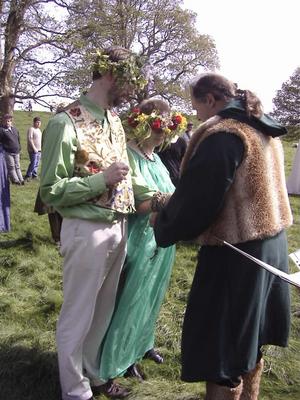
“Handfasting by Gordon” by Original uploader was Lizzievee at en.wikipedia – Transferred from en.wikipedia; Transfer was stated to be made by User:Undead_warrior.. Licensed under CC BY-SA 3.0 via Wikimedia Commons.

A Pagan wedding is called a handfasting, and can be contracted for a year and a day, for a lifetime, or for all lifetimes to come (the last of these seems a bit reckless to me). Pagans recognise both same-sex and opposite-sex weddings. Quite a few Pagans are polyamorous.
Pagan weddings have legal validity in the USA and Canada if the celebrant is registered with a recognised religious body, in Scotland if you are a registered celebrant, but not in England and Wales.
A handfasting is a wedding ceremony which involves wrapping cords around the couple’s clasped hands and tying a knot, symbolically binding them together in their declaration of unity. The contemporary handfasting ceremony is a revival of the handfastings of the past. The act of handfasting was originally part of a formal betrothal ceremony (the forerunner of today’s engagement) perhaps going as far back as ancient Celtic Scotland, and surviving up to the 16th century. During the betrothal ceremony, in which a couple agreed to marry each other in the future, there was a formal handshake to seal the deal. This was called the handfæstung, meaning, a pledge by the giving of the hand. To illustrate the imagery and importance of the handshake, the knotting of cords around the hands was eventually incorporated, possibly by contemporary Pagans.
Divorce
Pagans have always been liberal about divorce, and the fact that a handfasting allows a trial marriage shows that Pagans are aware of the possibility that a relationship may change for the worse, and therefore divorce may become necessary. Of course, marriage should provide security and be a commitment to work at the relationship and treat one’s partner with integrity – but that does not preclude divorce, as that is sometimes the only way of dealing with a marriage that’s not working any more. Paganism lacks a ritual for divorce, but individual Pagans may have crafted divorce rituals.
Croning
Croning is a ritual for recognising the menopause, when a woman ceases to menstruate and becomes a “crone”. Pagans have reclaimed the word crone to signify a wise older woman.
In early cultures, the female elder was considered a wise woman. She was the healer, the teacher, the imparter of knowledge. She mediated disputes, she had influence over tribal leaders, and she cared for the dying as they took their final breaths. For many women in Wicca and other Pagan religions, reaching the status of Crone is a major milestone. These women are reclaiming the name of Crone in a positive way, and see it as a time to joyfully welcome one’s position as an elder within the community.
Death
Pagan funerals generally focus on celebrating the life of the person who has died. There are some beautiful pieces of liturgy for Pagan funerals, and many of them can be found in the excellent book, A Pagan Book of Living and Dying, by the Reclaiming Collective.
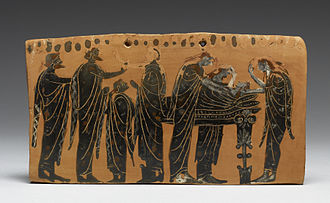
The lying in state of a body (prothesis) attended by family members, with the women ritually tearing their hair, depicted on a terracotta pinax by the Gela Painter, latter 6th century BC (Walters Art Museum [Public domain, CC BY-SA 3.0 or GFDL], via Wikimedia Commons)

This post is part of a series, Paganism for Beginners. All the posts in this series will appear in the category ‘A Beginner’s Guide‘. You can find them by clicking on the ‘FILED UNDER’ link at the foot of the blogpost.
The Pagan Channel has a page dedicated to posts about Rites of Passage. You can find out more information about handfastings, baby namings, Pagan funerals, and other rites of passage.
Previous Post

June 8, 2015
Paganism for Beginners: Values
Next Post

June 12, 2015 A Pagan perspective on the Bible
Browse Our Archives
Select a Category A Beginner's Guide Announcements Conversations Creative Endarkenment Embodied Spirituality General Interviews My Story News Commentary Pagan Studies Poetry Praxis Related topics Reviews Ritual Sacred Endarkenment Storytime Theology
Select a Month February 2017 December 2016 November 2016 October 2016 September 2016 August 2016 July 2016 June 2016 May 2016 April 2016 March 2016 February 2016 January 2016 December 2015 November 2015 October 2015 September 2015 August 2015 July 2015 June 2015 May 2015 April 2015 March 2015 February 2015 January 2015 December 2014 November 2014 October 2014 September 2014 August 2014 July 2014 June 2014 May 2014 April 2014 March 2014 February 2014 January 2014 December 2013 November 2013 October 2013 September 2013 August 2013 July 2013 June 2013 May 2013 April 2013 March 2013 February 2013 January 2013 December 2012 November 2012
Follow Us!
TAKE THE
Religious Wisdom Quiz
What happened to the first stone tablets of the Ten Commandments?
Select your answer to see how you score.
They were lost in battle Moses broke them They were placed in the Ark Pharaoh destroyed them
Related posts from Dowsing for Divinity



Embodied Spirituality: Magical Tools

Embodied Spirituality: Grounding and Centering
TRENDING AT PATHEOS Pagan

I was recently chatting with someone on Instagram. She asked me what...

While there are many people who share their results, the end of...

On July 23, I saw Christopher Nolan's The Odyssey which is Homer’s...

As I write this two big events have just finished up. One...

Restoring the Watershed of Divine Love
Perhaps cooperation is not something we manufacture through legislation, ideology, or moral...

Many UUs don’t pray because of bad experiences in a previous religion,...
view all Pagan blogs
Ad-Free & Subscriber Log-In Subscription Support
- About Us
- 2026 Calendar
- Videos
- Podcasts
- Library of World Religions
- Faith In Media Tracker
- Advertise With Us
- Write for Us
- Privacy Policy
- Terms of Service
- Do Not Sell My Data
- Contact Us
- Radiant Digital
- Manage Newsletter Subscriptions
- Unsubscribe From Notifications
- Sitemap
Copyright 2008-2026, Patheos. All rights reserved.
Subscription Support Ad-Free & Subscriber Log-In
Follow Patheos