
BuddhistCatholicContemplativeEvangelicalGeneral ChristianHinduJewishLatter-day SaintMuslimNew VisionsProgressive Christian
Beliefs
- Buddhist
- Catholic
- Contemplative
- Evangelical
- General Christian
- Hindu
- Jewish
- Latter-day Saint
- More Voices
- Muslim
- New Visions
- Pagan
- Progressive Christian
Topics
- Religion News
- Food and Religion
- Sports and Religion
- Religious Art
- Religious Music and Entertainment
- Religious Events
- History and Religion
- Style and Religion
- Politics and Religion
- Women in Religion
- Recreation Outdoors and Religion
- Business Finance and Religion
- Careers Workplace and Religion
- Education and Religion
- Family Parenting and Religion
- Health Fitness and Religion
- Home and Religion
- Relationships and Religion
- Technology and Religion
- Travel and Religion
Columnists
- Buddhist Columnists
- Business Finance and Religion Columnists
- Careers Workplace and Religion Columnists
- Catholic Columnists
- Contemplative Columnists
- Education and Religion Columnists
- Evangelists Columnists
- Family Parenting and Religion Columnists
- General Christian Columnists
- Health Fitness and Religion Columnists
- Hindu Columnists
- History and Religion Columnists
- Home and Religion Columnists
- Jewish Columnists
- More Voices Columnists
- Latter Day Columnists
- Muslim Columnists
- New Visions Columnists
- Nonreligious Columnists
- Pagan Columnists
- Politics and Religion Columnists
- Progressive Columnists
- Recreation Outdoors and Religion Columnists
- Relationships and Religion Columnists
- Religion News Columnists
- Religious Art Columnists
- Religious Events Columnists
- Religious Music and Entertainment Columnists
- Sports and Religion Columnists
- Style and Religion Columnists
- Technology and Religion Columnists
- Travel and Religion Columnists
- Women in Religion Columnists
Resource Library
- 2026 Calendar
- Library of World Religions
- The 100 Most Holy Places on Earth
- Patheos Answers
- Podcasts
- Videos
- Faith Leaders Database
- Anglican Episcopalian
- Bahai
- Baptist
- Buddhism
- Christianity
- Confucianism
- Eastern Orthodoxy
- Hinduism
- Holiness and Pentecostal
- ISKCON
- Islam
- Judaism
- Lutheran
- Methodist
- The Church of Jesus Christ of Latter-day Saints
- New Age
- Paganism
- Presbytarian and Reformed
- Protestantism
- Religion Behind the Scenes
- Roman Catholic
- Scientology
- Shia Islam
- Sikhism
- Sufism
- Sunni Islam
- Taoism
- Zen
- See all religions
Research Tools
 Ad-Free & Subscriber Log-In Subscription Support
Ad-Free & Subscriber Log-In Subscription Support
Follow Patheos 

- Trending:
- Forgiveness
- |
- Marriage
- |
- Consciousness
- |
- Death Penalty
- |
- Election
- |
- Halloween
 Dowsing for Divinity
-
Books
- Home
- Pagan
- Marriage equality: All you need is love… or is it?
Marriage equality: All you need is love… or is it?
Last updated on: June 30, 2015 at 2:29 am by Yvonne Aburrow
Marriage equality: All you need is love… or is it? 2015-06-30T02:29:15-04:00 Yvonne Aburrow
Patheos Explore the world's faith through different perspectives on religion and spirituality! Patheos has the views of the prevalent religions and spiritualities of the world.
All you need is love, all together now
All you need is love, everybody
All you need is love, love
Love is all you need – The Beatles – All You Need Is Love
I am immensely heartened by the legalisation of same-sex marriage across the United States of America by the Supreme Court ruling, and by popular referendum in Ireland. Even the Pitcairn Islands have legalised it, despite not having any gay couples living there. This makes the US the 23rd country to legalise it. Given the large number of people in same-sex relationships who want to get married, it seems like a very good idea, especially when it grants access to all kinds of other benefits (the ability to visit your spouse while they are dying in hospital, the ability to be named as their spouse on a death certificate, and so on). And we should celebrate our victories along the way. However, it does not mean that the struggle for equality is over.
- In the US, there are still 28 states where employers are permitted to fire people for being LGBTQIA. (In the UK, employment discrimination on the grounds of sexuality or religion was outlawed in 2003.)
- The freedom to marry may quickly become the coercion to marry, both from outside and within the community
- Trans* people, especially trans* people of colour, are at much higher risk of murder and suicide than other groups.
- Disabled LGBTQIA (and straight, presumably) people stand to lose a considerable portion of their disability benefit if they get married (because then their spouse is expected to support them).
- LGBTQ asylum seekers (in the US, the UK, and other countries) are treated badly, incarcerated with people who are homophobic and transphobic, and routinely disbelieved about their sexual orientations, and deported back to countries which will persecute them.
- Homophobia is still rife in schools, and the LGBT teen suicide rate is still much higher than that of straight teens.
- Intersex people are still routinely given surgery at birth to make their bodies “fit” the gender they have been assigned. Quite often, it is not the gender they would have chosen for themselves.
- People in polyamorous relationships still won’t enjoy legal protection.
All of the above is why I would urge you to support the LGBTQ Bill of Rights.
Love wins
I really the enjoyed the fact that my Facebook feed was full of rainbow profile pictures, as loads of friends, both straight and LGBTQIA, rainbowed up their profile pictures. Because they were celebrating with the LGBTQIA community, and they didn’t care if anyone else thought they might be gay. Could you have imagined that, twenty years ago? Ten years ago?

“A same-sex marriage in Taiwan” by Guy of Taipei – Own work. Licensed under CC BY-SA 3.0 via Wikimedia Commons.

Same sex marriage has been a stunning success in so many places because it is not particularly complicated, and it is easy to get behind it. BECAUSE LOVE. Everyone can get behind it, everyone can understand it. Two people in love – awww, right? Obviously it is a bit more complicated than that, because marriage is all tangled up with property and legal status and all that kind of stuff – and until relatively recently, marriage was a massively patriarchal thing designed to ensure that a father (who owned the property) could be sure that his biological offspring would inherit his property, because he knew his wife had not had sex with anyone else.
However, it was the concept of romantic love that changed heterosexual marriage for the better. Before the rediscovery of romantic love, and the invention of chivalry, women were mere chattels who could be exchanged as part of a contract. That is why so many of Molière‘s plays champion marrying for love against marrying for the furtherance of parental property deals.
Chivalry, and the accompanying tradition of courtly love, schooled the uncouth knights of Europe in the art of behaving like somebody who actually read books and knew one end of a lute from the other. Prior to this, they had been too busy indiscriminately raping, pillaging, and looting their way across Europe and the Middle East, all in the name of Christendom, in an activity usually referred to as the Crusades.
In fact, it may have been contact with the Muslim world that started the tradition of courtly love, according to Wikipedia:
The notions of “love for love’s sake” and “exaltation of the beloved lady” have been traced back to Arabic literature of the 9th and 10th centuries. The notion of the “ennobling power” of love was developed in the early 11th century by the Persian psychologist andphilosopher, Ibn Sina (known as “Avicenna” in Europe), in his treatise Risala fi’l-Ishq (“Treatise on Love”).
It took a good few centuries, and the subsequent introduction of the concept of companionate marriage, followed by the impact of feminism, but eventually heterosexual marriage started to be more equal. But it was the concepts of courtly and romantic love that started the process.
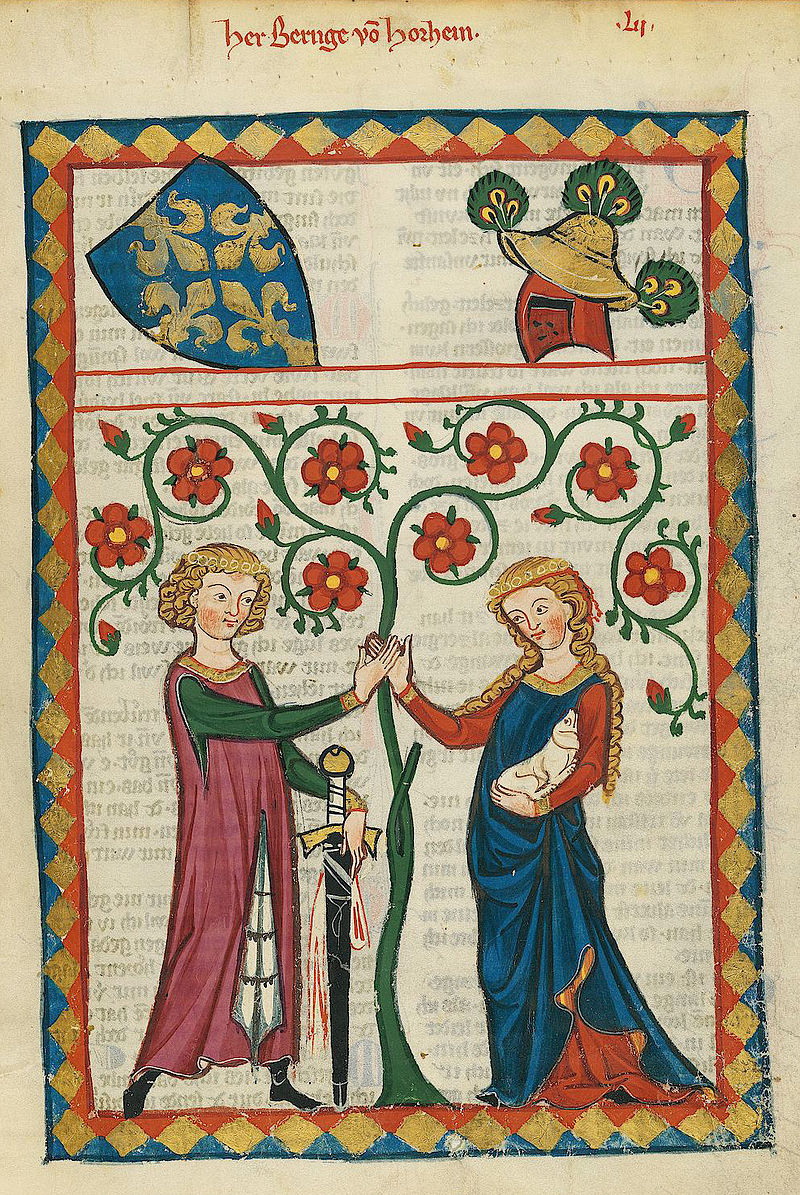
“Codex Manesse Bernger von Horheim” by Meister des Codex Manesse (Grundstockmaler) – Universität Heidelberg. Licensed under Public Domain via Wikimedia Commons.

The other day someone commented on Facebook that same-sex marriage is important because, “for some straight people, it is the only thing that makes them realise that queer people are human too”. I would argue that the concept of love (courtly and romantic) achieved the same thing for women.
Contrasted with the slow progress of equality in heterosexual marriage, the rise of same-sex marriage has been meteoric, and that in itself is quite an achievement – in England and Wales, homosexual activity between consenting adults over the age of 21 was legalised in 1967. It was not legal in Scotland until 1981, and in Northern Ireland, not until 1982. I was gobsmacked recently by an article by Colm Tóibin, in which he commented that some otherwise liberal people were unaware that same-sex relationships involve love:
I met a prominent Irish feminist, someone had been at the forefront of the women’s movement, and she too expressed surprise at the intensity of the relationship between the two men in the book. “They sound like straight people,” she said. I told her that that was because they were like straight people, that they wanted intimacy and love, they wanted each other, they wanted ease in their domestic and family lives. They also wanted their relationship to be publicly recognised. They wanted to move out of the shadows and into the light.
I am unsure of how anyone could be unaware of this, as it seems kind of obvious to me – but then I recall how, when I published a piece celebrating the legalisation of same-sex marriage in the UK in a magazine of which I was the editor, someone commented that “you already had one article about sex in that issue, did you really need another one?” I was appalled by the assumption that same-sex marriage is only about sex, and not about love and equal rights.
Progress is incremental
So, you think same-sex marriage is not enough? That we need polyamorous marriage, marriage that is not entangled with property rights, and an understanding that not everyone wants to get married? Well, yes, but let’s celebrate this milestone on the road to equality, because it’s all about love, and that is worth celebrating. Recently, it was the anniversary of Loving vs Virginia (1967), the Supreme Court case in which laws against people of different colours marrying were struck down. Someday, the idea that two people of the same sex were not allowed to marry will seem as bizarre as the idea that two people of different colours couldn’t marry. It was particularly apt that the couple bringing the case were called Mr and Mrs Loving.
Today we celebrate, tomorrow the struggle goes on.
Previous Post

June 27, 2015
Pagans and Money
Next Post

July 1, 2015 Paganism for Beginners: Controversies
Browse Our Archives
Select a Category A Beginner's Guide Announcements Conversations Creative Endarkenment Embodied Spirituality General Interviews My Story News Commentary Pagan Studies Poetry Praxis Related topics Reviews Ritual Sacred Endarkenment Storytime Theology
Select a Month February 2017 December 2016 November 2016 October 2016 September 2016 August 2016 July 2016 June 2016 May 2016 April 2016 March 2016 February 2016 January 2016 December 2015 November 2015 October 2015 September 2015 August 2015 July 2015 June 2015 May 2015 April 2015 March 2015 February 2015 January 2015 December 2014 November 2014 October 2014 September 2014 August 2014 July 2014 June 2014 May 2014 April 2014 March 2014 February 2014 January 2014 December 2013 November 2013 October 2013 September 2013 August 2013 July 2013 June 2013 May 2013 April 2013 March 2013 February 2013 January 2013 December 2012 November 2012
Follow Us!
TAKE THE
Religious Wisdom Quiz
If you show me, you will show your faith. Without me, faith is dead. What am I?
Select your answer to see how you score.
Love Obedience Works Prayer
Related posts from Dowsing for Divinity

Review of Queer Paganism by Jo Green

Imagining Other Possible Worlds

You say you want a revolution? (Review)

A Meditation: The Trees and the Forest
TRENDING AT PATHEOS Pagan

I was recently chatting with someone on Instagram. She asked me what...

While there are many people who share their results, the end of...

On July 23, I saw Christopher Nolan's The Odyssey which is Homer’s...

As I write this two big events have just finished up. One...

Restoring the Watershed of Divine Love
Perhaps cooperation is not something we manufacture through legislation, ideology, or moral...

Many UUs don’t pray because of bad experiences in a previous religion,...
view all Pagan blogs
Ad-Free & Subscriber Log-In Subscription Support
- About Us
- 2026 Calendar
- Videos
- Podcasts
- Library of World Religions
- Faith In Media Tracker
- Advertise With Us
- Write for Us
- Privacy Policy
- Terms of Service
- Do Not Sell My Data
- Contact Us
- Radiant Digital
- Manage Newsletter Subscriptions
- Unsubscribe From Notifications
- Sitemap
Copyright 2008-2026, Patheos. All rights reserved.
Subscription Support Ad-Free & Subscriber Log-In
Follow Patheos