
BuddhistCatholicContemplativeEvangelicalGeneral ChristianHinduJewishLatter-day SaintMuslimNew VisionsProgressive Christian
Beliefs
- Buddhist
- Catholic
- Contemplative
- Evangelical
- General Christian
- Hindu
- Jewish
- Latter-day Saint
- More Voices
- Muslim
- New Visions
- Pagan
- Progressive Christian
Topics
- Religion News
- Food and Religion
- Sports and Religion
- Religious Art
- Religious Music and Entertainment
- Religious Events
- History and Religion
- Style and Religion
- Politics and Religion
- Women in Religion
- Recreation Outdoors and Religion
- Business Finance and Religion
- Careers Workplace and Religion
- Education and Religion
- Family Parenting and Religion
- Health Fitness and Religion
- Home and Religion
- Relationships and Religion
- Technology and Religion
- Travel and Religion
Columnists
- Buddhist Columnists
- Business Finance and Religion Columnists
- Careers Workplace and Religion Columnists
- Catholic Columnists
- Contemplative Columnists
- Education and Religion Columnists
- Evangelists Columnists
- Family Parenting and Religion Columnists
- General Christian Columnists
- Health Fitness and Religion Columnists
- Hindu Columnists
- History and Religion Columnists
- Home and Religion Columnists
- Jewish Columnists
- More Voices Columnists
- Latter Day Columnists
- Muslim Columnists
- New Visions Columnists
- Nonreligious Columnists
- Pagan Columnists
- Politics and Religion Columnists
- Progressive Columnists
- Recreation Outdoors and Religion Columnists
- Relationships and Religion Columnists
- Religion News Columnists
- Religious Art Columnists
- Religious Events Columnists
- Religious Music and Entertainment Columnists
- Sports and Religion Columnists
- Style and Religion Columnists
- Technology and Religion Columnists
- Travel and Religion Columnists
- Women in Religion Columnists
Resource Library
- 2026 Calendar
- Library of World Religions
- The 100 Most Holy Places on Earth
- Patheos Answers
- Podcasts
- Videos
- Faith Leaders Database
- Anglican Episcopalian
- Bahai
- Baptist
- Buddhism
- Christianity
- Confucianism
- Eastern Orthodoxy
- Hinduism
- Holiness and Pentecostal
- ISKCON
- Islam
- Judaism
- Lutheran
- Methodist
- The Church of Jesus Christ of Latter-day Saints
- New Age
- Paganism
- Presbytarian and Reformed
- Protestantism
- Religion Behind the Scenes
- Roman Catholic
- Scientology
- Shia Islam
- Sikhism
- Sufism
- Sunni Islam
- Taoism
- Zen
- See all religions
Research Tools
 Ad-Free & Subscriber Log-In Subscription Support
Ad-Free & Subscriber Log-In Subscription Support
Follow Patheos 

- Trending:
- Forgiveness
- |
- Marriage
- |
- Consciousness
- |
- Death Penalty
- |
- Election
- |
- Halloween
 Dowsing for Divinity
-
Books
- Home
- Pagan
- Paganism for Beginners: Wicca
Paganism for Beginners: Wicca
Last updated on: May 27, 2015 at 9:25 am by Yvonne Aburrow
Paganism for Beginners: Wicca 2015-05-27T09:25:13-04:00 Yvonne Aburrow
Patheos Explore the world's faith through different perspectives on religion and spirituality! Patheos has the views of the prevalent religions and spiritualities of the world.
Wicca is both a religion and a magical practice. Wiccans interact with the world on many levels – physical, spiritual, magical and emotional. Witchcraft is the craft of magic.
Wicca and Witchcraft overlap – all Wiccans are also witches, but not all witches are Wiccans. But the practice of witchcraft (in the sense of doing spells and so on) is only part of the practice of Wicca.
Initiatory Wicca (known in the USA as “British Traditional Wicca”) is essentially an esoteric mystery religion in which every practitioner is a priestess or priest.
A mystery religion is one in which the dramas of the psyche are enacted by and for the benefit of its initiates, but because these mysteries often involve non-verbal concepts, they cannot be communicated. Also, some material is oathbound (initiates are forbidden to disclose it to non-initiates). This is not because we want to keep these mysteries to ourselves, but because you need the ceremony of initiation to prepare you to encounter the mysteries.
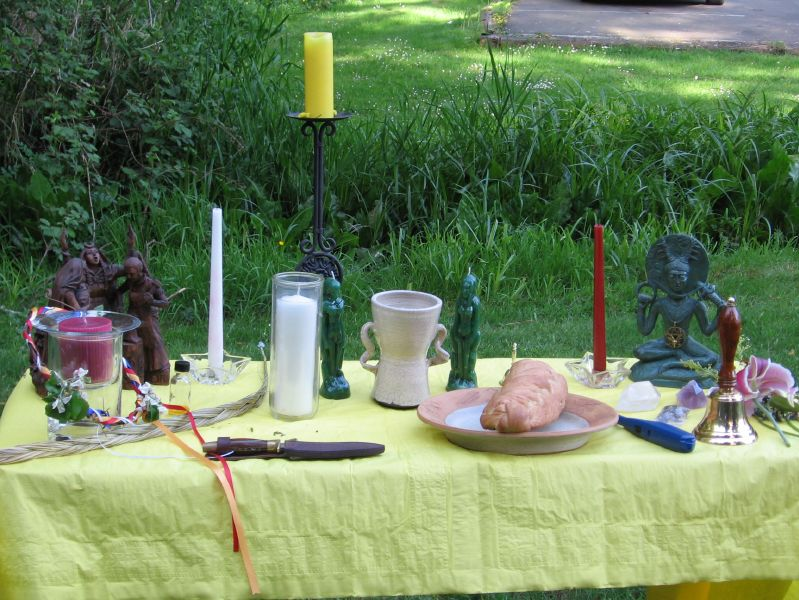
“Wiccan altar (0)” by RaeVynn Sands, Flickr user cronewynd – originally uploaded to Flickr by RaeVynn Sands as Beltane Altar. Licensed under CC BY 2.0 via Wikimedia Commons.

Initiation
There are three degrees of initiation in Wicca. After the first degree initiation, the initiate is responsible for their own spiritual development; in some groups, the period between first and second is where the new initiate is helped to develop their spirituality by their Coven and High Priestess and High Priest; after the second, they may take on responsibility for assisting others’ development; after the third, their psyche is fully integrated with itself. (The third degree is generally regarded as a personal step in British Gardnerian Wicca, not something that is required in order to be able to run a coven.)
Initiatory Wicca has many variants (Gardnerian, Alexandrian, and offshoots of these) but all share an adherence to a similar ritual structure and the practice of initiation.
Sources
Early modern Wicca was inspired by the general interest in the early 20th century in ancient paganisms, esoteric orders of the 19th century, and a strong interest in nature and magical realms. It appears that the basic structure of modern Wicca was devised by two women in the Bournemouth area in the mid-1920s. They passed this on to Gerald Gardner via Dafo. Gardner genuinely believed that he had found an ancient practice which could be traced back centuries, possibly even millennia. There were, however, other covens practising in other parts of Britain, but little is known about these other than that they existed, and most claims that traditional and hereditary Craft existed before Gardner have not been proven – but nor have they been disproved.
Gardner eventually published a novel, High Magic’s Aid (a fictional account of medieval witchcraft) and Witchcraft Today, an account of the witches that he had encountered.
Many people joined Gardner’s early covens, including Doreen Valiente, who added quite a lot of new material into Gardner’s Book of Shadows. Each new person added more material.
The modern Craft both draws upon its roots in the Western Mystery Tradition, and looks to traditional forms of folk magic, folklore, and the pagan traditions of the British Isles for inspiration. The structure of rituals remains reasonably constant, but the content varies quite a lot according to the inclinations and tastes of individual covens. Only initiations remain fairly standard, in order to ensure that they will be recognised across the whole Craft.
Gods and other beings
Wicca encompasses a variety of beliefs:
- A belief in many gods and goddesses, spirits of place, nature and elemental spirits (polytheism)
- A belief that “all the gods are one God and all the Goddesses are one Goddess” (duotheism)
- A belief that there is no duality of good versus evil (monism)
- Devotion to a specific deity (henotheism)
- Belief that there is only one deity, usually the Goddess or the Great Spirit (monotheism)
- A belief that everything has a soul, including trees, rocks, animals, birds, places (animism)
- A belief that the divine is immanent or manifest in the physical world (pantheism)
- A combination of one or more of the above
Fortunately it is possible to accommodate all these different views within Wicca because of the autonomy of covens and the diversity in unity of Wiccan practice.
Structure
Most Wiccans gather in covens. Most covens have a High Priestess and High Priest, but the extent to which these are leaders in the generally-accepted sense of the word varies from one coven to another. Their role is more like that of a facilitator or mentor; their aim is to empower their coveners to develop as priestesses and priests in their own right, passing on their experience and knowledge to their coveners, and usually learning from them in the process. Covens are autonomous, but as their founders will have been trained in another coven, they usually maintain contact with their previous High Priestess and sometimes seek guidance from her. The maximum size of a coven is usually limited by the size of the room where they meet.
Most coven members will also practice on their own (either a full ritual or meditation and visualisation), and sometimes will become solitary for a time if they move to another part of the country and cannot find a compatible coven or simply because that is what they wish to do at the time.
Solitary Wicca is also practised by non-initiates, either because they do not want to join a coven or cannot find a compatible one. Solitaries sometimes perform a self-dedication or self-initiation ritual.
The structure of a ritual
The basic structure of a ritual is similar to that of a story. It has a beginning (the opening of the circle), a middle (the purpose for which the ritual is being conducted be it celebratory or magical) and an end (the closing of the circle).
Wicca is practised in a sacred circle, and most rituals have a structure broadly based upon the Western Mystery Tradition. This involves consecrating the space, orienting it to sacred geometry, raising some power, performing the ritual, sharing consecrated food and drink, and then closing the circle and bidding farewell to the beings and powers that have been called upon. Coveners usually bring a contribution to the feast.
Festivals
Wiccans celebrate eight festivals and the thirteen Full Moons of the year. They will sometimes meet on other festivals and other phases of the Moon.
The eight festivals are Samhain or Hallowe’en (31st October); Yule (21st December); Imbolc (2nd February); Spring Equinox (21st March); Beltane (1st May); Midsummer or Litha (21st June); Lammas or Lughnasadh (1st August); and Autumn Equinox (21st September). The dates, practice and meaning of these vary according to where the coven is located, when particular plants actually come out, and the local traditions where the coven members live. Some covens celebrate on the nearest weekend to the actual festival. Some writers have tried to fit the festivals to the story of the interaction between “The God” and “The Goddess”.
It is now generally recognised that the eight festivals were not all celebrated by the same culture (in spite of wild claims made on some web sites), and some of them are retro-engineered Christian festivals, but this is in keeping with the nature of Wiccan practice. Whatever the origins of the festivals, they have now taken on a life of their own, and could be considered a valid development of pagan tradition, provided that we do not make spurious claims for their antiquity.
While the Solstices and Equinoxes are fixed points governed by the movements of specific movements of the Sun and Moon, the other four, Imbolc, Beltane, Lammas and Samhain are moveable and relate to the passing of the seasons as they display themselves wherever the practitioner happens to be geographically.
In the Southern Hemisphere, the equinoxes and solstices are reversed, so the winter solstice is in June, and so on.
Magic
Most Wiccans practice magic for healing and other ethical results. The intention behind the working of magic is not to impose our will on the universe, but to bend the currents of possibility somewhat to bring about a desired outcome. Magic is generally practised at Full Moons rather than major festivals.
Ethics
The Wiccan attitude to ethics is mainly based on the Wiccan Rede, “An it harm none, do what thou wilt”. However, it is significant that this injunction occurs as part of the first degree initiation, and was probably originally meant to show the new initiate that it is impossible to do anything without causing some harm, so it is necessary to consider carefully the consequences of one’s actions. The other famous (and often misquoted) injunction occurs at the second degree, and is generally known as the Law of Threefold Return. The actual text enjoins the initiate to return good threefold wherever s/he receives it. To my mind, the most important aspect of Wiccan ethics is the list of the eight virtues which occurs in The Charge of the Goddess. These are beauty and strength, power and compassion, mirth and reverence, honour and humility. Each of these pairs of virtues points to the need for balance.
Further reading
- Wicca: an introduction – John Macintyre
- Inclusive Wicca – Yvonne Aburrow
- Aspects of Initiation – Yvonne Aburrow
- Mystery Religions: the what and why – Sarah Howe
- Witches in history – Yvonne Aburrow
This post is part of a series, Paganism for Beginners. All the posts in this series will appear in the category ‘A Beginner’s Guide‘. You can find them by clicking on the ‘FILED UNDER’ link at the foot of the blogpost.
Previous Post

May 20, 2015
Paganism for Beginners - Overview
Next Post

June 3, 2015 Paganism for Beginners: Theology
Browse Our Archives
Select a Category A Beginner's Guide Announcements Conversations Creative Endarkenment Embodied Spirituality General Interviews My Story News Commentary Pagan Studies Poetry Praxis Related topics Reviews Ritual Sacred Endarkenment Storytime Theology
Select a Month February 2017 December 2016 November 2016 October 2016 September 2016 August 2016 July 2016 June 2016 May 2016 April 2016 March 2016 February 2016 January 2016 December 2015 November 2015 October 2015 September 2015 August 2015 July 2015 June 2015 May 2015 April 2015 March 2015 February 2015 January 2015 December 2014 November 2014 October 2014 September 2014 August 2014 July 2014 June 2014 May 2014 April 2014 March 2014 February 2014 January 2014 December 2013 November 2013 October 2013 September 2013 August 2013 July 2013 June 2013 May 2013 April 2013 March 2013 February 2013 January 2013 December 2012 November 2012
Follow Us!
TAKE THE
Religious Wisdom Quiz
How many plagues did God send upon Egypt?
Select your answer to see how you score.
Seven Twelve Twenty Ten
Related posts from Dowsing for Divinity

Review of Queer Paganism by Jo Green



Erotic Religion: The Body and Sex for Wiccans...
TRENDING AT PATHEOS Pagan

I was recently chatting with someone on Instagram. She asked me what...

While there are many people who share their results, the end of...

On July 23, I saw Christopher Nolan's The Odyssey which is Homer’s...

As I write this two big events have just finished up. One...

Restoring the Watershed of Divine Love
Perhaps cooperation is not something we manufacture through legislation, ideology, or moral...

Many UUs don’t pray because of bad experiences in a previous religion,...
view all Pagan blogs
Ad-Free & Subscriber Log-In Subscription Support
- About Us
- 2026 Calendar
- Videos
- Podcasts
- Library of World Religions
- Faith In Media Tracker
- Advertise With Us
- Write for Us
- Privacy Policy
- Terms of Service
- Do Not Sell My Data
- Contact Us
- Radiant Digital
- Manage Newsletter Subscriptions
- Unsubscribe From Notifications
- Sitemap
Copyright 2008-2026, Patheos. All rights reserved.
Subscription Support Ad-Free & Subscriber Log-In
Follow Patheos