
BuddhistCatholicContemplativeEvangelicalGeneral ChristianHinduJewishLatter-day SaintMuslimNew VisionsProgressive Christian
Beliefs
- Buddhist
- Catholic
- Contemplative
- Evangelical
- General Christian
- Hindu
- Jewish
- Latter-day Saint
- More Voices
- Muslim
- New Visions
- Pagan
- Progressive Christian
Topics
- Religion News
- Food and Religion
- Sports and Religion
- Religious Art
- Religious Music and Entertainment
- Religious Events
- History and Religion
- Style and Religion
- Politics and Religion
- Women in Religion
- Recreation Outdoors and Religion
- Business Finance and Religion
- Careers Workplace and Religion
- Education and Religion
- Family Parenting and Religion
- Health Fitness and Religion
- Home and Religion
- Relationships and Religion
- Technology and Religion
- Travel and Religion
Columnists
- Buddhist Columnists
- Business Finance and Religion Columnists
- Careers Workplace and Religion Columnists
- Catholic Columnists
- Contemplative Columnists
- Education and Religion Columnists
- Evangelists Columnists
- Family Parenting and Religion Columnists
- General Christian Columnists
- Health Fitness and Religion Columnists
- Hindu Columnists
- History and Religion Columnists
- Home and Religion Columnists
- Jewish Columnists
- More Voices Columnists
- Latter Day Columnists
- Muslim Columnists
- New Visions Columnists
- Nonreligious Columnists
- Pagan Columnists
- Politics and Religion Columnists
- Progressive Columnists
- Recreation Outdoors and Religion Columnists
- Relationships and Religion Columnists
- Religion News Columnists
- Religious Art Columnists
- Religious Events Columnists
- Religious Music and Entertainment Columnists
- Sports and Religion Columnists
- Style and Religion Columnists
- Technology and Religion Columnists
- Travel and Religion Columnists
- Women in Religion Columnists
Resource Library
- 2026 Calendar
- Library of World Religions
- The 100 Most Holy Places on Earth
- Patheos Answers
- Podcasts
- Videos
- Faith Leaders Database
- Anglican Episcopalian
- Bahai
- Baptist
- Buddhism
- Christianity
- Confucianism
- Eastern Orthodoxy
- Hinduism
- Holiness and Pentecostal
- ISKCON
- Islam
- Judaism
- Lutheran
- Methodist
- The Church of Jesus Christ of Latter-day Saints
- New Age
- Paganism
- Presbytarian and Reformed
- Protestantism
- Religion Behind the Scenes
- Roman Catholic
- Scientology
- Shia Islam
- Sikhism
- Sufism
- Sunni Islam
- Taoism
- Zen
- See all religions
Research Tools
 Ad-Free & Subscriber Log-In Subscription Support
Ad-Free & Subscriber Log-In Subscription Support
Follow Patheos 

- Trending:
- Forgiveness
- |
- Marriage
- |
- Consciousness
- |
- Death Penalty
- |
- Election
- |
- Halloween
 Dowsing for Divinity
-
Books
- Home
- Pagan
- Pagan Theology: Recommended Resources
Pagan Theology: Recommended Resources
Last updated on: August 27, 2015 at 11:57 am by Christine Kraemer
Pagan Theology: Recommended Resources 2015-08-27T11:57:49-04:00 Christine Kraemer
Patheos Explore the world's faith through different perspectives on religion and spirituality! Patheos has the views of the prevalent religions and spiritualities of the world.
Looking for resources that explore the theoretical and theological bases for contemporary Pagan practice? Look no further: here’s an annotated list.
Books
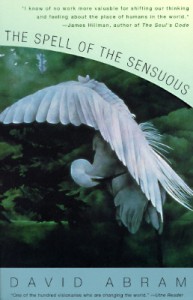 Abram, David. The Spell of the Sensuous: Perception and Language in a More-Than-Human World. New York: Pantheon, 1996.
Reading level: Academic/Undergraduate
I can’t overstate how important this book is to the development of contemporary animism. Abram argues that without contact with the other-than-human world, human beings’ capacities for perception are badly stunted. He backs up his argument both with Western phenomenology and with his lived experiences studying shamanic practitioners in Bali — but the book is structured so less-academic readers can skip the hardcore philosophy if they prefer. Overall, however, the book is best read as poetry or theology, as Abram’s argument about the transition from oral to textual cultures rests on shaky research that takes him well outside his academic field of expertise.
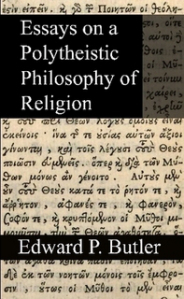 Butler, Edward P. Essays on a Polytheistic Philosophy of Religion. New York: Phaidra Editions, 2012.
Reading level: Academic/Graduate
Make no mistake: this is a challenging read and probably requires some pre-existing university-level study of philosophy (especially ancient Greek philosophy) to appreciate. For the Pagan who wants a scholarly basis for a fundamentally polytheistic philosophy, however, this book is satisfyingly sophisticated. (Note: several of the essays were previously published in peer-reviewed academic journals.)
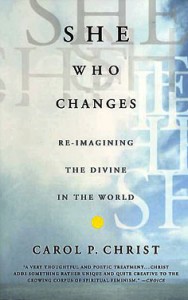 Christ, Carol P. She Who Changes: Re-imagining the Divine in the World. New York: Palgrave, 2004.
Reading level: Academic/Undergraduate
Christ has been at the center of the Goddess spirituality movement since the late 1970s. She Who Changes draws on Christ’s formal training in theology to combine Goddess spirituality with process theology. In process theology, divinity is immanent in the world and in a state of constant flux and change–one in which human beings and all things actively participate. Readers will find an accessible introduction to process theology that can be adapted to other Pagan theological contexts.
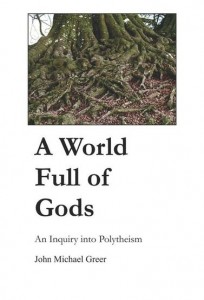 Greer, John Michael. A World Full of Gods: An Inquiry into Polytheism. Tucson, AZ: ADF Publishing, 2005.
Reading level: Semi-academic/Undergraduate
This self-published introduction to polytheistic theology by Archdruid John Michael Greer is very useful, but flawed. For readers who know little about theological terminology or want to explore what kinds of religious behaviors and ethics a polytheistic sensibility calls for, it is an excellent read. For those who have a theological background, however, the fact that Greer’s theological knowledge seems to stop around the mid-twentieth century may be frustrating; his portrayal of monotheisms is outdated, and his writing often falls prey to the same kinds of circular arguments and special pleading that he criticizes in others. Typos are common, and a number of references are missing from the bibliography, which makes it difficult to check Greer’s work. Because of these issues, A World Full of Gods is best read as a grounded introduction to Greer’s polytheistic theology rather than an authoritative, scholarly text.
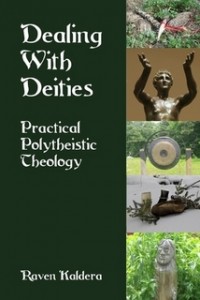 Kaldera, Raven. Dealing with Deities: Practical Polytheistic Theology. Hubbardston, MA: Asphodel Press, 2012.
Reading level: General audience
The purpose of this book is to introduce its audience to a theological position often called “hard” polytheism — the belief that deities have individual and distinctive existences in the same way as human beings. Kaldera, however, is unusual in the movement for his accepting and compassionate attitude toward other theological positions. His writing is accessible and often personal, and although he uses and explains basic theological terminology, fundamentally his purpose in writing is to make recommendations for polytheistic practice. Kaldera makes no claims to scholarly authority, but his theological reflections on human-deity relationships are rich and come directly from his decades of experience as a practicing shaman.
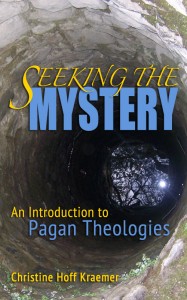 Kraemer, Christine Hoff. Seeking the Mystery: An Introduction to Pagan Theologies. Englewood, CO: Patheos Press, 2012.
Reading level: General audience
I wrote this book after noticing that Pagans were increasingly hungry for more coherent theories behind their practice — but that many simply didn’t have the background they needed to read theology. Seeking the Mystery systematically introduces basic theological terminology and concepts relevant to Pagans. At the same time, it also introduces and summarizes Pagan theological writing that already exists (including the books recommended in this post). Most importantly, however, Seeking the Mystery emphasizes not that Pagans need theology, but that they already have it: theologies are attitudes and beliefs that arise out of practice and then inform that practice in an ever-renewing cycle. The book contains discussion questions and activities for individual and group study.
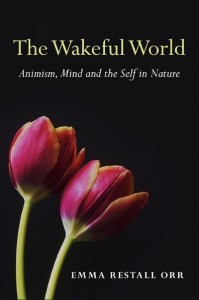 Orr, Emma Restall. The Wakeful World: Animism, Mind, and the Self in Nature. Hants, UK: Moon Books, 2012.
Reading level: General audience/Undergraduate
This is one of several recent sophisticated books on “the new animism,” along with the work of David Abram and scholar Graham Harvey (Animism: Respecting the Living World). I’ve chosen to highlight Druid Emma Restall Orr’s book here since she is writing explicitly for Pagans as a Pagan philosopher and because she draws directly on both of these other writers: her book functions as an introduction to Abram and Harvey’s works, and it is also less textbook-like than Harvey’s Animism. Not just a presentation of the idea that all things have a spirit or soul, The Wakeful World is an argument for adopting an animistic worldview.
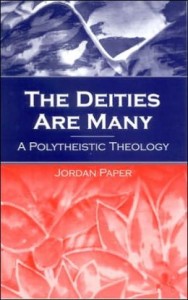 Paper, Jordan D. The Deities Are Many: A Polytheistic Theology. Albany, NY: State University of New York Press, 2005.
Reading level: Semi-academic/Undergraduate
Jordan Paper is a religious studies scholar who spent his career traveling the world to study indigenous and shamanic religious traditions. After publishing several academic studies of these religions, Paper wrote this short book during a month-long sabbatical. It is the first book of his that could be considered “theology” as opposed to a more-or-less objective anthropological study. In it, Paper backs up his own polytheistic beliefs with his lived experiences of the traditions he spent his life learning from. The book is a tour of the many approaches to polytheism that can be found around the world. Pagans looking for a how-to on thinking like a Pagan polytheist will probably prefer Greer or Kaldera, since Paper does not identify as Pagan, but they are still likely to resonate with Paper’s eclectic personal spirituality and conviction about the reality of spirits, gods, and ancestors.
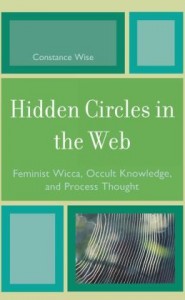 Wise, Constance. Hidden Circles in the Web: Feminist Wicca, Occult Knowledge, and Process Thought. Lanham, MD: Altamira Press, 2008.
Reading level: Academic/Graduate
Like Carol Christ, Constance Wise brings formal training in process theology to her work — but unlike Christ, she explicitly identifies herself as a Pagan and her work as Pagan theology. Hidden Circles is a challenging book, but it is chock-full of juicy and innovative ideas: for instance, Wise redefines “occult knowledge” in a feminist framework as inherently experiential knowledge that comes through the body, and she presents not just a process theology of the Goddess, but a process theology of human history and gender. The book’s dense theological passages are lightened by Wise’s personal anecdotes and reflections.
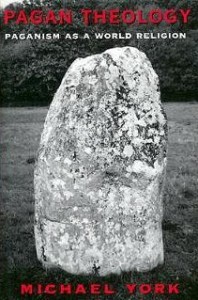 York, Michael. Pagan Theology: Paganism as a World Religion. New York: New York University Press, 2003.
Reading level: Academic/Undergraduate
York’s Pagan Theology attempts to formulate a theology from a sociological point of view. Rather than using Western theological terms or concepts, York looks at indigenous, earth-centered, and place-based religious traditions around the world to identify their commonalities. He argues that these “pagan” religious impulses constitute humanity’s root religion, and that remnants of this first religion remain in all the world’s religions. York seeks to lend legitimacy both to indigenous religions and to contemporary Paganism by presenting this root religion as a coherent worldview — one of four that he identifies, along with the Abrahamic, dharmic, and secular worldviews. Pagan Theology has been heavily discussed in academic circles, and its definition of “paganism” continues to be influential. There is a summary of academic reviews and critiques of the book on Wikipedia.
Websites and Blogs
Arkadian Anvil — Sam Webster, MDiv, Pagan Priest, and PhD candidate, has posted a number of essays on theological topics here (recommended starting point: “Theology Is God-Talk“). He also writes At the Herm for the Patheos Pagan channel.
Theologies of Immanence — A wiki hosting resources on Paganism, pantheism, polytheism, polymorphism, animism, Heathenry, Druidry, Unitarianism, Wicca, and more. Many of the contributors are known writers or scholars. Edited by Yvonne Aburrow, who also writes here at Dowsing for Divinity. (Recommended starting point: “Pagan Theology.”)
Aedicula Antinoi — Essays by polytheist theologian P. Sufenas Virius Lupus (recommended starting point: “Theology vs. Philosophy: What’s the Difference?“). Lupus also writes for the Patheos Pagan channel (recommended starting point: “Polytheology: Syncretism, Process Theology, and ‘Polyamorotheism‘”).
Theology on Dowsing for Divinity — Recommended starting points include “What Is Theology?” (Yvonne Aburrow), “Theology Is Not Religious Studies” (Christine Kraemer), and “Opening a Pagan Theological Dialogue” (Christine Kraemer).
Patheos Pagan Channel — Posts and blogs relating to Pagan theology.
Proteus Coven Library — Essays on Wiccan theology, ethics, and more. (Recommended starting point: “Pagan Deism: Three Views.”)
Theology from Ár nDraíocht Féin: A Druid Fellowship (ADF) — Essays by former Archdruid Ian Corrigan on how ADF understands Pagan theology.
Animism: Respecting the Living World — A companion website to the book of the same name by Graham Harvey.
The Alliance for Wild Ethics — Resources on cultural ecology, philosophy, and animism from David Abram and associates.
PaganTheology.com — This page, which primarily hosts the writings of a UU-identified Pagan named Porphyry, unfortunately seems to be inactive. Nevertheless, there are some useful introductory essays here (recommended starting point: the misleadingly-titled “Theology Is for Christians“), and more recent work by the same author can be found at PaganPages.org.
Did I miss your favorite Pagan theology-related book or website? Let me know in the comments!
Previous Post

July 19, 2013
Individuation in Pagan traditions
Next Post
September 16, 2013 Occupy Spirituality: Reflections from a Once and Future Activist
Browse Our Archives
Select a Category A Beginner's Guide Announcements Conversations Creative Endarkenment Embodied Spirituality General Interviews My Story News Commentary Pagan Studies Poetry Praxis Related topics Reviews Ritual Sacred Endarkenment Storytime Theology
Select a Month February 2017 December 2016 November 2016 October 2016 September 2016 August 2016 July 2016 June 2016 May 2016 April 2016 March 2016 February 2016 January 2016 December 2015 November 2015 October 2015 September 2015 August 2015 July 2015 June 2015 May 2015 April 2015 March 2015 February 2015 January 2015 December 2014 November 2014 October 2014 September 2014 August 2014 July 2014 June 2014 May 2014 April 2014 March 2014 February 2014 January 2014 December 2013 November 2013 October 2013 September 2013 August 2013 July 2013 June 2013 May 2013 April 2013 March 2013 February 2013 January 2013 December 2012 November 2012
Follow Us!
TAKE THE
Religious Wisdom Quiz
Who fell out of a window and was restored to life by Paul?
Select your answer to see how you score.
Silas Barnabas Eutychus Timothy
Related posts from Dowsing for Divinity

A Meditation: The Trees and the Forest

Erotic Religion: The Body and Sex for Wiccans...

Misconceptions about cultural appropriation

Paganism and the Body Class Sneak Peek
TRENDING AT PATHEOS Pagan

I was recently chatting with someone on Instagram. She asked me what...

While there are many people who share their results, the end of...

On July 23, I saw Christopher Nolan's The Odyssey which is Homer’s...

As I write this two big events have just finished up. One...

Restoring the Watershed of Divine Love
Perhaps cooperation is not something we manufacture through legislation, ideology, or moral...

Many UUs don’t pray because of bad experiences in a previous religion,...
view all Pagan blogs
Ad-Free & Subscriber Log-In Subscription Support
- About Us
- 2026 Calendar
- Videos
- Podcasts
- Library of World Religions
- Faith In Media Tracker
- Advertise With Us
- Write for Us
- Privacy Policy
- Terms of Service
- Do Not Sell My Data
- Contact Us
- Radiant Digital
- Manage Newsletter Subscriptions
- Unsubscribe From Notifications
- Sitemap
Copyright 2008-2026, Patheos. All rights reserved.
Subscription Support Ad-Free & Subscriber Log-In
Follow Patheos