
BuddhistCatholicContemplativeEvangelicalGeneral ChristianHinduJewishLatter-day SaintMuslimNew VisionsProgressive Christian
Beliefs
- Buddhist
- Catholic
- Contemplative
- Evangelical
- General Christian
- Hindu
- Jewish
- Latter-day Saint
- More Voices
- Muslim
- New Visions
- Pagan
- Progressive Christian
Topics
- Religion News
- Food and Religion
- Sports and Religion
- Religious Art
- Religious Music and Entertainment
- Religious Events
- History and Religion
- Style and Religion
- Politics and Religion
- Women in Religion
- Recreation Outdoors and Religion
- Business Finance and Religion
- Careers Workplace and Religion
- Education and Religion
- Family Parenting and Religion
- Health Fitness and Religion
- Home and Religion
- Relationships and Religion
- Technology and Religion
- Travel and Religion
Columnists
- Buddhist Columnists
- Business Finance and Religion Columnists
- Careers Workplace and Religion Columnists
- Catholic Columnists
- Contemplative Columnists
- Education and Religion Columnists
- Evangelists Columnists
- Family Parenting and Religion Columnists
- General Christian Columnists
- Health Fitness and Religion Columnists
- Hindu Columnists
- History and Religion Columnists
- Home and Religion Columnists
- Jewish Columnists
- More Voices Columnists
- Latter Day Columnists
- Muslim Columnists
- New Visions Columnists
- Nonreligious Columnists
- Pagan Columnists
- Politics and Religion Columnists
- Progressive Columnists
- Recreation Outdoors and Religion Columnists
- Relationships and Religion Columnists
- Religion News Columnists
- Religious Art Columnists
- Religious Events Columnists
- Religious Music and Entertainment Columnists
- Sports and Religion Columnists
- Style and Religion Columnists
- Technology and Religion Columnists
- Travel and Religion Columnists
- Women in Religion Columnists
Resource Library
- 2026 Calendar
- Library of World Religions
- The 100 Most Holy Places on Earth
- Patheos Answers
- Podcasts
- Videos
- Faith Leaders Database
- Anglican Episcopalian
- Bahai
- Baptist
- Buddhism
- Christianity
- Confucianism
- Eastern Orthodoxy
- Hinduism
- Holiness and Pentecostal
- ISKCON
- Islam
- Judaism
- Lutheran
- Methodist
- The Church of Jesus Christ of Latter-day Saints
- New Age
- Paganism
- Presbytarian and Reformed
- Protestantism
- Religion Behind the Scenes
- Roman Catholic
- Scientology
- Shia Islam
- Sikhism
- Sufism
- Sunni Islam
- Taoism
- Zen
- See all religions
Research Tools
 Ad-Free & Subscriber Log-In Subscription Support
Ad-Free & Subscriber Log-In Subscription Support
Follow Patheos 

- Trending:
- Forgiveness
- |
- Marriage
- |
- Consciousness
- |
- Death Penalty
- |
- Election
- |
- Halloween
 Dowsing for Divinity
-
Books
- Home
- Pagan
- Ritual, liturgy, and worship
Ritual, liturgy, and worship
Last updated on: December 26, 2014 at 12:14 pm by Yvonne Aburrow
Ritual, liturgy, and worship 2014-12-26T12:14:38-05:00 Yvonne Aburrow
Patheos Explore the world's faith through different perspectives on religion and spirituality! Patheos has the views of the prevalent religions and spiritualities of the world.
The structure of ritual in Paganism tends to be to create the sacred space as a microcosm representing the whole cosmos, then to raise power within it, then to wield the power, thank the divine powers and/or commune with them, and then to dismantle the whole structure. This format is essentially derived from the Western magical tradition. If you go to a church service, where the ritual mode is liturgical, there is no wielding of power; rather the approach is to wait for the power to manifest.
Ronald Grimes, theorist of ritual, identifies several different modes of ritual.
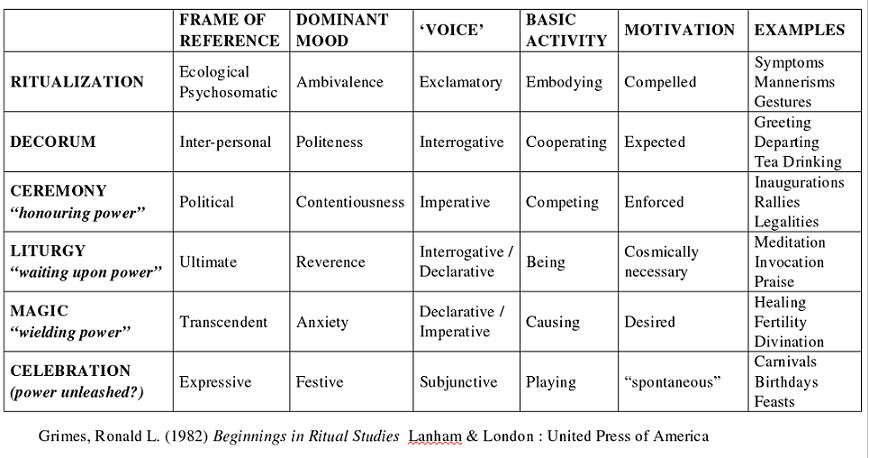
This diagram repays a lot of study and thinking. Most church services are liturgical; most Pagan rituals are magical or celebratory. If you go to a ritual expecting one mode, and it turns out to be in another mode, it can be very jarring, especially if you were expecting a magical or liturgical ritual and it turned out to be celebratory.
Examples of ritualisation include your morning routine (get up, have breakfast, have a shower, brush your teeth, go to work – or some variation on that set of actions); your evening routine (come home, kick off your shoes, maybe change your clothes, have a glass of wine); and so on. They are psychosomatic because you don’t even think about them; they are automatic. They are embodied because they are physical actions.
Examples of decorum include shaking hands, waving goodbye, asking someone how they are. These are polite gestures that smooth your passage through your social milieu.
Ritualisation and decorum are not full-blown rituals; they are mini-rituals. The other categories are performed at greater length.
Typical ceremonies would include the crowning of a new monarch, the inauguration of a new President, the state opening of Parliament, and so on. They honour the power that is vested in the status quo.
Liturgy, which means ‘the work of the people’ is a collective affirmation of what is of ultimate worth, also known as “worship”. If you have issues with the word “worship” because you think it means self-abasement, I highly recommend reading An Abraxan Essay on Worship, available from the UUA website. This essay reclaims the word to mean ‘honouring whatever we regard as being of ultimate worth’, and draws on the theology of Paul Tillich, including the idea of the ground of all being.
Liturgy may involve waiting for power to manifest, but there is a dignity and solemnity in liturgical ritual which can be very enjoyable, and if it is done well, it can bring power through just as much as a magical ritual does. I would like to see more of the liturgical mode in Pagan rituals. I would imagine that Reconstructionists would be well-placed to create liturgical ritual, because ancient polytheism was more about worshipping deities than invoking them for theurgical or magical purposes. I have only attended one Reconstructionist ritual — it was very liturgical in style.
Magical rituals are intended to cause change and transformation, either in the inner states of the participants, or in the external world. These include rites of passage, whose function is to bridge the divide between one psychological state and another (for example, to manage the transition between childhood and adulthood); and healing rituals, whose function is to transform an ill person into a well person. Even seasonal festival celebrations could be said to be magical rituals, because they manage the transition between one seasonal and the next.
Interestingly, when Unitarians switch to magical or symbolic mode, they refer to it as “ritual”. Examples include planting seeds to symbolise renewal, the water communion, and the flower communion.
Celebratory rituals can include birthday parties, but also parties to celebrate seasonal festivals. The aim of such a festivity is not to transform anything or manage a transition, but to let off steam. In the ancient world, carnivals inverted the normal social order and allowed everyone to let off steam, and then they returned to the normal social order when the festivities were over.
When writing rituals, you can deliberately make use of these different modes to create a different mood, depending on the purpose of your ritual. Sometimes a ritual can include more than one of these modes.
Previous Post
April 2, 2013
Energy
Next Post

April 5, 2013 Why I Am a Pagan
Browse Our Archives
Select a Category A Beginner's Guide Announcements Conversations Creative Endarkenment Embodied Spirituality General Interviews My Story News Commentary Pagan Studies Poetry Praxis Related topics Reviews Ritual Sacred Endarkenment Storytime Theology
Select a Month February 2017 December 2016 November 2016 October 2016 September 2016 August 2016 July 2016 June 2016 May 2016 April 2016 March 2016 February 2016 January 2016 December 2015 November 2015 October 2015 September 2015 August 2015 July 2015 June 2015 May 2015 April 2015 March 2015 February 2015 January 2015 December 2014 November 2014 October 2014 September 2014 August 2014 July 2014 June 2014 May 2014 April 2014 March 2014 February 2014 January 2014 December 2013 November 2013 October 2013 September 2013 August 2013 July 2013 June 2013 May 2013 April 2013 March 2013 February 2013 January 2013 December 2012 November 2012
Follow Us!
TAKE THE
Religious Wisdom Quiz
Who was the scribe and priest that led a second group back to Jerusalem?
Select your answer to see how you score.
Zerubbabel Mordecai Ezra Nehemiah
Related posts from Dowsing for Divinity


A Meditation: The Trees and the Forest

Erotic Religion: The Body and Sex for Wiccans...
Misconceptions about cultural appropriation
TRENDING AT PATHEOS Pagan

I was recently chatting with someone on Instagram. She asked me what...

While there are many people who share their results, the end of...

On July 23, I saw Christopher Nolan's The Odyssey which is Homer’s...

As I write this two big events have just finished up. One...

Restoring the Watershed of Divine Love
Perhaps cooperation is not something we manufacture through legislation, ideology, or moral...

Many UUs don’t pray because of bad experiences in a previous religion,...
view all Pagan blogs
Ad-Free & Subscriber Log-In Subscription Support
- About Us
- 2026 Calendar
- Videos
- Podcasts
- Library of World Religions
- Faith In Media Tracker
- Advertise With Us
- Write for Us
- Privacy Policy
- Terms of Service
- Do Not Sell My Data
- Contact Us
- Radiant Digital
- Manage Newsletter Subscriptions
- Unsubscribe From Notifications
- Sitemap
Copyright 2008-2026, Patheos. All rights reserved.
Subscription Support Ad-Free & Subscriber Log-In
Follow Patheos